Axios Future of Energy

November 13, 2025


1 big thing: Our global progress on climate change, in one chart
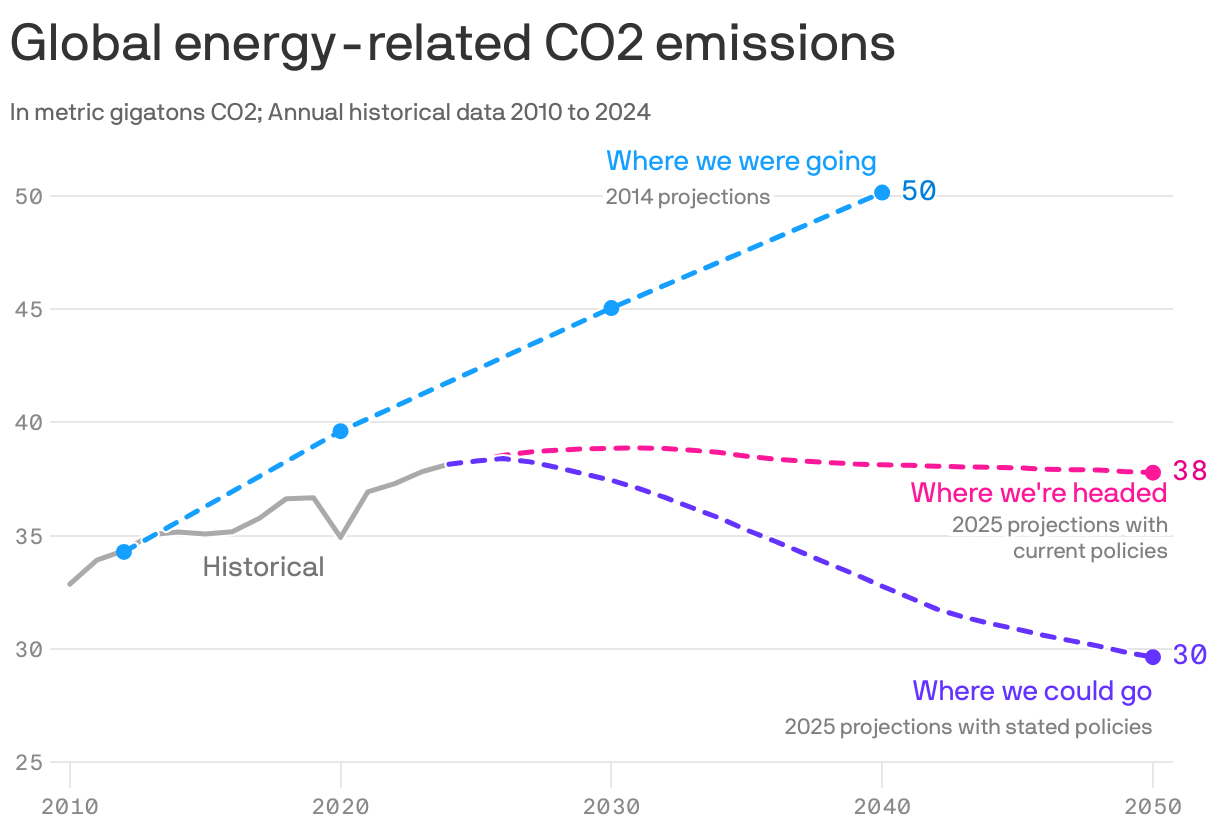
Global efforts to address climate change are — still — going far better today than they were a decade ago, even with recent politics pushing the problem to the back burner.
Why it matters: We humans usually operate on daily, monthly and yearly time frames. So it can be easy to miss the energy transition unfolding over decades and centuries.
Driving the news: The chart above compares two International Energy Agency projections to one from more than a decade ago.
- The larger gap between the top line compared to the lower two shows the progress made on clean energy over the last decade.
What they're saying: "This progress is not part of the prevailing view of climate change, but it should be," philanthropist Bill Gates said in his recent controversial memo while featuring a similar chart.
State of play: Clean energy, largely wind and solar, has grown significantly over the last decade, due largely to policies by a range of countries, including China, Germany and the U.S.
- Now they're more affordable than ever, which is pushing the energy transition forward even as policy stalls in key regions like the U.S.
- Natural gas, which emits far less carbon dioxide than coal, is also helping reduce emissions in the short term (though longer term its role is more complicated).
How it works: The chart above shows three different greenhouse gas emission scenarios from the IEA.
- The top blue line shows what the IEA was predicting would happen with policies in place and under consideration back in 2014.
- The middle pink line shows what IEA is predicting today based upon policies currently in place.
- The lower purple line shows where emissions from the energy sector could go if policies under consideration are put in place.
Reality check: Even so, past performance doesn't dictate future results.
"There is no guarantee that we will take stronger action on climate change in the future. I hope we will. I think we will because that's been the trend over the last few decades," said Berkeley Earth climate scientist Zeke Hausfather in an interview.
- "If the 21st century is led by leaders who share ideology closer to the Trump administration, we won't."
The bottom line: The possible trajectories are better than a decade ago, but they still indicate significant global warming.
- When it comes to the impact of more extreme weather, the difference we're talking about is bad compared to worse. It's already going to be bad, but we've made it less bad in the last decade.
Disclosure: Amy Harder is the former founding executive editor of Cipher News, an independent news outlet supported by Bill Gates' climate and energy initiative Breakthrough Energy.
2. 🇺🇸 U.S. carbon emissions are ticking up in 2025
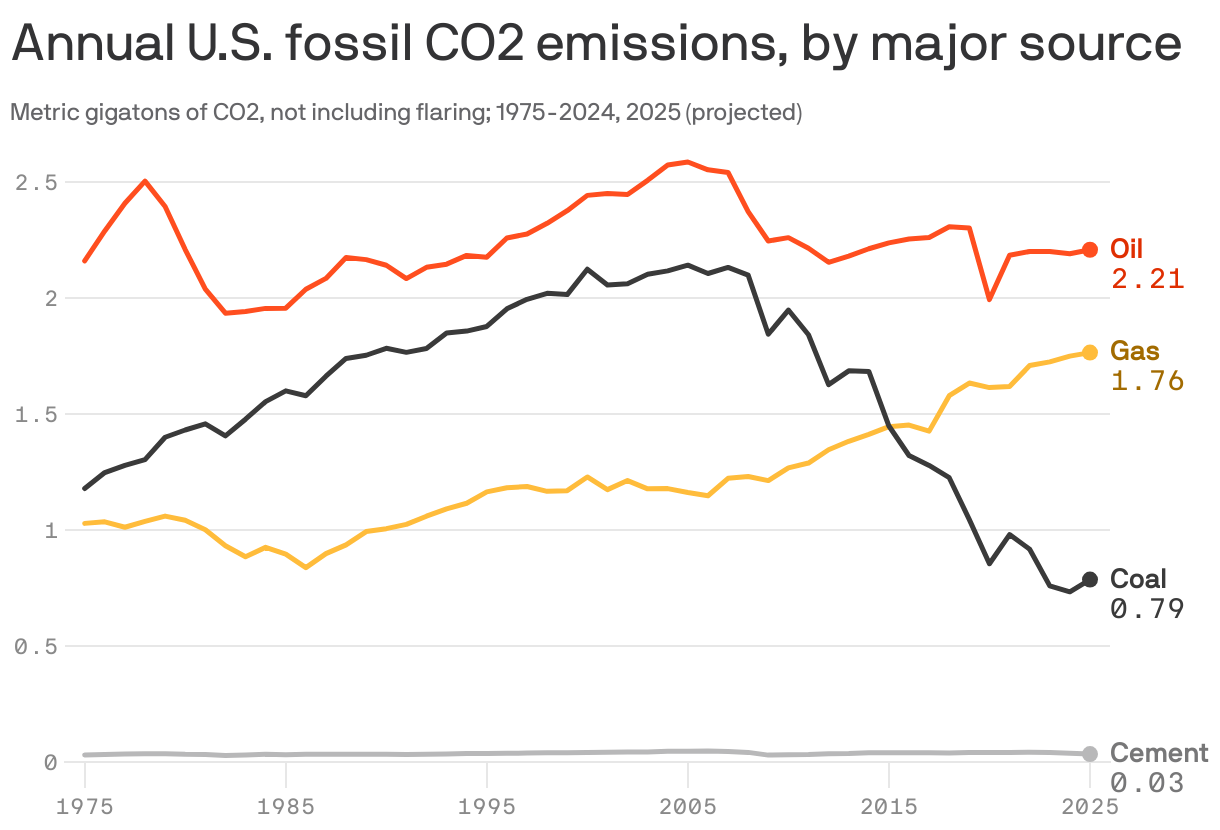
Energy-related CO2 emissions are rising an estimated 1.9% in the U.S. this year, new data shows.
Why it matters: U.S. emissions, the distant second-largest behind China, have generally been falling for about 15 years. But the path is bumpy.
State of play: A colder U.S. start to 2025 after a mild 2024 boosted heating needs, while higher natural gas prices lifted coal use, the Global Carbon Budget report finds.
- Higher electricity demand overall was also a factor, the research collaborative said.
Zoom out: Global emissions from fossil energy are climbing 1.1% this year (it also offers a range of 0.2% to 2.2%).
- The report is consistent with Amy's piece above — a world making strides on cleaner tech deployment but still facing very harmful warming.
Threat level: "The remaining carbon budget to limit global warming to 1.5°C is virtually exhausted," it states, citing the most ambitious Paris Agreement target.
- IEA's new World Energy Outlook sees nations' existing and planned policies bringing 2.5°C of warming above preindustrial levels by 2100.
What we're watching: It will take time to see how White House policies affect U.S. emissions.
3. 🗳️ The politics of Josh Shapiro's RGGI retreat

4. ☀️ Fewer U.S. solar projects are stalling these days


Fewer solar projects are being delayed now compared to this time last year, the U.S. Energy Information Administration reported this week.
Why it matters: Conventional wisdom pointing to politics, permitting and local battles suggests solar is facing increasing opposition, but short-term trends suggest that may be changing.
Driving the news: In the third quarter of this year, solar projects representing about 20% of planned capacity reported a delay, down from 25% in the same period in 2024, the EIA reported.
Reality check: Far more projects today are being delayed compared to just a few years ago, though.
- That 20% still represents a sizable increase compared to 2020, when about 10% of such projects were delayed.
The big picture: Despite a spike in delayed projects, 2024 still saw a record year for U.S. solar capacity additions, EIA reports.
The bottom line: Less than 1% of planned solar capacity is entirely canceled in a typical month, EIA says.
5. 🏃Catch up quick: COP30, EVs, critical minerals
6. 🛢️ Stat du jour: Roughly 13.6 million barrels per day
Axios Future of Energy