Axios Future of Energy

March 06, 2026

👋 We're ending week one of the Middle East conflict that's roiling markets while keeping our eyes on lots more. Today's edition explores...
- What it means for climate-friendly energy
- The latest shocks and Trump team countermeasures
- Capitol Hill updates and more, all in 1,535 words, 6 minutes.
🙏 Thanks to Chuck McCutcheon and Chris Speckhard for edits to today's newsletter, along with the brilliant Axios Visuals team.
📻 This week in 1982, The Cars dropped a perfect single that's today's intro tune...
1 big thing: Why the Iran crisis is a mixed bag for clean energy

In theory, an emergency that's blocking petro-flows and spiking prices should boost the case for clean energy. But in practice, it's way more complicated.
Why it matters: The Iran war is the biggest energy disruption since Russia's 2022 invasion of Ukraine, if not longer.
- Various analysts and advocates say it could — or at least should — prompt governments and investors to prioritize fuels that don't have to move across oceans.
- The upheaval "highlights how energy security and energy transition go hand in hand," Raymond James Investment Strategy analyst Pavel Molchanov said in a note.
The big picture: "Solar, wind, and nuclear are children of the 1970s oil shocks — with growth driven by security, not environmentalism," the Carlyle Group's Jeff Currie and Admiral James Stavridis, the former NATO commander, write in a new post.
Flashback: Today's impediments reflect the risks Currie covered in his buzzy March 2025 paper, The New Joule Order.
- It said rising geopolitical, financial and trade risks support homegrown electrons. "If trade is under threat, then so are fossil fuels," Currie argues.
What we're watching: By how much — and for how long — the conflict pushes up global oil and regional natural gas prices.
- Molchanov, the Raymond James analyst, writes that if oil prices stay high for a "prolonged period," higher gasoline prices could boost U.S. EV demand.
- He also notes that the EU's renewable electricity use grew a lot after the attack on Ukraine brought a sharp reduction in Russian natural gas supplies to the bloc.
Reality check: There are crosscurrents to spare.
- For one thing, higher energy prices could also boost inflation and bring higher interest rates, which makes clean energy deployment more expensive by raising borrowing costs, a nice Bloomberg look at the topic points out.
- And in China, already by far the world's biggest coal producer and user, the fuel can be a buffer against gas import disruption, it adds.
State of play: Neither the S&P Global Clean Energy Transition Index nor the iShares Global Clean Energy ETF — two major ways to track low-carbon energy stocks — have gotten a lift since the military strikes, Heatmap notes.
Zoom out: Another crosscurrent is that supply interruptions from one area can provide a lift to fossil fuels from elsewhere.
- U.S. liquefied natural gas and crude exports to Europe shot up after Russia's invasion — along the way underscoring how the domestic oil and gas boom provides geopolitical and financial leverage.
- Huge domestic oil and gas supplies are one reason why the U.S. faces relatively less jeopardy right now than many other countries.
- And the Ukraine crisis arguably helped push climate change lower on the global agenda.
The bottom line: "While I agree that oil price spikes could revive interest in renewables, I'll say it again: high prices tend to usher out incumbent politicians faster than they usher in new technologies," ClearView Energy Partners' Kevin Book posted on X.
2. 🛢️ Energy woes deepen as Trump team looks to soften blow


Oil and gasoline prices are marching upward again today, even as Trump administration officials seek ways to get more barrels into the market.
Why it matters: Ships avoiding the Strait of Hormuz and military threats to regional infrastructure are together shocking oil and natural gas markets.
- "There's no doubt that what's happening now is an order of magnitude bigger — in terms of potential fallout for oil markets — than Russia's invasion of Ukraine," writes Robin Brooks, a Brookings Institution economist.
The big picture: The global benchmark Brent crude is trading near $89 this morning, up roughly $16 since military strikes against Iran began.
- And don't forget that prices had already jumped in anticipation of the strikes, so the true rise attributable to the conflict is even higher.
- U.S. average regular gasoline prices are up 32 cents per gallon this week to $3.32, per AAA.
Stunning stat: The national average gasoline price is up 10.8% over the past four days, the largest spike since the aftermath of Hurricane Katrina, per Schwab analyst Kevin Gordon.
The latest: The Trump administration is making various moves to try to temper the shock. Energy Secretary Chris Wright said today on "Fox & Friends" that it would take "weeks, not months" for gas prices to decline.
- "We have a little bit of an interruption right now to finally put an end to their ability to wreak havoc," Wright said.
Last night the Treasury Department announced a 30-day sanctions waiver to enable Indian refiners to buy more Russian oil.
- "This deliberately short-term measure will not provide significant financial benefit to the Russian government as it only authorizes transactions involving oil already stranded at sea," Secretary Scott Bessent posted on X.
- Still, some analysts call the move a win for Russia.
What they're saying: "While this might help put some immediate downward pressure on the market, it is not a game-changer," ING analysts said in a note.
- "The only way for prices to come down on a sustained basis is a resumption of oil flows through the Strait of Hormuz," it adds.
What we're watching: Other triage efforts.
- "Top oil exporter Saudi Arabia is increasing shipments from the Red Sea, but the volumes are far from enough to offset the drop from the crisis-hit Strait of Hormuz," Reuters reports this morning.
3. 🔍 Zoom in: Mideast energy data and flows
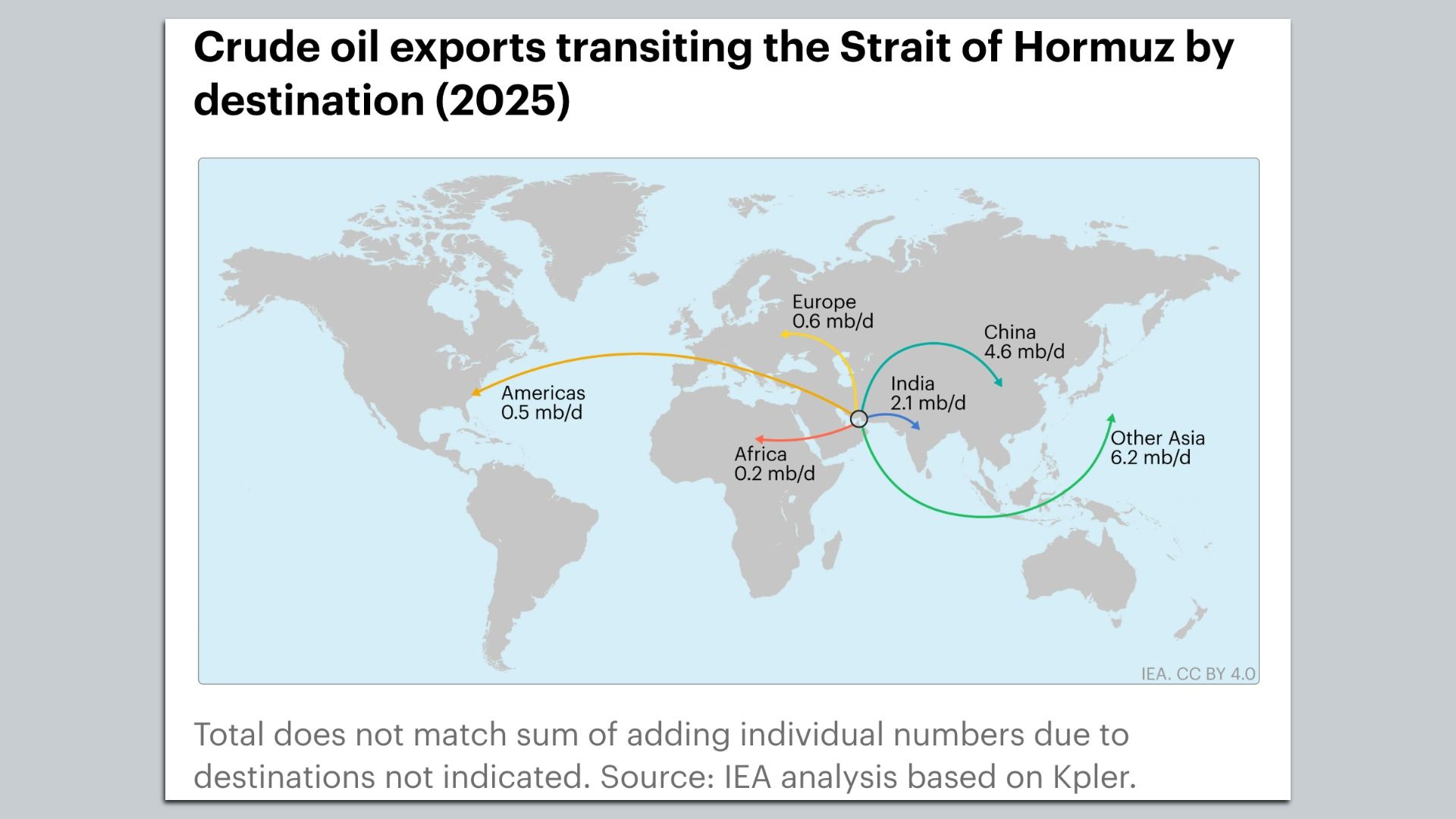
This map ☝️ is one part of the International Energy Agency's helpful primer on the Middle East's role in global crude, petroleum product and gas markets. Worth a bookmark.
4. 🧑⚕️ Permitting bill has a pulse, and more policy notes

🕺 They are so back. Senior Senate Democrats who walked away from talks on a permitting legislation said they're returning to the table — with caveats.
- Why it matters: Last night's statement from Sens. Sheldon Whitehouse and Martin Heinrich — the top Dems on the environment and energy panels — keeps alive the uphill quest for a sweeping bipartisan deal.
- State of play: The two cited recent signs of a "positive direction" from Trump officials on loosening solar project restrictions. But they'll bail if there's "further mischief" on renewables including already-approved offshore wind projects, it states.
- The bottom line: Permitting is the top legislative priority for lots of major business groups, but the political path remains very narrow.
⭐ Everybody is a star. Primary management of the longstanding Energy Star appliance efficiency program is moving from EPA to DOE, the agencies said.
- Why it matters: It's a sigh of relief for backers of the program who feared its demise. "Congress provided $33 million to EPA for Energy Star in its January minibus, despite the Trump administration targeting the program for closure last year," Politico reports.
🛢️ Via Reuters, The Interior Department "said on Thursday it would replace a Biden-era rule that required some oil and gas companies to set aside billions of dollars in extra funds for decommissioning oil platforms if they go out of business."
5. 👓 Hot reads: LNG, power demand, movies

Cheniere Energy Received $370 Million IRS Windfall for Using LNG as 'Alternative' Fuel (Inside Climate News)
Amy says: This is an important accountability story that you should read regardless of what you think about this specific tax credit.
As Demand for Electricity Grows, Energy Parks Are Being Explored as Potential Solutions (National Academies)
Chuck says: If transit centers can combine bus, rail and air, this story asks, why not have a park that puts different energy sources and storage capabilities all in one place?
- Experts say it would balance energy production and use as well as help with affordability — so we're likely to hear more about this.
What's behind your sky-high power bill: A region-by-region breakdown (Canary Media)
Amy says: I found this write-up more useful than I thought I would! It summarizes the main factors increasing power prices in each region of the country.
- Spoiler alert: Data centers are not the main cause in most states. As the saying goes, it's (far) more complicated than that.
Climate change goes to the Oscars (Climate-Covered Goggles)
Chuck says: Five of this year's nominees — more than ever before — passed the group Good Energy's "Climate Reality Check": "Arco," "Begonia," "Jurassic World Rebirth," "The Lost Bus" and "Sirat."
- Good Energy sees it as an encouraging trend, though climate journalist Sammy Roth says none are as "in-your-face" as 2021's star-studded "Don't Look Up."
6. ☀️ Number of the day: -27%
That's 2025's year-over-year decline in U.S. power purchase agreements for solar, wind and storage, per a new American Clean Power Association report.
Why it matters: It's an indication that a slowdown looms, even as 2025 was a strong year overall, especially for batteries.
- The decline in PPAs "signals lower clean power deployment in 2028-2030," the group said in a summary.
7. 🤔 Quote du jour: Thinking is easier edition
"We can conceive of things faster than we can physically do it."— Jim Burke, president and CEO of utility Vistra Corp.
He was talking about the delay in actual data center construction versus projections, during the first-ever power and AI conference hosted by the Dallas Federal Reserve this week.
📬 Did a friend send you this newsletter? Welcome, please sign up.
Sign up for Axios Future of Energy