Axios Future of Energy

April 08, 2026

😮 The world obviously changed a lot since our last edition. We've got plenty on Iran but also...
- A fusion funding exclusive
- States seeking nuclear development
- Permitting data and more, all in 1,494 words, 5.5 minutes
🙏 Thanks to Chuck McCutcheon, David Nather and Chris Speckhard for editing and to our brilliant Axios visuals team.
📻 At this moment in 2004, Usher and guests were partway through 12 weeks atop the Billboard Hot 100 with today's all-timer of an intro tune...
1 big thing: Record fusion funding lands as Trump eyes cuts

A key government agency is announcing today a record amount of funding for fusion energy — tapping the power of the stars — even as President Trump seeks to cut other parts of the federal fusion budget.
Why it matters: The split-screen approach underscores tensions in the administration's energy strategy — and highlights how federal support is falling short of what the fusion industry says it needs.
Driving the news: The Energy Department's Advanced Research Projects Agency (ARPA-E) will commit $135 million over the next 18 months to accelerate the development of fusion energy technologies, according to details shared with Axios.
- The funding — the largest single fusion investment in the agency's history — will focus on tackling technical barriers that have kept fusion from reaching commercial scale.
The big picture: Fusion is still early in its development, and federal government support will likely be essential for it to ever commercialize.
- Big tech companies are also giving a boost to fusion as they race to build data centers, since the power source — if it scales — could provide continuous, carbon-free energy.
Yes, but: The ARPA-E announcement comes as President Trump's 2027 budget proposal seeks to cut the Energy Department's fusion energy sciences initiatives from $805 million to $755 million, according to Andrew Holland, the head of the Fusion Industry Association.
- "To have one bureau increasing funding while another is cutting is no way to beat China to commercial fusion," Holland said.
- The Chinese government is spending at least $6.5 billion on fusion, according to an analysis Holland has cited. That's compared to estimates of about $1 billion from the U.S. government.
Friction point: Conner Prochaska, director of ARPA-E, said that despite lower U.S. federal spending, those dollars help unlock private investment across startups and venture firms — enough to approach China's total.
- "I personally take our combination of capital, venture capital and investments from the private sector, along with government spending ... versus that pure government spend in China any day of the week," Prochaska told Axios yesterday.
How it works: The mission of ARPA-E is to leverage private dollars with relatively smaller bets on riskier technologies.
- Prochaska said the agency has spent $134 million on fusion over the past 12 years, which has unlocked $1.5 billion in private spending.
- With this new proposal of an additional $135 million, Prochaska says they're looking to accelerate different fusion technologies already under development.
What they're saying: "It's not an exaggeration to say that much of the growth in private fusion investment and ambition can be traced back to ARPA-E," Holland said.
The bottom line: But the new $135 million "is not nearly enough. We need the broader DOE to step forward."
2. 🛢️ No guarantees on oil shipping as terms remain murky
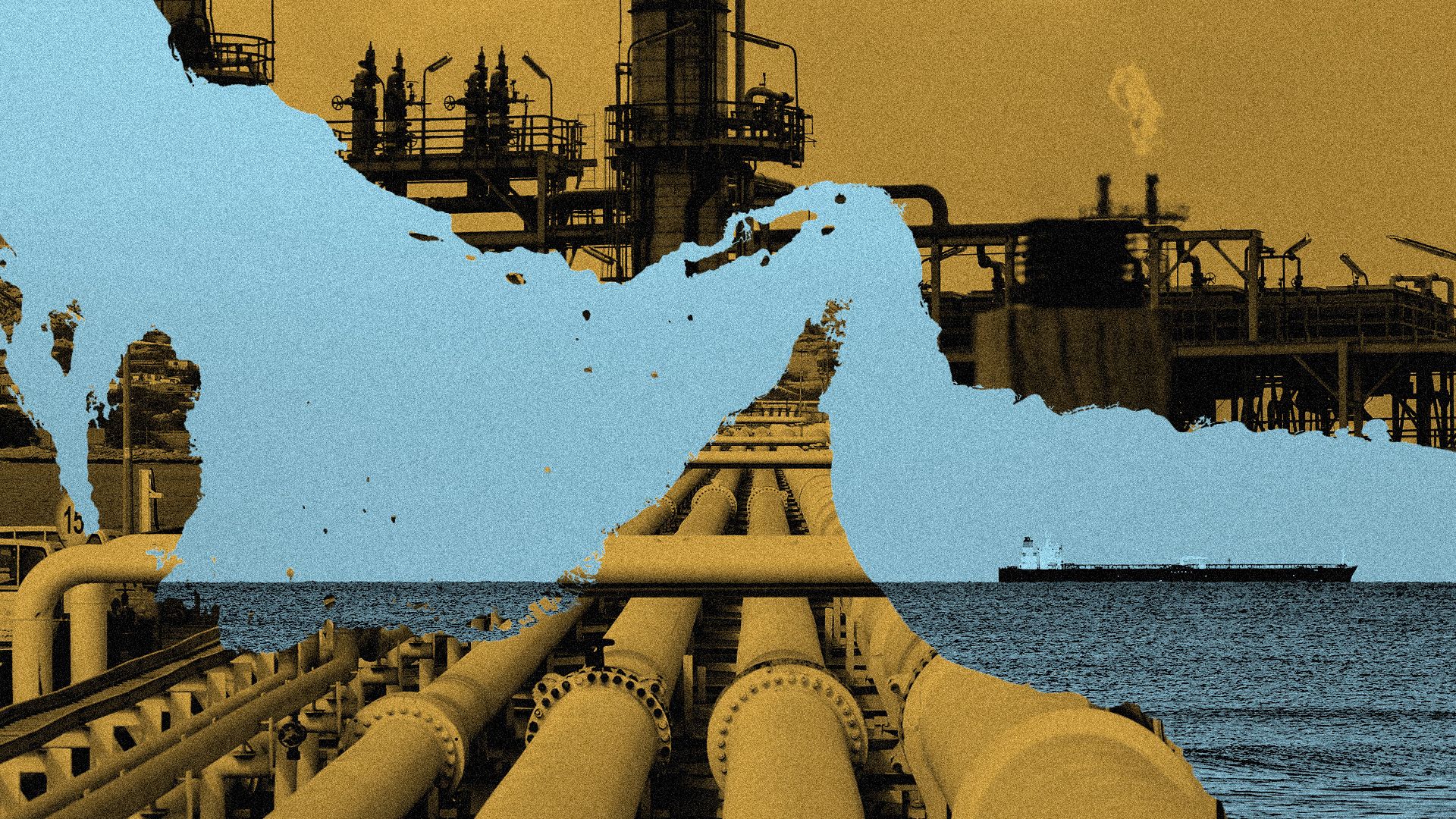
Untangling the largest disruption in oil market history won't happen quickly or easily — and that means continued high prices and scarcity in major importing countries.
Why it matters: A big thing to watch following the U.S.-Iran ceasefire deal is whether it gives tanker owners enough certainty to start resuming significant traffic of oil, petroleum products and other commodities through the Strait of Hormuz.
The big picture: "Confidence-building measures in coming days are going to be key to restoring shipments," Joe Brusuelas, chief economist at the financial services and consulting firm RSM US, said in an interview.
- He notes insurance for the tankers needs reestablishment, and that means figuring out the specific conditions and tolls Iran may impose, which remain murky right now.
- Iranian Foreign Minister Abbas Araghchi said in a statement that safe passage over the next two weeks "will be possible via coordination with Iran's Armed Forces and with due consideration of technical limitations."
What they're saying: "I expect individual ship owner and operator companies, in some cases in conjunction with government representatives, to seek explicit permission from Tehran to resume operations," said Clayton Seigle, an oil analyst with the Center for Strategic and International Studies.
- "We'll know from tracking platforms and anecdotal reporting of tanker movements whether they get it," he said via email.
"The ceasefire may create transit opportunities, but it does not yet provide full maritime certainty and we need to understand all potential conditions attached," shipping giant A.P. Moller-Maersk said in a statement.
3. 🗒️ Iran notes: Prices and pessimism


📉 Oil prices plunged on news of the two-seek ceasefire and talks, but it'll take time for that relief to filter down to consumers in the U.S. and worldwide.
⛽ The average U.S. regular gasoline price is up another couple of cents to $4.16 per gallon, per AAA, but could start dropping within days.
😬 Nobody really knows the future of oil transit or prices yet, but Sparta Commodities' Neil Crosby predicts that "price risk starts to build again over the next two weeks."
- Threat level: "Iran's 10-point plan looks an unacceptable deal for the US (and almost everybody else) and on that basis means a small chance that transits into Hormuz will be allowed to rise to anything substantial enough to make a dent in the problem," he said in a note this morning.
🧮 Bloomberg, citing data from market intel firm Kpler, reports 426 tankers hauling crude oil and clean fuels currently stuck in the Persian Gulf, along with 34 liquefied petroleum gas carriers and 19 LNG ships.
4. 🙋 These states are volunteering to become nuclear fuel cycle hubs

Four states — Tennessee, Utah, Idaho, and Nebraska — say they're interested in hosting the entire range of nuclear energy-related development, including high-level waste.
Why it matters: The Energy Department hopes that by building what amount to nuclear mega-cities for such activities as uranium enrichment and fuel fabrication, states will have to address the thornier problem of waste as well.
Driving the news: Two of the states that recently submitted publicly available applications to DOE, Idaho and Tennessee, already host department national laboratories that do extensive nuclear-related work.
- Nebraska Gov. Jim Pillen (R) cited his state's "public power utilities, robust regulatory environment, experienced workforce, and pro-business climate" in its application.
- And Utah Gov. Spencer Cox (R) noted an available site in Tooele County west of Salt Lake City along with an educated workforce and universities doing nuclear research.
Zoom out: A DOE Office of Nuclear Energy spokesperson said it has received responses from "dozens of states" to its request for information on "nuclear lifecycle innovation campuses," but declined to identify the states.
The intrigue: Nuclear News reported last week that a DOE official said front-end fuel cycle activities can be seen as "appetizers" for states, but that the "main course needs to be ultimate [waste] disposition."
5. 👀 Exclusive: A new blueprint for a future DOE
An environmental group focusing on clean energy and climate change is calling for internal management overhauls at the Energy Department to help it overcome political churn and other challenges.
Why it matters: The nonprofit Clean Tomorrow's recommendations could inform Democratic discussions about DOE in a future Congress or presidential administration.
- "Congress can appropriate billions, but without a DOE that is operationally fit for purpose, those investments will not be able to successfully catalyze the development of new energy technologies," the group said.
Driving the news: The group today put out an action plan aimed at implementing a report it released last fall on "reclaiming America's energy edge."
- One recommendation is to give a permanent strategy office the authority to move clean-energy technologies from the laboratory to market.
- It also calls for setting up a centralized center reporting to the Energy secretary to ensure programs run with greater agility.
- And it suggests appointing an "innovation legal adviser" to cut through contracting bottlenecks and overhaul hiring and career incentives to attract and keep qualified workers.
The report said DOE programs should be better aligned with industry needs by, among other things, making it easier for new applicants to navigate the system and seek funding.
Catch up quick: Clean Tomorrow's founder and CEO, Lindsey Baxter Griffith, is the former executive director of Clean Air Task Force Action.
- She previously worked for Sen. Ed Markey (D-Mass.) and at DOE during the Obama and Trump administrations.
What we're watching: If lawmakers pick up on the report's recommendations.
6. 🧮 Number of the day: 94%
That's the share of renewables developers who said federal permitting was a factor in project delays or cancellations, per a new survey by clean energy transaction platform Crux.
Why it matters: That's just one metric in the wider report stuffed with data points — and anecdotal horror stories — about permitting problems.
Stunning stat: Over 80% of respondents say they site projects to avoid triggering federal permitting.
- "This reflects a significant market distortion: regulatory avoidance, rather than optimal resource or land-use considerations, is driving siting decisions."
- Full analysis
📫 Did a friend send you this newsletter? Welcome, please sign up.
Sign up for Axios Future of Energy