Axios Future of Energy

August 11, 2026

🧩 An important piece of the AI emissions puzzle needs more attention, authors of a new study argue. We start there and then move on to...
- Items on oil, electric flight, offshore wind and more, all in 1,136 words, 4.5 minutes.
🙏 Thanks to Mackenzie Weinger, David Nather and Chris Speckhard for editing and to our brilliant Axios visuals team.
🎸 This month in 1993, The Breeders released a killer single that's today's intro tune...
1 big thing: AI could help unlock more oil — and emissions

Move over, data centers. AI's climate impact may extend well beyond the electricity it consumes.
Why it matters: A new peer-reviewed study finds AI could help produce more oil and natural gas — and produce a climate impact the authors argue could far outweigh the technology's benefits for renewable energy.
Driving the news: The research, just published in a Nature journal, concludes AI's role in boosting oil and gas production would outweigh its climate benefits from accelerating renewable energy, leading to a net increase in emissions under a range of scenarios.
- The study is among the first to estimate how AI-driven gains in fossil fuel production could affect global emissions.
"Most assessments of AI's climate impact are framed as a tradeoff between data center energy use and the emissions AI might help avoid through renewables and efficiency gains," said Holly Alpine, co-author of the paper.
- "What's missing from that calculation entirely is the other side of the same ledger: the emissions enabled from using AI to make fossil fuel production cheaper and more profitable," Alpine said.
Holly Alpine and Will Alpine, former Microsoft employees who founded the nonprofit initiative Enabled Emissions Campaign in 2024, co-led the study with researchers from Purdue University and an independent researcher.
How it works: AI can help oil companies find new resources and recover more from existing fields. It can also help renewable energy by improving forecasting and operations. The new study argues the fossil-fuel gains are likely to dominate.
By the numbers: The researchers estimate AI could add emissions equal to roughly 1% to 5% of the global energy sector's 2024 emissions under the scenarios they modeled.
- The study estimates those emissions would be roughly three to 13 times the International Energy Agency's estimate of current data-center emissions.
The other side: A spokesperson for the American Petroleum Institute, the oil industry's main trade group, disputed the idea that more energy and lower emissions are in conflict.
State of play: The oil industry's embrace of AI has accelerated over the past two years, including using it to improve recovery from existing fields and optimize well placement.
The big picture: AI is a general-purpose technology that can boost productivity in both fossil fuels and clean energy. Some experts argue the more important question is which applications society chooses to prioritize.
What they're saying: "I think cleantech is going to win anyway, so let's just focus on how we unlock clean energy resources with AI," said Brian Janous, who previously worked with Holly Alpine at Microsoft and now runs data center developer Cloverleaf Infrastructure.
Yes, but: The model doesn't attempt to estimate AI's potential to accelerate cleantech breakthroughs such as fusion or long-duration storage.
What we're watching: The study's authors are making a call that echoes that of many others working at the intersection of AI and environmental issues: more transparency.
2. 🏃 Catch up quick on oil and gas: Markets, Venezuela, Trump
📊 Brent crude oil prices are whipsawing today on mixed signals about progress toward a U.S.-Iran agreement and lots of bellicose rhetoric flying around.
- The latest: After climbing to $90 earlier today, Brent is trading around $87 as we send this edition.
- The bottom line: "Current rhetoric suggests any potential deal is still some way off, meaning risks remain skewed to the upside for oil prices," ING analysts said in a note.
🇻🇪 Commodities giant Vitol has brought on lobbying heavyweight Holland & Knight to work on "pursuit of potential oil and gas and mining business and investment opportunities in Venezuela," a filing shows.
🚢 President Trump extended waivers of the Jones Act — the law requiring U.S.-built and operated ships to move goods between domestic ports — for 90 days through mid-November.
- Why it matters: The waivers are among the federal levers for easing fuel prices, though market analysts call the effects modest.
- Driving the news: The extension limits the waivers largely to various fuels and some other goods including fertilizers. It also requires new consultations between the Pentagon and the Transportation Department on the availability of U.S. ships for a given voyage. Go deeper
3. ⚡ A shakeup in the electric aviation race

Archer Aviation is buying Boeing subsidiaries Wisk Aero, Insitu and SkyGrid in an all-stock deal that transforms the startup from a largely pre-revenue air taxi developer into a broader aerospace and defense company.
Why it matters: The deal gives Archer something investors have been demanding: revenue today, while reducing its reliance on the still-unproven electric air taxi market.
- For Boeing, the divestiture allows the company to focus on its core commercial airplanes, defense and space operations.
Driving the news: Boeing will receive newly issued shares equal to nearly 20% of Archer's pre-deal share count, giving it roughly a 16% stake immediately after the issuance, Archer CEO Adam Goldstein told Axios in an interview.
- Boeing will also receive warrants to buy additional shares, a seat on Archer's board of directors, and will retain access to Wisk's autonomous flight technology for its current and next-generation commercial and defense aircraft.
4. 🥵 Record heat is putting grids to the test

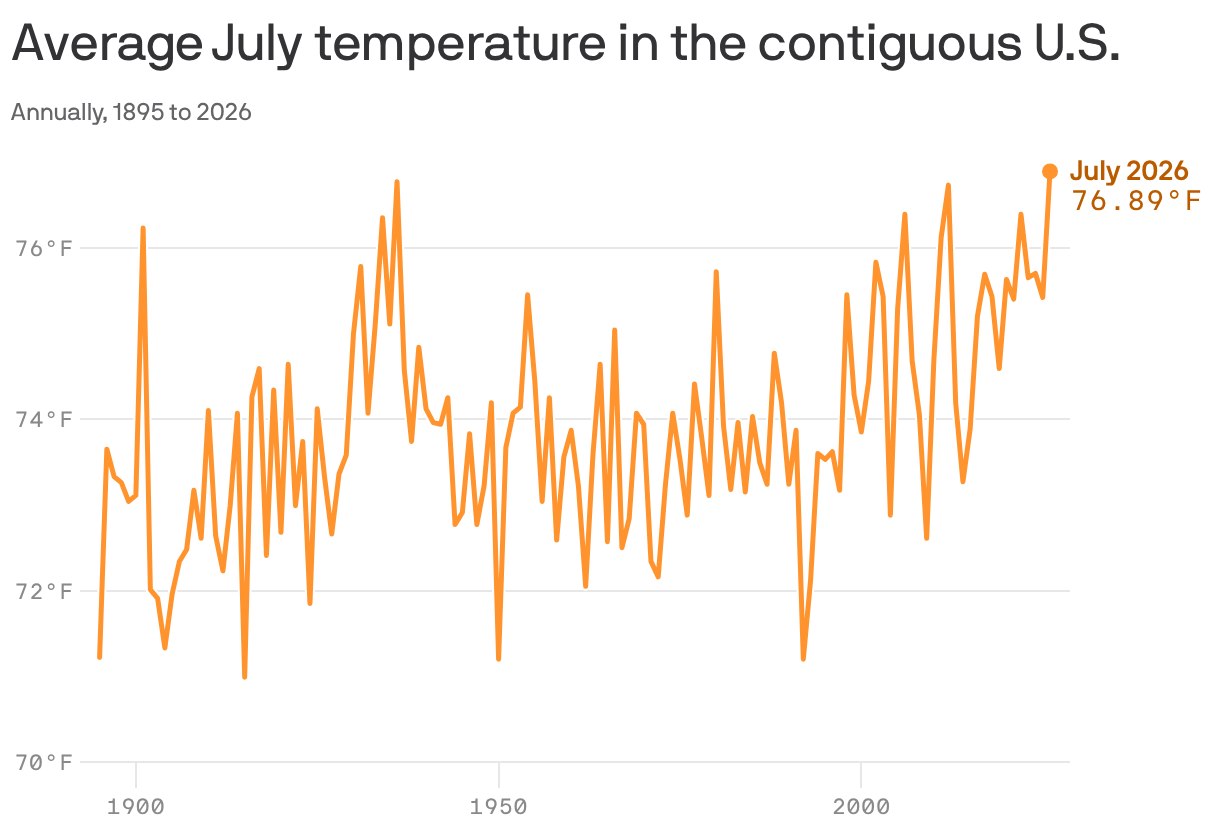
July was the hottest month on record for the contiguous U.S., per new federal data dating back to 1895.
Why it matters: Higher temperatures — which boost cooling use — come alongside rising demand from data centers and more to create new stress on power grids.
The big picture: Last month's average temperature was 76.89°F, topping the 76.77°F mark set in July 1936. That's 3.3°F warmer than the 1901-2000 average.
What we're watching: NOAA's Climate Prediction Center is calling for an elevated chance of above-average temperatures for most of the continental U.S. through August.
5. 🧮 Number of the day: $500 billion

Nvidia and a group of blue-chip Wall Street firms are collaborating to provide a half-trillion-dollar bankroll to the AI chipmaker's customers.
Why it matters: The gargantuan financing package illustrates the mushrooming scope and costs of the infrastructure needed to keep the AI economy humming.
The big picture: Nvidia announced yesterday that it is partnering with Apollo, BlackRock, Blackstone, Brookfield, Goldman Sachs and KKR to assemble more than $500 billion in financing at "attractive rates" for "the buildout of AI infrastructure over time."
6. 💬 Quote du jour: Double tap edition
"The buyouts may limit how quickly offshore wind could rebound in a future economic and policy environment, but as of today it seems as though the government just spent $3.9 billion of taxpayer dollars ... to shoot a corpse."— UC Berkeley energy economist James Sallee, in a post on buyouts of offshore wind leases unlikely to be developed anyway
📫 Did a friend send you this newsletter? Welcome, please sign up.
Sign up for Axios Future of Energy