Axios Future of Energy

October 29, 2025

🐣 Good morning! We've got a data exclusive to start the day and plenty of other news, all in 1,394 words, 5.5 minutes.
🙏 Thanks to Chuck McCutcheon and Chris Speckhard for edits to today's edition, along with the brilliant Axios Visuals team.
📻 Exactly two years ago, Taylor Swift was No. 1 on Billboard's Hot 100 with today's 10/10 intro tune...
1 big thing: Exclusive - New data center tech aims to temper energy strains
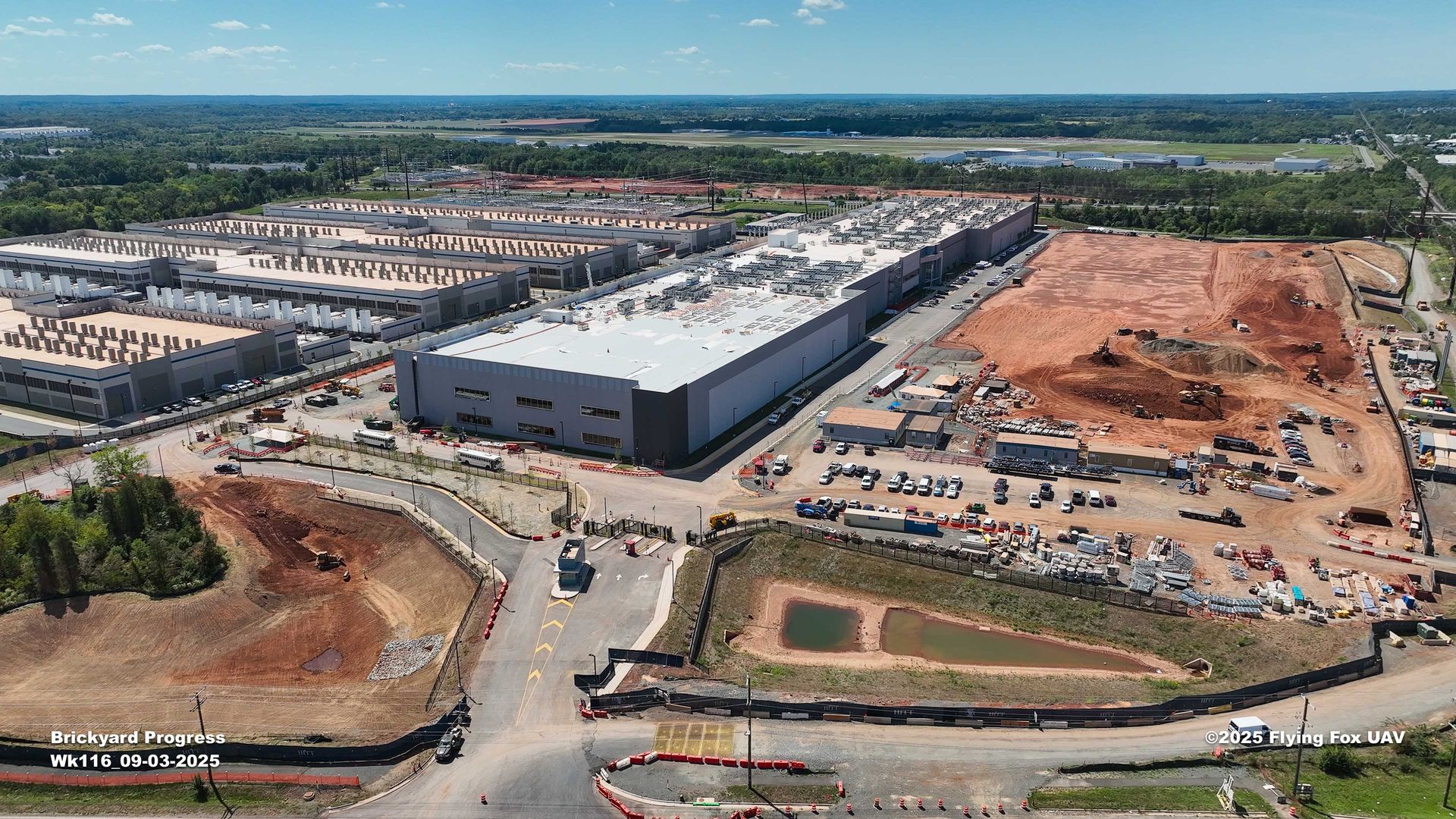
A new kind of data center built by a coalition including Nvidia aims to smooth out power use as AI demand surges.
Why it matters: This is the first commercial rollout of software that adjusts energy draw in real time — a model the companies say can ease strain on the grid and curb electricity costs.
Driving the news: Nvidia is deploying software developed by startup Emerald AI at a facility under construction now in Virginia by Digital Realty, one of the world's biggest developers of data centers.
- The facility, called Aurora, will be the first built to a new industry-wide certification on flexible power.
- Nvidia is leading the certification alongside Emerald AI, the nonprofit Electric Power Research Institute and regional grid operator PJM.
The big picture: A frenzy is underway to get more power to the booming AI sector.
- Energy Secretary Chris Wright just called on federal regulators to expedite reviews, and OpenAI sent a letter to the White House Monday urging swift action on a similar front.
Where it stands: Like most industrial facilities, data centers have long been inflexible energy users. AI's explosion is forcing operators to find smarter ways to manage electricity since the power needs are so much greater.
How it works: Aurora will use Emerald AI software to shift compute-intensive AI jobs across time and geography — throttling workloads when grids are stressed and resuming when demand drops.
- It's like taking 18-wheelers off the road at rush hour, says David Porter, vice president at EPRI.
What they're saying: "Until now, most observers have assumed that, except for Google, the only way for AI data centers to provide grid flexibility was through on-site generation or storage," said Tyler Norris, a power analyst and advisor to Emerald AI, by email.
- "The Aurora project challenges that assumption, showing that software-based workload shifting can be a credible and measurable grid resource," added Norris, who knew about the project ahead of time but isn't involved.
Follow the money: Nvidia, an investor in Emerald AI, says the tech will help satiate near-term energy demands and smooth out variable renewable energy.
- "It helps rebalance the market dynamics of variable energy by making it more useful in the concept of data centers," said Josh Parker, head of sustainability at Nvidia, in an interview with Axios.
What's next: Emerald AI CEO Varun Sivaram says his tech doesn't negate the need for new power sources like geothermal and nuclear, but it eases the long path to deployment.
- "We've got a real shot at unlocking fast capacity of power immediately to power AI data centers without exorbitantly raising community prices, and we could even lower them," Sivaram said in an interview.
2. 🧁 Bonus data center notes: Friction and flexibility
🗜️ House Democrats are pressing utilities, tech companies and regulators for more info on how data centers hit household energy costs — and what to do about it.
- Why it matters: The letter from 20 lawmakers, led by California Rep. Kevin Mullin, could foreshadow oversight plans if Democrats regain the House in the midterm elections.
- Go deeper: Read the letter sent to the Edison Electric Institute, the Data Center Coalition, and FERC.
🤸 OpenAI is endorsing the notion of data centers acting as flexible demand sources, a filing with Trump officials shows.
- Why it matters: It signals growing support for the idea that DOE is also backing, though needless to say, the devil's in the policy details in terms of what hyperscalers, utilities and other parties can agree on.
- The big picture: "To strengthen grid reliability and expand capacity for AI and other flexible loads, FERC should allow more demand-side participation in wholesale markets and speed up interconnection for large loads that can curtail," the AI giant said in a wider letter about policy goals and more.
3. ⏯️ Transition turbulence and the warming in store
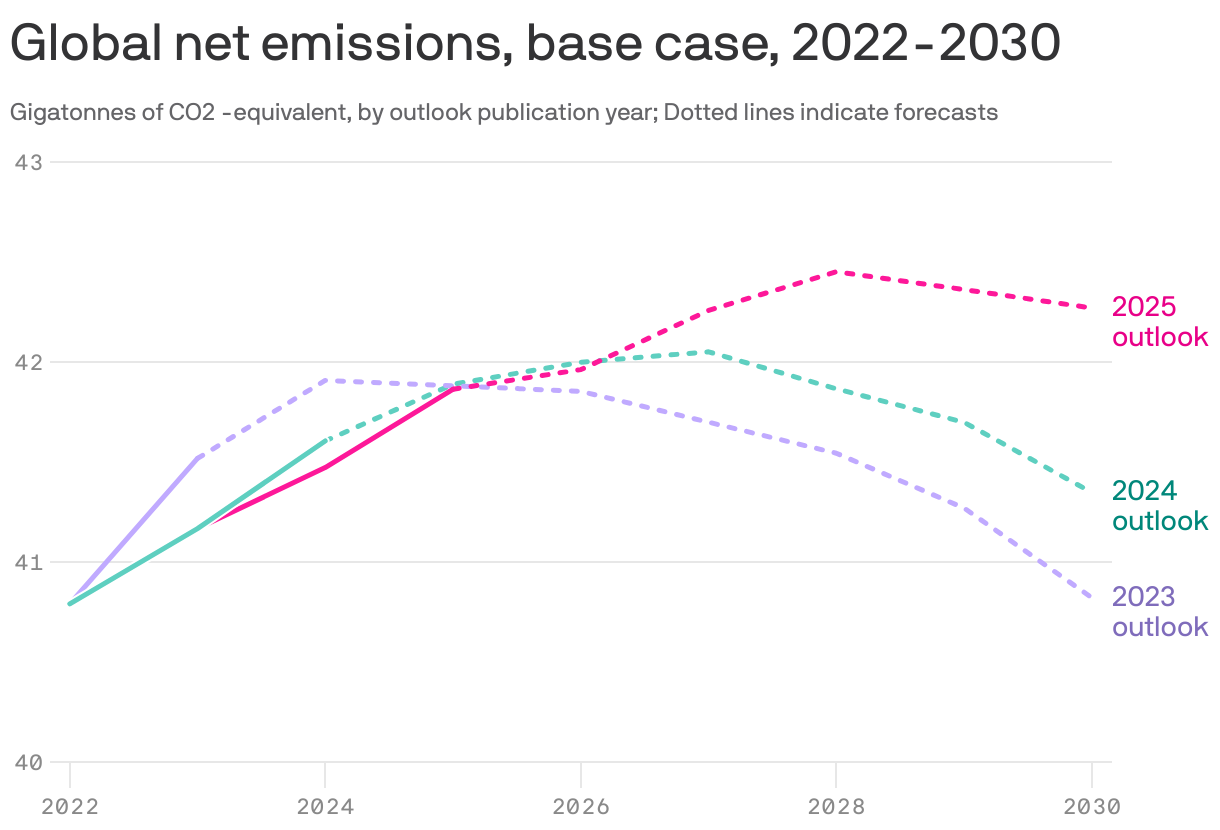
"The global push to tackle climate change has slowed," Simon Flowers, Wood Mackenzie's chief analyst, writes in the firm's new energy transition outlook.
Why it matters: Its latest annual look-ahead sees fresh headwinds, with a "base case" bringing 2.6°C of long-term warming above preindustrial levels.
- That's far past Paris Agreement goals, and above the 2.5°C projection in last year's report.
Threat level: "No major country and only a handful of smaller nations are on track to meet their 2030 emissions targets," it states.
- "The 1.5°C warming threshold is increasingly out of reach due to geopolitical tensions and macroeconomic pressures."
What we're watching: Limiting the rise to 2°C is "plausible" but would require annual investments to rise 30% to average $4.3 trillion between now and 2060, Woodmac concludes.
4. 💵 Trump's new nuclear plan: what we know and what they're saying

Let's get into early fallout and more specifics of the $80 billion "strategic partnership" between the U.S. and several companies to deploy the big Westinghouse AP1000 nuclear reactors.
Why it matters: It's Trump 2.0's most direct effort yet to spur new U.S. reactor builds with an eye toward AI power needs.
Catch up quick: The parties include Brookfield Asset Management and nuclear fuel provider Cameco — which jointly own Westinghouse.
- Japan has also agreed to financing in a wider set of investment pledges, the White House said in a summary of bilateral ties.
State of play: The deal envisions profit-sharing of 20% for the U.S. government if Westinghouse is first able to pay out over $17.5 billion to its owners.
- But for this to happen, the U.S. must make investment decisions and enter agreements that enable $80B worth of reactors to actually get built, per a Cameco summary.
- The deal also provides a pathway for the U.S. to require a Westinghouse IPO, in which the government could turn its profit-sharing rights into a substantial equity stake.
What they're saying: The agreement "raises questions of taxpayer risk (and opportunity) in a space that has seen major cost overruns and bankruptcies," TD Cowen analysts said in a note.
What we're watching: The U.S. is expected to use "financial, regulatory, policy and diplomatic tools" to support the partnership, per Cameco, which saw a 23% stock bump on the news.
- This could include help with land acquisitions, loan guarantees and more, per FT reporting that a source familiar with the plan confirmed to Axios.
5. ❗Exclusive: Group wants to speed permitting to boost AI

A leading business group — in a report shared exclusively with Axios — is trying to jump-start efforts in Congress to cut red tape so that new AI and other projects can roll out more rapidly.
Why it matters: The National Association of Manufacturers (NAM) carries considerable clout with Republicans.
- Its report released today argues that streamlining the permitting process is key to prevailing in AI and fulfilling President Trump's "energy dominance" agenda.
Driving the news: The group's report says AI "has become integral to modern manufacturing." Sixty percent of the manufacturers NAM surveyed expect to deploy artificial intelligence in their operations by 2027.
- But it said bureaucratic red tape remains a hindrance to further progress.
- "Unclear timelines, lack of agency coordination, overlapping statutes and endless litigation continue to drive up the costs of critical projects or halt them altogether," it said.
- "Permitting reform underpins our energy, AI and manufacturing future — now is the time for Congress to act."
Catch up quick: NAM is one of several prominent groups to recently call for Congress to hasten work on permitting.
- A bipartisan group of more than a dozen governors — led by Oklahoma's Kevin Stitt and Pennsylvania's Josh Shapiro — put out a package of priorities yesterday to improve permitting and regulatory processes for energy infrastructure projects.
Reality check: Democrats and Republicans remain apart on specifics.
NAM's report also urges lawmakers to invest more heavily in solar, wind and battery storage in addition to nuclear and fossil fuels.
6. 🤝 Number of the day: 100,000
That's the number of Nvidia's powerful Blackwell specialized chips going into an "AI supercomputer," DOE said in unveiling plans for several new facilities with the AI giant and Oracle.
Why it matters: DOE said the systems will link to the department's vast, existing computing network to "address some of the nation's most pressing challenges in energy, security, and discovery science."
📬 Did a friend send you this newsletter? Welcome, please sign up.
Sign up for Axios Future of Energy