Axios Future of Energy

October 20, 2025


🥞 Welcome back! We're sprinting into the week with 1,328 words, 5 minutes.
🙏 Thanks to Chuck McCutcheon and Chris Speckhard for edits to today's edition, along with the brilliant Axios Visuals team.
🎧 Today marks 45 years since the late great Donna Summer released the album "The Wanderer," which provides today's intro tune...
1 big thing: China's overwhelming battery edge

China's dominance in batteries shows just how much the Asia powerhouse is beating the U.S. on key tech fronts.
Why it matters: This positions China to be the geopolitical winner as the world transitions (unevenly) to cleaner energy.
Inside the room: Spencer Gore, founder of the now-defunct battery maker Bedrock Materials, visited China as part of his research. He recounted his experience for the latest podcast episode of "Shocked."
- The battery-material campuses are the size of small towns. As many as a dozen production lines operate remotely, and the facilities themselves are "something out of science fiction," he said.
- "It's decades ahead of anything that we've done here," Gore said.
The intrigue: Gore's reflections echo those of a group of Western venture capitalists' recent trip to China.
- They told Bloomberg the visit showed just how many clean-energy technologies were simply not investable domestically because of China's leadership — including batteries.
The big picture: China has been beating the U.S. in the clean-energy race for at least a decade, probably far longer, especially including batteries and the materials and processes involved in making them.
- Any inroads the U.S. has tried to make in recent years are being eroded as President Trump pulls back support for electric cars (a key demand signal) and related initiatives.
Driving the news: The U.S.-China trade war escalated earlier this month when China said it was tightening export controls on a range of critical minerals.
- China also said it was requiring licenses for exports of certain lithium batteries and associated products, which could raise prices of lithium after a recent plummet.
Zoom in: Such a twist would turn Gore's initial thinking on its head.
- His startup was betting that batteries made from plentiful and cheap sodium-ion would out-compete lithium, which is concentrated in China and saw prices skyrocket between 2020 and 2022.
- But by December 2024, largely due to China's advancements, "there was not really a clear pathway to make a sodium-ion battery that was cheaper than lithium-ion," Gore said.
How it works: Batteries made from sodium ion, compared to lithium, are cheaper and safer (lithium is flammable). But they're heavier.
- That compels their application as energy storage to the power grid and even inside people's houses, said Shirley Meng, a University of Chicago professor and chief scientist for energy storage designs at the Energy Department's Argonne National Laboratory.
The bottom line: Gore still thinks sodium-ion batteries can scale if the competitive economics improve — which is, of course, a big if.
Editor's note: This article was written partly based on content from the "Shocked" podcast, which was created by a team including experts at the University of Chicago's Institute for Climate and Sustainable Growth and producers at Magnificent Noise. Amy is also the institute's inaugural journalism fellow.
2. 🥊 Takeaways from the collapse of UN shipping talks

Let's break down the big news since our last edition: the collapse of the UN International Maritime Organization's planned system of carbon fees on shipping.
Why it matters: Shipping accounts for roughly 3% of global CO2 emissions and rising, and a binding system of CO2 targets and payments could help drive cleaner practices.
🏃 Catch up quick: Nations on Friday agreed to shelve a vote amid U.S. threats to retaliate against countries with visa restrictions, port fees, sanctions and more.
- The IMO plans to reconvene in a year.
- Environmentalists slammed the collapse, while Secretary of State Marco Rubio called it a "diplomatic victory" that protects consumers.
Here are some takeaways, with a big assist from Evelyne Williams and Trevor Sutton, scholars from Columbia's energy think tank who know this stuff backwards and forwards.
⚔️ A new phase. It's Trump officials' most bare-knuckled move yet to thwart global climate initiatives.
- This goes beyond steps like bailing on the Paris Agreement and ending U.S. funding for overseas work.
- The U.S. is "now using a broad suite of economic tools and diplomatic tools to discourage other countries from pursuing a green transition," Sutton said in an interview.
🛑 This plan looks kaput, not just delayed, Williams tells me.
- The U.S. position doesn't look malleable under Trump, and changing the system would require lengthy new talks with the clock ticking toward 2030 targets.
- "I think it's dead under the Trump administration, unless there is a definitive take back of multilateral power by some of the key actors," said Williams.
🚢 It's not the end of efforts to clean up shipping... Williams points to EU maritime rules already in place, industry investments in cleaner fuels and dual-fuel vessels to use them, and more.
- "The opportunity is there, and whether it manifests as a global framework or regional network is left to be said," Williams tells Axios.
🐢 ...but further slows the industry's tech transition. "We expect a consequence of last week's indecision will be a shift back to conventional fuel engines for new vessel orders and for many of those currently in the orderbook," Jefferies analysts said in a note today.
3. 🏃♀️ Catch up quick on policy: Loans, shakeups, EU
⚛️ DOE's loan office "is going to provide a lot of low interest capital" to nuclear reactor developers as part of the department's multifront nuclear push, Energy Secretary Chris Wright said in remarks Friday.
💼 That was fast. Wells Griffith is no longer DOE's Undersecretary of Energy after being confirmed by the Senate in July. His replacement is Alex Fitzsimmons, who has served as chief of staff and in other roles, DOE said.
- What we're watching: The change is part of wider tensions within DOE and between the department and the White House, Politico reports.
🇪🇺 The EU will float new measures to curb costs in its expanding CO2 markets, Bloomberg reports.
4. 🛢️ On my screen: the oil glut and how it might ease
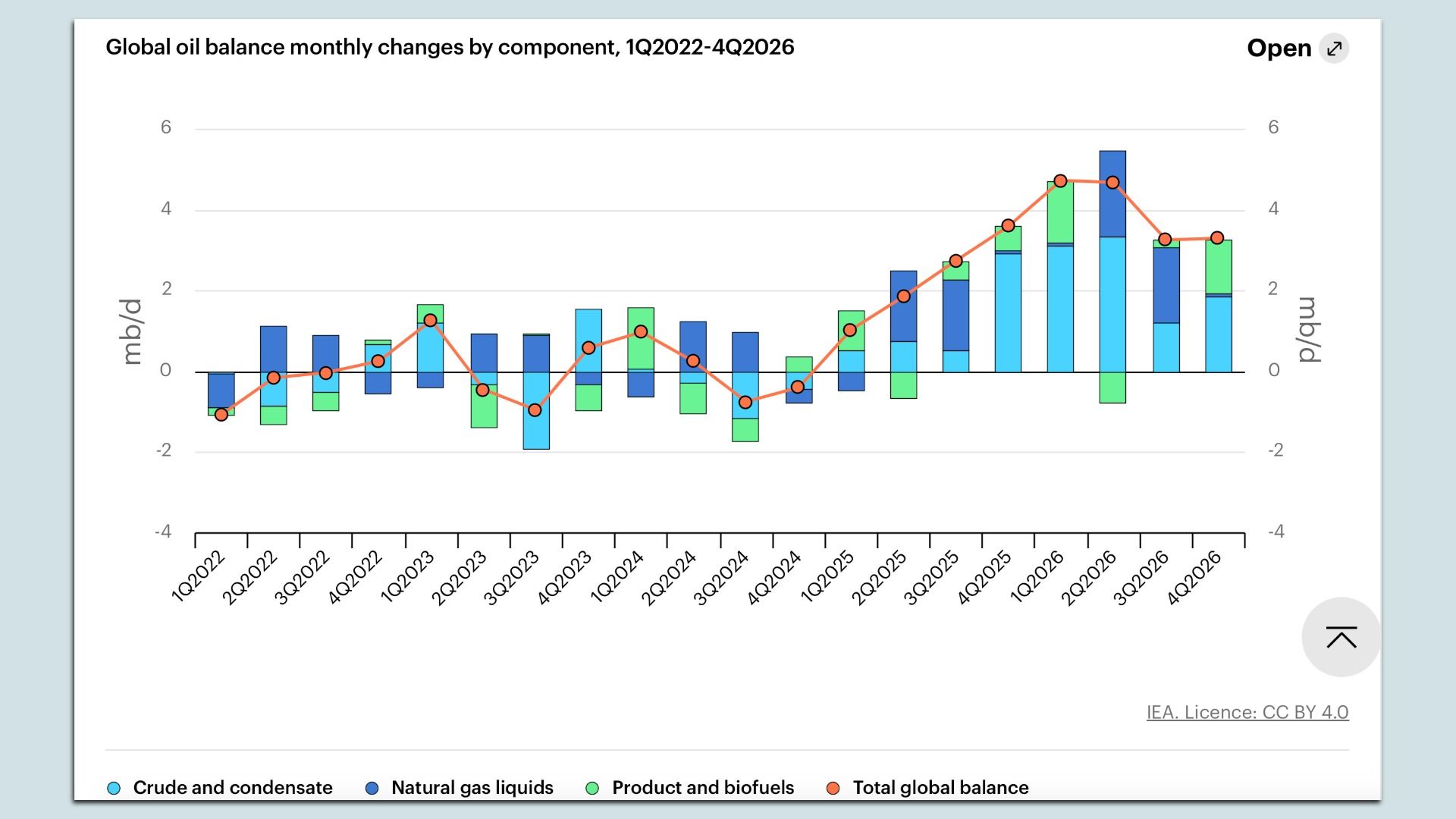
A pair of lucid new analyses unpack why there's so much oil sloshing around — and what might move global markets closer to balance.
Why it matters: Rising supply and tepid demand growth are pushing down prices.
- That ripples through consumer costs, shale's health, EV competitiveness, midterm election politics and far beyond.
The big picture: New International Energy Agency commentary breaks down the agency's projection of a whopping 4 million barrel-per-day surplus in 2026.
- That's just "untenable ... something has to give," writes Toril Bosoni, head of IEA's oil industry and markets branch.
What's next: Near-term demand is pretty inelastic, with huge price swings needed to greatly change the picture, she writes. So supply changes are far more likely.
- OPEC+ could end or even reverse production hikes.
- And low prices could turn U.S. output increases into decline as higher-cost producers cut back.
Friction point: Supply could also fall if big economies further "tighten the screws" on Kremlin-backed barrels, and she also flags Ukrainian attacks on Russian energy infrastructure.
- Sanctions enforcement against Venezuela and Iran are also in the supply mix.
Oil analyst Rory Johnston explores how we got here and what's next.
- It's "U.S. shale patch producers that are most likely to quickly respond to this price signal by cutting investment," he writes in The Dispatch's energy newsletter.
The bottom line: Johnston mulls how the U.S. boom underway for 15+ years means tradeoffs.
- Gone are the days when lower prices — which President Trump favors — were an "unambiguous stimulant for the [U.S.] economy."
- "Instead, the U.S. is the world's largest exporter of crude and petroleum products today, so this price decline slashes the value of those exports."
5. ⛽ Number of the day: $2.98 per gallon
That's the average U.S. regular gasoline price, per GasBuddy tracking yesterday, while AAA today has it at $3.03
What we're watching: The political fallout of prices falling back under $3 per gallon and heading for the lowest cost since 2021.
- The White House is keen to promote this (though they were essentially at this level in late 2024).
- Yet electricity prices are rising, which Democrats hope to parlay into midterm election gains.
📬 Did a friend send you this newsletter? Welcome, please sign up.
Sign up for Axios Future of Energy