Axios Future of Energy

November 07, 2025


🍺 Happy Friday! We're looking south to Guyana and Brazil, then back to the U.S., all in 1,456 words, 5.5 minutes.
📺 Now live: The Season 1 finale of "The Axios Show" features Palantir CEO Alex Karp interviewed by Mike Allen. Watch on Axios ... Subscribe to our YouTube.
🎧 This week in 1998, Beck released the album "Mutations," which provides today's intro tune...
1 big thing: Guyana's eye-popping ascent on oil production and wealth

Guyana is racing ahead on oil production and wealth since Exxon struck crude off its coast a decade ago.
Why it matters: The South American nation, about the size of Idaho, shows how quickly oil money can transform — and test — a country.
State of play: A new episode of the "Shocked" podcast explores how oil cash is reshaping Guyana and then zooms to Texas to see similar forces at work.
The big picture: This newfound oil is catapulting Guyana to the top of the world's economic growth.
- The IMF says Guyana led the world with an average 47% real GDP growth from 2022 to 2024, propelled by Exxon's offshore projects.
Reality check: Challenges persist, of course, including an ongoing border dispute with Venezuela and charges of corruption, which the oil wealth risks exacerbating.
- Guyana also boasts one of the world's largest virgin forests, which allows it to keep describing itself as "net zero" despite rapidly growing oil production.
Friction point: We reference a heated BBC interview with President Irfaan Ali last year.
- Asked if the nation's forests give it a right to drill for oil, Ali responds: "Does that give you the right to lecture us on climate change? I want to lecture you on climate change."
- In a related exchange about Greenpeace, Ali says: "Who is going to pay for the development and advancement of our country? Are you going to pay? It's not coming from anywhere. It's not coming from Greenpeace or anyone else."
Follow the money: Let's share two strikingly different figures:
- $1.8 billion: That's how much the World Bank has given Guyana from 1969 to 2024, the latest available number (adjusted for inflation), according to the University of Chicago's Institute for Climate and Sustainable Growth. Most was in loans that will require repayment.
- $6.3 billion: This is what Guyana has earned by allowing Exxon to drill for its oil from 2019 to 2024.
What they're saying: Guyanese residents told our partner reporter that the boom is building hospitals and apartments and funding scholarships — but also raising prices.
What's next: The second half of the podcast takes us to Midland, Texas, to see how oil wealth shapes life closer to home.
Editor's note: This article was written partly based on content from the "Shocked" podcast, which was created by a team including experts at the University of Chicago's Institute for Climate and Sustainable Growth and producers at Magnificent Noise. Amy is also the institute's inaugural journalism fellow.
2. 🌡️ Catch up quick on COP30: Temps, politics, money

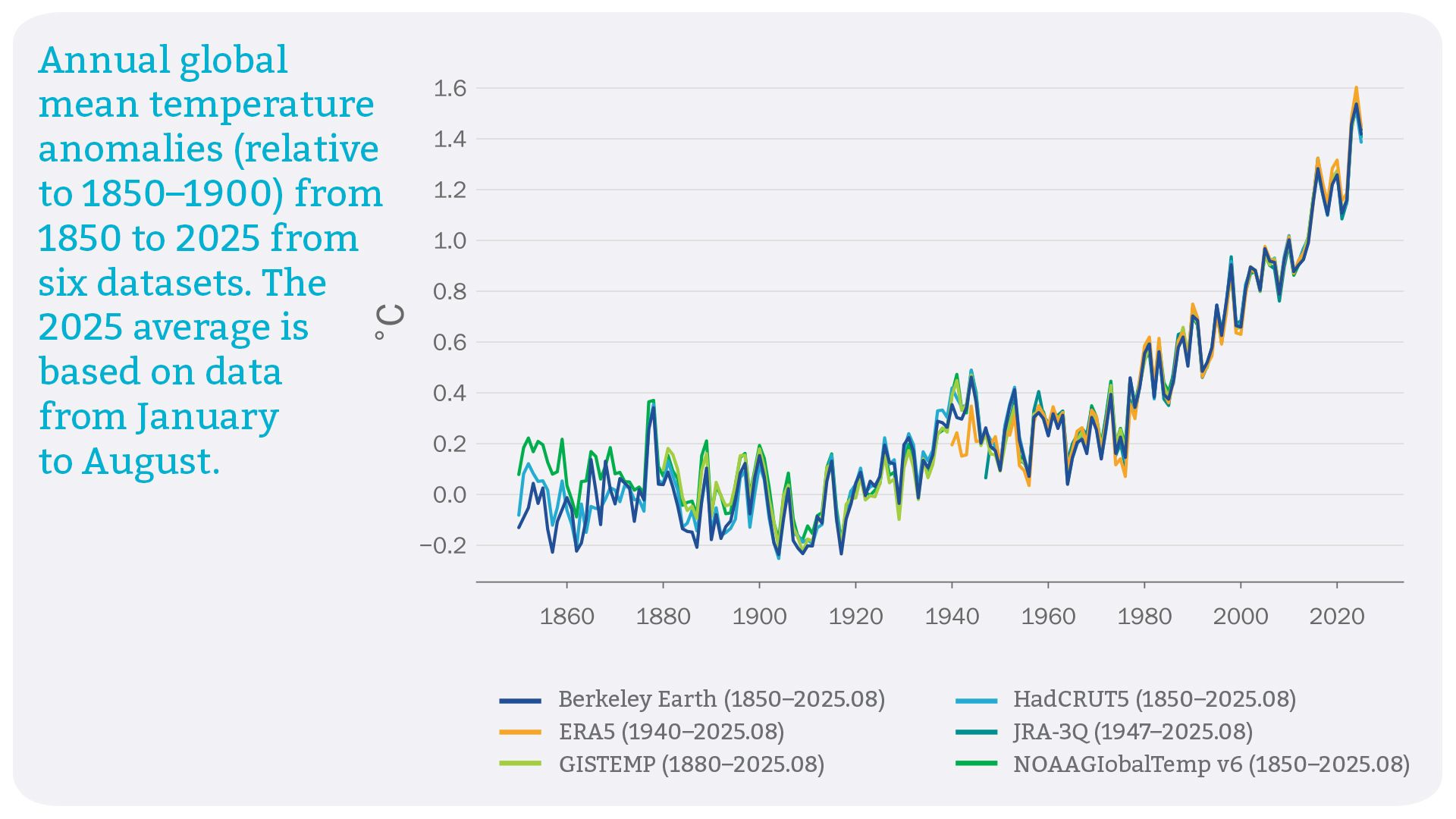
🧮 2025 will almost certainly be the second- or third-warmest year behind 2024 in records dating back to the 1800s, per new reports from the World Meteorological Organization and the EU's Copernicus Climate Service.
- Why it matters: The finding underscores the stakes of the COP30 summit that's now underway in Brazil.
- The big picture: "[T]he last 11 years, including 2025, will individually have been the 11 warmest years on record," states WMO's annual "State of the Climate" report.
🗳️ California Gov. Gavin Newsom (D), who's mulling a White House run, said he's heading to COP30 next week.
- Why it matters: His announcement hints at how Newsom might politically position himself on climate — a topic polling shows isn't top of mind for voters overall.
- State of play: "The economic winners of the 21st century are those who build the clean energy future," he said, citing "jobs, clean air, and lower costs."
🇬🇧 World leaders aren't being shy about criticizing the U.S. at a pre-COP summit in Brazil.
- The big picture: U.K. Prime Minister Keir Starmer said that while climate was once a reason for unity internationally, "today, sadly, that consensus is gone."
- Friction point: Without mentioning Trump directly, President Luiz Inácio Lula da Silva of Brazil warned of "extremist forces that fabricate fake news and are condemning future generations to life on a planet altered forever by global warming." Go deeper.
🌳 A major new forest protection fund that launched at COP30 has already attracted over $5.5 billion in funding pledges, host Brazil said.
- Yes, but: Initial funding "falls well short of expectations," Bloomberg reports.
3. 💵 Lowercarbon Capital raising second fusion fund


Lowercarbon Capital is raising its second fusion fund, founder Chris Sacca said at the SOSV Climate Tech Summit yesterday.
Why it matters: The momentum around fusion has been growing, but a dedicated fusion fund remains an anomaly.
State of play: "What we're seeing is across multiple diverse approaches to fusion, incredible success. Exponential growth and in some cases double exponential," said Sacca.
Yes, but: Given fusion isn't yet a commercial technology, not all LPs will be eager to invest.
Unlock the whole story — and a steady diet of scoops and smart analysis — by talking to our sales team about Axios Pro Deals.
4. 🗒️ Policy notes: Critical minerals edition

⛏️ The Interior Department added copper, metallurgical coal, uranium and others to the expanded list of "critical minerals."
- Why it matters: Inclusion can help unlock faster permitting for extraction and processing, and signals where federal officials may steer investment.
- What we're watching: How it might change the equation for specific projects. Copper giant Freeport-McMoRan "said this year it could generate more than $500 million annually in tax credits tied to the 2022 U.S. Inflation Reduction Act if the red metal were declared critical," Reuters reports.
- The bottom line: It's the latest step in a Trump 2.0 push to boost domestic production of materials needed for defense, industry and energy.
👋 Meet the newest policy coalition: The Advanced Materials Security Council (AMSC), unveiled yesterday, is focused on rare earths, polysilicon, black mass, lithium, and cobalt.
- The big picture: Goals include "level[ing] the playing field for American producers by combatting unfair trade practices, promoting fair competition, and expanding market access." It's urging stronger U.S. trade policies to counter China.
- Zoom in: It's run via staff at Venn Strategies, which plans to register lobbyists on AMSC's behalf, Venn's Emma Bishop, who's serving as president, tells Axios.
- What we're watching: AMSC hasn't yet disclosed corporate members. Other participants include universities like the Colorado School of Mines and think tanks such as the Hoover Institution.
5. 🚪 Climate among Pelosi achievements as she exits

Rep. Nancy Pelosi (D-Calif.) pushed climate change to the front burner as House Democrats' leader, though Republicans have undone some of her accomplishments.
Why it matters: Pelosi, who announced her retirement yesterday, is regarded as one of history's most successful House speakers, partly because of her ability to mobilize her caucus to deal with issues like climate.
The big picture: After becoming the first woman speaker in 2007, she set up the Select Committee on Energy Independence and Global Warming.
- Also in 2007, Pelosi steered an energy bill into law that raised vehicle fuel efficiency standards for the first time in three decades.
Friction point: Under President Barack Obama, she got the House to pass a big cap-and-trade system for greenhouse gas emissions.
- But it stalled in the Senate and was seen as a political albatross for some of the more than 50 House Democrats who lost their seats in 2010.
State of play: In the Biden era, she steered Democrats toward backing a bipartisan infrastructure package that invested heavily in EV charging and clean energy projects.
- She was also speaker for passage of the Inflation Reduction Act, which made the single largest investment in climate and energy in history.
6. 👓 Hot reads: Data centers, lobbying, the future

AI's rapacious appetite for electricity can accelerate clean energy (Foreign Policy)
Amy's take: This is such an important and fascinating story about finding the customers (in this case hyperscalers) willing and able to pay higher prices. I hope to tackle it in Axios sometime soon.
Data centers are fueling the lobbying industry, not just the growth of AI (Open Secrets.org)
Chuck's take: The money-in-politics watchdog examines a phenomenon that's likely to get more attention as AI and data centers become more pervasive.
Scenarios in the World Energy Outlook 2025 (International Energy Agency)
Ben's take: Look between the lines of this straightforward explanatory exercise, and you'll find IEA preempting criticism that could follow its upcoming flagship report.
- Keep a close eye on the revived "current policies scenario." When the report lands, there will be lots of attention to how it models future oil and gas demand.
7. 🧮 Number of the day: up to $1 trillion
Tesla shareholders agreed to a compensation package for CEO Elon Musk worth up to nearly $1 trillion.
- But it ties Musk's compensation to ambitious growth targets.
- Full story
🙏 Thanks to Chuck McCutcheon and Chris Speckhard for edits to today's edition, along with the brilliant Axios Visuals team.
📬 Did a friend send you this newsletter? Welcome, please sign up.
Sign up for Axios Future of Energy