Axios Future of Energy

December 22, 2025

🚨 We've got big offshore wind news, a look back at 2025 and more, all in just 1,489 words, 5.5 minutes.
🛢️ Situational awareness: U.K.-based Harbour Energy is diving into the Gulf of America (renamed from the Gulf of Mexico) with a $3.2 billion acquisition of LLOG Exploration. Go deeper.
🎶 Ukrainian energy firm DTEK filmed holiday carolers at a plant damaged by Russian attacks, and the effort to boost international rebuilding aid provides today's intro tune...
1 big thing: Exhaling after 2025's wild ride
This year took humanity on a wild ride — and energy was no exception.
The big picture: The AI boom came of age, climate ambition was reset and the surprises never stopped.
Catch up quick: Here are trends I'm reflecting on — anchored by ones I predicted in January would drive this year.
🔍 Cleantech scrutiny
"Scrutiny" was the word I used in January. It holds up — but President Trump went after wind and solar more aggressively than I anticipated.
Friction point: Offshore wind took the biggest hit. BloombergNEF's forecast for U.S. offshore wind capacity plunged from 39 gigawatts to just six, per Canary Media.
On Capitol Hill, Congress also repealed more of the Inflation Reduction Act than many expected.
- But a sizable chunk of cleantech support survived — including funding for advanced nuclear, geothermal, sustainable aviation fuel and battery storage.
🥺 Humility and surprises
This one hits close to home. Cipher News, the outlet I was leading until July, shut down after funding changes at Breakthrough Energy, which is backed by Bill Gates.
Zoom out: Gates' shifting priorities — and his controversial memo — reflect a broader reset across climate and tech that's driven largely, but not exclusively, by Trump's election.
- From companies like Ford to institutions like the International Energy Agency, the forces pushing ambitious climate action clearly lost momentum this year.
Surprises were everywhere. Even accounting for present bias, last week's news that Trump Media & Technology Group (parent of Truth Social) is merging with nuclear fusion startup TAE Technologies felt like a Mad Libs headline come to life.
🏎️ The AI race
This ranked third in my January outlook. It should have been first.
- We're now so deep into the AI race that talks of bubbles are the norm.
The bottom line: We've spilled plenty of ink on AI and energy this year, and spoiler alert: We'll keep it up next year.
- My article on tectonic plates sums up the AI and energy story for 2025.
🇪🇺 Europe's existential competition
The European Union is also scaling back its climate ambitions — partly in response to Trump, but also because of deeper, unresolved tension over global competitiveness considering its higher energy prices.
🌏 Tariffs, China, Brazil, oh my!
This was my January catchall for geopolitics, and it largely holds up.
- Trump's tariffs rippled across the economy, but somehow faded into background noise amid the AI energy rush.
- The annual United Nations climate talks in Brazil came and went with relatively little fanfare.
China is the world's biggest and most enduring energy and climate story.
- China flexed its geopolitical muscle by restricting exports of rare earth materials and extending its cleantech lead by investing in emerging areas like fusion.
What's next: Read my full look-back, and let us know what we should include in our 2026 outlook: [email protected]
2. 🚨 Breaking: Trump halts all offshore wind leases for projects under construction
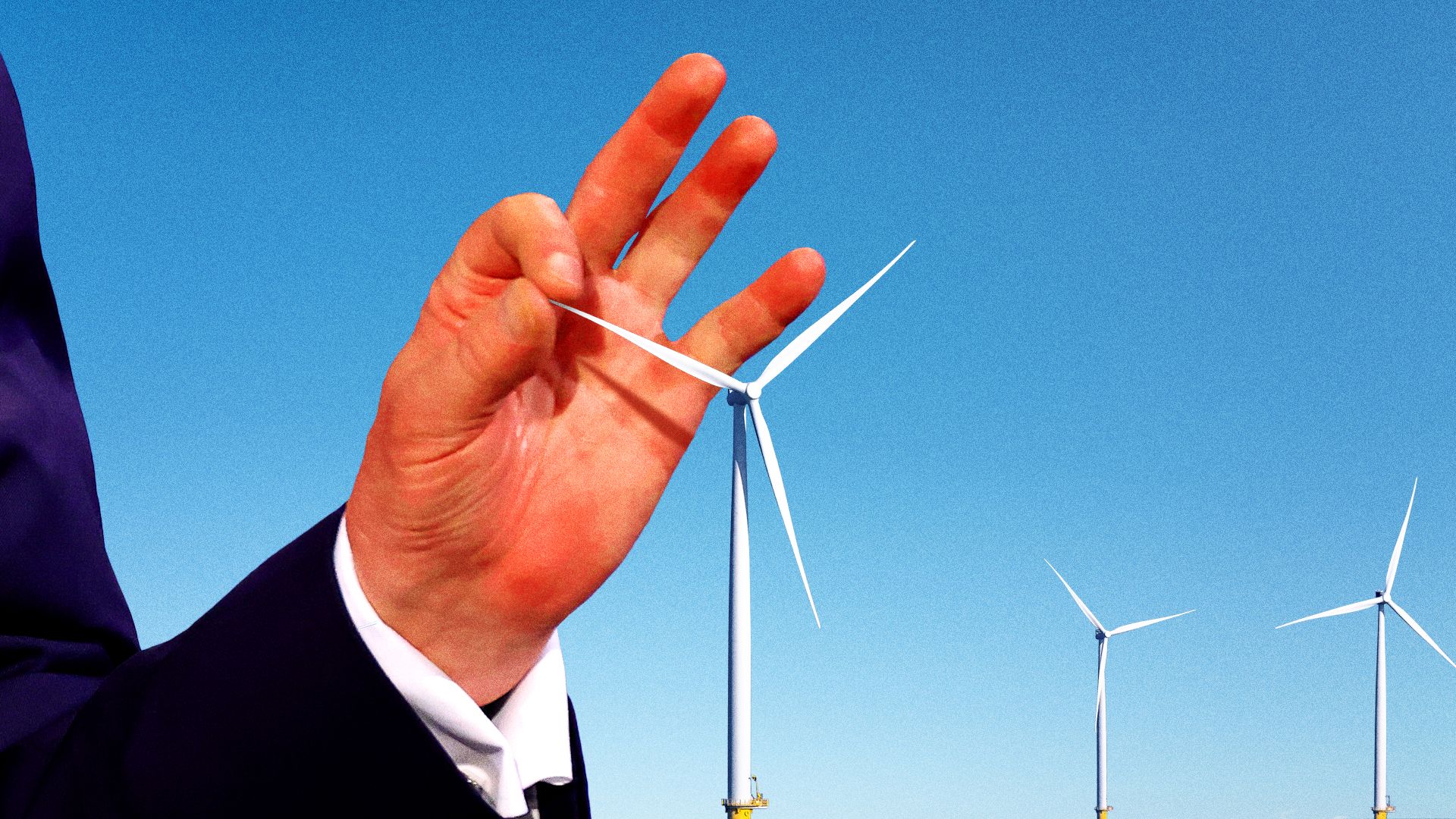
The Trump administration said this morning that it's immediately pausing all leases for offshore wind projects under construction due to "national security risks."
Why it matters: It's among the most sweeping broadsides yet against the renewable energy source that's most directly in President Trump's crosshairs.
- It follows billions of dollars in investments into the large-scale projects.
Driving the news: The Interior Department announcement alleges national security risks "identified by the Department of War in recently completed classified reports."
- "This pause will give the Department, along with the Department of War and other relevant government agencies, time to work with leaseholders and state partners to assess the possibility of mitigating the national security risks posed by these projects," it said.
- It alleges that unclassified reports show that offshore wind can create radar interference called "clutter."
State of play: Interior identified five Atlantic Coast projects affected: Vineyard Wind 1 off Massachusetts; Revolution Wind off Rhode Island and Connecticut; Coastal Virginia Offshore Wind; and offshore New York projects called Sunrise Wind and Empire Wind.
The big picture: Renewables backers say that the Trump administration is starting with the president's distaste for offshore wind — and working backwards from there to find reasons to thwart projects approved in the Biden era.
- The latest move arrives roughly two weeks after a federal judge threw out President Trump's January order against wind projects.
What we're watching: Likely court battles over the latest move.
3. ⚛️ Nuclear waste exec sees co-location opportunities

As the energy industry looks to step up co-location of data centers and power sources, a company developing a new nuclear waste disposal technology is hoping to do the same thing.
Why it matters: With nuclear gaining in political and public acceptance, many observers say the issue of how to dispose of waste over the longer term deserves more attention.
Driving the news: Deep Isolation CEO Rod Baltzer told Axios that putting his technology near advanced nuclear plants would ease public fears about shipping wastes to a disposal site.
- "Transportation is one of the safest things we do in nuclear," Baltzer said. "It's also one of the most hated things we do in nuclear."
How it works: Deep Isolation wants to use directional drilling technology, popular in the oil and gas industry, to dig long, narrow holes thousands of feet underground into which canisters of waste can be placed.
- The concept has both supporters and skeptics.
What's next: Deep Isolation is working with other countries in the hope of building a groundswell of support for U.S. usage.
- The U.S. Trade and Development Agency funded a feasibility study for the company with Bulgaria last year, but the Trump administration paused it for months before recently restarting it.
- "We're glad the administration saw this is the U.S. exporting nuclear technology and creating additional U.S. jobs and taking a leadership position in the back end" of the nuclear cycle, Baltzer said.
4. 👓 On my screen: Democrats and the oil industry
A (pretty substantive!) social media dispute erupted over center-left writer Matt Yglesias' NYT column arguing Democrats should embrace the U.S. oil and gas industry.
Why it matters: It's a proxy fight in the party's wider tensions over how to approach energy and climate in the 2026 and 2028 elections.
Catch up quick: He says backing U.S. production and exports would help Dems expand the electoral map — and then take climate and pollution seriously, if much less aggressively than climate hawks want.
- It gets into the economic and geopolitical-leverage case for U.S. oil and gas.
- Yglesias makes an environmental case, too, even diving into the treacherous waters of LNG's climate effects vs. coal.
Friction point: He's getting lots of pushback, including this detailed rebuttal from Rep. Sean Casten (D-Ill.), who's steeped in energy policy and has a cleantech background.
- And there's a rebuttal to the rebuttal, and various wonks and scientists weighing in.
The bottom line: It wouldn't be social media without accusations and name-calling.
- But bushwhack through it, because checking out the underlying policy and tactical disputes is worthy of your time.
5. 🇺🇸 Mapping U.S. data center hot spots


Nearly 3,000 new data centers are under construction or planned across the U.S., per a new analysis — adding to the more than 4,000 already in operation.
Why it matters: Big tech and many local leaders are full steam ahead on building as many data centers as possible to generate revenue and power the AI boom — but they're fueling a major political fight, with locals pushing back over energy use and other concerns.
Driving the news: Virginia leads the country in data centers, with 663 operational and 595 more either under construction or planned.
- Texas is also up there, with 405 existing data centers and 442 planned or being built.
- That's per a new report from the American Edge Project (a pro-tech advocacy group) and the Technology Councils of North America (which represents tech and IT trade organizations).
What's next: Georgia and Pennsylvania are among the states due for particularly big data center booms, if all goes to plan.
- But data centers face political backlash in some areas, clouding the wider outlook.
6. 💵 Energy deals you may have missed

🤑 Energy-focused private equity firm Kimmeridge has offered to buy gas company Ascent Resources for $6 billion in cash from Energy & Minerals Group (EMG) and First Reserve. Go deeper
💰 Microreactor developer Radiant has closed a $300 million Series D, valuing it at over $1.8 billion. Go deeper
🔋 Exclusive: Second-life EV battery company B2U has closed a $45 million structured finance fund that will own seven of its grid storage projects, says CEO Freeman Hall. Go deeper
🙏 Thanks to Chuck McCutcheon and Chris Speckhard for edits to today's newsletter, along with the brilliant Axios Visuals team.
📬 Did a friend send you this newsletter? Welcome, please sign up.
Sign up for Axios Future of Energy