Axios Future of Energy
September 22, 2025


🗽Greetings from NYC! Welcome to the launch of Future of Energy.
- We are stoked to bring you all the news that matters on tech, policy and people when it comes to our energy mixes of tomorrow and the coming decades.
🎉 We — Amy, Ben and our editor Chuck McCutcheon — are in town to moderate a suite of events at the Axios House during Climate Week. Check out today's livestreams.
- Today's word count is 1,613 — brisk considering the busy week ahead of us!
🎶 Today's intro tune is, appropriately, the Supremes' "High Energy," courtesy of Chuck.
1 big thing: Chris Wright calls offshore wind disruption a unique case
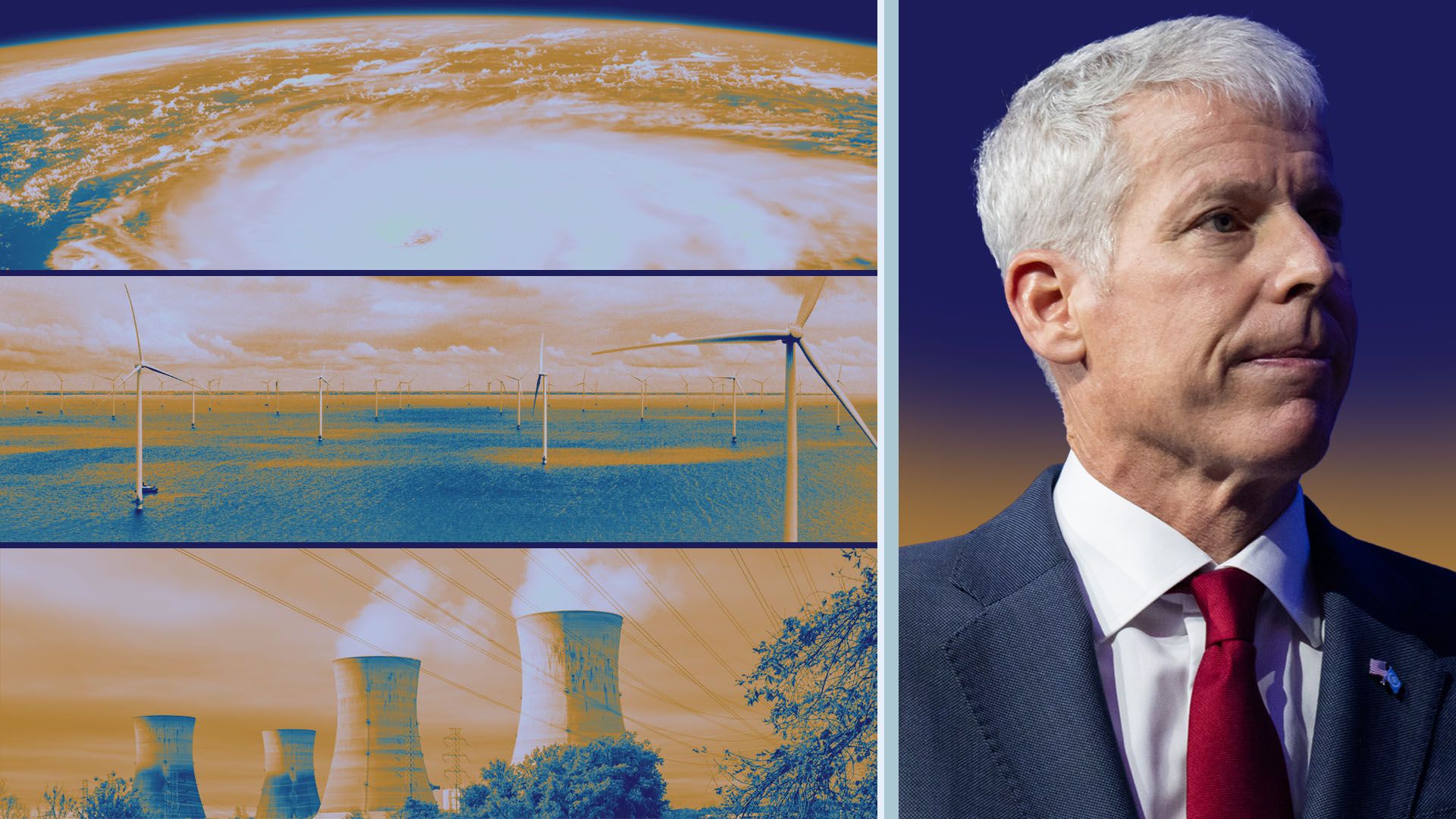
Energy Secretary Chris Wright said in an exclusive interview that freezing offshore wind projects doesn't make America a risky place to invest — but he wants Congress to overhaul permitting to make other infrastructure easier to advance.
Why it matters: Wright is powerful in Trump 2.0 — a point man for the White House "dominance" agenda on fossil fuels, powering AI data centers, and shredding Biden-era climate playbooks.
- The former fracking exec offered a peek into his upcoming moves and current thinking in a chat with Amy and Ben that ranged widely from offshore wind to nuclear waste to climate science.
🏈 State of play: Offshore wind pullbacks are a "one-off exception," he said. Those Atlantic Coast projects already permitted or under construction that Trump's team is freezing?
- "There's very active dialogue among the administration, among parties outside the administration, about the right answer there."
- "But I think that'll be a one-off exception, or one-off complication, [on] what to do with offshore wind," said Wright. Overall, building infrastructure is "going to be massively easier than it has been in a long time," he said.
Threat level: That said, while offshore wind is most directly in Trump's crosshairs, the reversal of renewables support has hit other projects, too.
- And his portrait of offshore wind as an isolated matter arrives amid business world concern that halting construction or reversing approvals sends a bad signal.
More highlights...
⚛️ "Raise your hand in the air" on hosting nuclear waste. DOE is crafting a process furthering the Biden approach that seeks communities interested in accepting waste facilities — and receiving incentives, Wright said.
- "Our suspicion is, several communities around the country will say, 'Absolutely we want that — for the economic benefits, for the jobs, and for the activity,' and they'll get comfortable with the safety of it."
- How to handle waste long-term has bedeviled policymakers for decades, and it's only getting more important as the White House pushes new reactor projects.
👷"The biggest remaining thing? Permitting reform." It's the best way Congress could help the "energy dominance" agenda now that the GOP budget plan is law, he said.
- "We're building big infrastructure, but that's still much slower and clumsier than it should be," Wright said, adding he's been talking with Republicans and Democrats.
- Is the political window open this year? "Quite possibly."
- But bipartisan compromise faces long odds.
🌎 "We'll invite all authors" on climate science. Wright wants fresh debate over the findings of DOE's contrarian report on global warming, which broke with mainstream researchers and drew heavy pushback.
- "I think you will see a gathering with the authors of the DOE climate report, and we'll invite all the authors for the reports that have come out in response."
- The July report — which informs EPA plans to avoid regulating CO2 — didn't deny human-caused warming, but called risks and harms often overstated. But many scientists called it laden with errors and sins of omission.
What's next: Wright has multiple appearances around Climate Week NYC.
2. 🧁 Bonus: Wright sees solar, not wind, as part of "energy dominance"
Wright sees a brighter future for solar power than wind.
Why it matters: Trump policies create new restrictions — and eventually end incentives — for both technologies that have gone increasingly mainstream.
🏈 State of play: "Solar will continue to grow," he said, responding to a question about whether solar and wind play any part in the "energy dominance" agenda.
- Wright cited solar's "energy density" edge over wind. "It's cheaper, faster to assemble," he said. "It has a role."
⛔ Yes, but: "Wind, with the end of subsidies, you probably don't see a lot of wind get built," Wright said.
🔭 What we're watching: Analysts expect continued wind growth — but significantly less over the long-term thanks to the GOP budget law that phases out tax credits.
3. 🌎 The new world of energy policy

We are rebranding and retooling our newsletter to be even more clinically focused on the future of energy.
Why it matters: We want our readers — that's you! — to have a laser clear understanding of what we're covering and why. Our new name and clearer mission will help drive that goal.
The big picture: Future of Energy will chronicle the people, policies, companies and technologies shaping our energy mixes of tomorrow — and in the decades (and sometimes even centuries) to come.
We'll examine:
- People: Interviews with policymakers, CEOs and other leaders shaping the debate — not just what they decide, but how they think.
- Companies: Fossil-fuel behemoths seeking continued footholds, startups aiming to unveil new ways of doing business and others with stakes in both sectors (think banks, nonprofits and more).
- Technologies: AI, nuclear power (fusion and fission), carbon capture, geoengineering — and breakthroughs we can't yet imagine.
Between the lines: "Future of energy" means just that — the contested path ahead. Some readers may picture only renewables, others only fossil fuels.
- In reality, our future includes it all: everything from liquefied natural gas, oil and coal to the whole spectrum of cleaner energy sources. We'll be dissecting the debate over how long and how much of all of the above.
Yes, but: A lot is staying the same about the newsletter.
- We'll still be focused on bringing you plenty of scoops and smart analysis.
- We'll still be sending it to you at the same time: around 8-9am ET.
- The length will remain about the same: 1,200 words and often fewer.
The bottom line: Who and what do you think we should be covering more? Covering less? Let us know: [email protected] and [email protected].
4. 📸 A snapshot of what we'll be covering

Here are some of the topics that will drive our reporting:
- Money flows: who's investing what across corporates, private equity, venture capital, governments and more.
- Artificial intelligence: We'll look at the surging energy demand it's creating, the potential for it to accelerate innovation and the criticism surrounding it all.
- The new Washington: We'll focus on the new wave of leaders, agencies and policies that are reshaping federal energy priorities.
- Fossil fuels' evolving prominence: the push-and-pull of capital discipline (like preserving profits by actually drilling less), preferential treatment by the Trump administration and how much (or how little) this sector invests in clean energy.
- Global energy markets: How markets of all types of energy-related commodities react to U.S. news and worldwide events. We'll be tracking the obvious ones — oil and liquefied natural gas, for example — but also others key to the energy transition, like critical minerals and other metals.
- Nuclear power: Nuclear energy is seeing an unprecedented level of public and political support as new technologies are being developed to meet soaring future demand. Will it be up to the challenge? And where does fusion fit in?
- Emerging tech: We'll go deeper on the whole spectrum of newer technologies, delving into what's working, what's not and what the drivers are of the successes and failures in this area.
- America's aging power grids: We'll be focusing more on what industry, policymakers and other stakeholders are doing to ensure electrical grids are equipped to fulfill growing demand — and possibly even upgrade to a higher tech and more connected future.
What trends did we miss? Hit reply and let us know.
5. 🎙️ Breaking: $1 billion fusion deal
💵 Commonwealth Fusion Systems (CFS) and energy heavyweight Eni unveiled a $1 billion-plus power purchase deal this morning.
Why it matters: Selling to Eni helps advance plans by CFS — among the best-capitalized fusion startups — to bring a commercial-scale plant online in Virginia in the early 2030s.
Go deeper: Axios Pro Deals' Katie Fehrenbacher has much more on what's next for CFS.
- Talk to our sales team about Axios Pro for a steady diet of scoops and smart analysis.
6. 👀 A new recurring feature: Hot Reads


We'll be looking at energy news elsewhere and giving you our brief takes.
The Vulture Effect ("Shocked" podcast)
Amy's take: Disclaimer: I'm the host, so I'm biased! But I found this a fascinating episode connecting the dots between how our world's demand for dairy products (indirectly) kills people in India. I haven't looked at vultures, or dogs or cows, the same since recording this.
China running out of rubbish to burn as waste power goes into overdrive (FT)
Amy's take: It's crazy to think China is running out of waste when in the U.S., we have too much garbage everywhere! Waste-to-energy seems like an elegant double solution, but ensuring its operations are not toxic is (obviously) key.
It Isn't Just the U.S. The Whole World Has Soured on Climate Politics (NYT)
Chuck's take: A pessimistic scene-setter for the coming COP as well as Climate Week, noting that what's changed since the Paris Agreement is "everything but the science."
AI for the Grid: Opportunities, Risks, and Safeguards (Center for Strategic and International Studies)
Ben's take: A nice primer of the flip side of the AI energy suck problem — ways AI can improve power systems. Think demand forecasting, grid optimization and plenty more.
7. 👀 Quote of the day: Permitting pessimism edition
"The level of distrust and, you know, frankly, hatred — because I can't find a better word this morning — between the two sides."— Constellation Energy CEO Joe Dominguez, explaining dimming prospects for Congress overhauling permitting, at a Harvard forum on Friday
📪 Did a friend send you this newsletter? Welcome, please sign up.
🙏 Thanks to Chuck McCutcheon, David Nather and Chris Speckhard for edits to today's edition, along with the brilliant Axios Visuals team.
Sign up for Axios Future of Energy