Axios Future of Energy

June 23, 2026


🤔 Are data centers getting a bad rap when it comes to power bills? We start there and then dive into other news about...
- Natural gas waste and opportunities, state EV policies, wind-powered freight and more, all in 1,289 words, 5 minutes
🚨 Breaking: The Energy Department will make $17.5 billion in loans available for utilities to finance orders of large-scale nuclear reactors, the Wall Street Journal reports.
- Why it matters: The Trump administration is keen to enable construction of major reactor projects, but financing remains a challenge for developers in an industry that has faced huge cost overruns.
📻 At this moment in 1983, Mtume ruled Billboard's R&B chart on the strength of a legendary hook that propels today's intro tune...
1 big thing: The case against blaming data centers for rising power bills

Two new reports push back on claims that data centers are the culprit for higher U.S. power bills in recent years.
Why it matters: The AI boom faces growing backlash, yet tech giants desperately want more computing infrastructure — and power.
Driving the news: Large loads, shorthand for energy-thirsty industrial projects that include data centers, "have not been a principal driver of price increases, and in some locations have led to deflationary pricing," analysis from Columbia University's energy think tank states.
- But the report out today isn't a total exoneration of data centers' role in regional price trends.
- Large loads are one reason that "price inflation is increasing under increased demand pressure," it states.
State of play: The report summarizes roundtables that Columbia's Center on Global Energy Policy held with regulators, utility and tech industry people, academics and others.
- Google supported the project, but the findings reflect the Columbia authors' view of the discussions, it states.
Separate analysis via the nonprofit Electric Power Research Institute suggests data centers have so far put downward pressure on retail costs.
- The white paper's modeling estimates that rapid growth in data centers lowered average residential electricity rates by about 6% from 2019 to 2024.
- Virginia, ground zero for the data center surge, saw below-average residential rate increases in recent years, a summary notes.
How it works: Power often doesn't behave like other commodity markets. With electricity, distribution monopolies have high fixed costs, so adding more demand helps spread those costs across more customers and sales.
- "If the incremental cost of meeting demand is smaller than the status quo mix of average costs and marginal costs that are passed through to customers, then new demand mechanically lowers average costs," it states.
- And on average, new generation tends to have cheaper technology costs than what it replaces.
Reality check: It's too soon to draw forward-looking conclusions from either report.
- Many massive data centers are on the drawing boards, and the AI industry's power suck is slated to grow a lot.
Threat level: EPRI's paper offers caveats about the data center-price relationship going forward.
- One is constraints on new supply, like the gas turbine backlog, transformer shortages, White House anti-renewables moves and more.
- And if data center demand doesn't materialize as expected, other ratepayers could be left holding the bag for utilities' costs for upgraded grid systems — a hot topic among policymakers these days.
What we're watching: Many recent and brewing state and federal policies — including last week's Federal Energy Regulatory Commission move — look to prevent consumers from subsidizing the AI boom.
- The Columbia report lays out lots of ideas for managing large load growth. One bucket is about making sure they have special rate classes, minimum transmission charges, non-refundable interconnection fees and more.
- "Their effectiveness will depend heavily on regulatory design and enforcement," it finds.
2. 🔥 The wrong direction on wasted natural gas
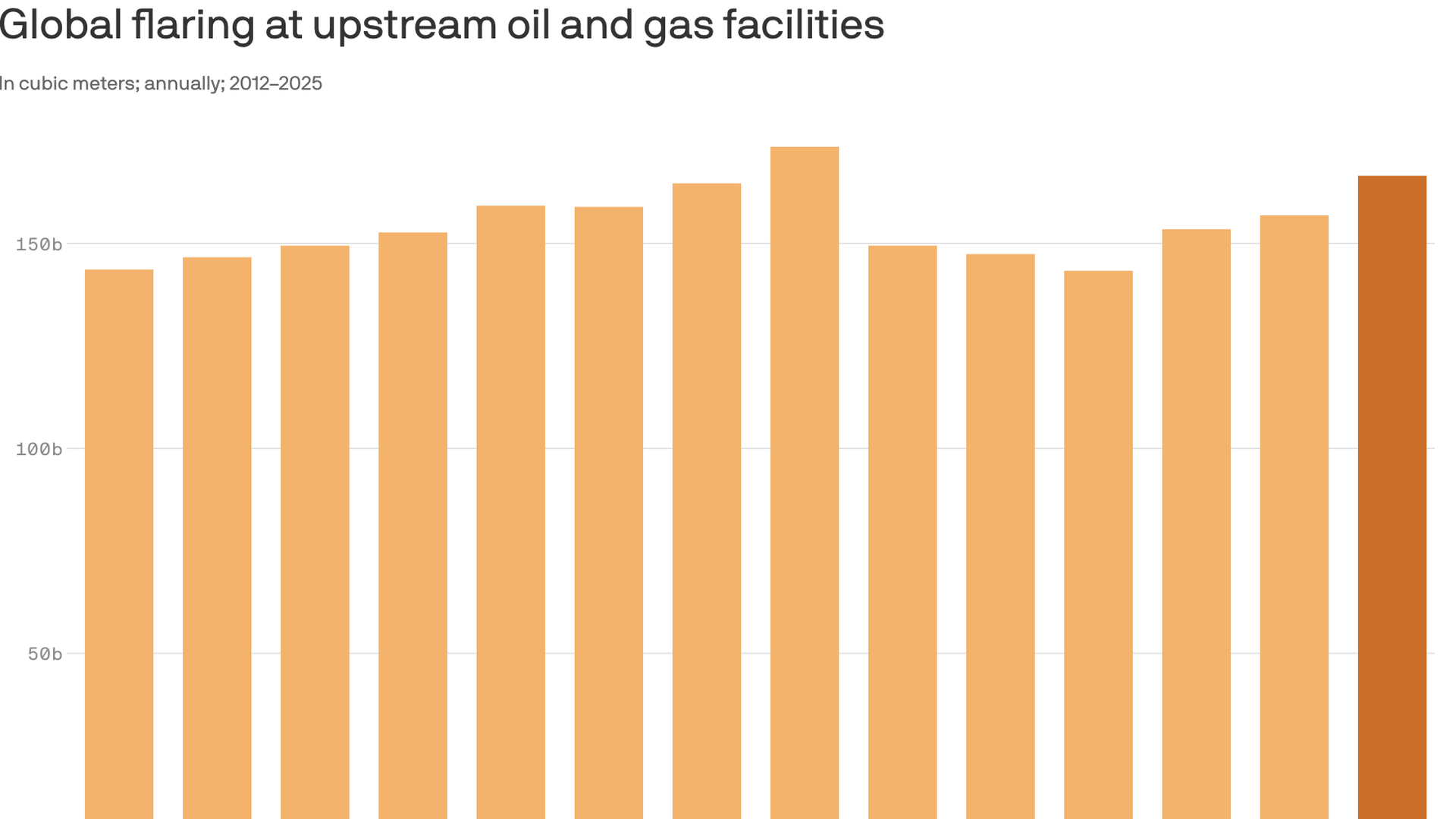
The amount of natural gas burned at oil and gas production sites jumped 6% last year to its highest level since 2019, new World Bank data shows.
Why it matters: This flaring is a big source of planet-warming emissions, releasing CO2 and methane.
- Much of the gas could be cost-effectively captured and used for energy rather than wasted, per World Bank and International Energy Agency analysts.
Stunning stats: "Flaring volumes in 2025 were larger than LNG exports via the Strait of Hormuz, and matched Africa's annual gas consumption," the report states.
- It's worth an estimated $54 billion, roughly three quarters of the estimated cost of ending routine flaring entirely, it states.
The big picture: Russia, Iran, Iraq, Venezuela, Mexico, Libya, Algeria, Nigeria, and the U.S. produce nearly half of the world's oil but account for about 80% of global flaring, according to the World Bank.
State of play: Despite the global rise, there are "reasons for measured encouragement," the bank finds — like the U.S. cutting both flaring and the amount per unit of energy production.
What we're watching: The bank, working with the Colorado School of Mines, has improved its global satellite tracking, which the report says can help countries cut down on flaring.
3. 👟 Catch up quick: Data centers, gas, minerals, EVs
💬 UN Secretary-General António Guterres today pressed AI companies to better disclose land and water use and commit to powering every data center with renewables by 2030.
- What we're watching: His call for an "AI environmental transparency initiative," in a speech at London Climate Week, could signal that AI will have a higher profile at the annual UN climate summit later this year.
📣 Speaking of the UN, Guterres also issued a "call to action" on methane, dropping a new report on "priority actions."
⚔️ Via the FT, "The Trump administration and Qatar have warned the EU that it faces a gas supply crunch that would force up prices unless Brussels rewrites planned rules on methane emissions."
⛏️ Vacuumschmelze, a Germany-based rare earth magnet producer with a South Carolina plant, is getting Hoovered up by the U.S. critical minerals firm Energy Fuels, the companies said this morning.
- Why it matters: It's the latest move in efforts to ease China's grip on the rare earth sector. The $1.9 billion cash-and-stock deal helps the Pentagon-backed Energy Fuels create what it calls a "fully integrated mine-to-magnet rare earth platform."
😬 Lucid Motors, the luxury U.S. EV startup, disclosed that it's laying off 18% of its workforce — the second round of layoffs this year — and ending the second shift at its Arizona factory.
- Why it matters: Money. Going from buzzy startup to commercial-scale automaker is an expensive and fraught journey — even for a player like Lucid with well-received models. CNBC has more.
4. 🚗 Mapped: State EV policies from strong to weak
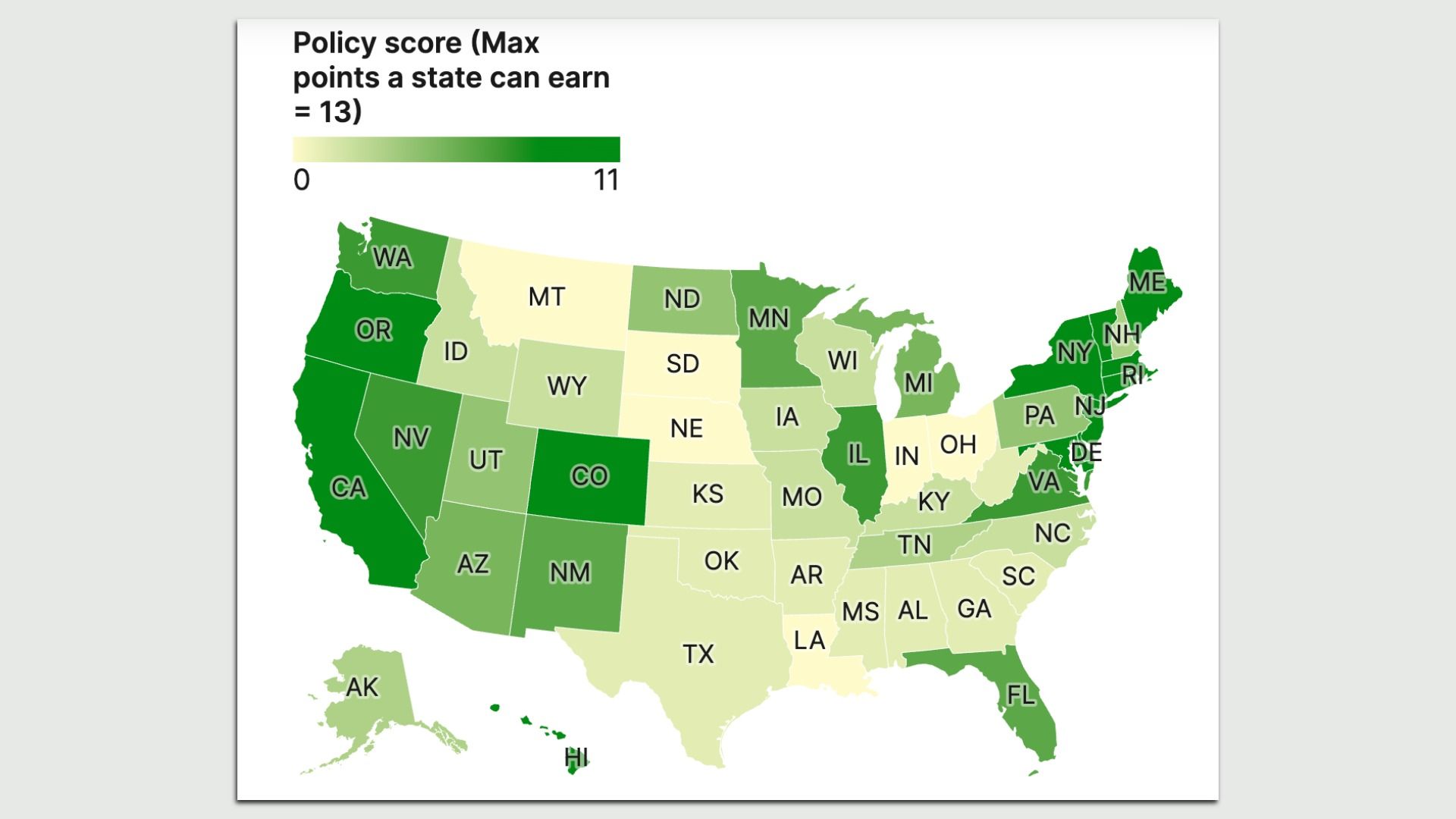
The strengths of state-level policies that promote electric vehicles vary widely, a new Brookings Institution analysis finds.
Why it matters: States are where the action is now that federal subsidies and pro-EV rules are kaput under Trump 2.0.
State of play: The analysis starts with five policy buckets: incentives, environmental standards, charging, market access, and government procurement.
- It subdivides them to gauge whether 13 separate types of policies are present to give each state a score of 0-13.
The bottom line: California and Massachusetts score highest at 11 each, followed by eight states with scores of 10, with the Northeast heavily represented.
- Indiana, Ohio, Nebraska, Montana, Louisiana, and South Dakota all got zero points.
5. 🌊 One tech thing: Wind-powered ocean shipping advances

DHL and wind-powered marine startup Vela are teaming up to bring cargoes between Europe and North America beginning as soon as early 2027.
Why it matters: Petroleum-powered ocean freight is a big source of CO2 emissions.
The big picture: Vela's shipping vessels are "tailored to the pharmaceutical, high value & luxury goods, cosmetics, aerospace, and wine & spirits industries," the announcement states.
- DHL is booking space on the boats along with other companies, it states.
- The three-hulled, 220-foot boats can carry 415 metric tons of goods and have five times the cargo space of planes, but are far smaller than traditional marine shipping vessels, per the WSJ.
🙏 Thanks to David Nather, Mackenzie Weinger and Chris Speckhard for editing and to our brilliant Axios visuals team.
📫 Did a friend send you this newsletter? Welcome, please sign up.
Sign up for Axios Future of Energy