Axios Future of Energy

July 21, 2026

🤷♂️ Lots of smart analysts are doing yeoman's work to figure out how much power AI will suck up and when, but it's tough sledding. We explore fresh analysis and then move on to...
- The latest on a busy stretch in oil and gas, the state of air conditioning as El Niño strikes again, and more, all in 1,065 words, 4 minutes.
🙏 Thanks to Mackenzie Weinger, David Nather and Chris Speckhard for editing and to our brilliant Axios visuals team.
🎧 This week in 1993, Cypress Hill dropped their sophomore album "Black Sunday," which cuts through the haze with today's intro tune...
1 big thing: The wild west of estimating data center power demand

Data centers are projected to consume about 12% of U.S. power in 2030, per new analysis by the research firm BloombergNEF.
Why it matters: It highlights a problem looming over policymakers and utilities: While everyone knows the direction of AI energy demand (up, probably a lot!), the scope is really tricky to pin down and plan around.
Driving the news: BNEF's "base case" now sees data centers' electricity demand soaring to 117 gigawatts by 2030 and 194 GW by 2035.
Stunning stats: Its 2030 estimate is a whopping 52% higher than the firm's prior outlook from just last December. The 2035 outlook is 83% higher.
- This captures all data centers, but the ones used for training and querying AI models are the main growth area.
- This reflects the "rapidly ballooning project pipeline," the report states.
Yes, but: The firm notes variables pulling development timelines in opposite directions.
- Developers are trying to avoid long waits for grid interconnections by installing onsite gas-fired generation.
- But "NIMBYism" is a growing challenge for developers, prompting a wave of project cancellations.
State of play: The report tracks down how a range of competing wonks see the world, like McKinsey, the Electric Power Research Institute, the International Energy Agency, and others.
- Forecasts have generally been increasing across the board, but the difference among them is often gigantic.
- And that's understandable, with respected analysts all trying to understand a fast-evolving landscape.
"There is now a spread of over 100GW between the lowest and highest forecasts, underlining the level of uncertainty around how much capacity will get built," it states.
- BNEF's report also includes a second scenario showing much more growth based on projected increases in chip supply.
- That means that while energy and data center siting is a check on AI growth, BNEF doesn't see chip supply being a bottleneck.
What we're watching: There's a flurry of federal, state, and local action on data centers.
- The House Energy and Commerce Committee is slated to advance a bipartisan bill this week that would push state regulators to consider policies that ensure data center developers cover new generation and grid upgrade costs.
- And tomorrow morning, all five FERC commissioners will appear before the Senate's energy committee, and data centers will be front and center.
2. 🍰 Bonus: Where the data centers are going
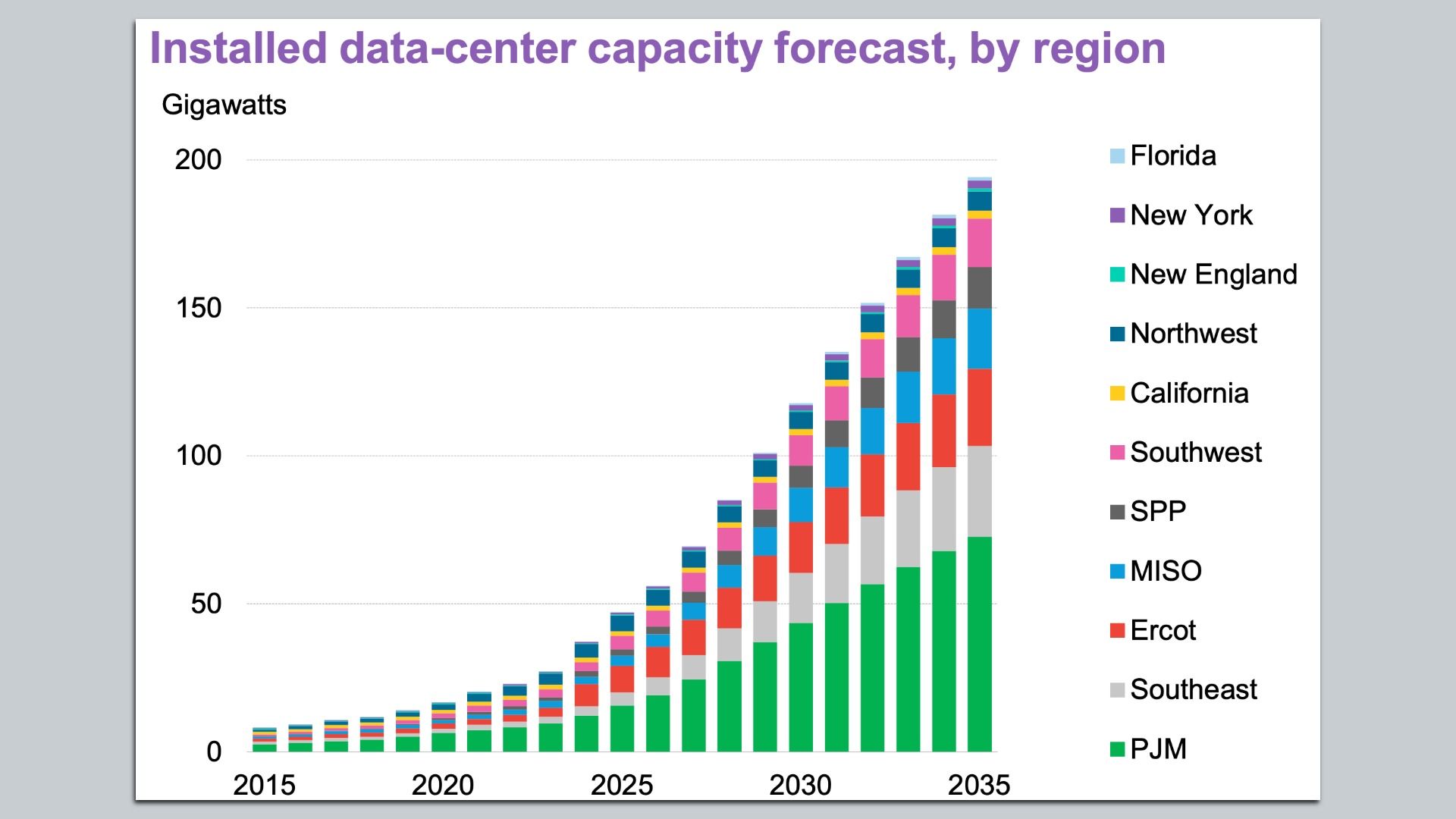
BloombergNEF projects that data centers will account for 20% of U.S. power consumption by 2035.
- But it's quite concentrated in some regions including Texas (ERCOT) and PJM, the nation's largest grid region that covers the mid-Atlantic and parts of the Midwest.
3. 🏃 Catch up quick on oil and gas: Threats, deals and rules

➡️ ADNOC, the United Arab Emirates' state-owned oil and gas giant, announced a $6.2 billion decision to develop an offshore find called the Umm Shaif Gas Cap.
- Why it matters: The project — with partners TotalEnergies, Eni and China National Petroleum Corporation — will help feed the UAE's expanding LNG exports.
- Zoom out: The company cited expanding global gas demand and the need to power AI in today's rollout of the decision.
💵 Crude oil prices rose back above $90 per barrel, a move that comes after Yemen's Iran-backed Houthis threatened a "blockade" of Saudi Arabia, which uses the Bab el-Mandeb Strait off Yemen as an oil export route.
- The latest: Brent crude is trading at $90.74, nearly matching the spike above $91 when markets opened Sunday, as traders respond to the Houthi threat and continued hostilities in the Strait of Hormuz. Go deeper on the Houthis via the Atlantic Council's Allison Minor.
🤝 Magnolia Oil & Gas Corp. is acquiring WildFire Energy for $4.06 billion including debt, expanding its shale footprint in South Texas.
- Why it matters: "A wave of private equity asset offerings that hit the market in the wake of higher crude has resulted in its first marquee sale," Enverus Intelligence Research's Andrew Dittmar said in a note.
🇪🇺 The European Commission is recommending that members suspend penalties under its methane emissions standards for oil and gas imports.
- Why it matters: The Trump administration, alongside some other major gas exporters and companies, has been pressuring EU officials to back off the rules, warning they jeopardize supply.
- Yes, but: The changes, which also include more flexibility in how the rules are implemented, are unlikely to satisfy Trump officials and other critics who call the standards unworkable.
4. 🌡️ Charted: Air conditioning by region


Around 40% of the world's population now has access to air conditioning, the International Energy Agency reports, but distribution is highly uneven — and needs are growing as Earth warms.
Why it matters: It's nowhere near what's needed. More than 80% "experiences cooling needs during at least part of the year," the new analysis finds.
- Yet rising energy demand for air conditioning can strain grids as adoption grows (a good thing) and global warming marches on (not so good).
- Electricity demand for space cooling climbed 50% from 2015-2025, and accounted for 14% of total power demand growth.
The big picture: IEA's commentary notes that efficiency of air conditioning is rising, but there's more to be done.
- And other measures can help ease strains, like building designs and codes that keep indoor spaces cooler, and steps to mitigate "urban heat islands," like greener spaces.
- Some hot places like Dubai are implementing "district cooling," systems that "can relocate exhaust heat to a centralised cooling plant outside densely populated areas."
What we're watching: The onset of the El Niño weather pattern, which adds even more upward pressure on temperatures, could sharply increase cooling needs this year and next.
5. ♣️ Quote of the day: Oily casino edition
"The biggest danger of the 24/7 revolution is the trend toward turning oil trading into a casino-style endeavor focused on retail investors, rather than on the needs of commercial users and institutional investors, who have traditionally shouldered the price-discovery process."— Bloomberg commodities columnist Javier Blas, arguing the rise of round-the-clock trading platforms can't be stopped, so will require strong oversight
📫 Did a friend send you this newsletter? Welcome, please sign up.
Sign up for Axios Future of Energy