Axios Future of Energy

November 10, 2025


🥞 Good morning! Let's dive right in with a newsy 1,363 words, 5 minutes.
🇺🇸 We're off tomorrow in honor of Veterans Day. See you Wednesday!
📣 Utah-based readers: Join Amy on Thursday at 8:30am MT for an event in Salt Lake City on Utah's energy future, featuring Sen. John Curtis and other news-making guests. RSVP here.
🎶 Happy birthday to Warren Griffin III, better known as Warren G, who's surely talking about EPA rules on today's intro tune...
1 big thing: Exclusive — Carbon Direct acquires Pachama in major climate deal

Carbon Direct, which provides a suite of data-driven climate management services to companies, is acquiring Pachama, a major player in the nature-based carbon credits market.
Why it matters: Demand for credits from rainforest preservation and other projects is rising, driven partly by tech giants trying to juggle climate goals with the data center boom.
- Also rising: buyers' interest in ensuring voluntary market credits actually offset or suck up CO2 and don't just suck.
- It's a need both Carbon Direct — whose clients include corporate giants like Microsoft and JPMorganChase — and Pachama help the market meet.
Driving the news: "The acquisition augments Carbon Direct's world-class scientific expertise and advisory services with Pachama's proprietary technology and ground-breaking digital platform for forest carbon project monitoring, reporting, and verification," the companies said.
- Terms of the deal weren't disclosed.
State of play: The deal lands amid flux in carbon markets and corporate sustainability efforts more broadly.
- On the voluntary market side — a focus for both companies — tech giants, airlines, banks and others are looking for projects to help meet their decarbonization goals.
- "What we're seeing on the ground is consistent and, frankly, increased work in and around decarbonization, particularly because of the growth in the power sector and the size and scale of the companies that are driving it," Carbon Direct CEO Jonathan Goldberg tells Axios.
- The New York-based company founded in 2019 has long worked in North America and Europe, and recently expanded into South America and Japan.
Friction point: In recent years, multiple studies and investigations have found that voluntary market projects achieve far less than advertised.
- It's a problem the companies and now the new deal can address by helping buyers vet and obtain high-quality credits, according to Carbon Direct.
- Regulated markets are also poised to grow. One focus at COP30 is implementing the Article 6 carbon market rules under the Paris Agreement.
- The EU's aggressive long-term emissions goals also envision a growing role for international credit markets.
The intrigue: Goldberg tells me that over time, the voluntary and regulated markets will "speak to each other a little bit more."
- "The technology that we're acquiring from Pachama, the technical tools that our team has to evaluate credits are extremely relevant, both in that regulatory setting and also in the voluntary setting," he said.
What we're watching: The credit market is global, but the Amazon is a focus — especially as Brazil hosts COP30.
- "There's a large number of high-quality suppliers in Brazil that are going to benefit from the technology that we can bring to bear, because we'll be able to better understand, better monitor, better follow these projects that are coming online," Goldberg said.
The bottom line: The deal is an "accelerant" to Carbon Direct's services, Goldberg said, expanding the "digital and technical infrastructure" for carbon management, removal, and measurement.
2. ➡️ The politics soaking an underwater pipeline approval
Bookmark this one because you'll hear about it again: New York Gov. Kathy Hochul's (D) regulators on Friday approved permits for a contested natural gas pipeline under New York Harbor.
Why it matters: Williams Companies' Northeast Supply Enhancement (NESE) project has been the stuff of lawsuits and political battles over gas — and how Democrats approach the fuel.
Catch up quick: "As governor, a top priority is making sure the lights and heat stay on for all New Yorkers as we face potential energy shortages downstate as soon as next summer," Hochul said in a statement.
- New Jersey regulators also signed off Friday on the project, first proposed in 2017, that runs from Pennsylvania to New York.
Friction point: GOP Rep. Elise Stefanik, who is running for New York governor, called Hochul a "hypocrite."
- "She just approved a pipeline in New York after years of blocking its construction and denying New Yorkers the cheap, clean, reliable energy they deserve," Stefanik said in a statement.
- But Hochul also faces pressure from the left over the pipeline that a number of NY Democratic lawmakers also oppose. Environmental groups condemned the NY and NJ permits.
Driving the news: "We need to govern in reality," Hochul said, adding that Washington Republicans are waging "war against clean energy."
- That's "why we have adopted an all-of-the-above approach that includes a continued commitment to renewables and nuclear power to ensure grid reliability and affordability," she said.
The intrigue: Last spring, Trump officials said Hochul endorsed new pipeline capacity in exchange for federal regulators allowing a big offshore wind project to resume construction.
- Hochul and her team have repeatedly denied any deal.
Yes, but: The White House took credit for the pipeline in a statement to Axios last night.
- "As promised, President Trump is unleashing American energy dominance across the country — even in Blue states like New York — because he is a President for all Americans," spokeswoman Taylor Rogers said.
- It will "keep the lights on, create jobs, and keep New Yorkers warm," she said.
What we're watching: A separate Williams proposal, the Constitution pipeline, which Hochul's regulators have refused to approve thus far.
- The company said Friday it plans to continue pursuing the pipeline.
3. 🧁 Bonus: The shifting energy on pipelines
Approval of the NESE pipeline might foreshadow a broader shift in battles over gas infrastructure in the northeast, Jefferies analysts said in a research note this morning.
The big picture: "Across the energy and utility space, stakeholder focus continues to shift from ESG to customer affordability," it states.
- Still, the analysts add that they need to see more progress on permitting in the region "before we label it a structural shift as opposed to a 'one-off.'"
- And environmental groups will keep fighting, too. The Natural Resources Defense Council said Friday that if built, the NESE project would "destroy marine habitats" and dredge up toxins.
What we're watching: The Constitution proposal.
- "We struggle to see President Trump abandoning his interest in this project as a political wedge issue," TD Cowen analysts said in a note today.
4. 🏃 Catch up quick on COP30

COP30 in the Amazonian city of Belém, Brazil formally opens later this morning. A few tidbits ahead of the action...
🗣️ Negotiators were still haggling last night over the formal agenda that Brazilian hosts will look to get approved this morning, per the Energy & Climate Intelligence Unit, a U.K. think tank.
- "The job of the presidency — who must achieve unanimity on the agenda — is to deal with [the agenda items] without creating umpteen more COPs-worth of work for this COP," it said in a morning dispatch from Belém.
😬The conference will open amid massive hurdles and competing priorities, as several curtain-raisers note.
- Emissions keep rising, the U.S. isn't taking part, and finance remains well below what developing countries call needed for adaptation, to name just a few.
- "Rich countries have lost enthusiasm for combating the climate crisis while China is surging ahead in producing and using clean energy equipment, the president of the UN climate talks has said," the Guardian reports, referring to Brazil's André Corrêa do Lago.
5. 🛢️Charted: The shale oil and gas hamster wheel
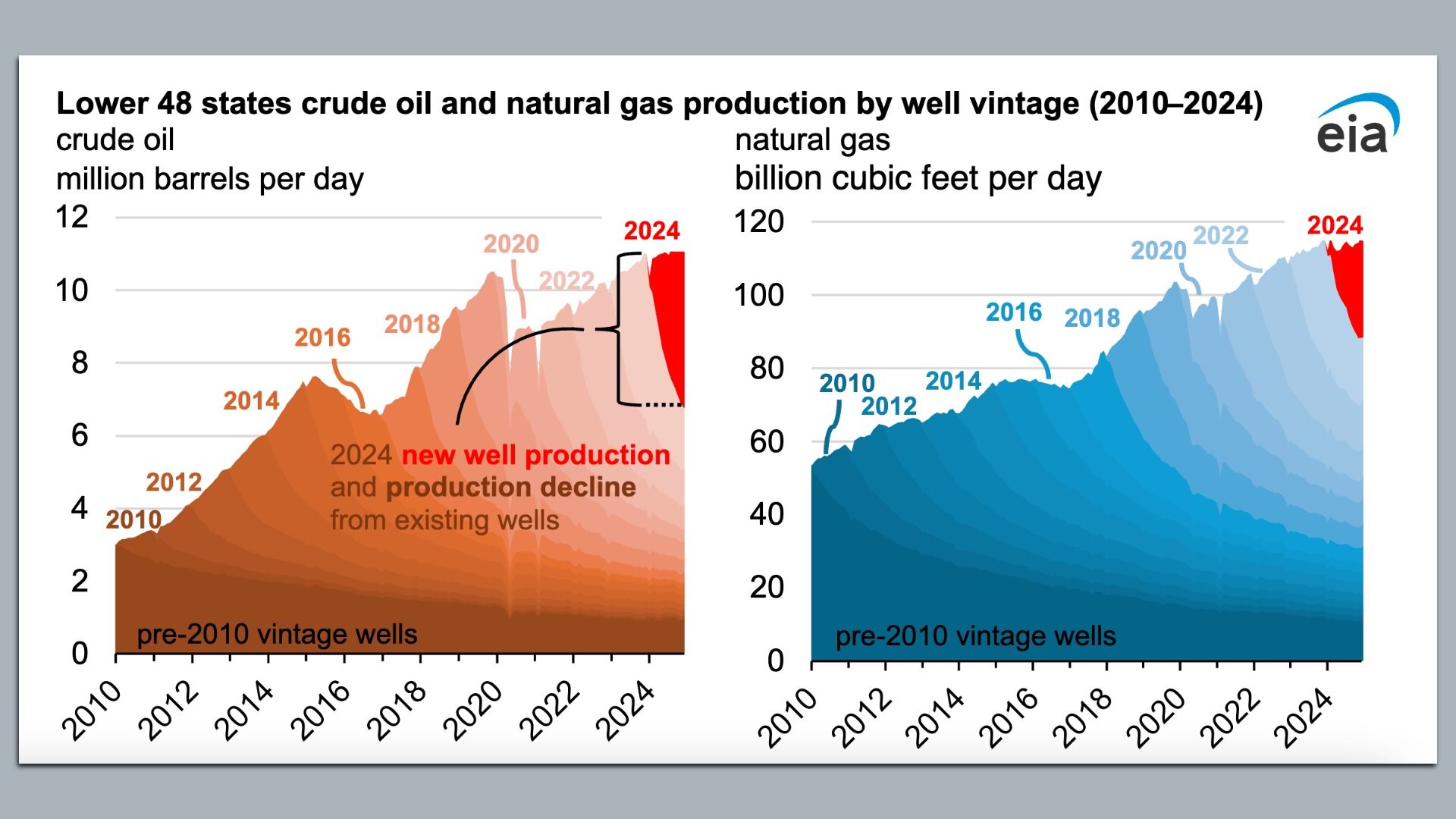
This chart helps explain why so much new drilling is needed to keep boosting U.S. shale output.
- Shale wells, especially the horizontal ones, have steep decline rates after high initial production.
- Full EIA primer
6. 🧮 Number of the day: $800 million
That's the rough amount of a potential deal for NextEra Energy to acquire Symmetry Energy Solutions, Bloomberg reports.
- Why it matters: It would expand renewables heavyweight NextEra's natural gas assets as the AI boom adds demand for the fuel, the story notes.
7. 🧠 Quote of the day: Climate and psychology edition
"We are particularly biased when the science or information threatens our beliefs or our identity, our social identity, our religious identity, even our political identity."— John Cook, senior researcher fellow at the University of Melbourne, on climate misinformation on the latest episode of the "Shocked" podcast
🙏 Thanks to Chuck McCutcheon and Chris Speckhard for edits to today's edition, along with the brilliant Axios Visuals team.
📬 Did a friend send you this newsletter? Welcome, please sign up.
Sign up for Axios Future of Energy