Axios Future of Energy

August 14, 2026


👋 Happy Friday! Willie Nelson fought pipelines and fracking, and now he's taking on data centers. Plus...
- Greenland drilling delays, a massive oil spill, your weekend hot reads and more, all in 1,027 words, 4 minutes.
🙏 Thanks to Mackenzie Weinger, David Nather and Chris Speckhard for editing and to our brilliant Axios visuals team.
📞 This week in 2012, Carly Rae Jepsen was wrapping up a nine-week run atop the charts with today's iconic intro tune...
1 big thing: Data center backlash echoes fossil fuel politics
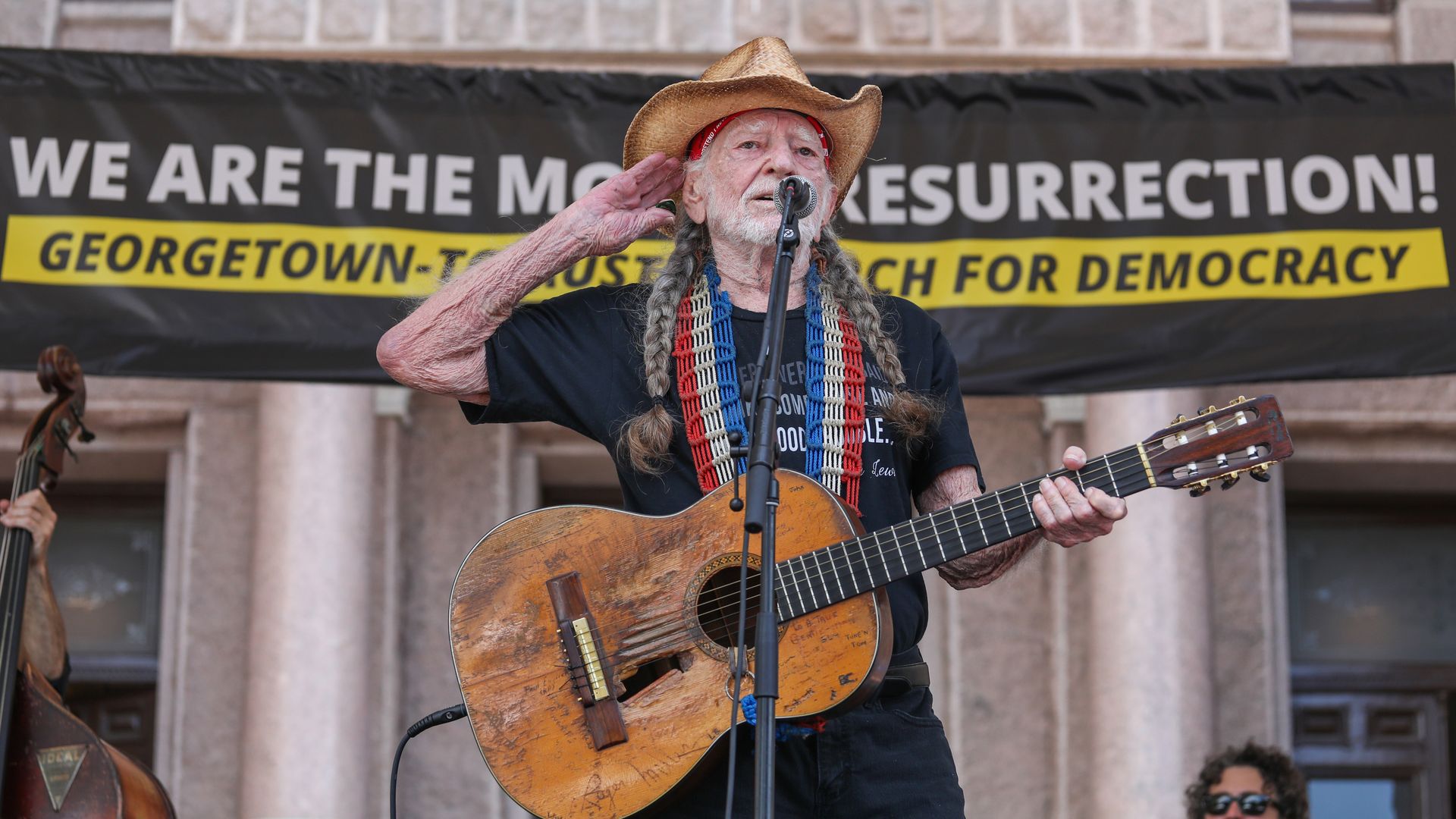
Willie Nelson has become an unlikely barometer of America's biggest infrastructure fights. He once protested the Keystone XL pipeline and fracking. Today, he's fighting data centers.
Why it matters: The American icon's latest cause underscores how the politics surrounding AI infrastructure are beginning to resemble the last decade's fights over fossil fuels.
"The last thing we need is a loud, water thieving, light polluting, data center anywhere near our town (or any others for that matter)," Nelson told his more than one million Instagram followers recently.
"We always listen to our Yoda," joked Nebraskan activist Jane Kleeb, referring to Nelson.
- A leader of Nebraska's fight against the now-canceled Keystone XL pipeline, today Kleeb is active in the largely decentralized opposition to AI infrastructure.
The big picture: Data centers represent one of the fastest-growing, most bipartisan infrastructure backlashes in years.
How it works: The parallels between the fossil fuel sector and data centers are striking.
- Tech companies have been touting how essential data centers are to our lives, which echoes how fossil fuel companies remind us we use oil and natural gas to move around.
- Kleeb says many developers approach communities with a "tech bro" mentality that leaves residents feeling unheard.
What they're saying: "You don't get your social license to operate by telling everybody how they're going to do better economically," said Kevin Book, managing director at the nonpartisan research firm ClearView Energy Partners, whose clients include institutional investors and corporate leaders.
- "You get it by listening to their concerns and helping them process emotions."
Friction point: Tech companies often say a few unnamed "bad actors" give everyone a bad reputation on data centers.
- "Pipeline companies used to say this, too," Kleeb said. "If that's true, name them and put out a set of policy suggestions that you believe are the proper guardrails around data centers."
The other side: That might be in the works, according to Dan Diorio, executive vice president of state policy and government affairs for the Data Center Coalition.
- "We are in the process of honing in on how to better demonstrate our commitments to these principles for responsible development," Diorio told Axios.
- Those include open dialogues with communities, paying their fair share of power costs and efficiently using water, he added.
- "One of the things that is very clear from the industry perspective is that we're catching up," said Diorio, whose group represents roughly 50 companies across the value chain of AI.
What we're watching: More state lawmakers are likely to consider imposing rules on power and water, along with repealing tax credits, said Timothy Fox, an analyst who works with Book at ClearView Energy Partners.
Zoom out: That's what happened with fossil fuels. States responded with stricter fracking regulations and, in some cases, higher taxes rather than shutting the industry down, Book said. Even after Keystone XL was canceled, most fossil fuel development continued.
The bottom line: The fossil fuel industry had years to respond to growing local opposition. The AI industry may have only a matter of months.
2. 🏃 Catch up quick on energy moves from Greenland to Texas

🇬🇱 A President Trump-linked U.S. oil company has delayed plans to drill in Greenland until winter 2027, CNBC reports, after Greenlandic authorities said the necessary regulatory approvals could not be completed in time.
- The delay for Greenland Energy and its joint venture partner 80 Mile comes amid Trump's renewed push for the U.S. to acquire Greenland.
🛢️ An oil spill that could eventually rival the 1989 Exxon Valdez disaster in size has started to hit Oman's coastline, Reuters reports.
- "The tanker first reported difficulties off Yemen on June 8 after what maritime sources said appeared to be a blast," per the newswire. "No party has claimed an attack, but the vessel was navigating two separate wars on its journey from Russia to India."
🌿 Scoop: The Washington state governor's office delayed climate data correction, our Axios Seattle colleague Melissa Santos reports.
☢️ X-energy is getting up to $1 billion in federal funding for a Texas project, Reuters reports.
3. 👓 Hot Reads: PJM, offshore wind and climate accounting

PJM eyes data center, crypto reliability requirements after 3.8 GW of load trips offline (Utility Dive)
Amy says: Instead of "tl,dr" this might be "tc,dr" = too complicated, didn't read. But this is important stuff!
- My translation: Data centers are, to quote one expert, "too sensitive," and need to be more flexible with the kind of power they can accept. Aww, good advice for us all.
Who Killed Offshore Wind? (Energy Institute at Haas, University of California, Berkeley)
Amy says: This is worth the read about how the Trump administration may well have overpaid to nix offshore wind leases.
Space X, OpenAI, Anthropic quiet on emissions in post-ESG era (Bloomberg)
Amy says: This will be interesting to see these massive startups try to respond to — or delay — forthcoming disclosure regulations in California. Maybe it'll be a jobs boon for climate accounting professionals!
4. 💰Number of the day: $133 million
That's the amount of the inaugural venture capital fund supported by the All Aboard coalition, which was unveiled yesterday.
Why it matters: The coalition is a group of highly influential climate tech investors, whose exclusive gathering we wrote about last fall.
Yes, but: The amount is less than half the initial target, which was $300 million.
Catch up quick: The idea of the coalition is to create a snowball effect: Once multiple coalition investors independently back a company, the fund adds capital to help promising climate technologies reach commercial scale.
For the record: "We view the $133 million Fund I as a successful first fund raised in an intentionally short period," said Stan Miranda, co-founder of All Aboard. He added that the window was mostly just October to January, "appropriately sized to demonstrate the All Aboard model."
📫 Did a friend send you this newsletter? Welcome, please sign up.
Sign up for Axios Future of Energy