Axios Future of Energy
October 27, 2025

🪇 DOE shook up the data center policy landscape, and there's also lots of news on oil, mining, climate and more, all in 1,263 words, 4.5 minutes.
👀 Eyes peeled: We've learned that DOE boss Chris Wright will make an announcement this afternoon with CEOs of computing heavyweights AMD and HPE.
- And more AI announcements from DOE are coming later in the week.
📻 Exactly five years ago, 24kGoldn was No. 1 on Billboard's Hot 100 with today's oh-so-catchy intro tune...
1 big thing: What to watch in DOE's new data center move

Let's gauge early fallout from DOE boss Chris Wright pushing FERC to quickly craft formal rules that speed data centers' connection to power grids.
Why it matters: It's Trump officials' most direct move yet to smooth the bureaucratic path for AI data centers — and power sources serving them — to come online.
🏃 Catch up quick: Wright, in a letter released Friday, urged FERC to assert jurisdiction over "large loads" that link directly to interstate transmission.
- His letter floats policy ideas for considering these new demand sources alongside new generation, as well as assigning network upgrade costs to these loads.
A few early takeaways...
🏅 A take on winners and losers. Overall, the strategy firm Capstone LLC sees the plan as bullish for nuclear plant owners interested in co-location agreements with data centers.
- It's also good news for gas turbine makers and onsite power tech players, it said in a note.
🤸 Flexibility has truly arrived. The proposal urges expedited consideration for projects that are "curtailable and dispatchable." It's new buy-in for the feasibility of data centers, in limited instances, lowering energy needs or moving compute function between facilities.
- "One of the reasons large load flexibility appears to have broad appeal is that it can be served by, and coordinated with, everything from battery storage and natural gas to biofuels, geothermal, and advanced computational resource management," power analyst Tyler Norris, who analyzes data center flexibility, tells me via email.
- But hyperscalers will be on the lookout for anything they find too prescriptive (this is playing out in PJM).
🤝Wright's pitch seems to have wide initial buy-in, at least for now, making it a rarity in a polarized time.
- "There is broad bipartisan support for FERC taking action soon on these issues," David Rosner, a Democratic FERC commissioner, posted on X.
- Allison Clements, a former Democratic FERC member, posted that it could be "game changing."
🗓️ But it's early days. Wright's letter offers only high-level principles, so the devil will be in the details.
- "Given that many of our industry sources appeared surprised by the DOE's October 23 letter, it is far from clear how asset owners, state policymakers, and customers will respond," ClearView Energy Partners said in a note.
⚖️ Battles could loom. Analysts see legal fights, even though Wright's letter argues at length that the plan doesn't trample on state jurisdiction over generation and retail prices.
👀 Watch the big, powerful utilities. Capstone predicts for-profit utilities will fight "any rules to allow large loads to self-fund or build interconnection-related network upgrades."
- That's because it could prevent inclusion of this infrastructure in their rate base.
- The Edison Electric Institute, the main trade group of for-profit utilities, issued a statement praising White House energy and AI goals. But it avoided comment on the specifics.
⏱️ Watch the clock, too. Wright asked FERC to complete a final rule by April 30, 2026. That would be blazing speed.
2. 🏃 Catch up quick: Oil and gas, mining, EU

⚖️ Exxon sued California officials over state laws that require many companies to disclose emissions and reports on climate-related business risks.
- Why it matters: State-level climate policies are increasingly in focus as the Trump administration avoids federal mandates.
- State of play: The complaint in a U.S. district court says Exxon already makes such info public, but that the laws compel it to "trumpet California's preferred message even though ExxonMobil believes the speech is misleading and misguided."
- The other side: It is "truly shocking that one of the biggest polluters on the planet would be opposed to transparency," a spokesperson for California Gov. Gavin Newsom sarcastically told multiple outlets.
💵 Breaking today: Perpetua Resources announced $255 million in equity investments from Agnico Eagle Mines Limited and JPMorganChase.
- Why it matters: The company has begun initial work on an Idaho project to provide domestic supplies of antimony, which has key defense and commercial applications — including batteries.
⛏️The U.S.-China trade "framework" includes China backing off new rare earth export controls, Treasury Secretary Scott Bessent said on the Sunday morning news shows.
- The latest: Shares of U.S. rare earth miners are falling in pre-market trading on the news, CNBC reports.
- What we're watching: President Trump's Thursday meeting with Chinese President Xi Jinping.
🇪🇺 Via Reuters, EU countries are "negotiating proposals to give industries a more flexible path to meeting climate goals."
- Why it matters: The European Commission is pushing for a 90% reduction by 2040, but there are crosscurrents to spare as officials look to balance green ambition and industrial competitiveness.
3. 🍂 First freeze is coming later as fall warms

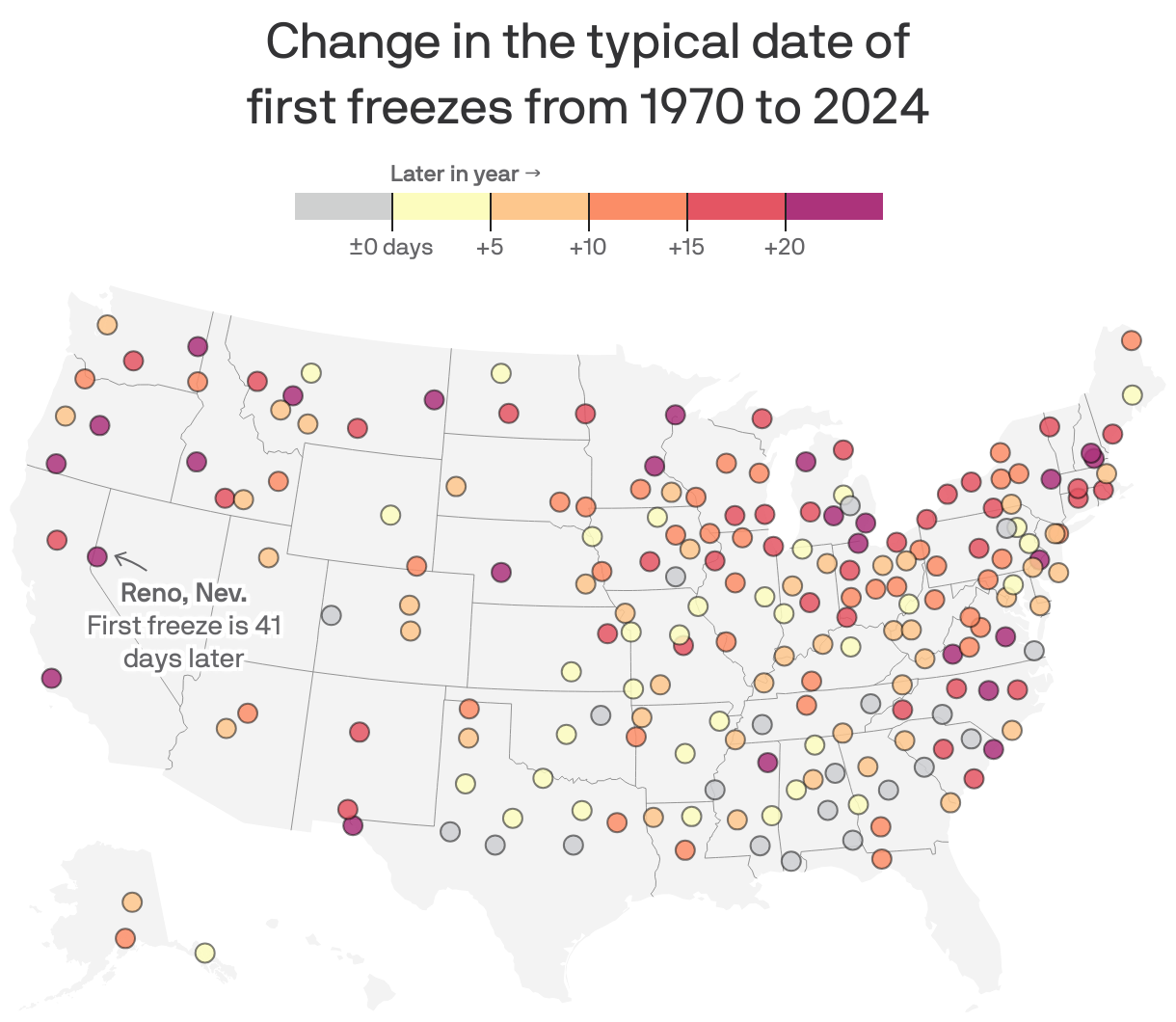
The first freezing temperatures after summer are coming later on the calendar than they used to in many U.S. cities, new analysis finds.
Why it matters: It's another indication of fall warming amid climate change, and affects farmers, gardeners and allergy sufferers.
Driving the news: Compared to 1970, first freeze is arriving later in nearly 90% of the 204 U.S. cities analyzed in a new report from Climate Central, a climate research group.
- Among those cities, first freeze is happening 12 days later on average.
- The group defines "first freeze" as the first date from Aug. 1 onwards with low temperatures at or below 32°F.
Caveat: "First freeze" is different from "first frost," which can happen with slightly higher temperatures — and damage frost-intolerant crops.
Zoom in: Reno, Nev. (41 days later); Bend, Ore. (38 days) and Santa Maria, Calif. (35 days) have seen the biggest first freeze delays.
- Some cities are experiencing an earlier first freeze, including Dothan, Ala. (16 days earlier compared to 1970); Waco, Texas (11 days earlier) and Charlotte, N.C. (10 days earlier).
How it works: Climate Central's analysis is based on NOAA weather station data.
- The group excluded locations without traditional freezing seasons.
4. 👓 Hot reads: Sea levels, climate evolutions (or not), rare earths, power prices

Water Rising ("Shocked" podcast)
Amy's take: A reminder of news you can use: sea level rise = flooding. I learned a lot in recording this podcast (disclaimer: I'm the host), and it helps to dissect how these complicated climate issues play out and affect our lives, especially our homes.
'I'm the Same Me': Canada's Mark Carney Defends His Climate Record (Bloomberg)
Amy's take: I was waiting for this! That headline-making quote is interesting. It raises questions about how people's perspectives can shift — or appear that they have shifted — depending on political and economic contexts.
Rare earth miners are set to come back down to earth (Financial Times)
Ben's take: Louise Lucas' column is worth bookmarking as the U.S. takes equity stakes or otherwise looks to support producers, and valuations soar. Caveat emptor for investors.
Factors Influencing Recent Trends in Retail Electricity Prices in the United States (Lawrence Berkeley National Laboratory and The Brattle Group)
Ben's take: The perfect stocking-stuffer for anyone lulled into thinking there are single or simple answers (demand! renewables! data centers! gas prices!) for why retail electricity prices are increasing.
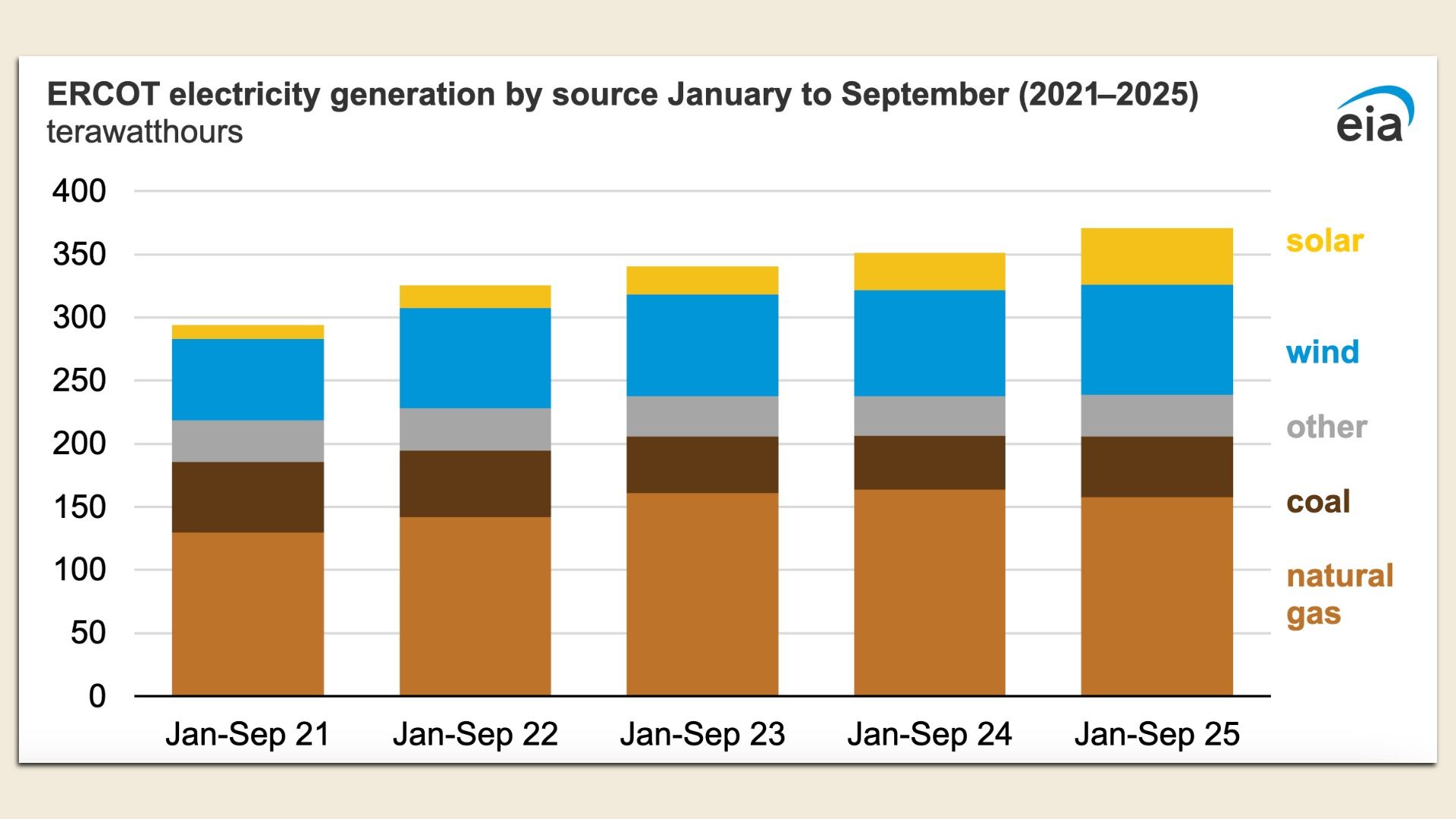
5. 🤠 Number of the day: 36%
That's wind and solar's combined 2025 share of the electricity mix in Texas through September, per U.S. Energy Information Administration data.
Why it matters: The two sources, along with batteries, are "increasingly meeting rising demand" in the nation's largest grid, the EIA primer notes.
📬 Did a friend send you this newsletter? Welcome, please sign up.
🙏 Thanks to Chuck McCutcheon and Chris Speckhard for edits to today's edition, along with the brilliant Axios Visuals team.
Sign up for Axios Future of Energy