Axios Future of Energy

September 30, 2026


☀️ Hi! We're starting with a look at what's next for U.S. renewables, then moving on to...
- A big day for policy, diesel drama, fusion supply chains and more, all in 1,349 words, 5 minutes.
🙏 Thanks to Mackenzie Weinger and Chris Speckhard for editing, and to our brilliant Axios visuals team.
🌧️ On this date in 1985, Tom Waits released the stunning "Rain Dogs," which provides today's intro tune...
1 big thing: Renewables boom faces a Trump-era cliff

America is adding record amounts of clean power despite President Trump's opposition to wind and solar — but the industry's top trade group warns the growth could fall off a "cliff" as soon as 2028.
Why it matters: The disconnect illustrates the long lag between energy policy and what actually gets built, raising the stakes for a bipartisan permitting deal under negotiation now in the Senate.
State of play: Wind and solar development is still benefiting from favorable economics and projects launched before Trump returned to the White House, Jason Grumet, CEO of the American Clean Power Association, told Axios.
- "If the administration continues to block the permitting of clean power, you'll start to see a cliff," said Grumet, who said the drop could become apparent in 2028 or 2029.
Driving the news: Senate negotiators are expected to unveil a bipartisan deal to speed energy permitting as soon as today, though any final vote isn't expected until after the midterm elections.
Friction point: Democrats have sought assurances that the administration would allow stalled wind and solar projects to advance in exchange for supporting broader permitting changes.
- Grumet called the apparent agreement "encouraging," citing its technology-neutral approach and provisions for administration approval of wind projects.
- "Passage before the end of the year is essential," he said.
The latest: A White House official said last night the administration and lawmakers had agreed to a "strong bipartisan" package, but warned that administration commitments "will not remain frozen indefinitely" if the deal doesn't advance quickly.
The big picture: The fight is unfolding as U.S. electricity demand rises rapidly, driven largely by the AI boom. That's a contradiction Grumet sees at the heart of Trump's energy policy.
- "The imperative to repudiate renewables is a greater incentive than the imperative to lower energy costs," he said, calling that "outrageous."
The other side: "The issue the president has with wind and solar is, is it's not going to be the solution for the power needs that we have," said Jarrod Agen, executive director of the White House National Energy Dominance Council, on stage at an Axios event last week.
- He rejected the premise that the administration categorically opposes renewable energy, saying they shouldn't have received preferential subsidies and citing dependence on China for energy equipment. He highlighted nuclear power instead.
Zoom in: Pentagon delays in reviewing onshore wind projects are a key sticking point in the permitting debate.
- "Just rubber-stamping every project to come in is not good," Agen said.
- Grumet countered that legitimate military concerns can be addressed: "These are solvable problems."
What we're watching: Trump issued an executive order in August that could restrict certain electrical equipment with ties to China.
- Depending on how broadly the Energy Department interprets it, Grumet said, "it has the potential to be devastating to the economy."
2. 🗓️ Big today: Permitting, LNG, data centers
📜 Bipartisan Senate negotiators plan to unveil a draft permitting agreement later today, per multiple sources following the talks and published reports.
- Why it matters: Cutting bureaucratic hurdles for energy projects is a top priority for fossil fuels and renewables sectors.
- What we're watching: Votes are not expected until after the midterms, but we'll be watching for early signs of buy-in from influential lawmakers and groups.
💵 Via Bloomberg, President Trump will say today that South Korea has agreed to invest $54 billion in the planned Alaskan natural gas pipeline and LNG export project.
- Why it matters: Let's see what's really on the table! But it could help get the long-planned, uncertain project closer to reality, enabling a market for large gas reserves that have a (relatively) short route to Asian buyers.
🗳️ The Senate may hold a procedural vote today on legislation that tells states to consider new policies that prevent utility ratepayers from bearing data center costs.
- Why it matters: The bill itself is modest but shows the political salience of data centers, especially in some tight races. Sen. Jon Husted (R-Ohio) is the lead sponsor of the Senate version.
- State of play: It passed the House with overwhelming bipartisan support. But Senate Minority Leader Chuck Schumer (D-N.Y.) called it a "toothless messaging bill."
3. 🚛 Diesel fuels Trump's "dominance" dilemma
President Trump's potential diesel export limits would erode America's reputation as a reliable energy supplier, analysts warn.
Why it matters: Record diesel prices ahead of the midterms create a dilemma for the White House.
- Attempts to tame costs now could collide with Trump's "energy dominance" agenda that looks to expand U.S. oil and gas exports.
Catch up quick: Trump officials are weighing some kind of restrictions. But it's fluid. Energy Secretary Chris Wright has floated voluntary limits.
What they're saying: "An export ban would further undermine confidence in the United States as a reliable supplier, making foreign buyers more reluctant to sign long-term contracts and investors more wary of financing U.S. energy projects," Jason Bordoff and Bob McNally write in Foreign Policy.
- On diesel specifically, they note the U.S. is the largest exporter and a ban would "hand China a geopolitical advantage," given its spare refining capacity.
- McNally was in the George W. Bush White House, and Bordoff served in the Obama administration.
Friction point: They're not alone. The consulting firm Rystad Energy says diesel limits could make long-term LNG deals with Europe, and other parts of the export agenda, look shaky.
- "Temporary export restrictions address domestic emergencies over a period of months but put that longer-term relationship potentially at risk," it said in a note.
State of play: "The president always makes the decision that is best for the American people. He wants to see gas prices at the pump fall and is evaluating all the options on the table," a White House official tells Axios.
- The official notes that Trump has called on Europe to "unleash their energy dominance."
The intrigue: The administration is weighing whether to ask European governments to release diesel from their strategic reserves, Politico reports.
Zoom out: While export limits might quickly cut prices in some U.S. markets, it's a sugar high that brings higher costs down the road, analysts say.
What we're watching: The same things you are — how soon policy clarity will emerge.
4. ⚛️ Roll tape: Fusion takes a tangible step

Commonwealth Fusion Systems has an agreement with Fujikura Ltd. to buy over 10,000 kilometers of high-temperature superconducting tape for use in power plants.
Why it matters: It's a key material as the startup seeks to bring grid-scale energy online in the early 2030s, the company said.
- "This tape is a key component of what will make our approach to commercial fusion possible, because it's essential to the powerful magnet CFS manufactures," CFS chief science officer and co-founder Brandon Sorbom told reporters in a briefing.
State of play: The specialized tape enables current to travel through CFS' electromagnets and "confine super-hot plasma" within its fusion machines, the company said.
- Financials of the agreement were not disclosed.
The bottom line: Fusion timelines remain uncertain, but this kind of supply chain agreement is a tangible step toward moving fusion from the dream to reality category.
- "This collaboration underscores how the delivery of fusion power is becoming an industrial effort, not simply a scientific one," Sorbom said.
5. 🍁 One fall thing: When to see peak colors


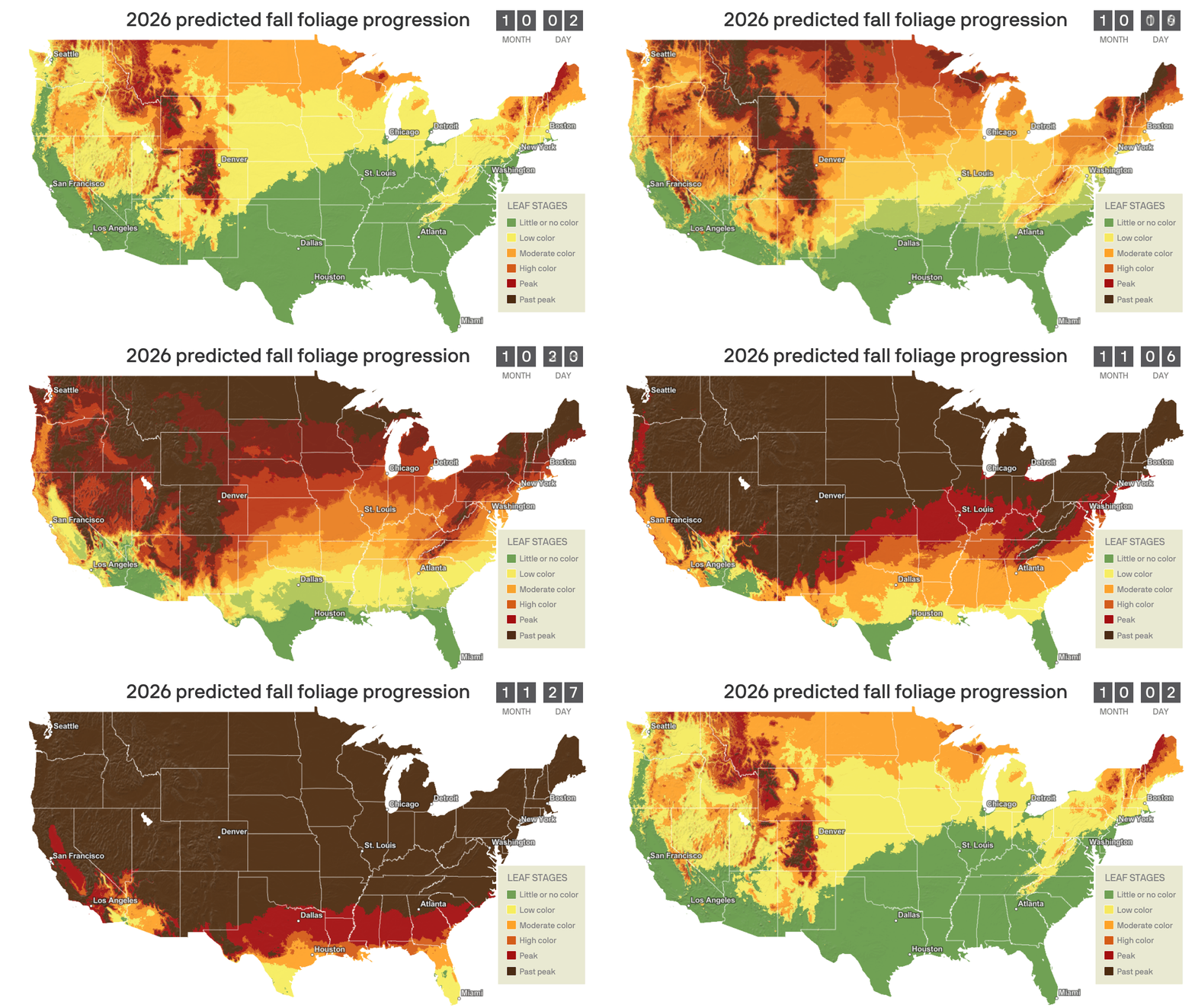
Fall color is expected across most of the country by mid-October, but warmer weather could end up scrambling the timetable.
Why it matters: A strong El Niño could raise temperatures and delay some peak colors, while persistent drought could mute the display. Go deeper
6. 💬 Quote du jour: Bill Gates' climate analogy edition
"If the dialogue ends up being one party is for AI and the other party's against, then we'll have the climate change scenario again, which is not a great place to be. You don't have room for debate when you only have the two extremes."— Bill Gates to the NYT's Ezra Klein
📫 Did a friend send you this newsletter? Welcome, please sign up.
Sign up for Axios Future of Energy