Axios Future of Energy

October 06, 2025

📈 More Chinese tech exports, more OPEC+ oil, more interest in nuclear power... we break it all down and, yes, more, all in 1,347 words, 5 minutes.
📺 Bestselling self-help author and podcaster Mel Robbins explains to Axios CEO Jim VandeHei how people can keep their sanity in a world of chaos. Watch the clip
- Catch the full interview, out tomorrow. Subscribe to our YouTube
🎸 Exactly 40 years ago, Dire Straits were No. 1 on Billboard's album charts with "Brothers in Arms," which provides today's intro tune...
1 big thing: China's electrotech export surge — and the U.S. stakes
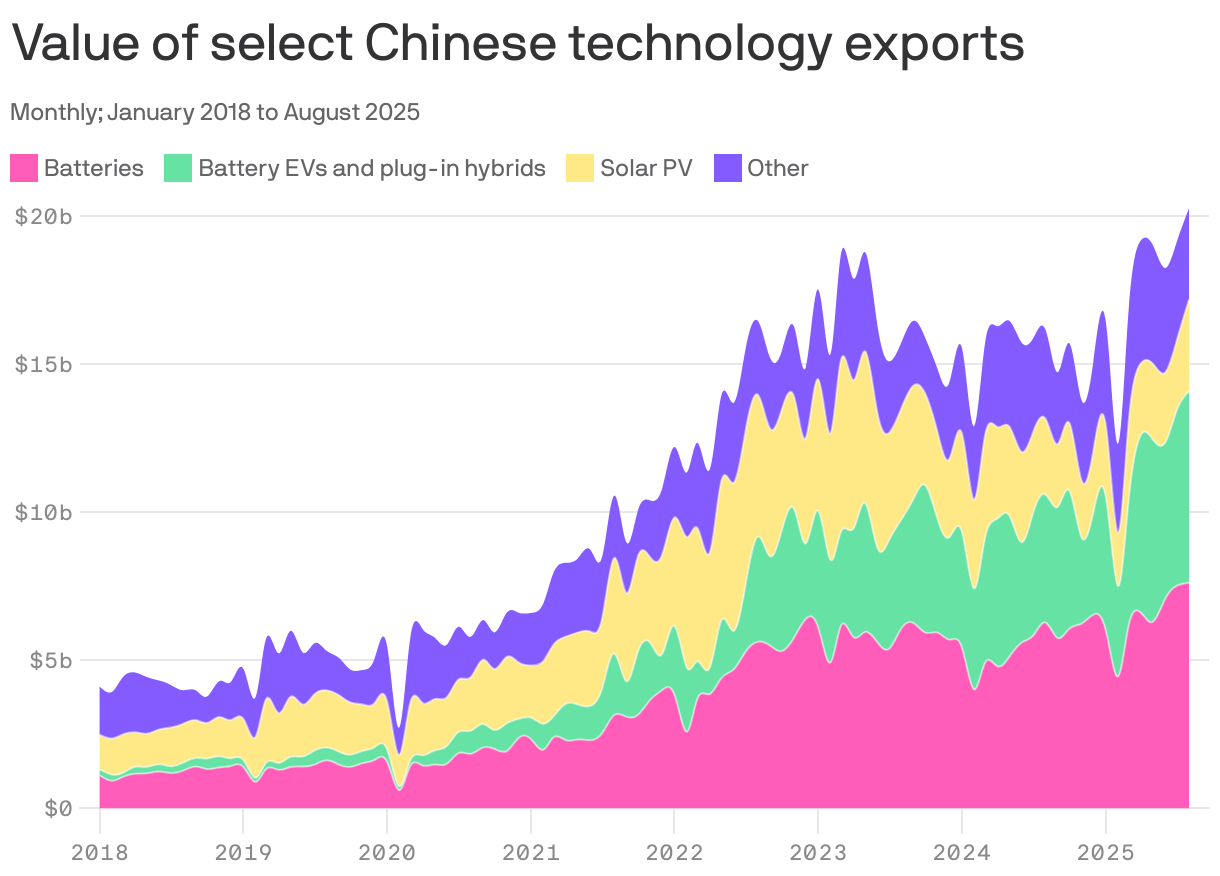
China's low-emissions tech exports hit fresh records in August on the strength of surging EV and battery shipments, data from the climate think tank Ember shows.
Why it matters: It's the latest sign of what some analysts call emerging divides between "electro-states" and "petro-states" — with White House policy solidifying U.S. placement in the latter camp.
- "At stake is not just the future of energy systems, but the contours of geopolitical power in the decades ahead," two Columbia University scholars wrote in a recent essay.
Driving the news: Ember just unveiled an online tool that closely tracks China's "clean" tech exports — and shows they hit $20 billion in August.
- EV exports were 26% higher in January-August 2025 compared to the same stretch last year, while batteries are up 23%.
- Several other categories rose, too, but solar PV fell.
What we're watching: The map. Just over half of this year's exports have gone to countries outside the OECD as emerging market uptake rises.
- "Exports to the ASEAN region rose 75% in January-August 2025, amid especially strong growth in Indonesia," a summary states.
- EV exports to Africa soared, albeit from a small base, the analysis finds.
Yes, but: Fossil fuel demand is also rising throughout developing countries — China's export surge, for now, affects the rate but not yet the direction.
The big picture: The data lands at a time when energy exports are especially stitched into geopolitics.
- The Trump administration is pressing nations to buy more U.S. LNG and other fuels to avoid big tariffs.
- It's also pulling back on federal funding and tax subsidies aimed at spurring manufacture of batteries, solar panels and other tech.
- And even more broadly, the Columbia scholars, in the recent essay, see a "new form of energy bipolarity" emerging.
The intrigue: Ember notes that China's numbers are climbing even though per-unit costs of some tech, notably solar, have fallen sharply.
The bottom line: "China's electrotech is becoming the basis of the new energy system, with continued cost reductions driving faster growth than ever, especially in emerging economies," Ember analyst Euan Graham said in a statement.

2. 🛢️ OPEC's even flow might be Trump's jam
Oil prices rose slightly after OPEC+ decided to return another 137,000 barrels per day amid rumors of a larger increase, but don't look for a surge amid ample supply.
Why it matters: If prices stay modest, as analysts predict, it could suggest a sweet spot of sorts for President Trump.
- He doesn't want higher pump prices, yet if OPEC+ flooded the market, that would bring the U.S. oil sector even more pain than it's already feeling.
- Instead, domestic production keeps rising slowly, setting fresh records.
Catch up quick: OPEC+ stayed the course yesterday with an on-paper addition of 137,000 barrels in November, the same boost as this month.
- "The group remains cautious about increasing its production share in the global oil market on predictions of an upcoming supply surplus in the fourth quarter as well as next year," ING analysts said in a note.
- Prices edged up by roughly 65 cents to $65.18 per barrel this morning after falling last week on reports of a much larger OPEC+ addition.
What we're watching: The war in Ukraine is the bigger wild card for prices right now.
- RBC Capital Markets' Helima Croft said that Russian output "remains at serious risk because of the ongoing Ukrainian attacks."
- "We did not get the sense that the Trump administration is opposed to Ukraine targeting energy facilities — a marked shift from the Biden administration," she said in a note.
Go deeper: OPEC and Allies Agree to Boost Oil Production (WSJ)
3. 🏃 Catch up quick on policy: DOE grants and offshore leasing

💵 GOP congressional districts aren't immune from $7.56 billion in DOE grant pullbacks even though they're aimed largely at blue states.
- State of play: House Democrats say the cancellations affect 108 districts held by Democrats and 28 GOP seats.
🛢️ A Louisiana federal judge struck down then-President Biden's order that looked to permanently ban oil and gas drilling in large coastal areas.
- Why it matters: It removes a barrier to Trump officials potentially leasing regions off the East and West Coast and the eastern Gulf of America, and parts of Alaska's Bering Sea.
- Yes, but: While the Gulf of America (renamed by the U.S. from the Gulf of Mexico) is coveted by oil companies, industry interest in those other regions is far less certain.
4. ⚛️ States link arms to speed up nuclear projects

Eleven states seeking to make nuclear a bigger part of their energy mix are asking for advice on how to speed advanced nuclear development within their borders.
Why it matters: Many states — including some that once resisted nuclear — are now embracing the power source, driven in part by the Trump administration's enthusiastic backing of it.
Driving the news: The National Association of State Energy Officials recently issued a request for information for companies, universities and others about how best to coordinate commitments for building multiple advanced nuclear projects.
- NASEO issued the request at the behest of the Advanced Nuclear First Mover Initiative, a recently formed coalition of the 11 states.
- New York, Indiana, Kentucky, Tennessee and Wyoming serve as the initiative's co-chairs, while Louisiana, Maryland, Pennsylvania, Utah, Virginia and West Virginia also take part.
Zoom in: The states' strategy "focuses on moving from one-off demonstration projects to widespread market adoption by building a robust and credible demand signal for advanced nuclear," the RFI states.
- Among the questions companies and others are being asked: pros and cons of structuring as a formal compact or other action among states as well as how states could divide any potential financial risks.
What's next: Responses to the RFI are due by Friday.
5. 👀 Hot reads: Data centers, pollution markets, hydro, nukes

Largest data centers in the US: the top 10 questions on data centers answered (Wood Mackenzie)
Amy's take: This is a great primer on data centers and the key questions we should be asking — and answering — as we all learn more about this space.
Markets for pollution ("Shocked" podcast)
Amy's take: This episode goes deep into the history of market-based systems to address pollution, including a flashback to when the Republican Party supported such mechanisms.
- Disclaimer — I'm the host. But I find it's helpful to compare the past to the present when so much change has occurred. Also: Check out Ben's story on a related effort.
Data center boom sparks sticker shock for PJM ratepayers (Energywire)
Ben's take: The numbers are eye-popping here — and will add pressure on regulators grappling with AI growth. This piece helpfully collects separate estimates of how much data centers could boost power bills in the largest U.S. grid.
US hydropower is at a make-or-break moment (Canary Media)
Chuck's take: "Make-or-break moment" can be a cliche, but it applies in hydropower's case. What's worth watching: Whether its champions in D.C. can sustain any kind of medium- to long-term political support.
WIPP lessons for state and local officials considering hosting a nuclear waste repository (Columbia University Center on Global Energy Policy)
Chuck's take: As nuclear power continues to surge in popularity, long-term waste storage often gets overlooked. Analyses like this one of New Mexico's Waste Isolation Pilot Plant are too few and far between.
6. 💬 Quote du jour: permit pendulum edition
"I think uncertainty in the regulatory environment is very damaging. However far the pendulum swings one way, it's likely that it's going to swing just as far the other way."— Shell USA president Colette Hirstius in an interview with the Financial Times
As Trump officials thwart already-permitted offshore wind projects, she warned that fossil fuel projects could face similar jeopardy in the future.
📬 Did a friend send you this newsletter? Welcome, please sign up.
🙏 Thanks to Chuck McCutcheon and Chris Speckhard for edits to today's edition, along with the brilliant Axios Visuals team.
Sign up for Axios Future of Energy