Axios Future of Energy
November 18, 2026

🔆 No outages to speak of here! We're up and running and opening the day with a look at expensive driving, then moving on to...
- The permitting fight, battery and Big Tech news, EV sales and more, all in 1,138 words, 4.5 minutes.
🙏 Thanks to David Nather and Chris Speckhard for editing, and to our brilliant Axios visuals team.
📻 Exactly 15 years ago, Rihanna and Calvin Harris ruled Billboard's Hot 100 with today's infectious intro tune...
1 big thing: U.S. drivers are just absorbing high prices
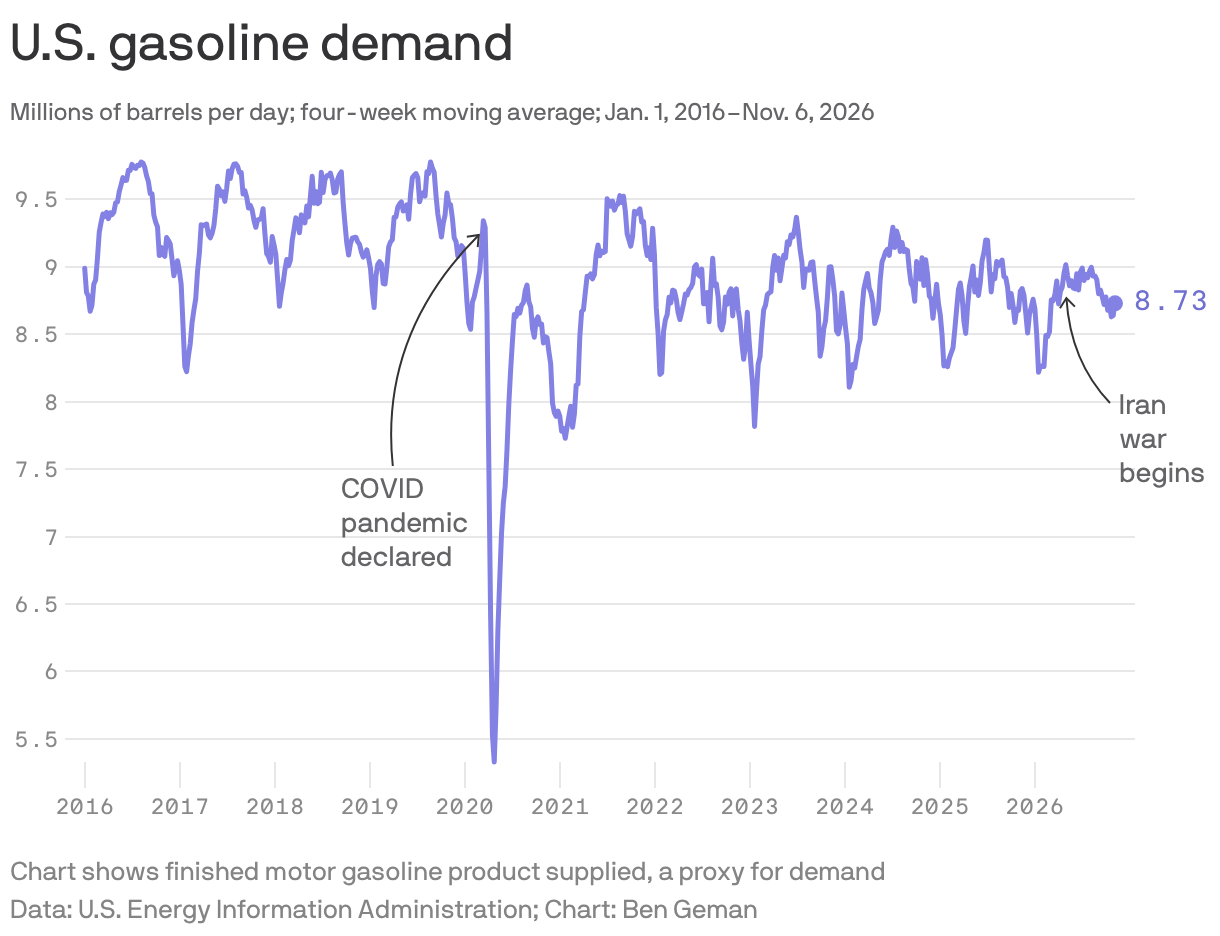
Pain at the pump may have changed some votes, but it's apparently not prompting big changes in how much Americans drive.
Why it matters: Most driving isn't especially optional, so people are absorbing the cost.
- This year Americans have paid an additional $88 billion for gasoline relative to a no-war baseline, according to Brown University's Climate Solutions Lab.
- The Energy Policy Research Foundation finds that U.S. households paid between $300 and $730 more on gasoline in March-August compared to the prior year.
State of play: Gasoline demand from the beginning of March, right after the Iran war started, through early November is very similar to the same stretch last year, per federal data.
- There's "no discernible evidence of a decline in gasoline consumption," UC-Berkeley energy economist Lucas Davis writes in a new post on the topic.
- That's despite gasoline prices being 31% higher since the war began compared to the same period last year.
The intrigue: Davis points out that the stubborn demand comes despite polling that shows Americans say high prices are changing their habits.
- He flags an April Washington Post-ABC News survey that showed 44% of respondents saying they had cut back on driving.
- Multiple polls show some version of this. For instance, 57% of respondents in a June Gallup survey said high prices were causing them to drive less.
How it works: Davis' post and the chart above rely on the federal Energy Information Administration's measure of gasoline product supplied.
- EIA calls it a proxy for demand, and measures gasoline leaving the supply chain, including refineries and bulk terminals.
- There's no perfect measurement. The Transportation Department tracks miles traveled, though there's a lag. The most recent data, for August, does not show a drop-off this year.
The bottom line: "[T]his is a valuable reminder of the gap between what people say and what they do," Davis writes.
- "Drivers may talk about cutting back, but studies in the economics literature consistently find that gasoline demand is inelastic in the short run," he writes.
2. 🗳️ Senate permitting fight comes to a head

The Senate will hold the next round of votes on the bipartisan permitting bill today as the measure heads for a final vote as soon as this week.
The big picture: The measure appears en route to passage with a strong majority of Republicans in support and Democrats divided.
What we're watching: The four co-authors unveiled new tweaks yesterday, so keep an eye on whether that helps push up the support level.
Catch up quick: It aims to strengthen consultation with property owners in areas slated for new transmission and requirements to restore affected land.
- Another change would boost funding for working with Native American tribes on historic preservation.
Friction point: The measure is nonetheless expected to face ongoing opposition from many Democrats and a number of tribal and environmental groups.
- Sen. Maria Cantwell (D-Wash.) joined tribal leaders, Patagonia and other opponents. She said Congress should slow down and follow the normal legislative process rather than rush through major changes to environmental laws and tribal protections.
- "What is wrong with the debate? What is wrong with the hearing? What is wrong with a markup?" she said.
What we're watching: The vote totals today and on final passage. The amount of Senate support will likely influence how much momentum it has in the House.
3. ⚔️ Climate investor backs permitting bill, bashes enviros

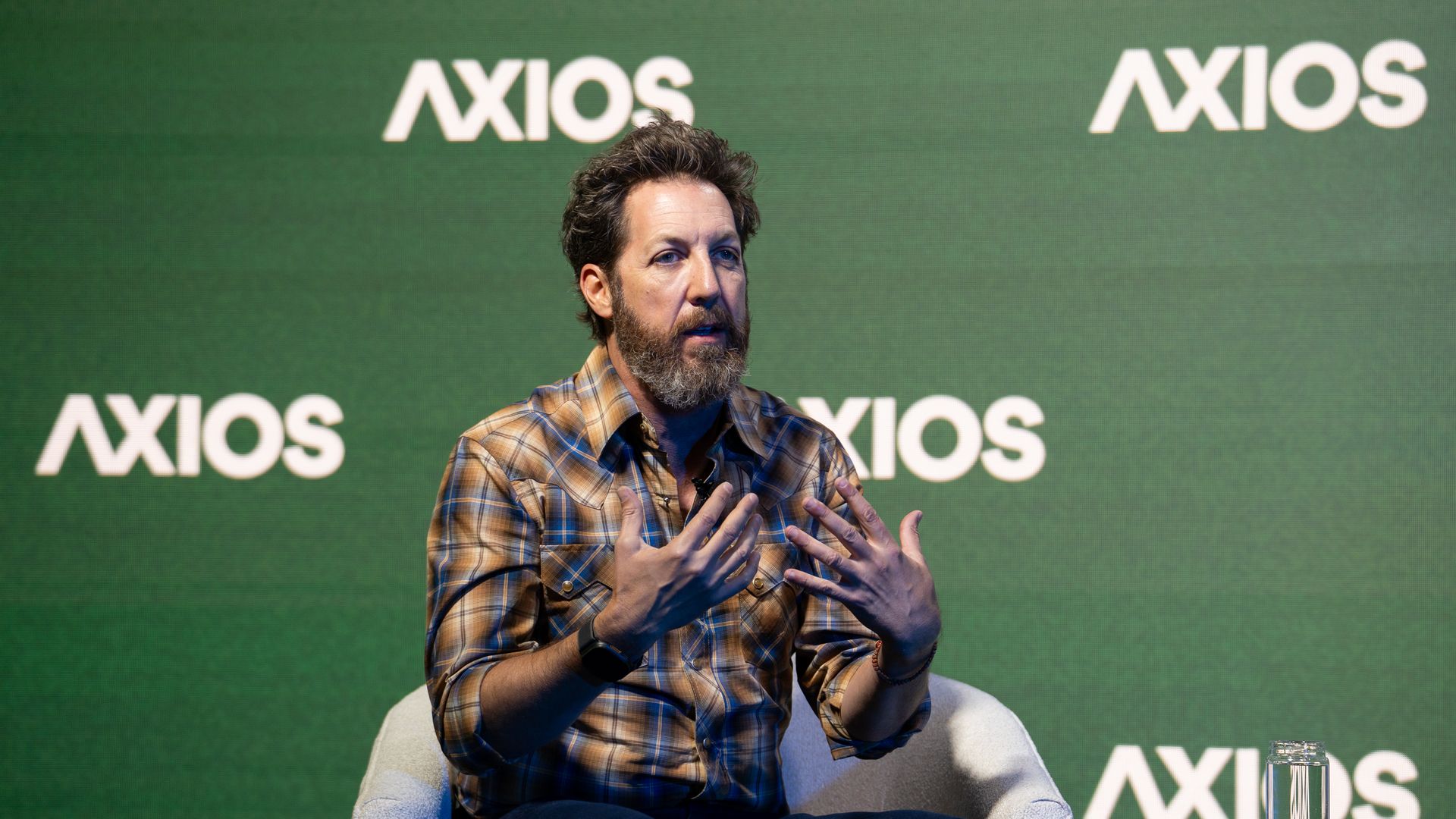
Nothing stands in the way of environmental progress more than environmentalists, Chris Sacca, co-founder of Lowercarbon Capital, said at Axios BFD yesterday.
Why it matters: Sacca said he supports the bipartisan permitting reform bill that advanced in the Senate on Monday and could clear the chamber this week.
State of play: "Any time you can remove carbon from a process, you are creating an opportunity to make more money as a result," said Sacca.
- "I trust in the markets, and I trust in the self-interest of individual participants in the market to get us there," said Sacca.
- He added "there are definitely going to be some shrubs or some rare frogs stepped on along the way."
Lowercarbon has a founding thesis that "hippies aren't going to get this sh*t done," and "activists are not going to move the needle on this stuff."
The big picture: Sacca comes from a growing group of investors — including Vinod Khosla and Tom Steyer — that see environmental regulation and bureaucracy as a hindrance to energy and climate progress.
- A group of clean-energy companies and infrastructure investors recently signed a letter calling for the passage of the permitting reform bill.
- Permitting bottlenecks are holding up $120 billion in clean-energy investments, argued a group of solar and storage companies in another letter supporting the bill.
4. 🗞️ Catch up quick: Batteries, Amazon, Venezuela, mining

🔋 Sila, an advanced battery tech and materials startup, has a long-term deal to supply Panasonic that could be worth north of $1 billion, the companies said today.
- Why it matters: It's a "big, long-awaited first after numerous false starts" for a U.S. advanced battery player to help power EVs, notes the Information's Steve LeVine (an Axios alum!). Go deeper.
⚡ Amazon is pledging to cut the amount of CO2 per unit of power it uses — a measure called carbon intensity — by 65% by 2030.
- Why it matters: Tech giants are under pressure to make the AI boom cleaner. "We're doing this as energy demand rises, because we believe growing our business and cutting emissions can, and must, go hand in hand," the announcement states.
- Context: Don't conflate intensity improvements with absolute reductions. Amazon reported rising 2025 emissions even as it sticks to its 2040 net-zero goal.
🛢️ Via Bloomberg, "Congressional Democrats are preparing multiple probes to examine the Trump administration's sweeping $100 billion deal with a controversial Venezuelan businessman to take control of more than a dozen of the nation's oil fields."
⚖️ The NYT reports that a "federal judge has ruled that the Trump administration violated the law when it greenlit the coming sale of deep sea mining leases in the Pacific Ocean off the coast of American Samoa."
5. 🚘 Number of the day: 83,262
That's the number of new electric vehicles sold in the U.S. last month, the first year-over-year increase in 2026, per Cox Automotive data.
Why it matters: The EV market has been recovering since sales plummeted following the Sept. 30, 2025 loss of federal tax credits.
- But overall 2026 volumes remain lower than they were before the credits vanished.
Disclosure: Cox Automotive and Axios are both owned by Cox Enterprises.
📫 Did a friend send you this newsletter? Welcome, please sign up.
Sign up for Axios Future of Energy