Axios Future of Energy

January 29, 2026

๐ฎ Zoinks! There's a lot happening. We've got news on...
- ๐ต Nuclear finance and DOE policy
- ๐งฎ Stunning data center numbers
- ๐ข๏ธ Oil and permitting on Capitol Hill
- ๐ Battery funding and lots more, all in 1,490 words, 5.5 minutes
๐จ Situational awareness: This morning, Brent crude prices hit $70 per barrel for the first time since September.
- Why it matters: Traders are weighing a potential U.S. strike on Iran.
๐ป This week in 1972, soul legend Al Green released the album "Let's Stay Together," which provides today's intro tune...
1 big thing: Exclusive โ Bezos fund backs nuclear initiative
Jeff Bezos' climate philanthropy is staking efforts to pave the way for building at least 10 new U.S. nuclear reactors.
Why it matters: The $3.5 million grant to the nonprofit Nuclear Scaling Initiative envisions an "orderbook" that "brings together multiple buyers to commit to building the same reactor design."
- Avoiding one-off builds in favor of the approach "can reduce risk, lower costs ... and provide greater certainty for developers, suppliers, and public partners," the announcement states.
What's next: The NSI plans to use the Bezos Earth Fund money for a "coordinated, multi-party process among federal, state, and commercial partners."
- The group is a partnership between the Clean Air Task Force, the EFI Foundation, and the Nuclear Threat Initiative.
The big picture: It's about avoiding cost overruns and logistical snafus that plagued past projects โ and have made capital skittish since.
- For a major build-out, it's probably vital that new plants aren't essentially one-offs like in the past and instead share learning, economies of scale, long-term supplier commitments and more.
Catch up quick: It's one of several efforts to embrace standardizing designs and practices.
- The Trump administration last year launched a partnership with Westinghouse, Brookfield Asset Management and fuel provider Cameco that envisions building Westinghouse AP100 units at multiple sites.
State of play: NSI executive director Stephen Comello tells Axios via email that the "orderbook" initiative is "directionally aligned" with that effort, but with a broader mandate that's untethered to any single consortium or tech.
- The National Association of State Energy Officials last year led a 12-state initiative to develop a coordinated orderbook strategy for advanced reactors.
The bottom line: "Our support for NSI is a targeted bet that smart coordination can unlock much larger public and private investment and turn this first reactor package into a model for many more," Bezos Earth Fund President and CEO Tom Taylor said in a statement.
2. ๐ ๏ธ Gas and data centers are the new "it" couple
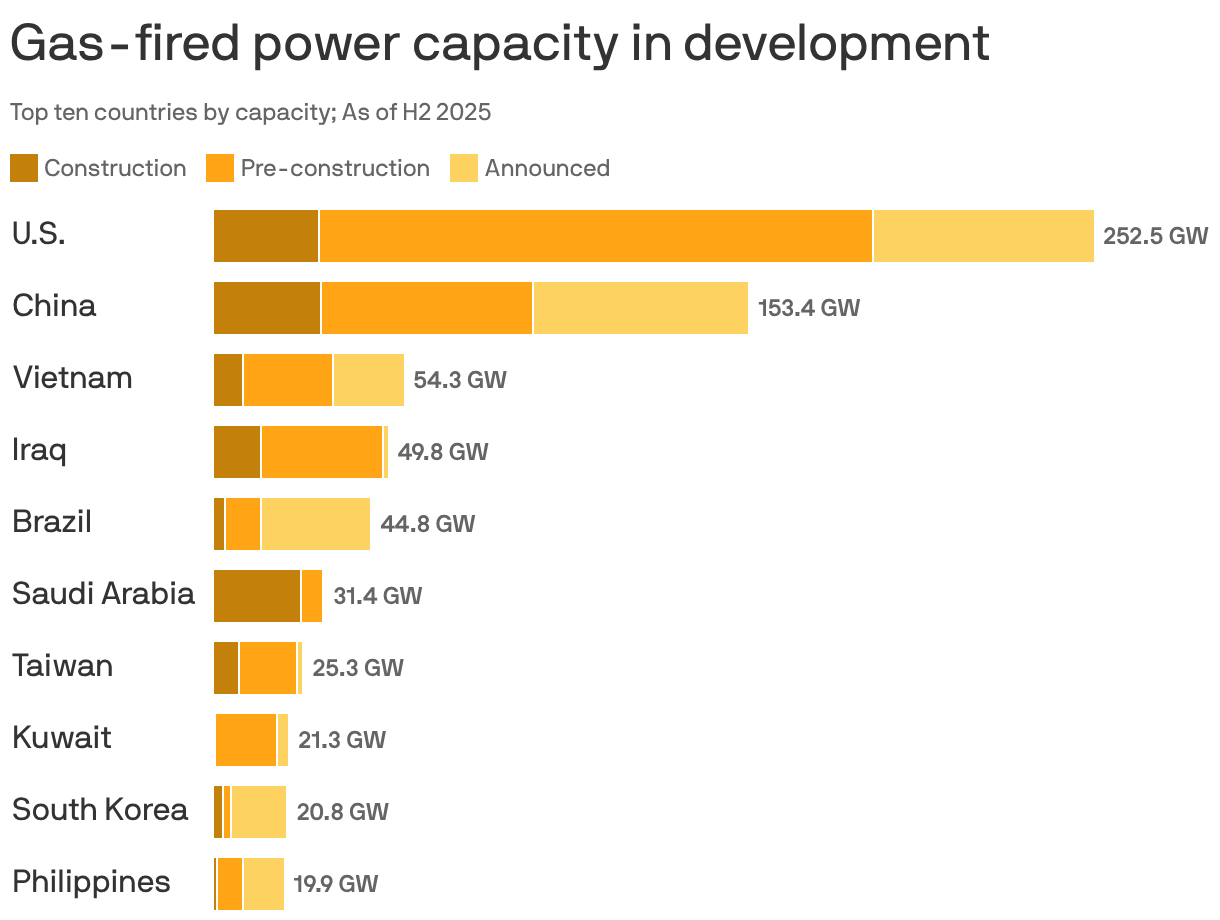
There's a wild finding in a new report on gas-fired power: over one-third of the U.S. capacity in development is "slated to directly power data centers on-site," the group Global Energy Monitor finds.
Why it matters: Projects to co-locate gas power with big new AI data centers seem to be taking flight very fast, though GEM's tally includes plans that are not definite.
The intrigue: GEM's team members aren't the only analysts taking notice.
- Michael Thomas, CEO of project tracking firm Cleanview, said 30 data center projects plan to use onsite gas with a combined 48 GW of capacity.
- Thomas wrote on his Substack that he's "shocked" by how much planned generation will directly power data centers, skipping the grid.
The big picture: Data centers โ grid-connected or not โ are one driver of a wider gas buildout as U.S. electricity demand climbs.
- The U.S. now leads the world in gas-fired power capacity in some stage of development, GEM's new report shows, accounting for nearly one-quarter of the global total.
- If โ a big "if" โ all the projects are built, "the U.S.' existing gas fleet would grow by nearly 50%, at an estimated cost of over US$416 billion in capital costs," GEM states.
State of play: Texas has the most gas-fired power in development at 80.6 gigawatts, more than the next seven states combined, GEM finds.
- "Nearly half of this capacity, 40 GW, is planned to directly power data centers, reflecting the state's eager appetite to meet energy-hungry tech demands."
Reality check: Nobody really knows how much will actually get built and how many years it will take.
- Turbine providers like market leader GE Vernova have long backlogs. GEM notes that many projects have not yet selected a supplier.
The bottom line: The evolution is quick.
- "A little more than a year ago, virtually all data center developers planned to use the electric grid to power 100% of their projects," Cleanview's Thomas writes.
3. ๐ข๏ธ Three takeaways from Rubio's Venezuela hearing
Secretary of State Marco Rubio yesterday offered a deeper look into the Trump team's thinking on Venezuela's oil sector.
A few tidbits from his appearance before the Senate Foreign Relations Committee...
๐ต He ruled out direct U.S. financial help for companies looking to develop Venezuelan oil.
- "There's no world in which the United States is subsidizing investment in Venezuelan oil," Rubio said.
- But Sen. Jeff Merkley (D-Ore.) was skeptical in the exchange (it starts around 1:42:30 here).
๐จ๐ณ Rubio said checking Chinese influence is also about oil, saying China will no longer receive Venezuelan crude at a steep discount โ and that sales at market prices would help Venezuelans.
- "China can buy Venezuelan oil, but they're going to have to buy it like everybody else in the world ... at the normal price, and that money is going to flow back to the benefit of the Venezuelan people," Rubio said.
โ๏ธ Democrats were critical of Trump's energy motives and said he's looking to benefit oil interests.
- "When you have the president United States himself, after taking Maduro, get up and say, this was about oil, oil, oil, it does make all of us ask the question โ whether he put men and women in the U.S. military at risk, simply so he could grab that oil," Sen. Chris Van Hollen (D-Md.) told Rubio.
- Democrats also questioned the handling of proceeds from sanctioned oil sales.
- Rubio said that the money now held in an account in Qatar would eventually be moved into a Treasury-controlled account under a "novel" system, but the U.S. will steer funds to the country's needs. AP has more.
4. ๐ DOE to states: Let's talk nuclear waste
The Trump administration is taking its first formal step to enlist states to host reprocessing and storage sites for nuclear waste.
Why it matters: With nuclear soaring in political and public popularity, some scientists and analysts say commercial plants' spent reactor fuel needs more attention.
Driving the news: The Energy Department yesterday issued a "request for information" to gauge states' interest in volunteering to host sites for reprocessing spent fuel and disposing of waste, along with fabrication and uranium enrichment.
- The request also seeks expressions of interest about advanced reactor deployment, power generation, advanced manufacturing and co-located data centers.
The big picture: Potential state hosts for what are being called "Nuclear Lifecycle Innovation Campuses" give the agency "the opportunity to work directly with states on regional priorities that support President Trump's vision to revitalize America's nuclear base," Energy Secretary Chris Wright said in a statement.
- The department asks states to provide details on workforce development and infrastructure investment.
Context: State-level nuclear support "is at an all-ยญtime high," a Nuclear Energy Institute official said in a recent article.
- The industry group said state legislatures have introduced over 350 bills and enacted over 60 measures over the past year.
What we're watching: Responses are due by April 1.
5. ๐ Catch up quick on policy: Permitting, loans, climate

๐ผ Industries seeking legislation to streamline permitting need to lobby the Trump administration โ not Congress, a key Democrat said yesterday.
- Why it matters: A permitting bill is a top priority for major industries.
- Yes, but: Sen. Sheldon Whitehouse, the environment committee's top Democrat, said Trump officials are gumming up legislative talks by stalling renewables projects. Go deeper.
๐ DOE has scuttled up to $1.8 billion in planned loan guarantees for Arizona Public Service Company transmission and clean energy projects, Bloomberg first reported and Axios confirmed.
- Why it matters: More info is emerging about steps to reverse Biden-era finance plans.
๐ The Brazilian leader of last year's UN climate summit is calling for "two-tier multilateralism" โ keeping the formal, longstanding UN process alongside a separate level of "open coalitions" focused on implementation.
- Why it matters: The plea โ in an open letter from COP30 President Andrรฉ Aranha Corrรชa do Lago โ is fresh recognition that the consensus-driven COP process doesn't boost deployment well enough.
6. ๐ Catch up quick on batteries
๐ Form Energy, a battery developer for electric grids and data centers, is raising $300 million to $500 million, Axios Pro Deals scooped yesterday. Subscribe for a steady diet of exclusives and smart analysis.
๐Google is investing in Redwood Materials, a battery recycling and storage company, in a $75 million Series E extension, now totaling $425 million.
- Why it matters: Data center developers are increasingly adopting batteries to help manage energy load. Go deeper.
7. ๐ Number of the day: -61%
That's Tesla's net income drop in Q4 2025 compared to a year earlier as its EV business struggles.
- Yet its stock rose after yesterday's earnings, the latest sign that investors are focused more on the Elon Musk-led firm's AI and robotics ambitions.
- Go deeper
๐ Thanks to Chuck McCutcheon and Chris Speckhard for edits to today's newsletter, along with the brilliant Axios Visuals team.
๐ฌ Did a friend send you this newsletter? Welcome, please sign up.
Sign up for Axios Future of Energy