Axios Future of Energy

November 19, 2026

β° It's the final countdown to Senate votes on the permitting bill. We explore how it got this far, and then turn to...
- The changing oil map, data center power, and more, all in 1,086 words, 4 minutes.
ποΈ Situational awareness: The latest draft COP31 decision out today drops a prior version's explicit support for transitioning away from fossil fuels. Go deeper
πΈ Exactly 50 years ago, the Flamin' Groovies released their signature song that's today's perfect intro tune...
1 big thing: Why this permitting bill might become law
If the sweeping Senate permitting bill becomes law, it will reflect a rare convergence of political and market forces strong enough to trump the Beltway aversion to big, bipartisan deals.
Why it matters: The bill could transform how America builds energy infrastructure, with major implications for everything from electricity costs to data centers.
- Getting rid of bureaucratic hurdles for energy projects is a top priority for the fossil fuels and renewables sectors.
- But critics argue the plan would unacceptably weaken environmental protections and the rights of Native American tribes.
The latest: A vote on final passage of the White House-backed bill could occur later today.
The big picture: Many industries β pipelines, transmission, housing, you name it β call permitting a long bureaucratic and judicial maze that stymies projects.
Yes, but: That, on its own, isn't nearly enough to get this far. Here are other reasons the bill has a path to becoming law.
π³οΈ The cost-of-living election. The midterms were soaked in affordability politics at a time of rising energy bills.
- While critics can call the projected savings modest, cost is politically front and center.
π Rising electricity demand. U.S. power thirst has been rising in the last few years after staying largely flat for decades, driven partly by AI and wider electrification of the economy.
π¦ A maturing clean energy industry. As sectors like renewables and storage become more mainstream, "more developers and companies are seeing the real-world challenges" of doing projects, clean energy lobbyist Jeff Navin notes via email.
π£ A mercurial White House was focused. The White House's National Energy Dominance Council was engaged with the bill.
- Trump officials have also allowed some onshore wind projects bottled up by Pentagon reviews to proceed.
π Shifting Democratic coalitions. Multiple analyses show the bill bringing somewhat lower power sector emissions compared to a world without it.
- But when climate had more political juice a few years ago, a bill backed by oil industry groups probably would not have had this much Democratic buy-in.
The intrigue: Data centers have been and remain a wildcard. There's a big political and public backlash, and opponents of the bill have seized on it, charging that the bill would help Big Tech by making the buildout easier.
- But bill authors and backers are emphasizing language designed to ensure that data centers pay for grid upgrades and have higher transmission service costs.
2. π’οΈ The Strait of Hormuz could become less important
The Iran crisis could reshape oil movements enough to greatly cut reliance on the Strait of Hormuz over the next decade, the International Energy Agency said in a report out this morning.
Why it matters: It's a stark sign of a broader reality. The war may reshape how energy moves around the world and influence which sources meet growing demand.
π» Driving the news: IEA's World Energy Outlook explores a hypothetical future in which shipping through the waterway remains constrained or unreliable, and nations act aggressively to curb their reliance on it.
- This "low Hormuz case" models major buildout and use of bypass pipelines, greater investment in oil production outside the region, and more aggressive efforts to curb demand.
- These moves could cut the need for oil shipments through the strait to 8.5 million barrels per day in 2030 and all the way down under 2 million in 2035, compared to 20 million pre-war.
π State of play: IEA also models an "Additional Response Case" that assumes governments fully implement responses to the crisis that they're already considering.
- In this scenario, shipments through the strait fall by more than 10 million barrels per day by 2035.
- But none of this is assured. In other scenarios, Hormuz volumes could return to pre-war levels and remain there.
πΌοΈ The big picture: The report takes stock of how the crisis is shaking up the wider landscape.
- "Many countries have turned to electrification as a strategic response to events in 2026," the report states.
- 25 countries have announced new electrification policies since February, while consumers are helping drive a spike in electric vehicle sales many regions.
βοΈ "The biggest beneficiaries from a pivot towards domestic energy resources are set to be renewables β led by solar PV β and nuclear power," a summary states.
- Coal is getting a "short-term boost," IEA finds, with several large Asian countries boosting use of coal-fired power or delaying plant shutdowns.
The bottom line: Even if reliance on Hormuz plummets, the Middle East would still be the top oil supplier to global markets, "underlining that supplies from this region are still vital for oil markets and security," the report states.
3. π Catch up quick: Methane, data centers, FERC
βΈοΈ European officials struck a deal today that delays methane requirements for fossil fuel importers by two years.
- Why it matters: Oil and gas groups and the Trump administration have lobbied hard against the rules.
π¨π³ CATL, the Chinese battery and energy services giant, plans to become a one-stop-shop for data centers' power needs, spanning generation, storage and more, Bloomberg reports.
π Via Utility Dive, most major grid operators have submitted FERC-required plans for connecting data centers and other large power users. Check out the proposals.
4. π What's powering global data centers
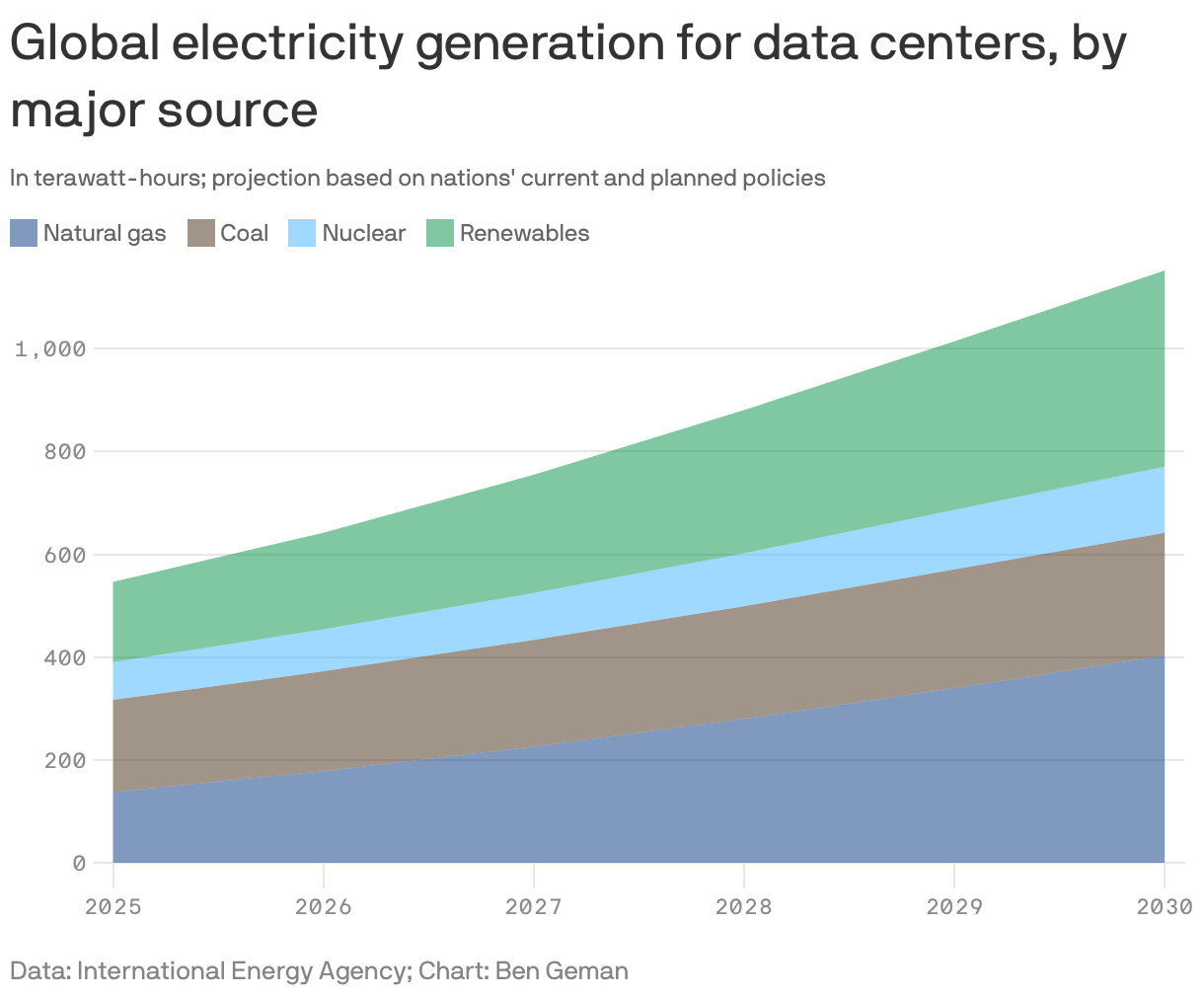
Data centers account for 1.7% of global electricity demand, but this small share is rising fast, the IEA report shows.
Why it matters: The AI boom is a source of rising emissions, and data centers can strain local grids.
State of play: While renewables growth is helping a lot (see above), IEA still sees emissions tied to data center energy rising 70% by 2030.
- Natural gas and, to a lesser degree, coal are also helping to meet the rising demand.
Threat level: Rapid data center growth "has been pushing electricity systems to their limits" in some places.
What we're watching: IEA sees data centers accounting for over 10% of U.S. electricity demand in 2030 under current policies.
5. π Quote of the day: Decoding COP edition
"How does 'urge' compare with 'invite' or 'request'? Is 'welcome' warmer than 'note'? It turns out that there is a strict hierarchy of verbs."β CarbonBrief's Simon Evans in his primer on UN climate summit decisions
π« Did a friend send you this newsletter? Welcome, please sign up.
π Thanks to David Nather and Chris Speckhard for editing, and to our brilliant Axios visuals team.
Sign up for Axios Future of Energy