Axios Future of Energy

April 14, 2026


✅ Hello Tuesday. We're diving into the Iran war shock with items on...
- New economic toll estimates and stunning oil market stats.
- We've also got lots of business news and more, all in 1,170 words, 4.5 minutes.
🙏 Thanks to David Nather and Chris Speckhard for editing and to our brilliant Axios visuals team.
🎧 Mamas Gun just dropped their new album "Dig!" and the command rings true on today's intro tune...
1 big thing: Global economy could take big hit from Iran war
🚨Breaking: The International Monetary Fund just cut its 2026 global economic growth forecast, warning of slower growth and higher inflation thanks to the Iran war.
Why it matters: The war and energy shock in tow has halted economic momentum — and even a rather short conflict will do real damage, it finds.
- And if it's a long-term conflict — which the forecast says is definitely possible — the damage would be even greater.
- "More attacks on critical energy facilities and the prospect of a longer shutdown of the Strait of Hormuz are raising the specter of a more significant and persistent conflagration for the global economy," the IMF states.
The big picture: IMF analyses are closely tracked by finance ministers and other global economic policymakers.
Driving the news: The fund's revised World Economic Outlook sees growth slowing to 3.1% this year — down from 3.4% in its pre-war look-ahead — and inflation rising to 4.4%.
- And even those headline figures obscure the acute damage unfolding in many countries (more on that below).
Threat level: It could actually get much worse. The outlook models several scenarios for the length of the conflict and its effect on energy prices:
- The short-term scenario is the 3.1% "reference" estimate. It assumes a "relatively short-lived" conflict lasting a "few more weeks," with energy commodities up 19% on an annual basis.
- The "adverse scenario" would be larger price increases that persist longer. In that case, global economic growth slows to 2.5%, and inflation rises to 5.4%.
- And then there's the even grimmer "severe scenario," with more damage to regional energy infrastructure and supply dislocations that extend into next year. In that case, 2026 growth plummets to 2% — and inflation hits 6.1%.
What we're watching: IMF outlines three large, connected buckets of variables that will decide how bad things get.
- 📈 High commodity prices are a "textbook negative supply shock" that raises costs for goods and services that require lots of energy — food, chemicals, shipping, you name it. The result: higher inflation and less consumer buying power.
- 🌀 These effects can be amplified as companies and workers alike try to make up their income losses. This risks an upward spiral — workers need higher wages as prices rise, which prompts businesses to further raise prices to deal with higher labor costs, and so on.
- 🏦 There could be quick changes in financial markets, such as lower asset values, in response to economic instability and central bank policies that could tighten monetary policy.
What's next: The forecast offers central banks and government policymakers guidance for managing the crisis.
- For instance, interventions like consumer energy subsidies and price caps should be well-targeted to the vulnerable and have sunsets to avoid adding large amounts of new government debt, it states.
The bottom line: "Despite the recent news of a temporary ceasefire, some damage is already done, and the downside risks remain elevated," Pierre-Olivier Gourinchas, the IMF's research director, said in a blog post alongside the report.
2. 🗺️ Bonus: Charting the uneven toll
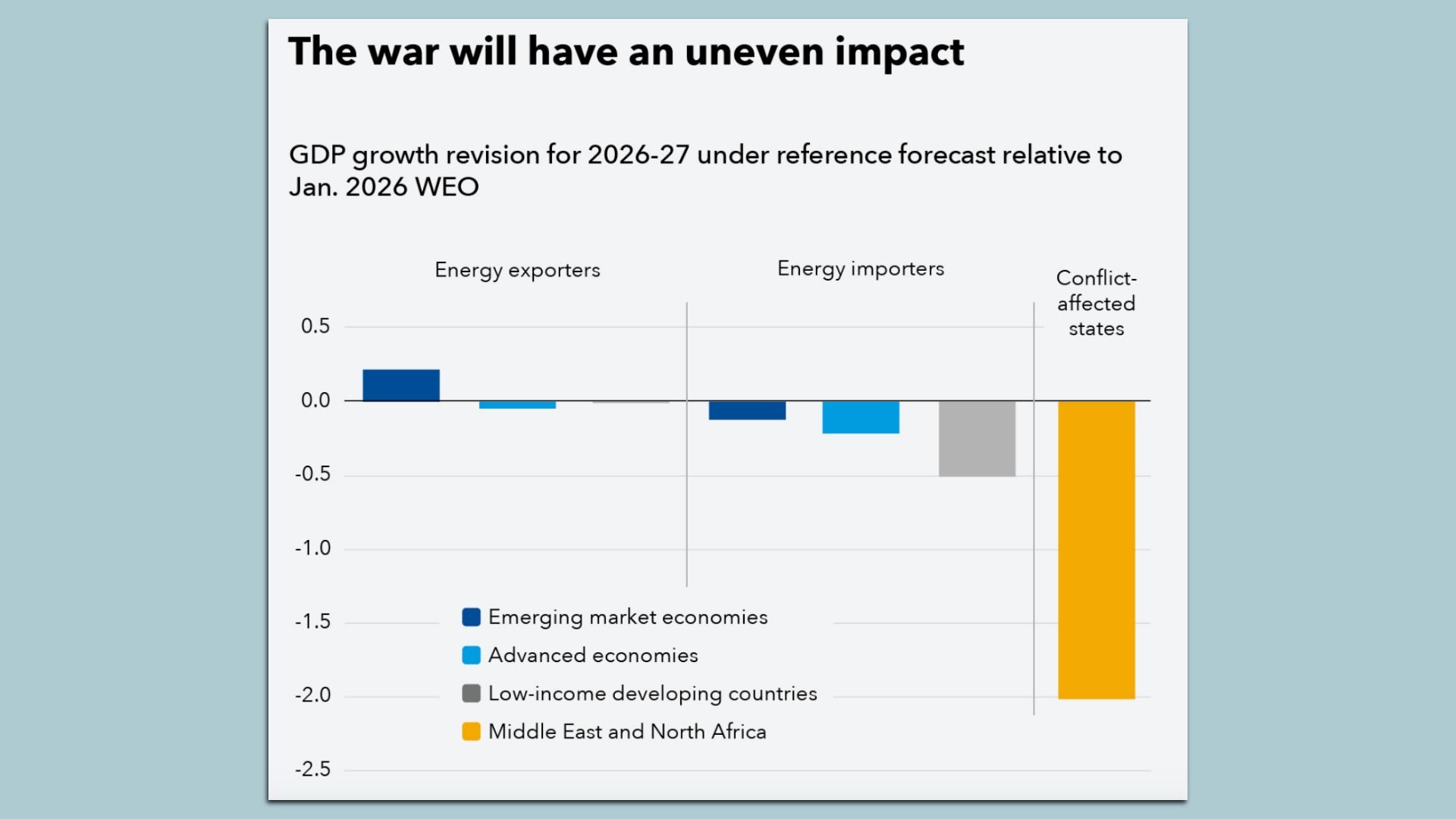
This IMF graphic gets to sobering findings in their revised outlook — the acute economic harms already unfolding in many nations.
- "[T]he toll on the conflict region and more vulnerable economies elsewhere — in particular, commodity-importing emerging market and developing economies with preexisting fragilities — is much more pronounced," the analysis states.
3. 😮 Iran war to bring first oil demand drop since COVID
Global oil consumption is slated to dip this year as high prices and scarce supplies bring "demand destruction," the International Energy Agency projected today.
Why it matters: It's a stunning reflection of the historic throttling of supplies from the Iran war.
- IEA's projection, if it comes to pass, would be the first global decline since 2020, when the COVID pandemic disrupted economies worldwide.
The big picture: The agency's monthly analysis sees a modest year-over-year decline of roughly 80,000 barrels per day — but it's a sharp change from pre-war estimates of 850,000 bpd of growth in 2026.
- "Initially, the deepest cuts in oil use have come in the Middle East and Asia Pacific, mainly for naphtha, LPG and jet fuel," IEA said.
- "However, demand destruction will spread as scarcity and higher prices persist."
Stunning stat: Shipments of oil, natural gas liquids and petroleum products through the Strait of Hormuz averaged just 3.8 million bpd in early April, down from over 20 million pre-war.
- Some oil is getting out through other routes, notably added volumes in Saudi Arabia's east-west pipeline to the Red Sea.
- But the overall export loss is still north of 13 million bpd.
What we're watching: IEA head Fatih Birol didn't rule out additional coordinated releases from nations' strategic reserves beyond the phased 400 million barrel initiative that began last month.
- "I very much hope we don't need to do it, but if it is needed, we are ready to act immediately," he said at the Atlantic Council yesterday.
4. 🏃Catch up quick on business: EVs, nuclear power, Venezuela, EU

🛻 Slate — a maker of affordable (think mid-$20,000s) electric pickups — closed a $650 million Series C round led by TWG Global.
- Why it matters: It's a bet on finding an opening for bare-bones EVs, even as vehicles with plugs have struggled to snag much of the massive U.S. pickup market.
- What's next: It hopes to start delivering its first vehicles to customers late this year.
⚛️ Rolls-Royce's nuclear arm and the U.K. government announced a contract to enable the design and delivery of small modular reactors there.
- Why it matters: The effort to site the reactors on the coast in Wales was underway long before the Iran war, but U.K. PM Keir Starmer has recently argued the conflict makes the case for more energy self-sufficiency.
- State of play: The company has secured up to roughly $809 million from the U.K. for the planned work, the Guardian reports.
🇻🇪 Chevron announced a deal with Venezuela's state-owned oil company PDVSA that expands Chevron's stake and holdings in the Orinoco heavy oil region.
- Why it matters: Trump officials are keen to see expanded investment from U.S. companies. Chevron, unlike other U.S.-based oil giants, has continually been operating in Venezuela for many decades. Go deeper
🇪🇺 Via Bloomberg, a coalition including Exxon, commodity trading giant Trafigura, chemical makers and others is urging EU energy ministers to "urgently consider changes to the bloc's upcoming regulations on methane emissions."
5. ⛏️ Number of the day: 11,600 square miles
That's the Massachusetts-sized area that AI-wielding miner KoBold Metals will aerially survey for lithium in the DRC as it eyes development of 13 exploration licenses that cover roughly 1,160 square miles.
Why it matters: It's "history's largest lithium exploration campaign," said the company, whose backers include Bill Gates-led Breakthrough Energy Ventures and industrial heavyweights BHP and Mitsubishi.
- The effort arrives as the U.S. and other nations are looking to diversify mineral supply chains. Go deeper
📫 Did a friend send you this newsletter? Welcome, please sign up.
Sign up for Axios Future of Energy