Axios Future of Energy

December 04, 2025

๐ฅ Good morning! We're unpacking what's fresh about the latest fight over auto rules, then exploring...
- โจ๏ธ Geothermal news
- ๐ Clean tech data
- ๐ข๏ธ Petro and plastics updates, and lots more, all in 1,462 words, 5.5 minutes
๐จ Next week in D.C.: Join Chuck & Nathan Bomey on Tuesday at 8am ET for an event on prospects for a permitting overhaul, featuring Sen. Brian Schatz (D-Hawai'i), Rep. Julie Fedorchak (R-N.D.) & more. RSVP here.
๐ธ RIP to guitarist and songwriter Steve Cropper, whose ridiculous menu of credits includes today's intro tune...
1 big thing: The politics of affordability rev up Trump's new auto fight
๐ถ Contra the late Kris Kristofferson, freedom's just another word for ... cheaper vehicles. That's what Trump officials claim by naming their rollback of auto mileage rules the "Freedom Means Affordable Cars" plan.
Why it matters: Auto standards are the latest energy policy fight to get subsumed into the politics of affordability that look slated to dominate the midterms.
๐Catch up quick: The White House and Transportation Department yesterday unveiled a plan to greatly soften Biden-era mileage rules โ and said it would save people money.
- The new proposal would require automakers to hit an average of 34.5 miles per gallon across their fleets by 2031.
- That's way lower than the Biden-era target of over 50 mpg, which would mean lots of EV sales.
The big picture: How much fuel cars burn is a huge climate story, because transportation is the country's biggest CO2 source and helps sway oil demand.
- The Biden-era rules were designed to give the market a hard shove toward EVs.
A few things we're watching...
๐ต Money is the message โ everywhere. Decades of fuel economy fights have been about energy security, climate, pollution, what's best for domestic automakers, and consumer costs.
- Now that last one dominates. Trump officials say the plan would save people $109 billion over the next five years and make the average new car $1,000 cheaper.
- Critics make precisely the opposite argument, citing higher lifetime fuel costs from less efficient vehicles, and the economic toll of more pollution. Several big green groups led their response with the cost argument.
โ๏ธ Rough contours of the inevitable legal fight started emerging immediately.
- The Center for Biological Diversity said the rules run afoul of the underlying fuel economy law that requires standards at the "maximum feasible" level.
- But Trump's DOT argues the Biden standards illegally shoehorned EVs into the mileage-setting process.
๐คท Industry wants certainty, but good luck with that.
- The industry generally argues the Biden-era rules were impractical, so this is a win for them there, and U.S. automaker stocks ticked up on the news. Trump unveiled the proposed mileage standards flanked by Ford, GM and Stellantis execs.
- But automakers are also facing years of policy and legal fights. The new move comes as EPA pulls back tailpipe CO2 rules, and EPA is also planning a brutal legal fight over its overall power to regulate vehicle CO2.
What they're saying: "We see no possibility that any future Dem-led Administration (2029 or later) would agree with today's proposal, elevating compliance uncertainty for [original equipment manufacturer] fleets hitting the market post-2028," TD Cowen analysts said in a note.
What we're watching: Whether the rule change further slows industry EV investments by taking the pressure off.
- It could give automakers some "short-term financial breathing room," Edmunds' head of insights Jessica Caldwell said.
- But while easing the mileage rules helps at the margins, automakers will be cautious about big strategy shifts that could be upended if a future White House reverses course again, she said in a note.
2. ๐ Geothermal company makes big discovery using AI

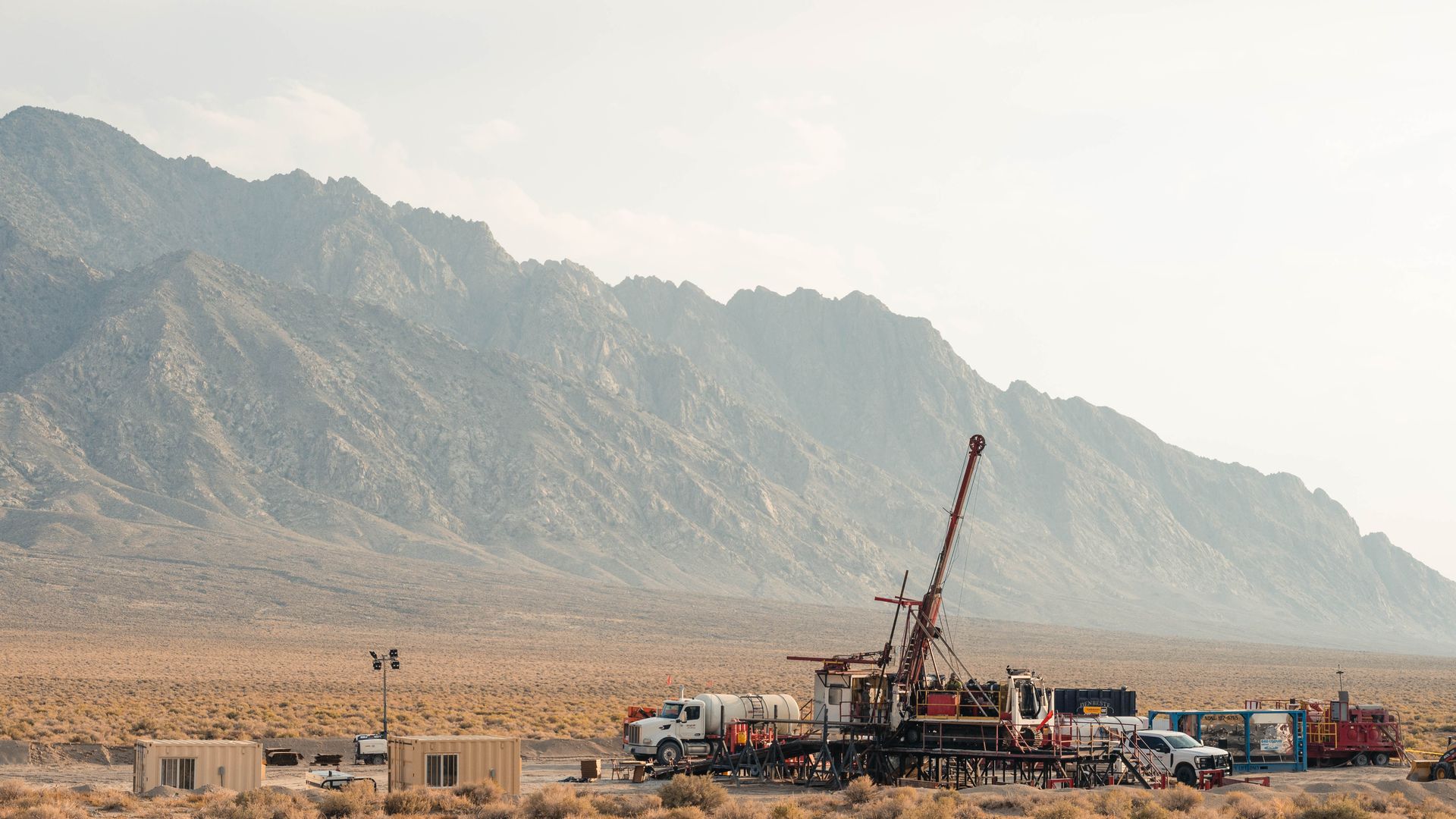
A geothermal energy company announced today that it has discovered โ with AI's help โ the first commercially viable system of its kind in over 30 years.
Why it matters: Zanskar Geothermal and Minerals officials said the underground find, in remote western Nevada, offers fresh evidence that geothermal can become an attractive option to meet soaring U.S. energy demand.
Driving the news: The Nevada formation, dubbed "Big Blind," had no surface signs of geothermal activity or any prior history of exploration.
- Zanskar scientists used computer models to locate a geothermal anomaly that indicated exceptionally high heat flow at the site.
- They then fed data into Zanskar's AI prediction engine.
Zoom in: The result led to "fewer bad wells" being drilled, Joel Edwards, Zanskar's co-founder and chief technology officer, told Axios. That reduces the cost of the projects, he said.
- Carl Hoiland, the company's other co-founder and CEO, said AI technology "has allowed us to target deeper and more precisely."
What's next: The company plans to seek permits to develop Big Blind into a commercial venture. It hopes the site will provide power by later this decade.
The bottom line: "If you sort of read the tea leaves in the public space, the perception is that naturally occurring systems are tapped out," Edwards said.
- "This is sort of showing that actually, there's a wave of these things coming, and this is just the beginning."
3. ๐ A clean power record โ and a warning
Breaking: A combined 11.7 gigawatts of new utility-scale solar, battery storage and onshore wind power capacity came online in the U.S. in Q3, per new industry data.
Why it matters: It's a record for any July-September stretch, with storage seeing an especially good stretch.
- 2025 should set a full-year mark for combined "clean" deployments as well, the American Clean Power Association said in its Q3 report.
- A gigawatt can power between 750,000 and 1 million homes, though renewable power is intermittent.
What we're watching: Trouble ahead for renewables following the race to tap incentives before phaseout deadlines.
- "The strength of 2025 deployments is reflective of early 2020s market and policy conditions," it states.
- "Projects are facing heightened regulatory burdens and policy uncertainty, putting the future trajectory of clean power project deployments at risk."
4. ๐ฎ New alarms on plastic waste โ and ways to fight it

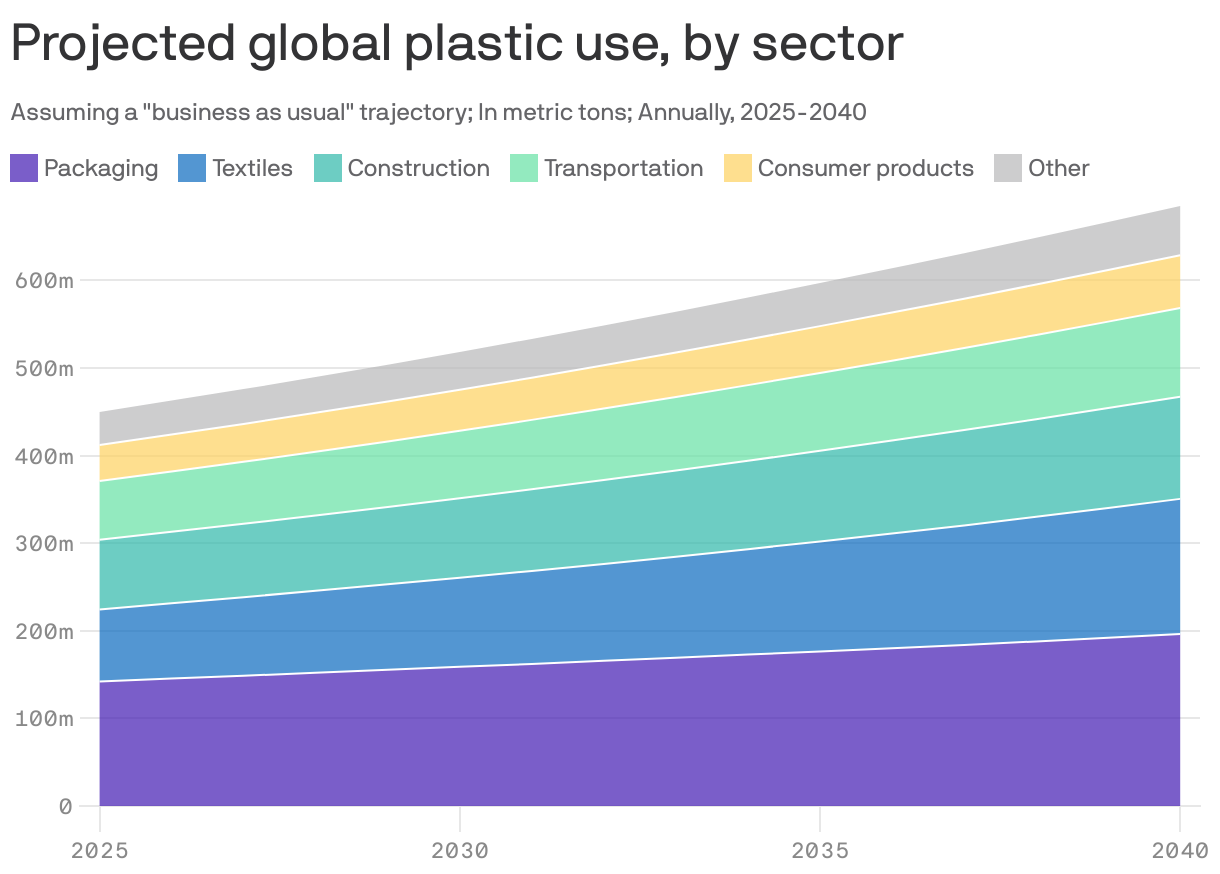
The amount of plastic pollution entering the environment each year could double by 2040 as industries and people use more of the materials, a new report led by the Pew Charitable Trusts finds.
Why it matters: Beyond the ecological and health toll, this is very much an energy story โ production of petrochemicals is a major source of oil demand growth.
The big picture: Plastics growth is far outpacing waste management, Pew finds.
- Without "ambitious global action," annual global plastics pollution will rise to 280 million metric tons by 2040, it finds.
- Absent major system transformation, the report also concludes that annual greenhouse gas emissions from plastics will rise 58% by 2040, "equivalent to the emissions from one billion gasoline-powered cars."
What we're watching: The report calls for greatly expanded global collaboration on chemical and mechanical recycling methods, and other techniques, that greatly cut demand and production.
- It sees a pathway to cut pollution by 83% by 2040.
5. More policy news! Permitting and EPA
๐ The National Petroleum Council, a DOE advisory group, dropped detailed ideas for permitting revisions via both executive and legislative changes.
- Why it matters: Surging energy demand is "colliding with aging and limited infrastructure" and "fragmented permitting processes are increasingly unable to keep pace with these shifts," it finds.
- What we're watching: Whether the plan, which multiple industry groups are embracing, informs the uphill climb for a big permitting deal in Congress.
โ๏ธ Six former EPA employees are formally challenging their termination over signing a letter that said agency head Lee Zeldin was thwarting science.
- Why it matters: They are raising First Amendment claims in the filings with the U.S. Merit Systems Protection Board, according to the group Public Employees for Environmental Responsibility. The Hill has more.
6. โกChris Wright lightning round: LNG, ethanol, IEA, climate science

Here's a few nuggets from the DOE head's remarks to the National Petroleum Council yesterday and a quick gaggle with reporters.
๐๏ธ Alaskan gas: Despite "logistical challenges," Wright told the group he's "reasonably confident" that the Trump-backed Alaska gas pipeline and LNG project will come to fruition.
๐ญ IEA drama: Asked if he's still considering a U.S. pullout from the body, he told reporters it's a "work in progress, but progress is being made."
๐ฝ Biofuels battles: Wright said there's a "very active dialogue" in the administration over competing goals of oil refiners and the biofuels sector over volume rules.
- "I think we'll come up with something that's better than where we are today," he said.
๐ Climate science: I asked whether he's still planning public forums to debate climate science (recall the contrarian report from a working group), and he replied, "Yes."
7. ๐ฌ Quote du jour: Shifting natural gas politics edition
"I do think that the political winds are starting to shift quite a bit."โ Alan Armstrong, CEO of gas pipeline giant Williams
He told reporters yesterday that Northeast governors are becoming more receptive to gas infrastructure.
- "They're very quickly changing their tune, and acknowledge the need for having natural gas to back up renewables at a minimum," said Armstrong, who also chairs the National Petroleum Council.
๐ Thanks to Chuck McCutcheon and Chris Speckhard for edits to today's newsletter, along with the brilliant Axios Visuals team.
๐ฌ Did a friend send you this newsletter? Welcome, please sign up.
Sign up for Axios Future of Energy