Axios Future of Energy

December 03, 2025

🐪 Halfway! We've got news on politics, policy, tech finance and electric air taxis, all in just 1,385 words, 5 minutes.
🎙️ Situational awareness: EU leaders reached agreement on plans to fully end Russian gas imports by mid-2027.
- Why it matters: The bloc's turn away from Kremlin-backed gas has widened the market for U.S. LNG.
🎧 Amy joined Columbia University's Energy Exchange podcast to discuss the media landscape. Listen here!
🎶 Happy birthday to Montell Jordan, whose classic 1995 smash is today's intro tune...
1 big thing: Gallego launches cost-focused energy plan amid 2028 chatter

Sen. Ruben Gallego just dropped an energy plan that's very much of this political moment: It leads with affordability, with climate present but not front and center.
Why it matters: The Arizona Democrat is a potential 2028 White House candidate, and his plan arrives as energy costs are atop the political radar.
The big picture: "Energy is central to our way of life, but it's also one of the most volatile costs many households face," the 32-page document states.
- It calls for a system that's "safe, clean, and affordable for working families."
State of play: A few toplines...
- It would reinstate and extend residential efficiency and clean energy tax credits scuttled under the GOP budget law, and utility-scale incentives too.
- Other provisions would fund R&D into small modular reactors and boost finance for the Energy Department's clean energy loan programs.
There's a lot on reliability, and transmission is a focus, including exemptions from the most detailed environmental reviews.
- It would revive programs that steer resources to communities "transitioning from oil and gas industries as markets shift."
Yes, but: The plan is heavy on promoting zero-carbon sources and efficiency, but supports oil and gas in sections.
- The permitting overhaul portion would help renewables but also provides "clean timelines and requirements" for oil and gas pipelines.
- It also looks to "ensure reliable oil and gas supplies through greater communication around supply disruptions and supply consistency."
The intrigue: Climate change is hardly absent. The plan argues Gallego's policies can cut emissions, and shout-outs to clean tech like geothermal.
- But it's not the A message, unlike plans many 2020 hopefuls unveiled when the Green New Deal (which Gallego didn't co-sponsor while in the House) had more cachet in Democratic circles.
My thought bubble: The scaffolding around the proposals is politically as important and interesting as the substance.
- It offers commentary and data about energy costs and stresses on households.
- Elsewhere, it hits the GOP budget law that scaled back the IRA, saying it will increase prices and cost jobs.
Zoom out: Get ready to hear a lot from Democrats about energy prices in the midterms as utility bills rise.
- The White House, meanwhile, prefers focusing on transportation fuels as gasoline slides below $3 per gallon.
Friction point: Political commentator Josh Barro coincidentally has a new piece arguing that President Trump has given Dems an opening on energy.
- "By canceling wind and solar projects for culture-war reasons, the president is essentially begging voters to blame him for rising electricity prices," Barro writes.
- But capitalizing also requires embrace of gas pipelines and other policies that make energy cheaper; otherwise, Republicans maintain a structural advantage on cost, argues Barro, a Democrat.
What we're watching: The energy posture of other 2028 hopefuls as they jostle for early position.
2. 🇨🇳 Tracking China's renewables and EV lead
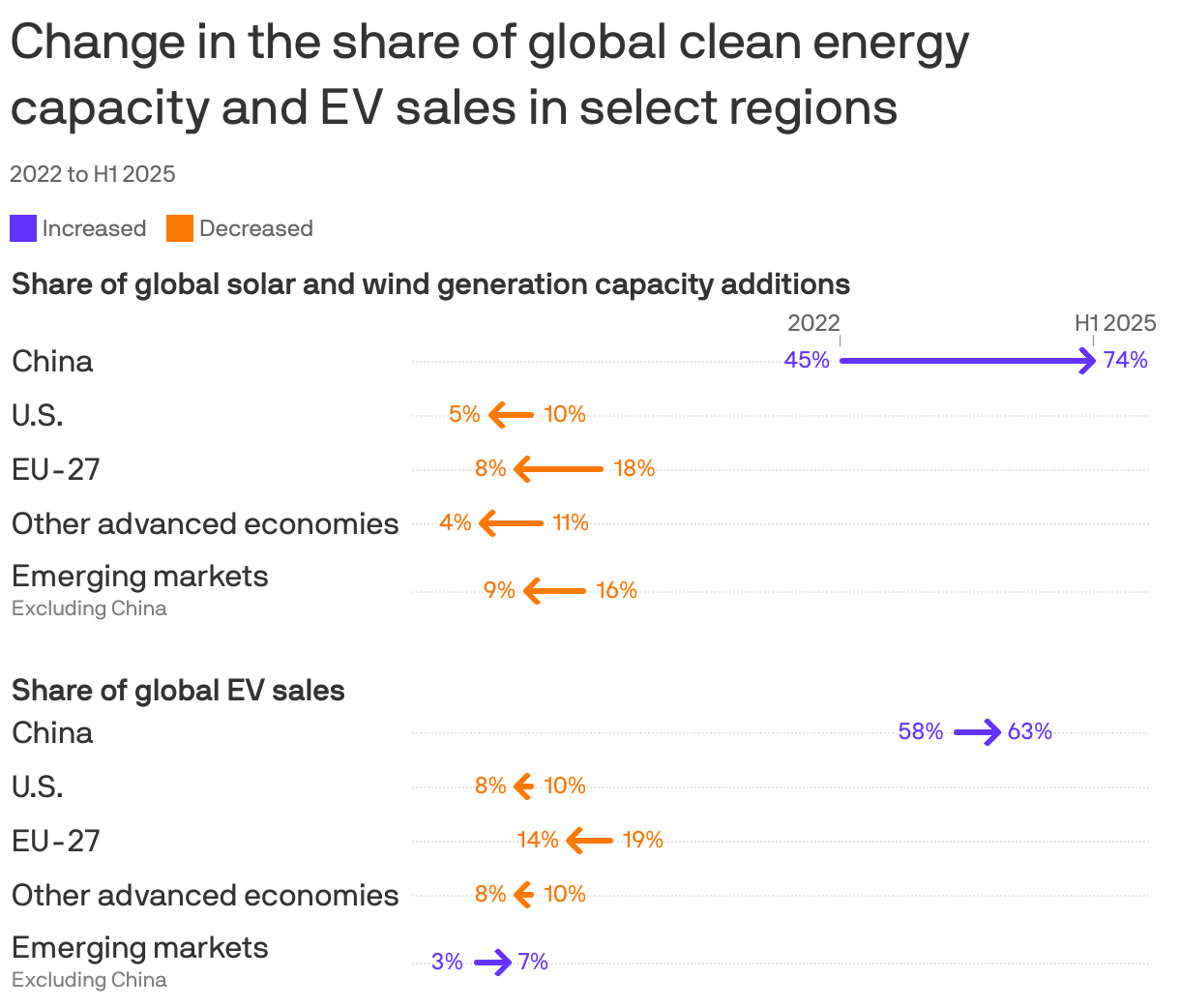
Not only is China winning the clean energy race, but it's picking up the pace when most other economies — including the U.S. — are slowing down, according to new McKinsey data.
Why it matters: The energy transition is shifting geopolitical alliances and power centers, and China is solidifying its lead while the U.S. falls back.
Reality check: The transition to clean energy is slowing down due to several factors, including President Trump rolling back key incentives.
- Fossil fuels are likely to stay dominant in many parts of our energy systems for decades.
- That will deepen the geopolitical power of the U.S., the world's largest producer of oil and gas.
What we're watching: To what extent efforts by the Trump administration to scale other types of clean tech — namely nuclear power and geothermal — counter China's lead in those areas too.
3. 👟 Catch up quick on policy: Reactors, cars, Congress

⚛️ DOE is awarding up to $800 million in federal cost-shares to advance small modular reactor projects in Tennessee and Michigan.
- Why it matters: It's among the most direct federal steps yet to deploy the tech. Trump officials — and power-thirsty tech companies — are keen to advance the tech that faces first-mover challenges.
- Driving the news: DOE is providing up to $400M for TVA to help build a GE Vernova Hitachi BWRX-300, and other efforts. Another up to $400M will support Holtec building two of its SMR-300 units at the shuttered Palisades plant in Michigan that's being reopened.
↩️ The Transportation Department is poised to weaken vehicle fuel economy rules, per Bloomberg and Reuters.
- Why it matters: Transportation is the largest source of U.S. CO2 emissions. Biden officials used EPA emissions rules — which are also getting scuttled — and efficiency rules to push the market toward EVs.
- What's next: Auto execs will join Trump for a White House announcement today, the reports state.
📝 The GOP-led House Energy & Commerce Committee will mark up a suite of bills today.
- State of play: It includes a gas industry-backed bill that would bar cities and states from banning new gas connections in homes and buildings.
4. 🐊 Meet the electric air taxi network coming to Miami

Archer Aviation plans to create an electric air taxi network in South Florida by linking regional airports with properties owned by Miami Dolphins owner and real estate developer Stephen Ross.
Why it matters: Traffic in Miami, one of the fastest-growing metro regions, can be a nightmare.
- Archer envisions people zipping over the congestion, reaching popular destinations in 10 to 20 minutes.
Driving the news: Archer revealed plans for the first pieces of its Miami network today.
- Existing helipads at Hard Rock Stadium and Apogee Golf Club in Hobe Sound will be readied for electric operations. Ross is an owner of both properties.
- Ross's real estate company, Related Ross, also plans to partner with Archer to develop a vertiport within its West Palm Beach downtown development.
Another real estate developer, Plaza Equity Partners, is partnering with Archer to develop a vertiport in Dragon Global's Magic City Innovation District, a mixed-use community in Miami's Little Haiti.
- The network will also offer travel between the region's largest airports in Miami, Fort Lauderdale and Palm Beach, and several private airports.
Reality check: It will be several years, at least, before it's operational.
- Archer's multi-rotor electric aircraft still needs FAA certification.
5. ⚛️ Micro-nukes startup Antares raises $96 million

Advanced nuclear startup Antares raised $96 million in equity and debt to turn on its test reactor by mid-2026, CEO Jordan Bramble first told Axios Pro Deals.
Why it matters: There's a nuclear renaissance brewing as customers hunt for electricity and the Trump administration offers support.
State of play: Shine Capital led the raise, which included $71 million in new equity and $25 million in debt.
- The company has over $12 million in government contract awards, including the Defense Innovation Unit, Bramble says.
How it works: Antares is developing micro nuclear reactors (100 kW to 1 MW) for defense and space applications.
- They're passively cooled by sodium heat pipes and use TRISO fuel, which consists of three-layered tiny pebbles that can prevent the release of radioactive materials.
Catch up quick: It's one of 11 companies DOE selected for its test reactor program, which aims to have at least three test reactors running by the summer of 2026.
What's next: Antares aims to turn on an electricity-producing reactor in late 2027.
Unlock the whole story — and a steady diet of exclusives and smart analysis — by talking to our sales team about Axios Pro Deals
6. 🧮 Number of the day: $400-$900 per household
That's the average annual cost of climate change to U.S. households based on a "narrow accounting" of a subset of costs, per a new analysis by MIT and UCLA researchers.
- "The breadth of this range is primarily explained by different assumptions regarding how to attribute weather-related costs to climate change," it states.
- Home insurance premium changes have the biggest effect.
The bottom line: "Although the chief concerns about climate change lie in the future, climate change is already having consequential effects for US households and taxpayers." Full study
🙏 Thanks to Chuck McCutcheon and Chris Speckhard for edits to today's newsletter, along with the brilliant Axios Visuals team.
📬 Did a friend send you this newsletter? Welcome, please sign up.
Sign up for Axios Future of Energy