Axios Future of Energy

January 22, 2026

🗞️ There's plenty of action at home and abroad, and we've got you covered in just 1,444 words, 5.5 minutes.
🛢️ Situational awareness: Venezuela's legislature will discuss oil reforms today that, if implemented, "will unwind the state monopoly of the industry and let private companies produce and sell crude from the country's vast reserves," Bloomberg reports.
📻 45 years ago this month (and maybe this week, though records are spotty), Hall & Oates released a perfect single that's today's intro tune...
1 big thing: Exclusive — solar industry launches new storage push

The Solar Energy Industries Association, the sector's main lobbying group, is ramping up its advocacy for policies that help deploy storage.
Why it matters: Utility-scale battery storage enables higher levels of renewables on grids and helps meet demand peaks.
- A number of companies — including SEIA members — are involved in both tech areas.
- And on the residential level, roughly 40% of the home solar systems installed last year also included storage, per SEIA data.
Driving the news: "SEIA is doubling down on our advocacy for energy storage at the federal, state, and local level," Abigail Ross Hopper, the group's president and CEO, said in a statement.
State of play: The new efforts, shared first with Axios, span steps like...
- An increase in the number of state-based lobbyists.
- A more detailed policy agenda.
- New advertising focused on storage, and first-time sponsorship of storage conferences.
- A new online resource hub to help companies and policymakers.
Catch up quick: Grid-scale and home storage are growing fast, and they haven't attracted the same ire from Trump officials as solar by itself and wind.
- Grid-scale storage has grown 400% since 2023, per SEIA.
- The research firm Wood Mackenzie projects 93 gigawatts of capacity across segments arriving over the next five years, despite a near-term market slowdown.
"[Storage] is a key driver of manufacturing and job growth in communities across America. And it is critical to American economic competitiveness on the global stage," Ross Hopper said.
Yes, but: Advocates see various barriers and threats to even faster deployment. SEIA's policy agenda includes steps like...
- Fighting for "fair valuation" in regional power capacity markets that considers storage's ability to help meet demand peaks.
- Working with state lawmakers and regulators to ensure utilities fairly compensate storage for various grid services it provides, like smoothing peaks.
- So-called "flexible interconnection tariffs" that enable faster and less costly grid access.
- Focusing on the Treasury Department to ensure granular rules that tether tax incentives to avoiding materials from "foreign entities of concern" — largely China — are "reasonable and attainable."
What we're watching: Signs of fresh traction for the tech, but also the various players in the lobbying world.
- Other trade and lobbying groups, notably the American Clean Power Association and the U.S. Energy Storage Association, also represent storage interests.
- SEIA is hosting a day-long policy forum on Capitol Hill today.
2. 🤝 General Fusion is going public
General Fusion, the Canadian fusion developer, plans to go public via a SPAC valued at $1 billion.
Why it matters: It's the second fusion company to look to the public markets for financing recently, highlighting the sector's demand for capital.
Zoom in: General Fusion agreed to merge with Spring Valley Acquisition Corp. III, and the deal is expected to close in the middle of this year and trade under the ticker GFUZ.
Catch up quick: General Fusion, founded in 2002, has been very public about its financing challenges and closed a $22 million round last year with eyes on a public offering.
- The company told Axios Pro last year that it needed $125 million to reach scientific break-even, and aims to bring a commercial power plant online in the mid-2030s.
Zoom out: Don't expect a wave of fusion IPOs in 2026.
- It's the decades-old fusion companies, struggling to close private rounds and outside of mainstream science, that are searching for public market capital.
- Some of the newer companies, like Commonwealth Fusion, have continued to tap private capital to build out projects.
Read the full story and get more scoops and analysis by subscribing to Axios Pro Deals.
3. 🗒️ Davos notebook: AI, Greece, Trump and nukes

🕰 AI's two climate timelines: AI is currently an environmental "drag" as it boosts consumption of all kinds of energy, Hans Kobler, founder of climate tech VC heavyweight Energy Impact Partners, told Axios in Davos.
- Yes, but: Longer term, it's a different story, he told Amy onstage at Axios House: "It will lead to innovation that we have not seen. That makes us optimistic. And we have never seen better use cases for clean technology, for good energy technologies to be deployed."
- State of play: EIP's portfolio includes several companies harnessing AI for one clean tech use or another, such as Atomic Canyon, which uses AI to help with nuclear power licensing.
🐟 AI and conservation: AI also was a theme for Nature Conservancy CEO Jennifer Morris, who told Amy it has an overlooked — but vital — role to play in helping to protect at-risk species.
- Threat level: "All of you that are in AI in the room who are listening, please make sure you're developing AI solutions for nature, because we need to move faster," she told the crowd in Davos.
☢️ Trump and nukes: Most of the attention from Trump's Davos speech came from his Greenland remarks, but he also acknowledged that he hasn't always been a booster of nuclear power.
- The big picture: "I was not a big fan because I didn't like the risk, the danger, but the progress they've made is unbelievable, and the safety progress they've made is incredible," he said.
🇬🇷 Greek gas: Trump's tussle with Europe over Greenland won't impede looming U.S. deals with those countries, Trump's Greek ambassador Kimberly Guilfoyle predicted to Amy.
- What we're watching: She said to expect more deals announced with European nations in early February. Greece is swiftly becoming a key U.S. LNG gateway to Europe.
4. 💵 The rise and (partial) fall of U.S. clean tech investment
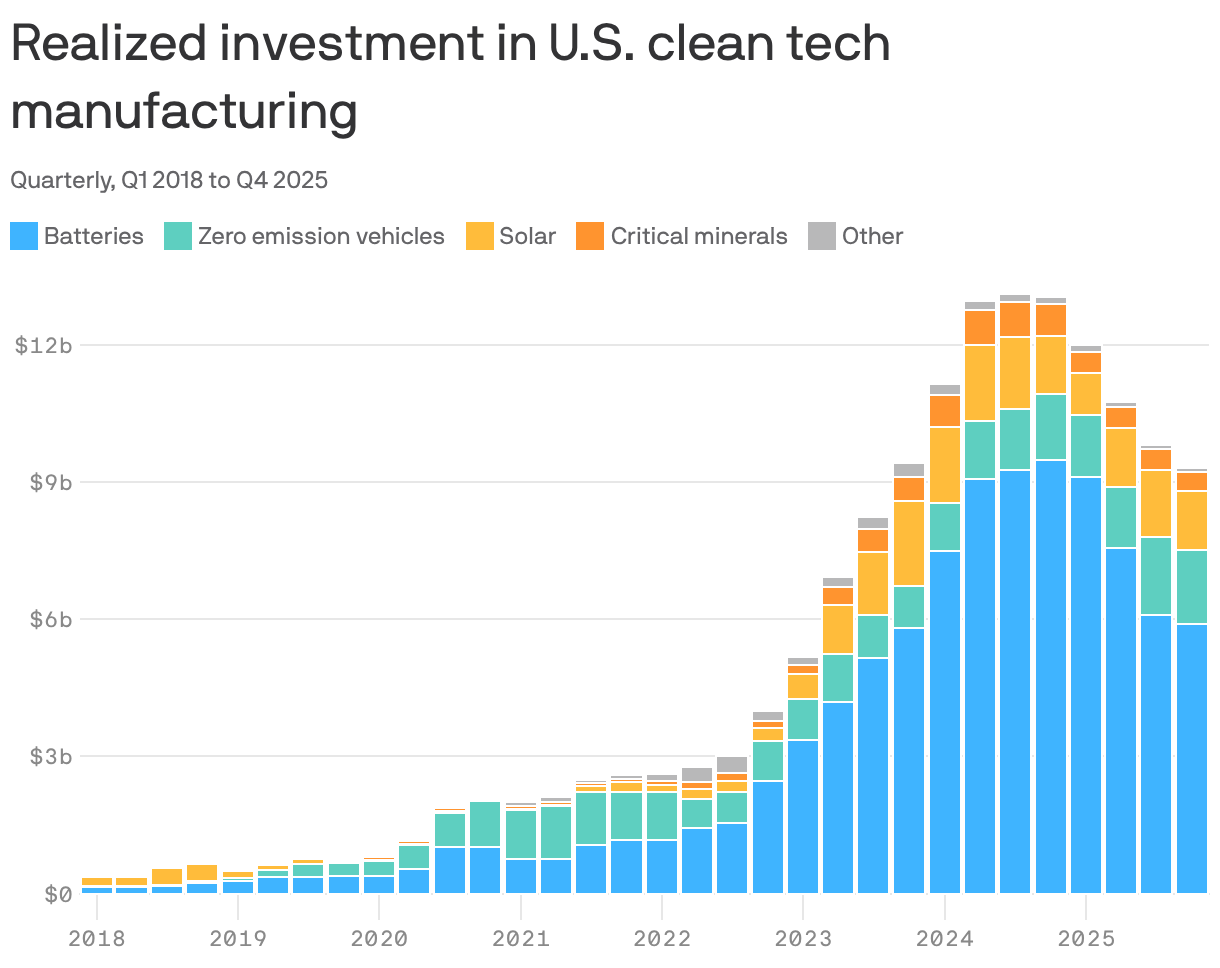
Investment in domestic clean tech manufacturing fell for the fifth consecutive quarter in the last three months of 2025, new data from the Rhodium Group and MIT analysts shows.
Why it matters: The federal climate policy reversal — especially around EVs — is among the forces deterring actual spending and new project announcements.
State of play: Actual investment was roughly $9 billion in Q4, down 29% from the same period a year earlier.
- Meanwhile, roughly $8.4B worth of planned investments were canceled, the highest total yet in their joint data tracking project.
- The scrapped investments were heavily centered on EVs and battery projects.
- Announcements of new investments totaled $3.4B, the lowest total since late 2020.
The bottom line: Lots of forces influence investment, but it's fair to say the federal U-turn is showing up in the data.
5. 🏃 Catch up quick: Natural gas, Greenland, Congress, geothermal
🇬🇱 While President Trump may covet Greenland's resources, extracting rare earths and other minerals would face massive challenges, a new Wood Mackenzie report finds.
- The big picture: "The local population is small and the lack of an established mining sector means imported skilled labour. Only southwestern ports operate year-round. Only Nuuk has modern port infrastructure," it finds, and those are just some of the hurdles.
🥶 U.S. natural gas futures have soared nearly 60% this week as frigid temps and winter storms start descending on the country.
- Threat level: The weather presents a double-whammy of spiking need and risk to supply. "[F]reeze offs are likely given the extreme cold, complicating the picture at a time when this weather will drive increased demand," RBC Capital Markets said in a note.
⛏️ The House yesterday narrowly passed, 214-208, a Congressional Review Act resolution that overturns a Biden-era attempt to shield Minnesota's Superior National Forest from mineral exploration and development.
- Why it matters: If the Senate follows suit, it could hand Minnesota Democrats another hot-button issue in addition to Immigration and Customs Enforcement's presence in Minneapolis.
💵 Geothermal startups are having a week! We already reported on Zanskar's $115 million raise, and now Sage Geosystems has closed a $97 million Series B round.
- Why it matters: Investors are placing bets that geothermal will break out this year as a more mainstream energy source, Axios Pro Deals' Katie Fehrenbacher reports.
6. 🧮 Number of the day: 33%
That's the percentage of data centers that Bloom Energy says will use 100% onsite power by 2030, based on its new survey of decision-makers across the industry.
Between the lines: The trend is profitable for Bloom Energy, which produces fuel cells that can be up and running in as little as six months, Axios Pro Deals has reported.
The intrigue: A year ago, that number was zero percent, Bloom Energy CEO KR Sridhar told Axios in Davos.
What we're watching: The survey says that by 2035, that figure will rise to 44%.
🙏 Thanks to Chuck McCutcheon and Chris Speckhard for edits to today's newsletter, along with the brilliant Axios Visuals team.
📬 Did a friend send you this newsletter? Welcome, please sign up.
Sign up for Axios Future of Energy