Axios Future of Energy

June 17, 2026


💉 Carbon removal is getting a shot in the arm this morning. We'll start there and then move on to...
- What's next for oil
- The latest Bezos Earth Fund move, policy and finance news and more, all in 1,383 words, 5 minutes.
🙏 Thanks to David Nather, Mackenzie Weinger and Chris Speckhard for editing and to our brilliant Axios visuals team.
🎸 This month marks 55 years since The Rolling Stones released a masterpiece as a B-side single (!), and it's today's intro tune...
1 big thing: Carbon removal group boosts spending, adds Anthropic

Frontier, the group of big companies trying to jump-start carbon removal, just unveiled $915 million in new purchase plans and added AI heavyweight Anthropic to its roster.
Why it matters: New or accelerated ways of pulling CO2 from the atmosphere could become a weapon against global warming — but massive scale-up is required to move the needle.
- Today's announcement nearly doubles the group's pledged contracting with companies trying to commercialize carbon-removal technologies.
- Expanded finance and the addition of Anthropic are "great signals for momentum in the field, and for the continued obedience to the idea that carbon removal is part of any rigorous climate program," Hannah Bebbington Valori, head of Frontier, tells Axios.
Driving the news: Frontier, which launched in 2022, is also refining its approach after brokering purchasing and finance agreements with over 50 startups.
- It will now focus on a "narrower portfolio of companies where we have high conviction the technology has gigaton-scale potential," the group announced today, referring to a billion tons.
- That means 10-15 "focused bets," with purchase deals in the 8-10 year range, that help commercial-scale plans get across the finish line.
Yes, but: Frontier is making crystal clear that for removal to reach a billion or more tons per year, governments worldwide must eventually be the main driver.
- The theory of the case: corporate buyers provide a needed bridge that helps prove and "de-risk" methods that make them ripe for public investment.
- Going forward, Frontier says, every deal must have a "clear line of sight to government-driven demand" by the time purchase contracts expire.
"The primary difference here is, how do we make sure that we are using our limited resources to buy from projects in a way that is going to pull forward the demand from governments that is ultimately going to take this market to scale," Valori said.
Catch up quick: Frontier — whose founding members include Google, Stripe, and Meta (which has since left) — launched with a pledge to facilitate $1 billion in carbon-removal purchases by 2030.
- It vets startups and brokers contracting agreements between carbon-removal companies and members, who include Shopify, Salesforce, JPMorgan Chase, H&M and others.
- Some are binding contracts for removal over various time spans, totaling $670 million to date.
- There are also smaller "pre-purchase" deals for companies piloting removal methods.
Zoom out: Carbon dioxide removal encompasses many technologies, including direct air capture, enhanced rock weathering, and ocean alkalinity enhancement, which boosts marine CO2 uptake.
- Today, these provide a tiny amount of removal compared to restoring and creating forests.
What we're watching: Frontier's "line of sight" standard for government-driven demand has implications for U.S. policy.
- Today, the federal tax credit for CO2 removal only applies to direct air capture projects, Valori said.
- Valori said that Frontier could still support other U.S. approaches if projects help build momentum for broader government support.
- "We are ... equally excited about doing deals that will bring into being new policies that don't exist today."
2. 🛢️ Here comes an oil rollercoaster
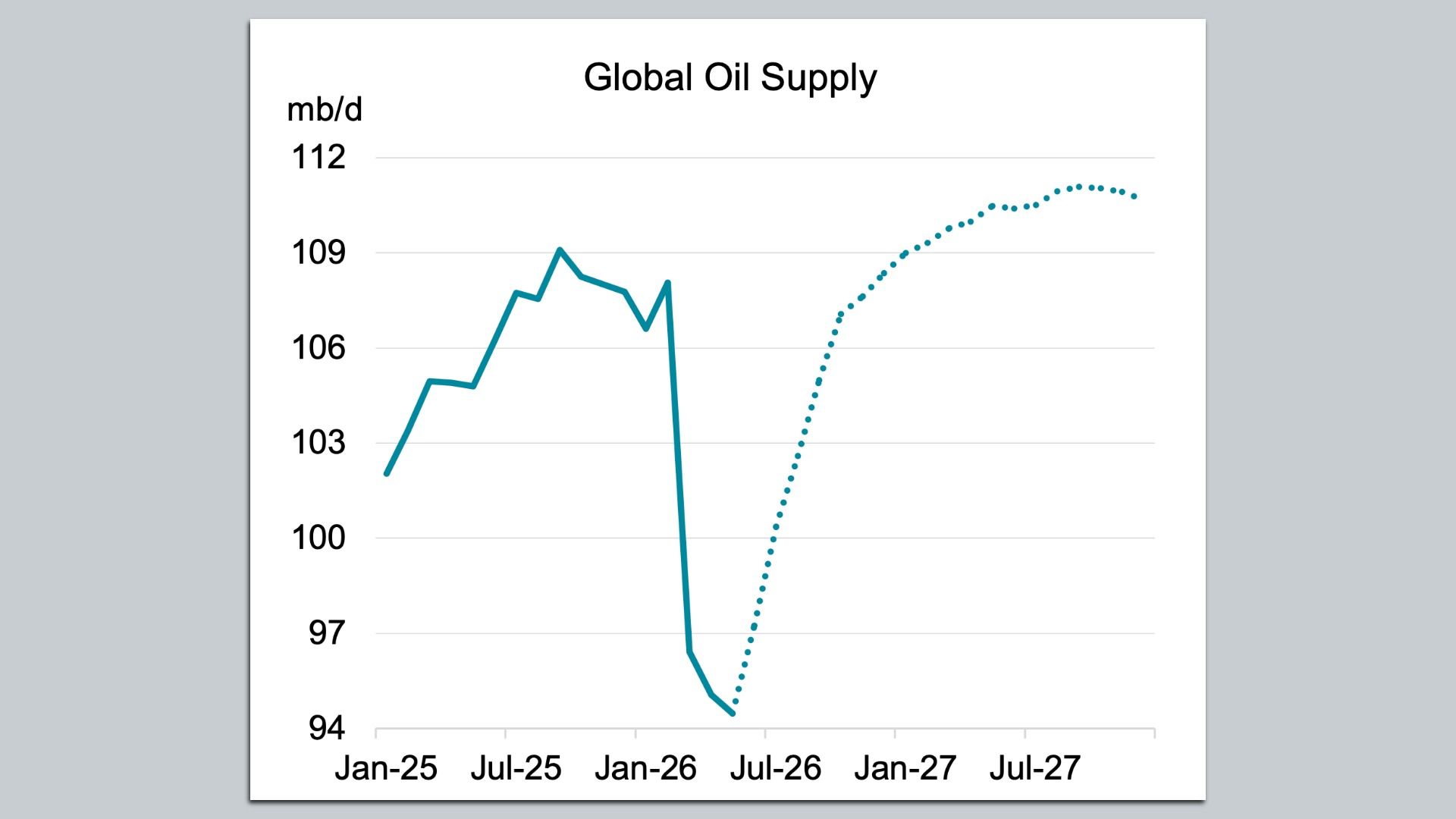
The oil supply shock could give way to a glut next year as the supply revival outpaces demand growth, the International Energy Agency projected this morning.
Why it matters: "This may provide a welcome respite to the market and an opportunity to replenish depleted inventories, or to build new strategic reserves, as countries review their energy strategies and policies in response to the crisis," IEA's latest outlook states.
The big picture: Its first look at the 2027 supply-demand balance sees a jump of 8 million barrels per day (bpd) in supply next year, compared to consumption rising 2 million bpd.
Yes, but: There's uncertainty about what the U.S.-Iran deal even contains, let alone negotiations and shipping conditions that may follow.
- "There appear to be several critical but contentious details on the mechanisms to resume flows through the Strait that are still to be negotiated, and as a result downside risks to our forecast remain," it states.
The bottom line: There's a bumpy road ahead.
- Right now, a huge resumption of supply is theoretical, mine clearance and other logistics will take time, and stockpiles are still draining in the meantime.
- "Despite the significant reductions in demand for crude oil and refined products, the buffers in the system continue to erode at a record pace," IEA notes.
👀 Speaking of the U.S.-Iran ceasefire agreement, Axios' David Lawler and Barak Ravid break down what it's thought to contain.
3. 🛰️ Bezos Earth Fund stakes satellite wildfire detection

The Bezos Earth Fund this morning announced a $26 million grant for the nonprofit Earth Fire Alliance and its satellite-based wildfire detection initiative.
Why it matters: Wildfires are a major driver of deforestation, which worsens climate change, accounting for 42% of tree cover loss in 2025, per World Resources Institute data.
- The funding is the largest single philanthropic grant to wildfire detection to date, per the fund's announcement.
Driving the news: The money — alongside support from Google and others — will help fund launch of three Earth Fire Alliance satellites this summer, the announcement states.
- "FireSat's initial three satellites will provide wildfire monitoring at least twice daily over critical geographies, including a focus on the Amazon Basin— one of the most fire-vulnerable regions on Earth," the Fund and the Alliance said.
- Longer term, the nonprofit hopes to have dozens of satellites operating by the early 2030s that can "monitor every point on Earth every 20 minutes."
The bottom line: The initiative has the potential to help protect homes, communities and biodiversity — and cut CO2 emissions from wildfires by up to 10% annually, the parties said.
4. 🏃 Catch up quick on policy and finance

🪖 The Pentagon plans to provide a $500 million loan for Phoenix Tailings to expand domestic processing of rare earth minerals — an area China currently dominates.
- Why it matters: The Trump administration isn't shy about finding new avenues to stake critical minerals companies, even taking equity stakes in some cases. Announcement ... Bloomberg coverage.
📝 The bipartisan Senate duo of Tom Cotton (R) and Catherine Cortez Masto (D) released broad permitting legislation that includes major new restrictions on federal agencies' power to block previously approved projects.
- Why it matters: Trump officials' moves against previously greenlit renewables projects have been a sticking point in Capitol Hill negotiations.
- What we're watching: A major permitting deal still faces long odds.
🔢 Aston Power, a startup that provides power services to data centers, raised $20 million led by TDK Ventures and Building Ventures, Axios Pro was first to report yesterday.
- Why it matters: The company's sales pitch is built around speed, something that AI companies want badly as their computing needs outpace power supply.
🛢️ Equinor, the Norway-based multinational energy giant, unveiled plans to expand oil and gas output and investment, citing demand "expected to be higher for longer."
- State of play: It also, per Reuters, scrapped its 2030 renewables capacity target.
- The bottom line: Even bigger European heavyweights, BP and Shell, are also pivoting back toward their core fossil fuel business.
5. 🤷 Quote of the day: What does normal even mean anymore edition
"There are just enormous unknowns on [the] supply side and the demand side. So what does that mean? It means brace yourself for continued volatility in pricing, and certainly volatility in the regularity and the safety of these transits."— Karen Young, a researcher with Columbia's energy think tank, on the new episode of its Columbia Energy Exchange podcast
With all the focus on how soon oil supply can resume under the Iran agreement, she's making a key point: the near- and medium-term future of oil demand is uncertain, too, as countries look to rebuild inventories.
- And pre-war demand was "fuzzy" because of China's stockpiling.
- The whole pod is worthy of your time.
📫 Did a friend send you this newsletter? Welcome, please sign up.
Sign up for Axios Future of Energy