Axios Future of Energy

June 09, 2026

🧳 If you're flying this summer, sustainable jet fuel probably won't power your flight. But today we're looking at efforts to make it more than a rounding error in the future fuel mix, then moving on to...
- The case against data centers in space
- A healthy dose of policy news, banks' fossil finance, and more, all in 1,149 words, 4.5 minutes.
🙏 Thanks to David Nather and Chris Speckhard for editing and to our brilliant Axios visuals team.
🎸 This week in 1968, Cream released the double album "Wheels of Fire," which provides today's intro tune...
1 big thing: Google and American Airlines team up on cleaner jet fuel

🚨 Breaking: Google and American Airlines just unveiled a deal that will help the aviation giant greatly boost its usage of low-carbon jet fuels.
Why it matters: Flying is a big CO2 source.
- But sustainable aviation fuel (SAF) — made from used cooking oil, farm waste and other sources — has been slow to catch on due to higher costs and limited supplies.
Driving the news: Under an agreement unveiled today, Google is buying SAF "certificates" from American that help offset the higher purchase cost compared to conventional jet fuel.
- American will buy 35 million gallons of SAF over three years from refiner Valero that will be delivered at Chicago O'Hare International Airport.
- It will result in about 300,000 metric tons of CO2-equivalent emissions reductions, they said.
The big picture: American and Google called it the largest-ever publicly announced deal for these kinds of certificates between an airline and a single corporate customer.
- It helps Google cut emissions from employee business travel, the announcement states. SAF is among the technologies Google supports under its wider climate and sustainability targets.
- "[W]e are sending a vital demand signal to catalyze investment and bring more SAF to market," Kate Brandt, Google's chief sustainability officer, said in a statement.
State of play: Policy matters.
- American's announcement today says Illinois' $1.50 per gallon tax credit for SAF users, which took effect in 2023 and helps with the economics of the fuel, helped enable the deal.
- And there are also federal tax credits for clean fuels producers, though the Treasury Department is still working through specifics on implementation.
Catch up quick: The agreement marks a major expansion of American Airlines' use of SAF building on prior deals with fuel producers Valero, Neste, Gevo and others.
- The company has a target of replacing 10% of its jet fuel with SAF by 2030.
Yes, but: The company used 2.9 million gallons in 2024, representing less than 0.1% of its total fuel use, according to its most recent sustainability report.
- Globally, SAF is growing but still expected to represent under 1% of global jet fuel use this year, per the International Air Transport Association.
The bottom line: "By working with leaders like Google who share our commitment to innovation, we're helping to grow demand for SAF and support the development of a stronger, more resilient market," Jill Blickstein, American's top sustainability executive, said in a statement.
2. 🛰️ The case against space-based AI data centers
Gigascale Capital founder Mike Schroepfer doesn't see the case for orbital data centers — but he's willing to make an exception for SpaceX CEO Elon Musk, who's bullish on the tech.
Why it matters: His skepticism in recent interviews arrives as a growing number of startups have visions of putting AI data centers in space.
- It's a part of SpaceX's sales pitch as the company prepares for what could be the largest IPO in history later this week.
Reality check: "[T]here's a lot of talk about space-based data centers right now. It's 100 times cheaper to put a ton of material on a floating platform in the ocean than to launch it into space," Schroepfer said in a new interview with the climate tech market intelligence company Sightline Climate.
The intrigue: One of Gigascale's portfolio companies is Panthalassa, the wave-energy startup aiming to power AI chips at sea.
- "[W]e should be doing a lot more compute in the open ocean than we should be in space," he said in a separate chat with The Information.
Yes, but: Schroep, as he's known, isn't betting against SpaceX succeeding with orbital data centers.
- SpaceX has a built-in advantage on satellite and launch costs, he said.
The bottom line: "I think Elon Musk is going to do a great job of it. I think it's a trap for everyone else ... I think everyone else chasing that dream is in for a rough ride," he told The Information.
3. 🏃 Catch up quick on policy: Renewables, Congress, oil reserves

⚖️ A federal district judge tossed out an IRS policy that put new limits on wind and solar developers' ability to tap rapidly sunsetting tax credits for new projects.
- Why it matters: These granular IRS "guidance" documents can help determine how many projects can tap major federal tax incentives.
- Catch up quick: Saturday's decision nullified an IRS policy that said developers can no longer claim a project has begun construction if it has already incurred at least 5% of the costs.
- What we're watching: It's not clear if the ruling opens the door for more projects to claim credits, because last year's GOP budget law requires projects to have started construction by July 4, 2026.
🗳️ The House, by voice vote, approved legislation yesterday to require the creation of a Bureau of Energy Security and Diplomacy within the State Department.
- Why it matters: The measure, if it becomes law, would effectively reverse the Trump administration's 2025 dismantling of a similar bureau and movement of those functions into other offices. E&E News has more.
🛢️ The U.S. Strategic Petroleum Reserve is down to its lowest levels since mid-2023, newly released Energy Department data shows.
- Why it matters: Ample government and private stockpiles heading into the war have kept an even more dire oil crisis at bay, but inventories are dropping worldwide.
- The big picture: The SPR was down to 349.2 million barrels as of June 5, the lowest point since August 2023, and could soon reach its lowest point since the Reagan era.
4. 🛫 Iran crisis prompts U.S. jet fuel milestone
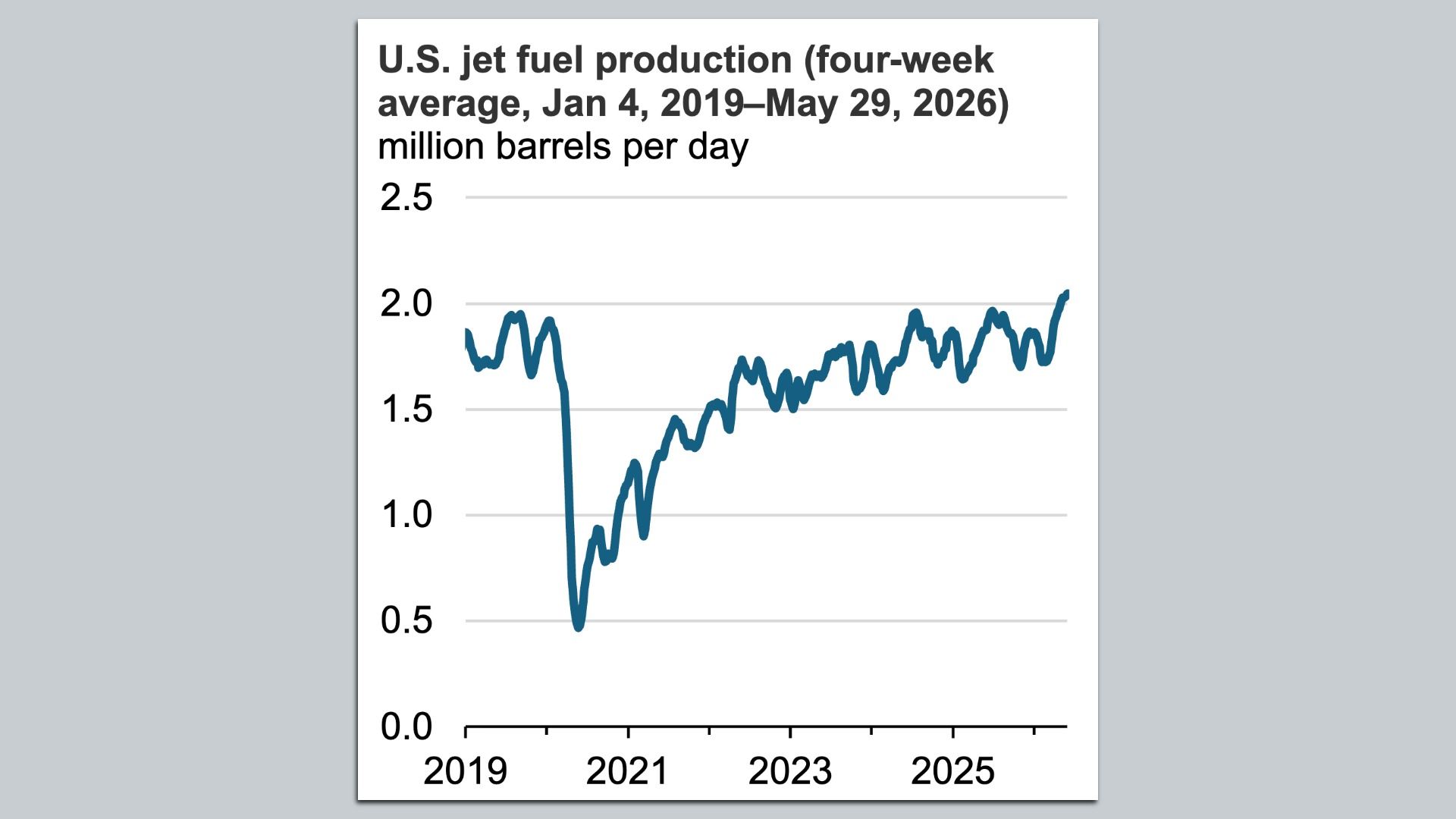
U.S. jet fuel production has hit record highs thanks to higher prices and overseas demand to make up for the throttling of the Strait of Hormuz, per the U.S. Energy Information Administration.
State of play: The estimated four-week production average surpassed 2 million barrels per day for the first time in the week ending May 1, the agency finds.
5. 🏦 Number of the day: $906 billion


That's how much the world's 65 largest banks provided in finance in 2025 for companies doing business in fossil fuels, per a new analysis from a coalition of environmental groups.
Why it matters: The "Banking on Climate Chaos" report notes that while some banks have pulled back, the overall trend is "directly incompatible with achieving carbon neutrality by 2050."
How it works: The annual analysis tallies corporate and project finance for companies involved in extraction, transportation, combustion, storage, trade and more.
- Groups including the Rainforest Action Network, Indigenous Environmental Network, BankTrack and others produced the report.
📫 Did a friend send you this newsletter? Welcome, please sign up.
Sign up for Axios Future of Energy