Axios Future of Energy

November 25, 2025


🥗 We've got a light but nutritious menu as the holiday looms. Today's edition is 1,218 words, 4.5 minutes.
🙏 Thanks to Chuck McCutcheon and Chris Speckhard for edits to today's newsletter, along with the brilliant Axios Visuals team.
🔊 This week in 1977, genius funk aliens Parliament dropped "Funkentelechy vs. the Placebo Syndrome," which provides today's intro tune...
1 big thing: Pipeline fights' unintended consequences

When activists protest oil pipelines with the slogan "keep it in the ground," they don't end up keeping most oil in the ground — and their efforts may even have side effects, like increasing air pollution when the oil is transported in other ways.
Why it matters: These unintended consequences show just how hard it is to curb oil and gas by targeting supply alone.
Driving the news: For the "Shocked" podcast's latest episode, we look at the Dakota Access Pipeline protests of nearly 10 years ago and contrast them with today's energy landscape, which shows oil and natural gas' continued dominance.
The big picture: U.S. oil and natural gas production are at record highs. The last decade makes clear that only two forces consistently bring down production: falling demand and falling prices.
- We saw this during the 2020 pandemic, when demand collapsed, oil prices plunged — and production briefly followed.
Catch up fast: Despite the massive 2016–17 protests, Dakota Access was built. It now moves roughly 500,000 barrels a day of North Dakota crude more than 1,000 miles to Illinois.
How it works: University of Chicago professor Ryan Kellogg wanted to find out what would have happened if the pipeline hadn't been built.
- Eighty percent of the oil would have gone out via trains instead, while 20% would have stayed in the ground, Kellogg said, citing his research.
Threat level: Moving oil by rail can cause explosions, like one in 2013 that destroyed a Canadian town.
- But "the biggest cost of crude by rail in terms of local impacts, really, is air pollution from particulate matter and nitrogen oxides," said Kellogg, who earlier worked as an engineer for BP.
Friction point: We put this dilemma to Jade Begay, a climate justice advocate and policy expert: Even if a fossil fuel project is stopped, the fuel would move by other, possibly more dangerous ways.
- "Why transport the oil at all?" Begay said. "Why are we not investing in the kind of energy we know to be safer?"
Reality check: Activists fight fossil fuel projects for reasons well beyond supply impacts.
- The Dakota Access protests were also a battle for tribal sovereignty — specifically the Standing Rock Sioux.
- Raising awareness of society's deep dependence on fossil fuels is another central goal.
The bottom line: Systematically lowering oil demand — such as with more electric cars — would likely prove a more successful way to stem pipeline projects. But a lack of policy is stalling such trends in the U.S.
Editor's note: This article was written partly based on content from the "Shocked" podcast, which was created by a team including experts at the University of Chicago's Institute for Climate and Sustainable Growth and producers at Magnificent Noise. Amy is the host and the institute's inaugural journalism fellow.
2. 💵 Trump's AI order rollout shows the dominance of price politics

There's nothing about power prices in President Trump's new order to boost AI-driven scientific progress, but Energy Secretary Chris Wright got there fast at a press briefing about it.
Why it matters: Growth of AI and the power-hungry data centers it needs can't be untethered from the politics of rising energy prices — even though it's just one reason for rising electricity demand.
State of play: Wright yesterday argued that AI can eventually bring down consumer costs — and brought up the topic unprompted at the briefing.
- "The ultimate goal of this is to make the lives better for American citizens," including creating job opportunities, he said.
- "In the energy space, it's to bring more energy on, make our electricity grid more efficient and reverse price rises that have infuriated American citizens."
My thought bubble: Wright's emphasis suggests that Trump officials see power prices as a political vulnerability.
The big picture: Officials argue that the hyperscalers' data center buildout will bring more power onto grids, more infrastructure upgrades and lower unit costs for power.
Catch up quick: OK, onto the exec order itself, which puts DOE in charge of a new "Genesis Mission." (The order also lacks "Star Trek II" references, but IYKYK.)
- It aims to leverage DOE's national labs to unite "America's brightest minds, most powerful computers, and vast scientific data into one cooperative system for research."
What's next: Priority areas for the project — which will partner with academic and private-sector researchers — include nuclear power and critical minerals.
3. 🧁 Bonus policy notes: Cars and power
🕵️ Republicans on the House energy committee allege California regulators are stonewalling their probe into state vehicle emissions rules that Congress has overturned.
- Why it matters: California is by far the country's largest EV market, and had set rules to phase out sales of gasoline-powered cars over time. Committee letter.
🗳️ Former Energy Secretary Jennifer Granholm and Allison Clements, a former Democratic FERC commissioner, are leading New Jersey gov-elect Mikie Sherrill's (D) energy transition team.
- Why it matters: Sherrill's energy policies will be under intense glare. Electricity costs were a big deal in her campaign, and Sherrill vowed aggressive moves to stop further increases.
4. ⚔️ On my screen: Oil sanctions and data center tension

🛢️ Two things are true at the same time — the Trump team has imposed major sanctions on Russian oil giants, and they're not game-changing, a new analysis argues.
- Why it matters: Oil exports are a critical cash source for Moscow as its war against Ukraine grinds on, and the October sanctions against Rosneft and Lukoil arrived ahead of stepped-up cease-fire talks.
- State of play: The sanctions' bite will be limited unless and until the U.S puts far more pressure on China, the largest buyer of Russian barrels, analysts with Columbia's energy think tank write in Foreign Affairs.
- Friction point: Other interests are getting in the way, namely reluctance to reignite the trade war with China and risk access to its rare earths, Erica Downs and Richard Nephew argue.
- Yes, but: Treasury Department officials are claiming progress with the sanctions, citing steep price declines in Russia's Urals crude benchmark. And Reuters reports this morning that India's imports are about to hit three-year lows.
⚡A few data center things crossed my screen that are worthy of your time.
- The big picture: One is this wide-ranging report from the Information Technology & Innovation Foundation. A key part is discussion of "bridging solutions" that wring more capacity and flexibility from existing grid systems in the years it takes new generation to get built.
- Zoom in: Utility Dive has a great breakdown of industry, state regulators' and others' input on DOE's plan for FERC to take control of big data centers' grid interconnection. Harvard's Ari Peskoe also spelunked the docket and posted useful summaries.
5. 📊 Charted: California's natural gas decline
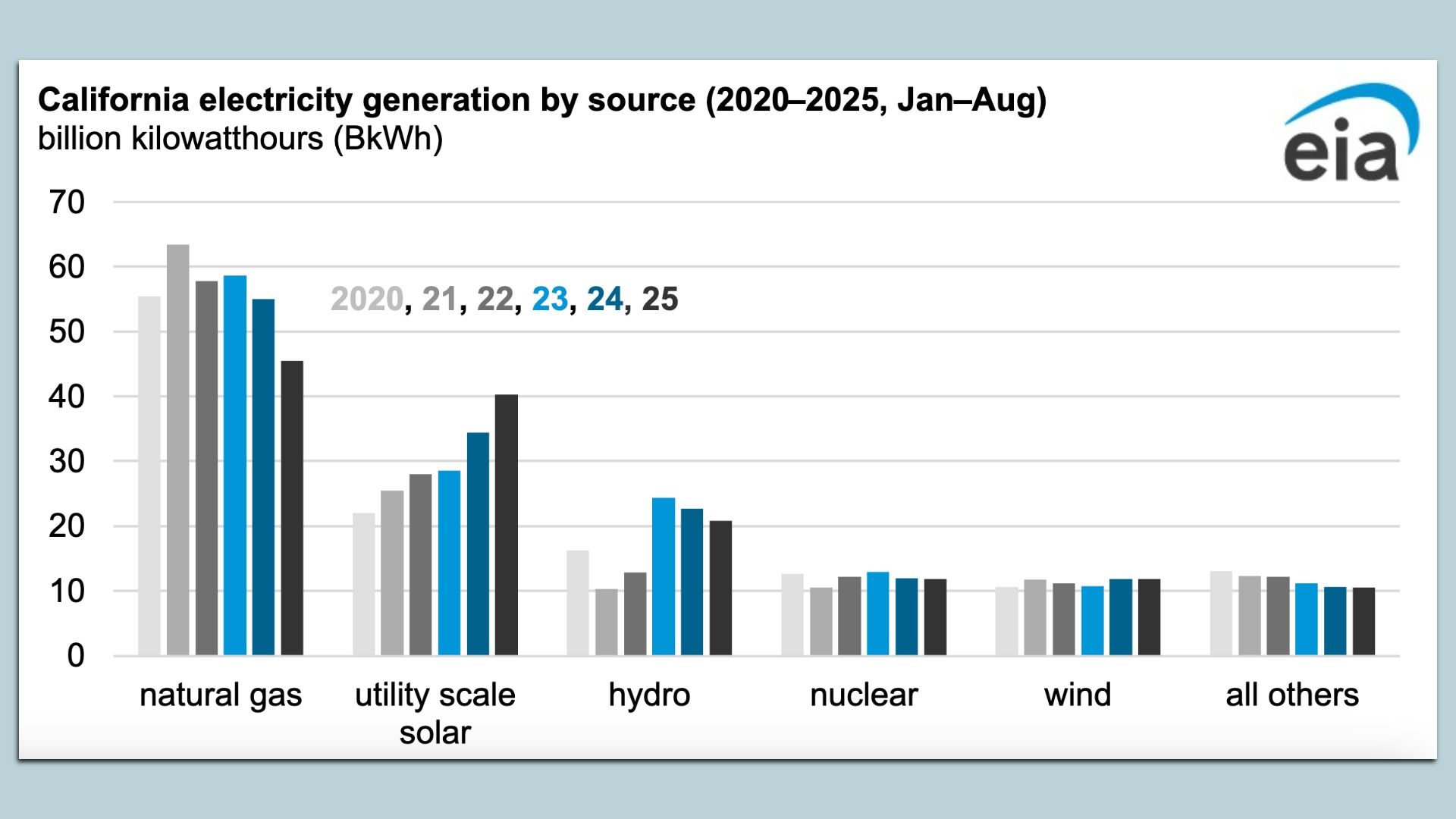
Natural gas remains California's largest power source, but its lead is slipping as solar rises, Energy Information Administration data shows.
The big picture: While gas generation varies partly based on how much water is available for hydro-dams, both gas and hydro are down in 2024 and 2025 as solar grows.
6. 🌡️ Number of the day: 94%
Those are the odds that 2025 will be the third-warmest in records dating back to the 1800s, per the research group Berkeley Earth's latest analysis that includes October data.
📬 Did a friend send you this newsletter? Welcome, please sign up.
Sign up for Axios Future of Energy