Axios Future of Energy

January 30, 2026


🕺Happy Friday! We're closing the week with a bang, offering items on...
- 👋 A new lobbying player
- ⚠️ Grid warning signs
- 🛢️ Venezuela action
- 🏭 EPA's pollution math, and more, all in 1,499 words, 5.5 minutes
🙏 Thanks to Chuck McCutcheon and Chris Speckhard for edits to today's newsletter, along with the brilliant Axios Visuals team.
🎶 Happy birthday to multitalented singer-songwriter-producer Jody Watley, who has today's intro tune...
1 big thing: Exclusive — Meet the newest energy tech deployment player

A new organization is launching to improve federal support for commercial deployment of a range of energy tech, with initial focus on DOE's loan office.
Why it matters: The Energy Infrastructure Alliance Forum (EIAF) aims to fill what organizers call a need for a broad-based push that complements others' ongoing work on specific tech and finance streams.
The big picture: "We really haven't had an organization solely focused on the commercialization or deployment of energy technologies as a whole," said Taite McDonald, a partner at Holland & Knight who is co-founder and a board member of EIAF.
Driving the news: The group's website went live today, and it recently incorporated with 501(c)(3) and 501(c)(4) arms, which enable a range of communications, advocacy and lobbying work.
- It formalizes ad-hoc work that various industry players and advocates have been doing for over a decade, organizers said.
- Others involved include board member and ML Strategies senior VP John Lushetsky, a former DOE official who advised the loan office; and board member Nick Loris, the executive VP of policy at the Conservative Coalition for Climate Solutions.
What's next: The group is searching for a full-time executive director. It then hopes to add staff as it aims to help technologies cross the "commercialization valley of death."
- It has seed funding and is looking to expand backing from philanthropies and other sources, the organizers say.
State of play: DOE's loan program — rechristened as the Office of Energy Dominance Financing — has $289 billion in available loan authority.
- EIAF is bullish on the office's potential for transformative finance in areas like nuclear, critical minerals, transmission, long-duration storage and geothermal projects.
- But it also has policy and legislative recommendations — spelled out in its first paper — to boost the program's influence by removing friction.
- The group could also focus in the future on other parts of DOE too, like the Advanced Research Projects Agency-Energy and the national labs.
Zoom in: Goals for the loan office include...
- "Clearer pathways for expedited review of commercially ready projects."
- Closer collaboration with the Defense Department, U.S. development finance agencies and beyond.
- A more proactive role in working with technologies that are "underrepresented in its pipeline but critical to energy dominance."
- Changing "direct and indirect limitations" on federal support for projects working with multiple DOE programs.
The bottom line: "Our focus is always to try to maximize those opportunities when possible, and reduce some of the frictions that you've seen historically when trying to work with an agency to test different technologies and to commercialize different technologies," Loris said.
- It's also looking long-term to "ensure that this program is successful from one administration to the next, whether it is a Republican to Democrat or Republican to Republican," he said.
2. 🏭 The fallout from EPA's pollution shift

You've all read about the EPA's move away from monetizing the benefits of avoiding ozone and soot in the air, so we made the rounds with a lot of smart people to tease out what it's really going to mean.
Why it matters: Environmental and public health groups say the shift is quite dangerous. There are dissenting voices, however, who think the impact might be less than those groups think.
What we're watching: Whether and how the shift might spill into upcoming air pollution rules, and the picture there is, well, hazy.
Driving the news: The agency stopped assigning — for now — monetary estimates of the health benefits of avoided ozone and fine particulate pollution, narrowing its focus to the costs to the industry.
- "From a practical perspective, there is a risk that ignoring one side of the ledger undermines the ability of decision makers to make fully informed decisions," Carrie Jenks, who heads Harvard's Environmental & Energy Law Program, said in an email.
The big picture: Health and green groups slammed the decision. Some former EPA officials, however, say the impact could be indirect, or might not actually steer the regulations in a different direction.
- "I don't think the new policy will change the outcome of any rulemakings, but it may take away one of the arguments that would otherwise be used against the Trump EPA," Jeff Holmstead, a partner with Bracewell LLC, said in an email.
3. 🏃 Catch up quick on oil: Venezuela, M&A, tariffs

💬 Chevron today is sounding fresh notes of both optimism and caution on Venezuela.
- Why it matters: It's the only U.S. oil giant still operating there, producing around 250,000 barrels per day via joint ventures with state-owned PDVSA.
- Driving the news: Chevron's Q4 earnings presentation cites "significant potential" there and says it's optimistic on the country's sector getting "more competitive." It reiterates the potential to boost production by 50% over 18-24 months.
- Yes, but: Chevron CFO Eimear Bonner tells the FT the company plans to keep a tight rein on spending and is focused on growing volumes from existing operations.
👀 U.S. shale heavyweights Devon Energy and Coterra are in advanced talks about a merger that "would be one of the largest oil and natural gas deals in years," Bloomberg reports.
▶️ The Treasury Department issued a broad license enabling companies to sell, market, store, transport and engage in other activities in Venezuela's oil sector.
- Why it matters: It's the broadest move yet to ease restrictions on U.S. companies. But yesterday's notice doesn't directly apply to upstream production, where Chevron is the only U.S. player authorized.
- The intrigue: ClearView Energy Partners said it might "leave room" for Treasury to "approve upstream operations not already authorized under existing licenses on a case-by-case basis."
- What we're watching: It comes as Venezuelan officials, under U.S. pressure, just changed their hydrocarbon laws to make them more favorable to foreign operators.
⚔️ President Trump issued an order threatening new tariffs on countries that sell or provide oil to Cuba. It "would primarily put pressure on Mexico, a government that has acted as an oil lifeline for Cuba," AP reports.
4. ⚠️ Power grid moving into the red in many areas, watchdog warns

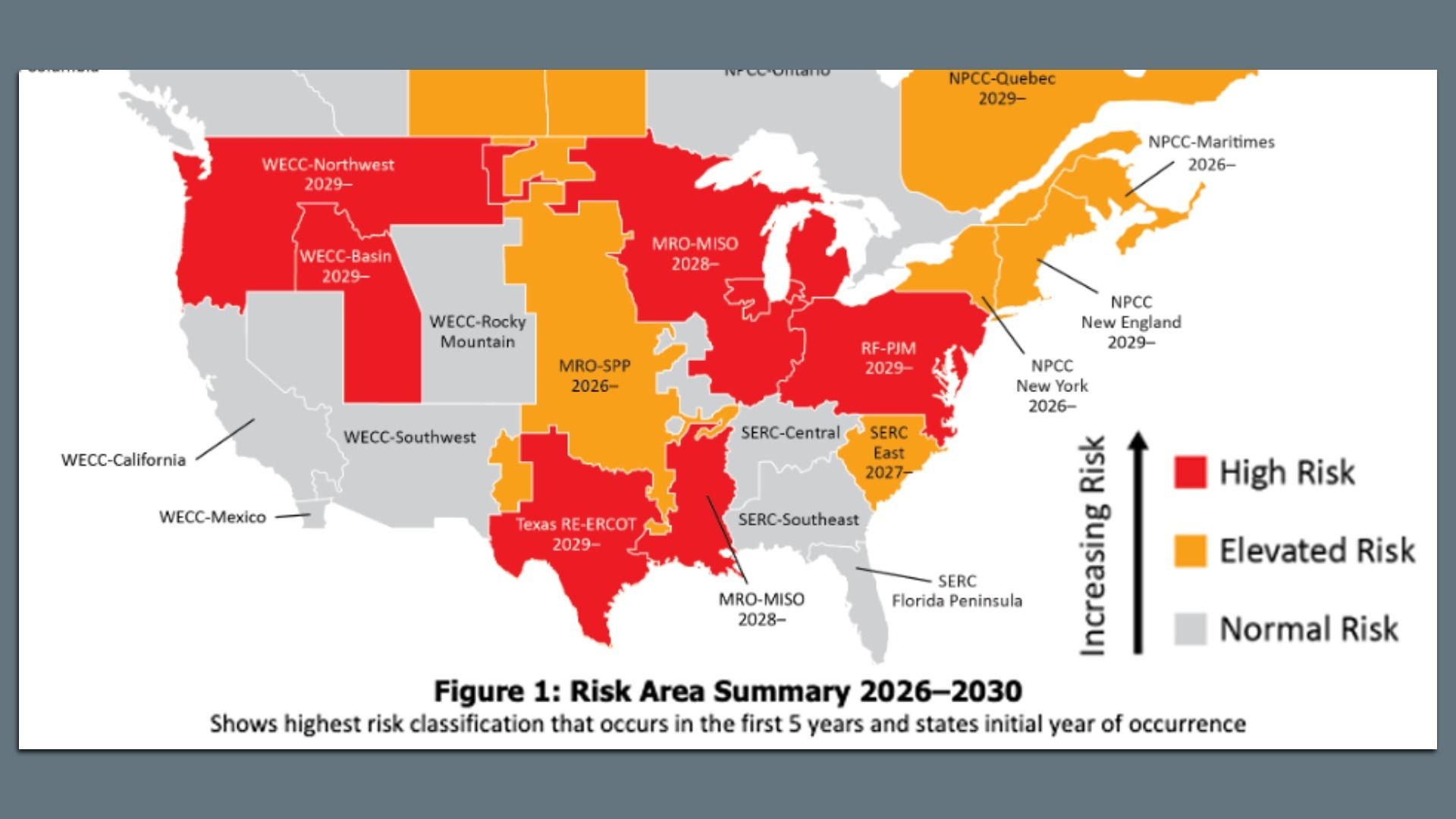
The group that monitors power grids in the U.S. and Canada released a dire analysis yesterday showing a growing risk of future blackouts in many areas.
Why it matters: The North American Electric Reliability Corp.'s latest assessment is certain to figure prominently in the ongoing raging debates over electricity, data centers and AI.
Driving the news: The Midcontinent Independent System Operator, which covers much of the Midwest, is seen as being in especially critical shape. It slips into code-yellow "elevated risk" next year and code-red "high risk" in 2028.
- Expected additions to the grid won't keep up "with escalating demand forecasts and announced generator retirements," NERC said.
- The much-maligned PJM Interconnection, which covers 13 states and the District of Columbia, also is set to enter "high risk" territory by 2029.
What they're saying: "Poor grid operator interconnection processes, as well as overly cumbersome state-level siting and permitting rules, need urgent attention," said Caitlin Marquis, a managing director at Advanced Energy United, which represents companies and buyers across clean-energy sectors.
- National Rural Electric Cooperative Association CEO Jim Matheson agreed: "This report clearly highlights the need for smart, swift actions and serious conversations about how we will meet tomorrow's energy needs as a country."
5. 👓 Hot reads: Nuclear rules, China, biofuels vs. power, EVs

China's Four-Year Energy Spree Has Eclipsed Entire US Power Grid (Bloomberg)
Amy says: Wow, China is building nation-sized power systems every year, reportedly to power all the electricity-hungry industries growing now, the buzziest of which is AI.
We could produce a lot of electricity on the land used for biofuels (By the Numbers)
Ben says: Energy data ninja Hannah Ritchie's post is a fascinating thought experiment with jaw-dropping stats about power potential, and it has the appropriate caveats (need for storage, where power is actually needed, etc.).
- "These comparisons all boil down to the efficiency benefits of solar over crops. Crops convert less than 1% of sunlight into biomass; solar panels convert around 20%. Add the efficiency gains of electrified cars over liquid fuels, and the efficiency gap widens further," she writes.
The Trump administration has secretly rewritten nuclear safety rules (NPR)
Chuck says: Even if you heard the story, read the online version — it details numerous proposed changes and cuts. As nuclear power barrels ahead, its findings will be integral to the debate.
EV charging keeps expanding despite Trump (Canary Media)
Amy says: This is a good reality-check type piece that parses fact from conventional wisdom, or conventional assumptions based upon a noisy news environment.
6. 💬 Quote of the day: Data centers, get-out-your-checkbooks edition
"These companies, at least in their public statements, say they're willing to pay their own way. We just want to make sure that that happens, when push comes to shove."— Sen. Chris Van Hollen (D-Md.) to reporters yesterday on his new bill aimed at containing consumers' rising electricity costs from data centers' energy needs.
📬 Did a friend send you this newsletter? Welcome, please sign up.
Sign up for Axios Future of Energy