Axios Future of Energy

June 12, 2026


📉 Oil markets are reacting like an Iran deal could really, truly be at hand, but we're diving into why nobody should get too comfortable. We've also got...
- Climate and battery news, weekend read ideas and more, all in 1,121 words, 4 minutes.
🙏 Thanks to David Nather and Chris Speckhard for editing and to our brilliant Axios visuals team.
🐴 This week marks a decade since Band of Horses released the album "Why Are You OK," which provides today's intro tune...
1 big thing: When oil prices could get even worse
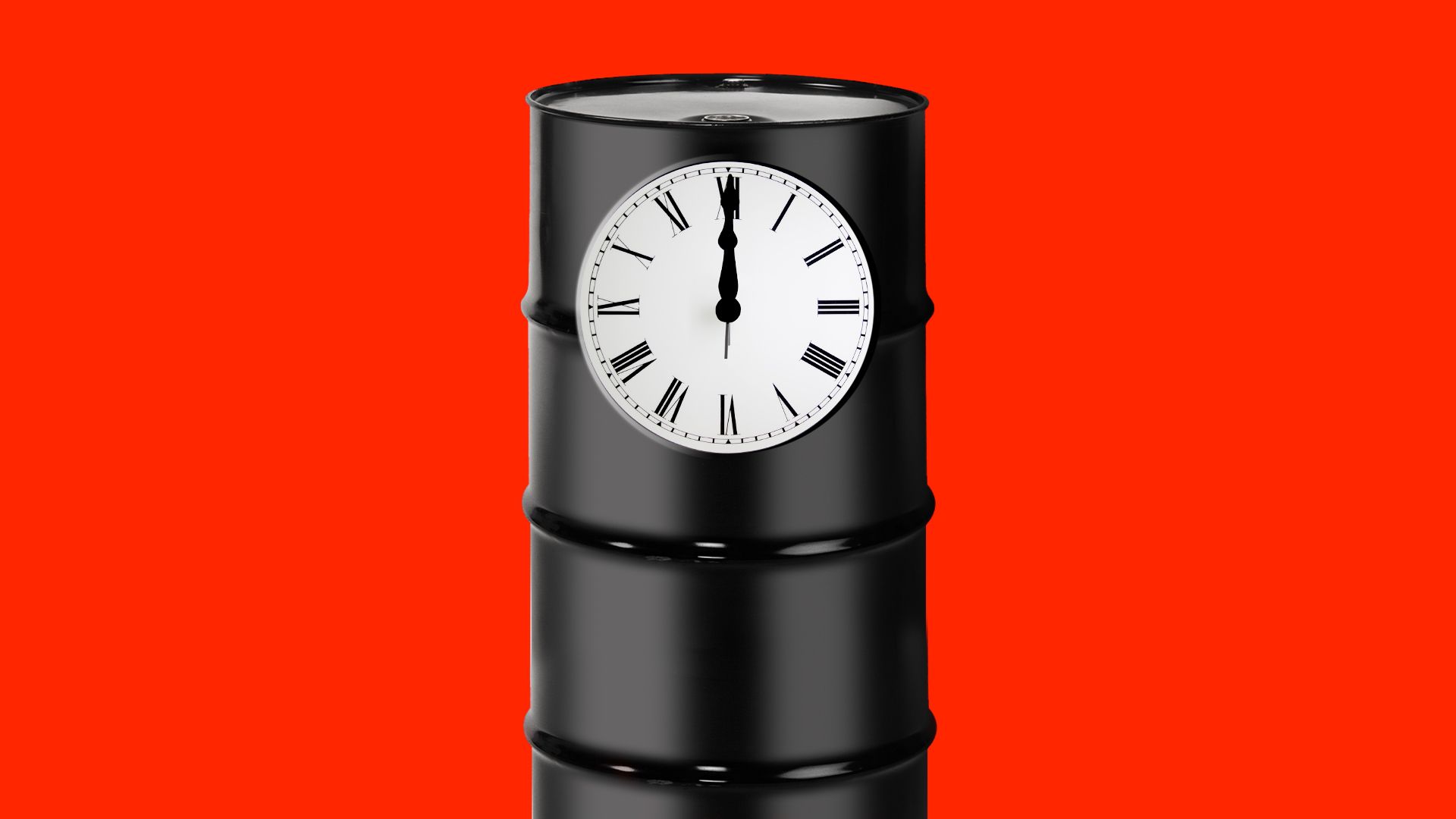
Oil prices have defied predictions of even bigger increases than we've seen — but the markets' shock absorbers could easily wear out later this summer unless the Strait of Hormuz opens soon, analysts warn.
Why it matters: If the stockpiles run too low and oil prices surge, prices at the pump — which have been falling lately — could spike again as the midterm elections approach.
The latest: President Trump said yesterday that a deal with Iran is imminent, but the outlook changed so many times in the course of one day that it could easily change again.
- The oil markets seem to think it might happen, though, as oil is trading around its lowest levels in three months. Read the latest from Axios' Barak Ravid.
- The global benchmark Brent crude is trading at $87.94 this morning.
Threat level: At some point, stockpiles will fall too low to keep easing the market, and other measures won't be able to offset the loss of barrels flowing through the strait.
- That point could be coming soon. A recent note from investment firm Macquarie estimates that if the strait is still closed on Labor Day, Brent crude prices could be $130-$150.
How it works: Storage can't go to zero. Sludgy oil at tank bottoms is not usable, pipelines need certain amounts to maintain function, and refineries need minimum stocks.
State of play: U.S. stockpiles, both private and the Strategic Petroleum Reserve, are dwindling fast. They're falling in a number of other nations, too.
- "The world has been relying on inventories to kind of manage the supply disruption, but ... that can't last forever," Aaron Brady, a top analyst with the research and consulting firm S&P Global Energy, said in an interview.
What they're saying: "If the strait is not reopened in, call it the next month or so, those inventories are going to get, we think, towards those minimum operating levels in the U.S., perhaps other places as well," Brady said.
The big picture: Before the war, global oil inventories were rising as production grew faster than demand.
- It's one of the biggest reasons that while oil prices have soared, they have stopped well short of dire predictions of $150 per barrel or even much higher.
- Other buffers include China's import decline, Saudi Arabia and some other producers moving more through pipelines, some tankers getting through, and governments' use of strategic reserves.
Zoom in: U.S. commercial crude storage levels fell by over 7 million barrels to 426.5 million the week ending June 5, per federal data.
- These commercial supplies are draining fast even as the Trump administration has provided the market with oil from the Strategic Petroleum Reserve.
The bottom line: S&P Global Energy points out that inventories in the critical Midwest and Gulf Coast refining markets are currently at 351 million barrels.
- A "danger zone" starts when they get down to around 325 million, the firm estimates.
- "As inventories drop below this threshold, the market becomes increasingly vulnerable to logistical bottlenecks and price spikes," the firm said in a note yesterday.
2. 🧁 Bonus: Charting the inventory decline


The recent decline in inventories is different than in 2022, because back then the drop was almost entirely because of President Biden's SPR drawdown.
- This time, as we noted above, commercial stockpiles are falling fast, too.
The intrigue: One reason for the U.S. inventory decline is rising U.S. oil exports.
- They're going into a global market that needs barrels to help offset the Strait of Hormuz bottleneck.
- But Trump administration officials have said they're not considering restrictions on U.S. shipments abroad.
3. 🏃 Catch up quick: Climate, Venezuela, batteries
🌎 The carbon removal industry is psyched that just-revised standards from the Science Based Targets Initiative, a top arbiter of corporate climate plans, provide a greater role for removal in achieving emissions targets.
- Why it matters: It's a boost for the young sector, which faces peril from climate getting less love in global diplomacy and some C-suites in recent years.
- What they're saying: "The new Corporate Net-Zero Standard provides important clarity for companies looking to invest in carbon removal and helps to justify both near-term corporate investments and longer-term procurement agreements," Ben Rubin, executive director of the Carbon Business Council, said in a statement.
- Go deeper: Heatmap News has a nice look at the new standards.
🇻🇪 Reuters reports from Caracas that "Venezuela signed five agreements with British oil major Shell on Thursday to advance oil and gas projects, including the company's participation in the coveted 7-trillion-cubic-feet Loran offshore gas field, the government said."
🔋 Battery startup ZincFive unveiled plans to go public via a SPAC formed by the SparkLabs Group.
- Why it matters: ZincFive is riding the AI wave. The tech is "positioned to address the accelerating build-out of global data center markets and the emerging need for short-duration, high-power solutions for advanced AI infrastructure designs," the announcement states.
- How it works: The company makes a nickel-zinc battery that can charge and discharge more quickly and is less flammable than lithium-ion batteries.
- State of play: The deal values the company at $600 million ahead of the transaction and will provide roughly $125 million in new capital. Go deeper.
4. 👓 Hot Reads: Data centers, Texas

Majority of US's new AI data centers to be built on drought-hit land (The Guardian)
Amy says: Quote du jour from Andrew Coppin, chief executive of Ranchbot, which helps ranchers track water use: "I mean, ChatGPT is a pretty nice tool, but most people would prefer to have a beef steak if they had to choose."
Oil prices are up; whither the Texas boom? (Federal Reserve Bank of Dallas)
Ben says: This is a lucid, data-rich look at how the energy price spike both helps and hurts Texas — and why higher prices don't bring the job gains they once did.
- "[W]indfall income from higher profits on existing production will be the primary channel for offsetting the negative effects of higher fuel prices on Texas households and the broader economy," the authors conclude.
5. 💬 Quote of the day: Energy security edition
"An electron can be sourced from coal, gas, sun, wind, or uranium; a combustion engine is married to a single fuel that must cross someone else's chokepoint. Electrification is the purchase of optionality, and China bought more of it than any nation in history."— Oil analyst Jeff Currie in a new Financial Times op-ed
📫 Did a friend send you this newsletter? Welcome, please sign up.
Sign up for Axios Future of Energy