Axios Future of Energy
September 29, 2025


🧑🍳 Welcome back! We've got a wide menu that won't fill you up — today's edition is a quick 1,433 words, 5.5 minutes.
📻 Exactly one year ago, Shaboozey was midway through an epic run atop Billboard's Hot 100 with today's intro tune...
1 big thing: A clean-tech VC player sizes up Trump 2.0

Power industry investments amid rising demand — from AI and beyond — create openings for clean tech startups despite policy headwinds, Energy Impact Partners founder Hans Kobler said.
Why it matters: EIP is a prominent backer of energy and climate tech companies via venture capital and other support, and works with utilities.
🖼️ The big picture: "Our utility investors are facing massive [capital expenditure] needs," he told Axios in an interview. "Anything that mitigates that is a top priority for us to invest in."
- That includes companies — inside and outside its current portfolio — that can help turn data centers into flexible grid assets, he said.
🏈 State of play: Kobler name-checked firms such as Enchanted Rock, which provides onsite power and microgrid solutions, in offering his wider thesis.
- Ways to optimize existing transmission and distribution infrastructure are good areas, too, he said.
"Data centers are big, big loads. Anything we can do there with companies like Enchanted Rock is at the top of our priorities, and reducing the cost of power delivery and the capex requirements," he said.
- He also noted widespread support for building nuclear plants.
- One of EIP's portfolio companies is AI startup Atomic Canyon, which helps navigate regulatory processes.
Reality check: The U.S. environment is a "mixed bag."
- "There's a little bit of a culture war going on against climate, clean tech, anything that is associated with that," he said.
- Inflation Reduction Act rollbacks and tariffs are obstacles, though the latter can help drive new U.S. manufacturing.
"Anything capex-intensive is a little bit of a challenge right now, and it's largely driven by the interest rate," he said. "I think our sector was spoiled for almost 10 years of free money and low interest rates. And that is good for venture capital, it's really good for capital-intensive businesses."
- He hopes that interest rates keep coming down after the Federal Reserve's latest cut.
👟 Catch up quick: EIP, founded in 2015, has grown to roughly 100 people, with around $5 billion in assets under management, Kobler said.
- Roughly 80% of investments so far are in North America, with most of the balance in Europe, but the company has relationships in Asia and the Middle East, he said.
- Its portfolio includes around 80 companies spanning grid tech, batteries, low-carbon industrial materials, nuclear, hydrogen, and lots more.
- It has had around three dozen exits.
👀 What we're watching: The next potential IPOs from its portfolio.
- "I think anything that allows us to add more load, cost-effectively, reliably, whether that's flexibility, whether that's speed to power, I think those are topics that the public market should like, because it's just an incredible growth trajectory," he said.
The bottom line: "The administration is all about AI dominance, all about energy dominance," Kobler said.
- "And to be energy dominant, you have to lead in energy innovation at the end of the day."
2. 🔭 The possible futures of battery storage
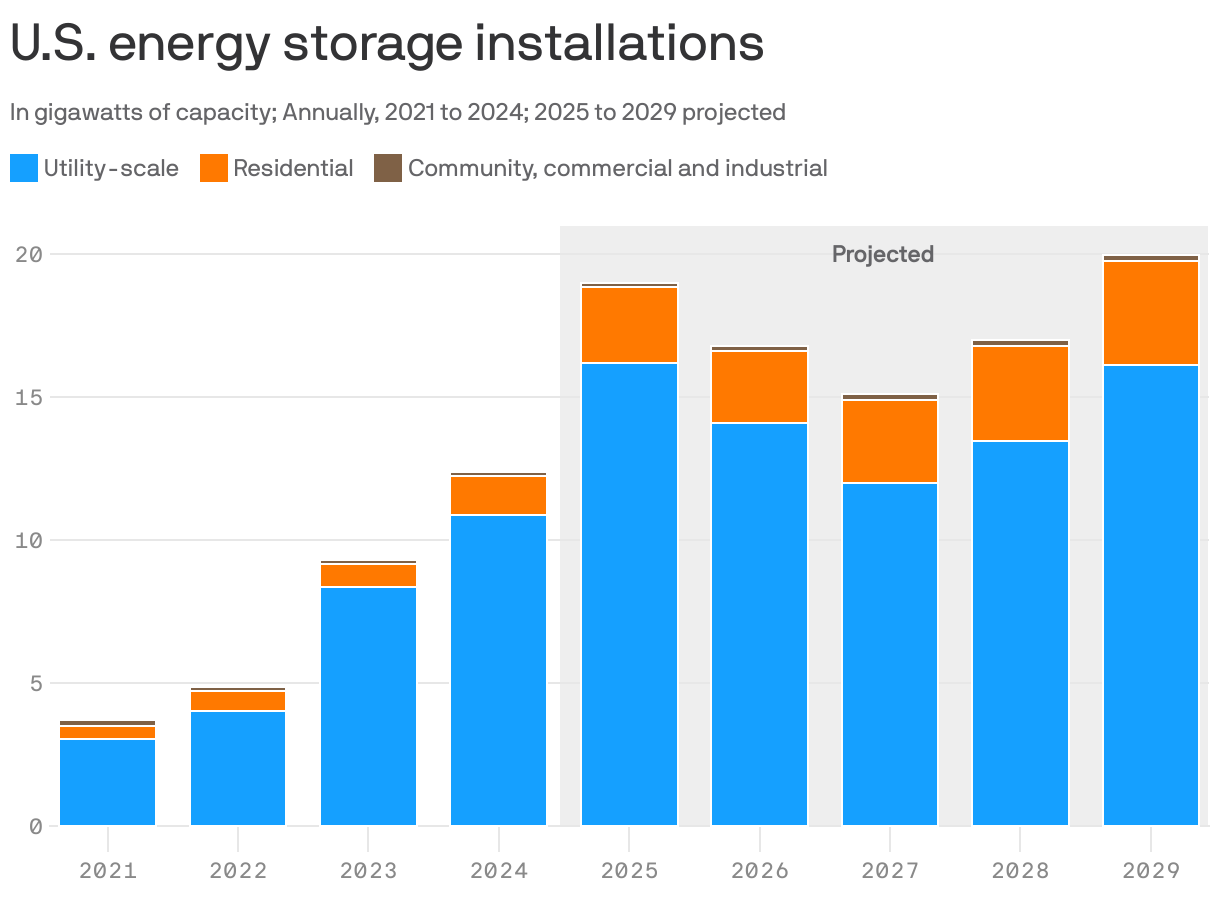
Battery storage will reach a fresh record this year, but a trough looms despite the GOP budget law keeping incentives in place, a new analysis finds.
Why it matters: Storage boosts grid resilience and helps enable higher levels of intermittent renewables.
What's next: Wood Mackenzie's outlook finds that annual installations won't reach this year's levels again until 2029.
- It cites "new restrictions on equipment sourcing and ongoing global trade uncertainty will slow deployment."
- Woodmac also models a more pessimistic case than what's shown above, depending on implementation of Chinese sourcing restrictions, trade friction and more.
3. 👀 Hot Reads: power markets, data centers, "Moneyball," banks


How to Make Energy in the West Cheaper and More Reliable (High Country News)
Chuck's take: An interesting look at regionalized power markets, in which participants can export and import energy across a larger geographical area. We'll be hearing more about these.
Citing Climate Crisis, NAACP Expresses Opposition to Massive Alabama Data Center (Inside Climate News)
Chuck's take: An example of how data center critics are seeking to constrain their rapid growth by spotlighting impacts on largely African American communities.
Moneyball for the Environment ("Shocked" podcast)
Amy's take: This episode shows how statistics analysis made famous in the movie/book "Moneyball" can be applied to environmental regulations. I learned a lot recording this (disclaimer: I'm the host). AI factors in here by making data-heavy metrics accessible to pinpoint pollution violators.
Spending on AI Is at Epic Levels. Will It Ever Pay Off? (WSJ)
Amy's take: When data center capacity = energy capacity, one needs to become hyper-informed on the data center growth landscape writ large. That's what I found useful about this big-picture — and skeptical — take on the massive buildout now underway.
Banks retreat from climate change commitments — but it's business more than politics (The Conversation)
Ben's take: It convincingly challenges the CW that GOP pressure over ESG is the big reason why banking giants are bailing on net-zero coalitions.
4. 🔍 Trend-spotting: business angst about EPA's climate anvil

Some K Street and corporate heavyweights fear EPA's plan to scuttle the "endangerment finding" alongside vehicle CO2 rules will bring risky side effects.
State of play: The powerful National Association of Manufacturers' comments back EPA's plan to avoid tailpipe CO2 standards for light- and medium-duty vehicles.
Yes, but: Despite EPA stating — and NAM agreeing — that federal policy preempts state and local climate laws, NAM fears legal headaches if the endangerment finding also goes away.
- EPA should consider a "streamlined repeal of the Tailpipe Rule" but "defer action on the endangerment finding to create the most favorable regulatory environment for American manufacturers."
Friction point: Oilfields services giant Schlumberger Technology Corp. (SLB) frets U.S. trading partners' response if EPA yanks the finding.
- "[M]any jurisdictions are tying market access to demonstrable emissions performance and verifiable data," it writes.
- And it's concerned EPA policies will slow U.S. investment in tech like carbon capture and geothermal — areas of diversification for drilling contractors.
Catch up quick: The 2009 endangerment finding provides the legal basis for regulating CO2 emissions from cars and trucks, and — by extension — some other big sources.
Zoom out: YMMV by industry sector, company, trade group, NGO, etc.
- I've been highlighting a few comments that stood out, but the whole docket is worth taking for spin.
The bottom line: Scratch the surface of business support for less regulation, and you'll find unease that EPA is failing the Goldilocks principle.
5. 🫤 VC investors and data centers: it's complicated


Venture investors at Climate Week NYC looked for anything to talk about other than data centers.
Why it matters: Funders are waiting for a shakeout in the overheated sector.
Inside the room: Data centers dominated virtually every panel and happy hour, as countless founders and funders hoped to capitalize on the sector's insatiable energy and water demand.
Yes, but: "The returns just aren't there," investor Grant Allen tells Axios Pro.
Zoom in: Some venture firms are simply pulling back from the sector.
- "I will not be investing in anything around data centers for the foreseeable future; too many companies," one climate-focused funder says.
Others are limiting investments to "adjacent tech" that might find traction with data centers but isn't dependent on them.
Unlock the whole story, and for a steady diet of scoops and smart analysis, talk to our sales team about Axios Pro Deals.
6. 🏃 Catch up quick on Big Oil: BP, TotalEnergies, Exxon

👍 BP is moving ahead with the $5 billion Tiber-Guadalupe project in the Gulf of America (renamed by the U.S. from the Gulf of Mexico), it said this morning.
- Why it matters: It would add another 80,000 barrels per day of production and underscores BP's pivot back toward its core oil and gas business.
💵 TotalEnergies is snagging a 49% stake in Continental Resources' gas assets in Oklahoma's Anadarko Basin.
- Why it matters: The deal "further strengthens" TotalEnergies' integration across the U.S. LNG value chain, it said today.
📈 Exxon is ramping up its trading operations as it "presses ahead with plans to make more money from its vast worldwide energy infrastructure," Bloomberg reports.
7. 🇨🇳 Quote of the day: China pledge fallout edition
"It is kind of like admitting that, well, if the United States isn't there leading, I'm not under pressure, I'm just going to go with my simplest, most straightforward [nationally determined contribution] and not overcommit myself, not stretch, not try to inspire others to come along the journey with me."— NYU energy scholar Amy Myers Jaffe on the latest episode of The Energy Gang podcast
That's Jaffe on China's pledge to cut emissions 7%-10% by 2035 under the Paris Agreement, which many analysts find underwhelming.
📪 Did a friend send you this newsletter? Welcome, please sign up.
🙏 Thanks to Chuck McCutcheon and Chris Speckhard for edits to today's edition, along with the brilliant Axios Visuals team.
Sign up for Axios Future of Energy