Axios Future of Energy
June 24, 2026


🚰 There's a gusher of info from Big Tech companies defending their water use. We start there and then flow into...
- President Trump's DOJ threat, analysis of DOE nuclear loans, news on oil, battery storage data and more, all in 1,380 words, 5 minutes.
🙏 Thanks to David Nather, Mackenzie Weinger and Chris Speckhard for editing and to our brilliant Axios visuals team.
🎧 Happy birthday to Hope Sandoval of Mazzy Star, who provide today's achingly beautiful intro tune...
1 big thing: Microsoft points to lower water use in AI era

Microsoft is seeking to make the case that its AI-fueled data center expansion does not come with soaring water use.
Why it matters: Combined with recent water announcements from Google, Amazon and Nvidia, Microsoft's update today shows how the companies at the heart of the AI boom are racing to respond to growing concerns about the buildout's environmental footprint.
Driving the news: Microsoft said its newest AI-focused data center designs — first unveiled in 2024 — do not consume water for cooling during normal operations.
- The move is part of a broader effort that the company says has helped improve its water efficiency by nearly 90% since the early 2000s.
- The company also said it replenished more water globally in fiscal year 2025 than it used across its operations, a milestone toward its goal of becoming water positive by 2030.
State of play: Microsoft's newest AI data centers continuously recirculate coolant directly to the chips and use air-cooled chillers outside the building, eliminating the need for water-consuming cooling towers during normal operations.
- The result, Microsoft says, is that the systems require an initial water fill but do not consume water during normal cooling operations.
Between the lines: Much like the other tech companies' recent announcements, the information is not entirely new.
Friction point: What is new is opposition.
- Roughly 70% of Americans oppose building data centers in their communities, according to Gallup polling released in May, with water and energy concerns the top two reasons.
What they're saying: "I have community [members] ask me questions about it, and if I come across and say we don't use water, they look at me like this guy's full of it," Steve Solomon, Microsoft's vice president of data center engineering, said in an interview.
- "But the reality is, the data centers that are getting all the press on the AI — we do not consume water."
Yes, but: Most of Microsoft's existing data center fleet still uses some water for cooling. The company says many facilities rely on systems that use outside air and only periodically require water.
Zoom out: Water use inside a data center is only one piece of a broader debate. Producing the electricity needed to run AI infrastructure can also require significant amounts of water, depending on the power source.
Reality check: To support the rapid AI buildout, Microsoft, along with other tech giants, is increasingly turning to natural gas-fired electricity, which does require more water compared to wind and solar, which require essentially none.
- Chevron announced a 20-year deal with Microsoft earlier this week to provide gas-fired power for a major West Texas data center project.
- Solomon said that right now their main focus is on water use at the data center itself, not water associated with electricity.
2. ⛽️ Trump threatens DOJ probe of oil companies
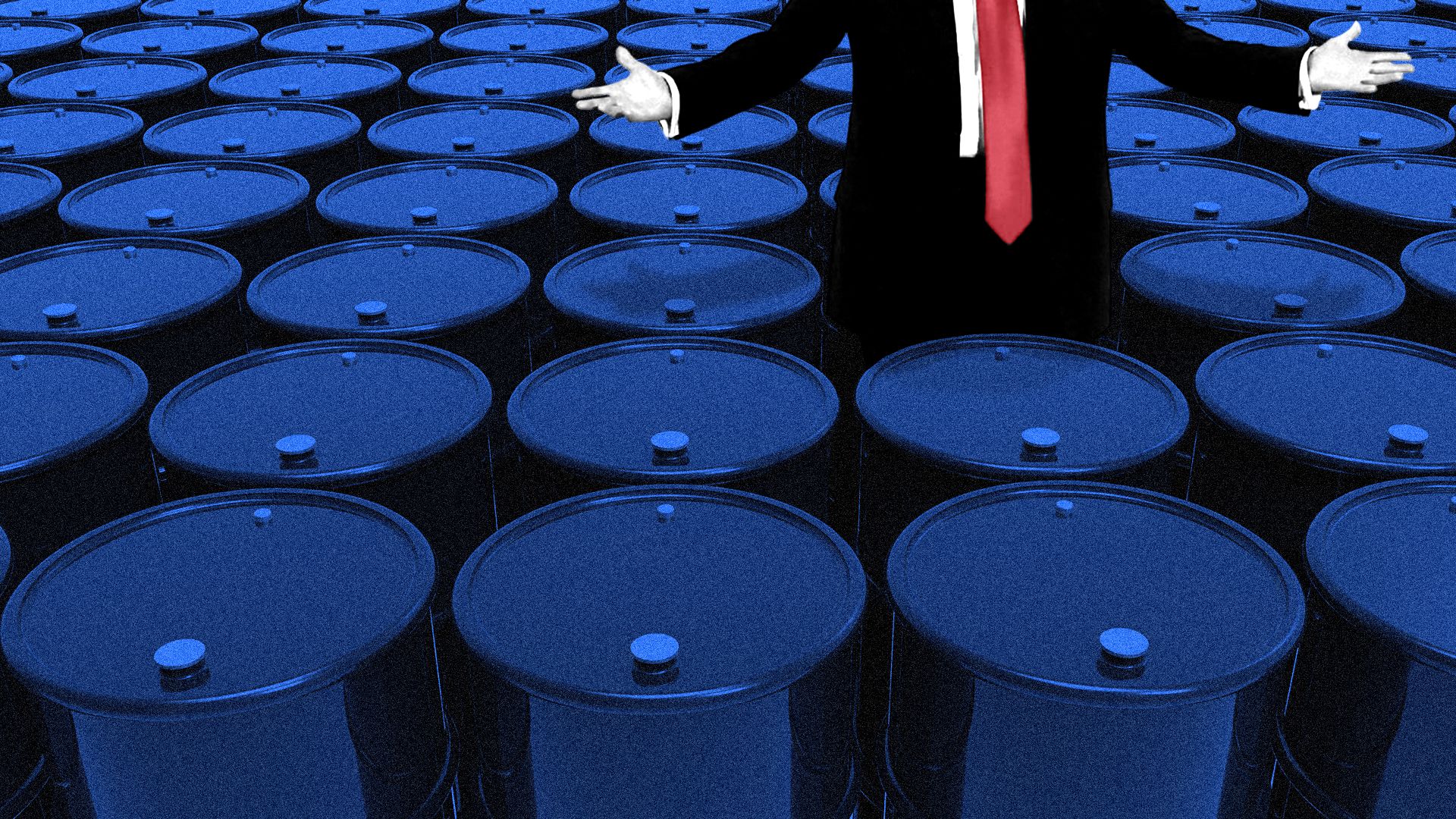
President Trump says he ordered the Justice Department to probe whether oil companies are gouging consumers.
Why it matters: It shows a new level of Trump's frustration with prices at the pump — and introduces a new wild card for oil companies, depending on what the Justice Department decides to do with the president's overnight Truth Social post.
Driving the news: "The big Oil Companies are not dropping their price at the pump commensurate with the sharply lower prices they are paying for Oil," he claimed in the post.
- "I have instructed the DOJ to immediately start looking into this. Gasoline prices better start going down a lot faster than what I'm seeing!"
My thought bubble: This is a classic political move when gasoline prices are high. Regulators in the Clinton, Bush, Obama and Biden years all conducted various types of inquiries.
Reality check: Probes going back decades have failed to turn up anti-competitive behavior in retail fuel markets outside of isolated local examples.
How it works: In the short term, even when oil prices fall, gas stations are working through the higher-cost inventory they bought when prices were higher.
- It's one of the reasons market-watchers point out the "rockets and feathers" dynamic. Retail fuel costs shoot up when oil prices do, but can decline slowly even when crude falls sharply.
3. ⚛️ How Trump's nuclear loans could move the needle

Here are early conclusions and things to watch in the Energy Department's plan to loan utilities billions of dollars to buy equipment for large new reactors.
Why it matters: DOE envisions 10 Westinghouse AP100 reactors — enough to power about 10 million homes — under construction across five two-reactor projects by 2030.
- That's an aggressive timeline in the slow and expensive world of developing big new U.S. nuclear plants.
Catch up quick: DOE hopes to provide five loans to "special purpose vehicles" that power companies and Westinghouse form, officials said.
- Westinghouse and each partner must first commit $500 million each per project.
Some initial thoughts...
🔄 It could move the needle. The hoped-for U.S. "nuclear renaissance" has for decades been longer on aspiration than action. But this caught the eye of nuclear advocates.
- "The US has taken the biggest step towards a nuclear renaissance in decades," Thomas Hochman, director of energy at the Foundation for American Innovation, posted on X.
🕵️ There's a theory of the case. DOE hopes to create more efficient, scaled, standardized and cheaper supply chains — a departure from decades past when each nuclear project was basically its own animal.
- "The long lead items funded by these loans are completely standardized to the point of being interchangeable between projects," Julie Kozeracki, acting chief investment officer in DOE's loan office, told reporters.
- Think equipment like massive steel vessels that house reactor cores, and steam generators, officials said.
🧠 Of course there's an AI angle! DOE officials expect that hyperscalers will help finance the hoped-for reactor projects with long-term power purchase agreements.
- "Those agreements with the hyperscalers will underwrite the economics of the plants to be built and constructed without driving any increase in rates for consumers," Energy Secretary Chris Wright told reporters.
- He also said tech giants might become equity investors in new reactor projects.
🧩 It's one piece of the loan puzzle. Gregory Beard, head of the loan office, said projects could later receive separate DOE loans for building the new reactors.
🚧 Barriers to new projects remain. Investment firm TD Cowen, in a note, said that for vertically integrated utilities to seek state regulatory approval for new reactors, "we believe a federal agreement on cost overrun protection needs to be in place."
4. 🏃 Catch up quick: Oil, coal, climate

🛢️ Crude prices are trading this week at their lowest levels since early March, with the global benchmark Brent at $74.66 per barrel this morning.
- Why it matters: The market is responding to more tankers successfully moving through the Strait of Hormuz.
- The big picture: ING analysts cited estimates of 6 million to 7 million barrels daily getting through in recent days. That's under the 20 million-ish pre-war, but with Saudi Arabia and the UAE moving more through pipelines, getting the strait back to 14 million would bring overall Persian Gulf supply back to where it was.
- Yes, but: "We continue to believe that the oil sell-off is overdone, with the market still tightening," their note cautions.
🇨🇳 Via Reuters, China's coal-fired power generation is set to rise this year after falling for the first time in a decade.
🥵 AP reports that "France recorded its hottest day ever Tuesday as an early heat wave gripped Europe."
5. 🔋 Number of the day: +54%
New U.S. battery storage installations in the first three months of 2026 surpassed their Q1 2025 record by 54%, per new industry data.
- Q1 2026 saw 3.3 gigawatts of capacity added across the utility-scale, commercial and industrial, and residential segments, Wood Mackenzie and the American Clean Power Association report.
What we're watching: How data centers and other "large load" electricity users drive the market.
- "Co-location and contracting with large loads will be a key market driver for the foreseeable future," Allison Feeney, research analyst at Wood Mackenzie, said in a statement.
📫 Did a friend send you this newsletter? Welcome, please sign up.
Sign up for Axios Future of Energy