Axios Future of Energy
November 13, 2026

🍺 Happy Friday! We're drilling into the evolving oil market and then closing the week with items about...
- The Nvidia shakeup's energy fallout, permitting talks, good weekend reads and more, all in 1,153 words, 4.5 minutes.
🙏 Thanks to David Nather, Mackenzie Weinger and Chris Speckhard for editing, and to our brilliant Axios visuals team.
🕵️♂️ Exactly 45 years ago, Hall & Oates were No. 1 on Billboard's Hot 100 with today's perfect intro tune...
1 big thing: Oil's new era of expensive supply recovery
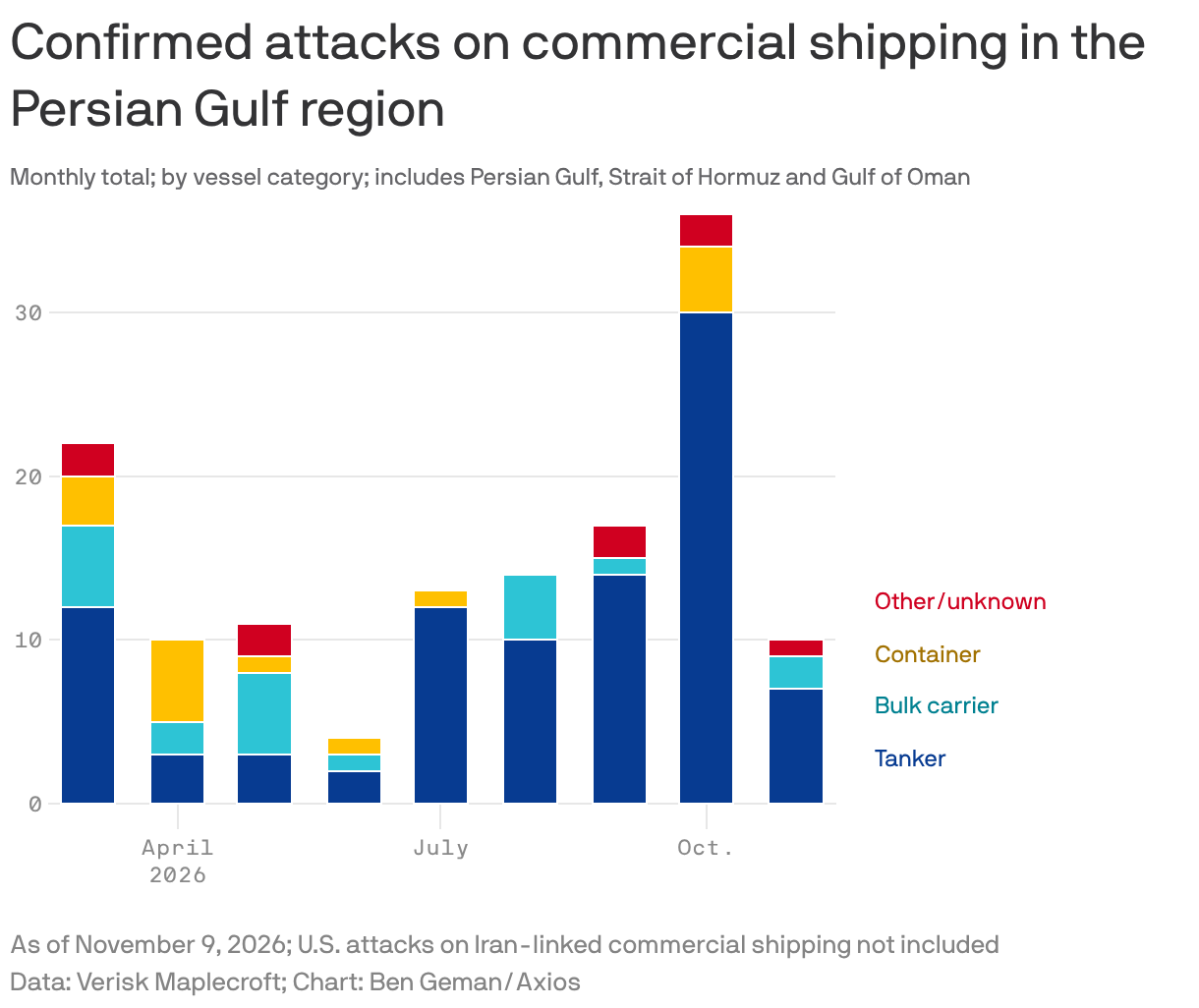
Oil markets are heading into an unusual period as the Iran conflict remains in dangerous limbo: The supply crunch is easing, but prices could stay stubbornly high.
Why it matters: While gasoline prices have dropped lately, don't expect pre-war levels anytime soon even as Middle East exports fitfully recover.
- Getting oil out of the region is expensive, which filters down to consumers.
- The threat of new attacks can keep oil costs higher, too, thanks to the risk premium embedded in prices.
The big picture: Traders are watching the state of potential diplomacy — and the possibility of a prolonged stalemate.
- Oil prices jumped yesterday after President Trump said on his Truth Social that "we don't need a deal with Iran. Those days have long since passed."
📻 Driving the news: Crude oil export levels bounce around, but have recently returned to pre-war levels at times, barrel-tracking firms and analysts say.
- Yet shipping threats will "persist in 2027," and attacks spiked last month (see the chart above), per political risk intelligence firm Verisk Maplecroft.
- A new agreement on navigating the Strait of Hormuz would just be a piece of the puzzle — if it ever happens.
"The threat of a renewed wave of shipping attacks will remain high as long as the underlying confrontation over Iran's nuclear and missile programmes remains unresolved," the firm's analysis states.
🏃 Catch up quick: Tracking how much supply is returning is a moving target, and higher production from countries outside the Middle East — including the U.S. — matters too.
- The oil market is "showing tentative signs of rebalancing, with global oil supplies surpassing demand for the first time since the outbreak of the war in Iran," the International Energy Agency said this morning.
- Crude oil exports from the Persian Gulf region rose to 82% of pre-war levels last month, though recovery of refined product shipments is weaker, its monthly analysis states.
With supply rising and oil demand lowered by the conflict, IEA predicts the global market will return to a surplus this quarter.
Yes, but: Insurance and shipping costs are elevated, and that puts upward pressure on prices.
- "Both Iran and the Houthis have demonstrated that they can severely restrict oil flows from the region using a range of attacks and tactics. This is something that will have to be priced in," Torbjorn Soltvedt, a senior Verisk analyst, tells me via email.
2. 🛢️ Bonus: Tracking volatile oil prices


Oil prices slid in recent weeks on hopes of new diplomacy, recovering supplies, and the prospect of ascendant Democrats' curtailing President Trump's war efforts.
Yes, but: Crude prices bounced upward yesterday after Trump posted that "we don't need a deal with Iran."
The latest: The average U.S. gasoline price today is $3.87 per gallon, down 47 cents over the last month but far above the pre-war level of under $3, according to AAA.
3. 🌪️ Nvidia turmoil threatens to roil energy deals

Nvidia founder Jensen Huang's sudden resignation as CEO could upend a range of data center energy deals that had centered on the chip giant.
Threat level: Huang played a key role in shaping many of Nvidia's energy-related deals.
- "Nvidia was a hivemind," says Steven Dickens, CEO of semiconductor research firm HyperFrame, "with Jensen as queen bee."
Friction point: Industry watchers are increasingly wary of Nvidia's practice under Huang of guaranteeing loans for data center developers that, in turn, buy its chips (SB Energy, for example).
- "Jensen has effectively been funding the buildout of the data center business," Ted Brandt, CEO of investment bank Marathon Capital, tells Axios Pro.
State of play: Bankers and analysts generally expect Nvidia will slow its venture investment activity amid stock volatility and leadership uncertainty.
Unlock the whole story, and for a steady diet of scoops and smart analysis, talk to our sales team about Axios Pro Deals
4. 🏃 Catch up quick on policy: Permitting and probes
⚔️ The 100+ member House Sustainable Energy and Environment Coalition is against the current Senate permitting bill and wants changes, it said in a statement yesterday.
- Why it matters: The latest — but not the only — sign of House Democratic criticism signals the uncertain lame duck prospects for the bill, even if it can clear the Senate.
- What we're watching: House Republicans. Speaker Mike Johnson told Bloomberg he sees enough GOP support to move the legislation. That said, some GOP lawmakers have expressed concerns.
- The latest: The Senate remains tricky despite a strong test vote early this week. Punchbowl News reports on Senate Dems looking to change the historic preservation title in response to tribal concerns. But there's little political space for major surgery.
🕵️♀️ House Democrats are sending new signals about their oversight plans. The latest is likely incoming Science Committee chairwoman Zoe Lofgren (Calif.) sending letters to 30 people, companies and agencies demanding they preserve records.
- Recipients include authors of the Energy Department's contrarian 2025 climate science report, as well as EPA and NOAA.
🚢 Via Reuters, Trump officials are slated to extend waivers of the Jones Act, the law that allows only U.S. ships to move goods including fuel between domestic ports.
5. 👓 Hot Reads: Climate, reactors, public lands

Trillions Hinge on a Future that Eludes Models (Bloomberg)
Amy says: It's interesting — and concerning — to see scientists say the extreme weather today is outpacing the science when it seems to me that it is broadly in line with the science. If it's this bad now, I do very much worry about the future — even in my lifetime.
Leading small modular nuclear reactor will be late and over budget (Canary Media)
Ben says: Cost overruns and delays hitting Ontario Power Generation's SMR construction could be a cautionary tale for planned U.S. projects.
Trump administration wants to sell public lands and shrink the federal estate (AP)
Amy says: Trump 1.0 tried this too, and I think the bipartisan backlash was similar. I wonder who is behind such a push, and the timing is interesting, right after the Republicans' midterm loss, too.
6. 💬 Quote of the day: Political reality check edition
"[D]on't delude yourself into thinking there are 56 votes against fossil fuel infrastructure, or that there is a viable path to a permitting deal that will keep oil and gas in the ground in the next few years. Any permitting bill will need to be bipartisan, and once policy windows close, there is no guarantee they will open again soon."— Clean energy lobbyist Jeff Navin, a senior Obama-era Energy Department aide and former Democratic Capitol Hill staff member
His thread is going viral in our corner of the world. It argues against some Dems and advocates who see a path to a more progressive permitting deal in the new Congress.
📫 Did a friend send you this newsletter? Welcome, please sign up.
Sign up for Axios Future of Energy