Axios Future of Defense
April 09, 2025

Could this week get any busier? Of course.
- If you're in D.C. tomorrow, my colleague Alex Fitzpatrick and I are hosting an event examining the future of defense aviation and tech innovation. Details here!
💫 Situational awareness: President Trump and Defense Secretary Pete Hegseth said the next Pentagon budget will be a whopping $1 trillion. That would be a first, and mark a roughly 12% increase.
- My thought bubble: Big if true — literally. Do you know where the extra money will go? Reply to this email.
Why you're here: A trade-show arsenal, AI-fueled logistics and cash for Aetherflux.
Today's newsletter is 1,642 words, a 6-minute read.
1 big thing: "F-150s of the sky"

The future, chock-full of super-stealth warplanes, blinding-fast missiles and network-crippling hacks, will also feature aerostats — specialty blimps, for the uninitiated.
Why it matters: For all the hoopla bleeding-edge technologies generate, it can be the simplest tools that prove most effective and long-standing.
- Plus, the juxtaposition is absolutely wild.
Driving the news: The U.S. Army could spend as much as $4.2 billion over the next 10 years to sustain and upgrade its aerostat arsenal, according to a contract announced April 3.
- Ten companies, including Leidos, Qinetiq and TCOM, will compete for work overseen by the service's intelligence, electronic warfare and sensors shop, PEO IEW&S.
- Foreign military sales could also happen across European and Central commands. Poland last year announced a $1 billion arrangement.
How it works: The Army has long deployed and experimented with aerostats and lighter-than-air systems; they contribute to communications relay, jamming, shot-spotting and more.
- One example, the Joint Land Attack Cruise Missile Defense Elevated Netted Sensor System, made headlines a decade ago when it broke free of its mooring in Maryland and floated into Pennsylvania.
- "Balloons are one of the very first intelligence, surveillance and reconnaissance capabilities used in air warfare," Brandon Pollachek, a PEO IEW&S spokesperson, told me.
- Today's aerostats "provide an essential and persistent 24/7 eye in the sky," he said. They're also "extremely cost-effective." (A Qinetiq spokesperson made the same point when asked about the contract.)
My thought bubble: These beacons of U.S. presence in the Middle East are being modernized with China and Russia in mind — like all things Pentagon.
The bottom line: "The United States of America needs to get over our JLENS problem, and we need to do it fast. There's just too much utility to these kind of platforms," Tom Karako, an expert at the Center for Strategic and International Studies, said in an interview.
- "These are the F-150s of the sky, or they should be," he added. "They're multi-mission pickup trucks."
2. Exclusive: Manassas manufacturing
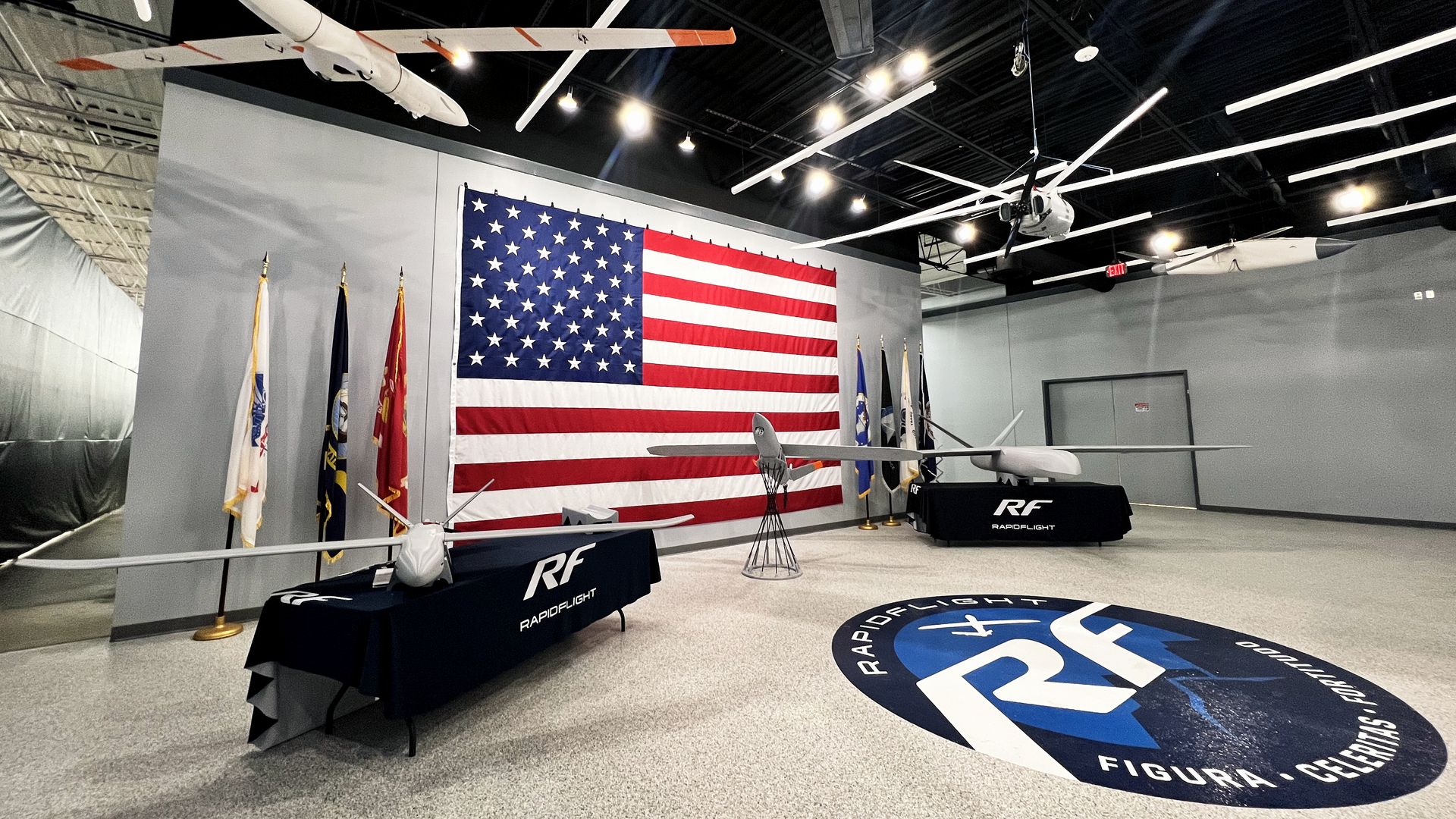
RapidFlight isn't a drone company, according to chief executive Esina Alic. It just so happens it can print an airframe in a day.
The big picture: At a time of defense manufacturing frailty, the Virginia upstart is billing itself as a merchant of industriousness.
- Through a combination of air-liftable containers and 3D printers known as Mobile Production Systems; common avionics and aircraft kits; and design libraries that encourage tinkering, it hopes to build out weapons capacity where it didn't exist.
- "Some industries do this really well, like automotive, like Ikea," Alic told me during a tour of the Manassas headquarters. "Our allies and our U.S. customers can get it immediately, at mass, cheaply and quickly, deployed anywhere in the world."
The intrigue: Tracker Capital, founded by Stephen Feinberg, was an early investor in RapidFlight.
- He played an active role at the company until being confirmed as deputy defense secretary.
Zoom in: RapidFlight has stuck to Group 2 and 3 drones and is now wading into interceptors.
- It has prototyped about two dozen unmanned aerial vehicles. The SPX, M2 and E2 have proven most popular, according to Alic.
- Customers exist stateside as well as in the Asia-Pacific (Taiwan and South Korea) and Europe (Ukraine). It went from design to demo in the Middle East in six months.
Fun fact: The company produced a Shahed clone in two weeks.
Yes, but: RapidFlight isn't the only player in the 3D printing game. It's not even the only player in the 3D-printed drone game.
The bottom line: The defense industrial base has yet to crack "mass customization," according to Alic.
- "Do you want a VTOL? Do you want a fixed-wing? Do you want rocket-launched? Do you want air-launched? They're just different symmetries, but they're the same," she said.
- "Using these different Lego modules, you can build different outcomes."
Go deeper: Simple drones, complex problems
3. Seen at Sea-Air-Space
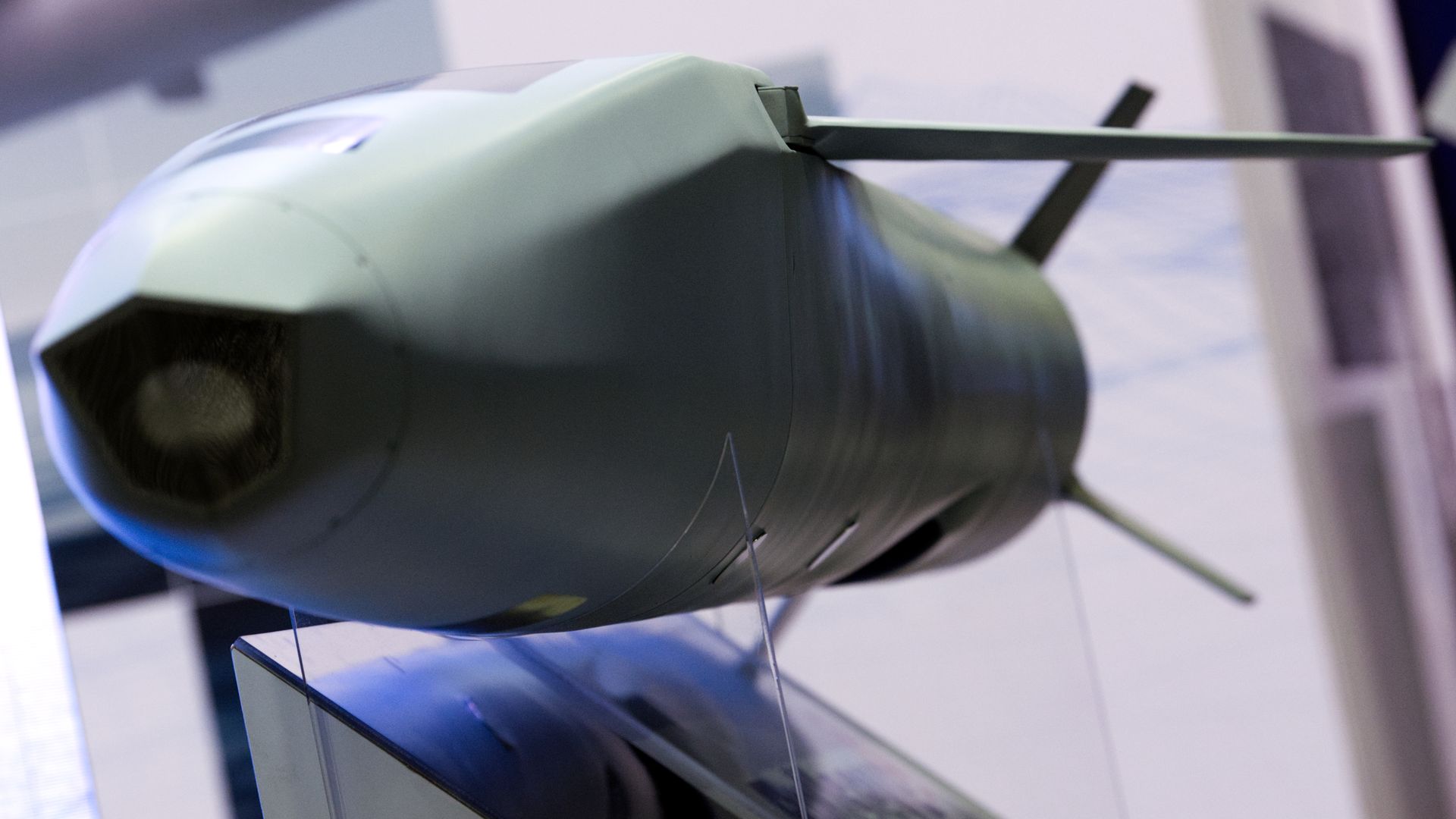
Some of the world's most influential weapons makers brought their wares to National Harbor, Maryland, this week for the Sea-Air-Space convention.
- Some even unveiled new products.
Why it matters: Defense conferences are a bellwether for U.S. strategy and industry plasticity. This one, hosted by Navy League, is no different.
Here's just a sample of what was announced, offered and on display:
Copperhead-100, -500 and the explosive -M variant, torpedo-like unmanned underwater vehicles made by Anduril Industries.
- The company's Dive-XL can carry "dozens of Copperhead-100Ms or multiple Copperhead-500Ms," according to an announcement.
Bullseye, a missile reminiscent of Ice Breaker, that will be produced by General Atomics and Rafael Advanced Defense Systems.
- They will be pumped out in Tupelo, Mississippi, according to the companies. Delivery is expected in the backend of this year.
Bofors 40 Mk4, a naval gun capable of firing 300 rounds per minute and taking out aircraft and boats.
- It was the first time it made an appearance in the U.S., according to BAE Systems. Colombia bought one in March; the Netherlands and Belgium committed to eight last year.
Leonidas H20, the latest version of Epirus' electronics-frying microwave weapon.
- The H20 is meant to counter aerial drones and unmanned surface vessels. It was successfully trialed at the Advanced Naval Technology Exercise-Coastal Trident.
Wombat, a sensor-jammer combo made by BlueHalo using internal research dollars.
- The prototype was spurred by the U.S. Navy's persistent elevated sensor needs, chief technology officer Vikram Manikonda told me.
An upgraded V-BAT that manufacturer Shield AI said vertically launches and lands unassisted, flies for more than 13 hours and consumes JP-5, a common maritime aviation fuel.
- V-BAT is the first-ever shipboard drone used by the Japan Maritime Self-Defense Force, as I exclusively reported earlier this year.
A combo of Saildrone's Surveyor and Thales Australia's BlueSentry towed array, meant to autonomously hunt submarines and monitor subsea conditions.
- The idea was announced at last year's Sea-Air-Space. Since then, "extensive sea trials" were conducted off California, the two said in a press release.
Go deeper: U.S. Navy "should be embarrassed" by lack of lasers, says admiral
4. Exclusive: Greetings from Gallatin

Gallatin AI emerged from stealth Tuesday, unveiling $15 million in funding and software its chief executive, Woody Glier, told me will streamline frontline logistics.
Why it matters: Getting bombs, bullets and bandages to the right place at the right time is infamously difficult and labor-intensive.
- It's also of the highest stakes: Supplies keep troops alive.
Follow the money: Gallatin was incubated through 8VC, which helped launch drone-boat maker Saronic (valued at $4 billion as of February) and directed-energy specialist Epirus, which announced a $250 million raise in March.
- Other backers include Silent Ventures, Moonshots Capital, Timeless Partners and Banter Capital.
- Gallatin's founding team includes Amazon, Scale AI and Pentagon alumni.
Zoom in: Navigator, the company's digital planner, was built using Palantir Technologies' Foundry.
- It aims to be predictive, not reactionary, offering users AI-generated advice, simulation tools and insights on how quickly stocks are chewed through.
What's next: Gallatin will collaborate with Booz Allen Hamilton — among the world's largest defense contractors — on contested logistics, a major focus of the U.S. Army.
Go deeper: U.S. military gets "smart" on warehouses
5. Quick hits

☄️ Booz Allen Hamilton entered the Golden Dome race with Brilliant Swarms, a proposed mass of satellites that can detect and smash into enemy missiles.
- Why it matters: "Because it's already in space, and there's enough of them to cover most of the globe, you can go after ballistic missiles far quicker and sooner than any of our ground-based capabilities," executive vice president Chris Bogdan told me. "The longer you wait to kill an enemy ballistic missile, the harder your problem gets."
- 💭 My thought bubble: The name's a nice nod to Brilliant Pebbles.
🚫 Russia's lost 3,000 tanks, 9,000 armored vehicles, 13,000 artillery systems, and more than 400 air-defense systems in its war against Ukraine, according to U.S. European Command boss Gen. Christopher Cavoli.
- Why it matters: While the materiel losses are staggering, Moscow's wartime industry is "on pace to replace them all," according to Cavoli.
- 💭 My thought bubble: Ukrainian troops are chipping away at the precious resources of Russia — a win for the U.S., where support for Kyiv's self-defense remains high.
🛠️ Global conflicts and the demands of military modernization expose "the chasm" between U.S. defense strategy and "defense industrial reality," a new report from the Center for a New American Security reads.
- Why it matters: This is yet another red flag screaming to be seen. "The U.S. DIB," the analysis warns, "is projected to be unable to meet the expected demands of future great power conflict."
- 💭 My thought bubble: The report's cover art goes hard.
🌞 Space-based solar energy startup Aetherflux raised $50 million. The CEO, Baiju Bhatt of Robinhood fame, previously invested $10 million of his own capital.
- Why it matters: Aetherflux wants to supply energy to remote military installations day or night. There are also humanitarian applications.
- 💭 My thought bubble: In an interview months ago, Bhatt told me he hopes to turn the pages of sci-fi into reality. He was also in the process of hanging up a massive American flag, which he guessed weighed 30-40 pounds.
6. Check this out

What was Vice Adm. Daniel Cheever, commander of U.S. Naval Air Forces, thinking about at Sea-Air-Space?
Why it matters: He's the "air boss."
Could he be mulling the highly anticipated F/A-XX?
- The service on Monday said it wants 25% more range out of its future fighter, compared to the existing F/A-18 Super Hornet fleet, according to Aviation Week.
Could he be pondering the Red Sea, where the Navy has expended more than $1 billion in ordnance?
- Acting Chief of Naval Operations Adm. James Kilby told reporters he was concerned about "not having better ways to more economically attrite the threat."
Or is he dreading the lunch lines that snake through the conference?
- Pro tip: Pack protein bars and energy drinks. Monster, not Celsius.
📩 Send me your best guesses. Or, if you helped prepare him for the panel, give me a definitive answer!
Shoutout to Nicholas Johnston and David Lawler for editing and Matt Piper for copy editing.
👋🏼 Thanks, as always, for reading and sharing. Tell your friends to subscribe, here.
Sign up for Axios Future of Defense