Axios Future
October 09, 2021

Welcome to Axios Future, where I'm thankful for all the responses on toddler Halloween costumes. I'm in favor of astronaut, though my son has decided he wants to be a bat.
- Or a pterodactyl.
If you haven't subscribed, make it so.
- Send feedback, tips and spare kidneys (see item No. 6) to [email protected].
Today's Smart Brevity count: 1,799 words or about 7 minutes.
1 big thing: The best antidote to poverty could be cold, hard cash
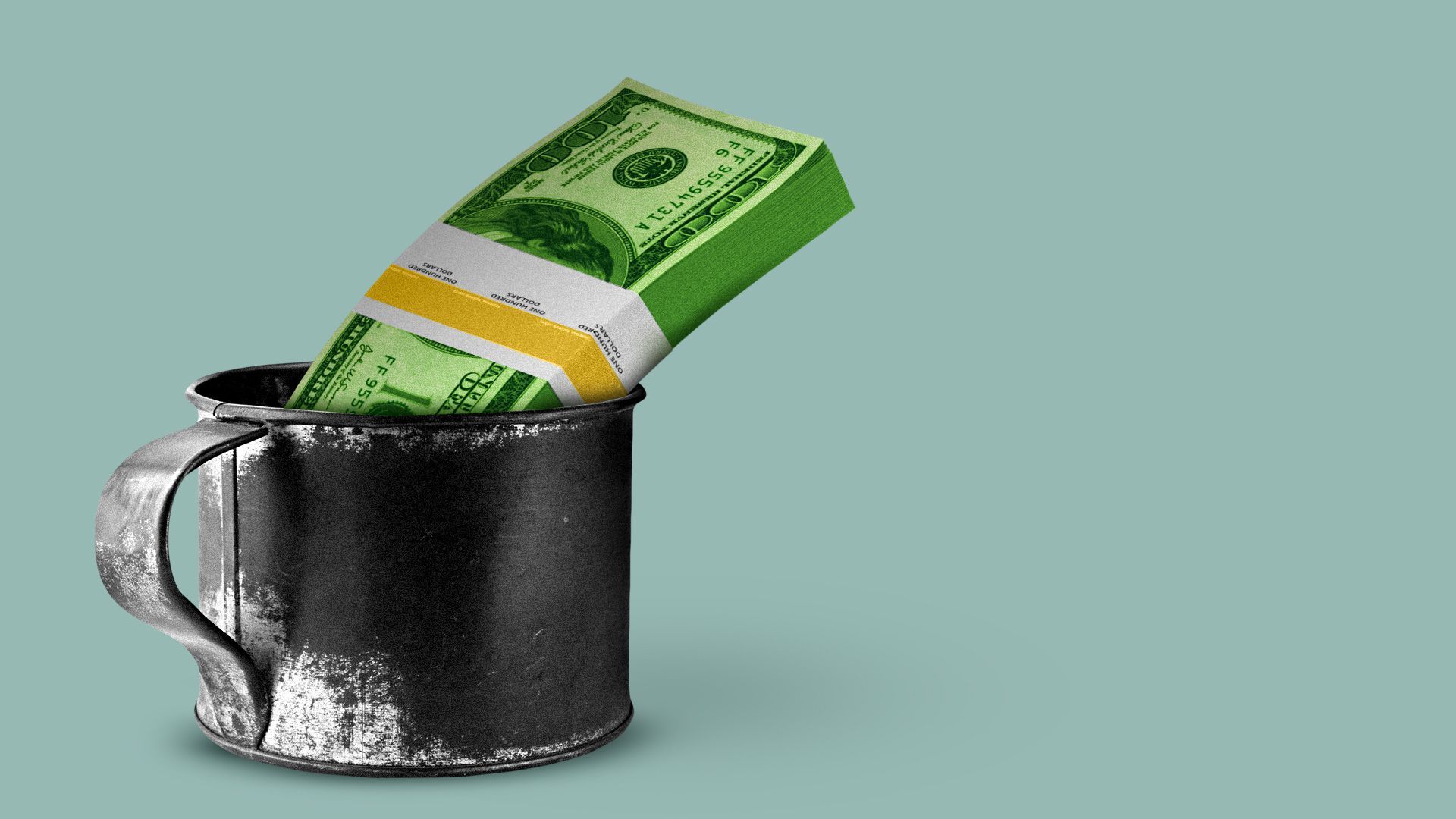
Illustration: Aïda Amer/Axios
Experts in philanthropy are gradually coming around to the idea that simply giving poor people cash — rather than services or in-kind benefits — is the most efficient way to make progress on severe poverty.
The big picture: The divergent economic experiences between rich and poor countries during the pandemic has shown the value of directly giving money to those in need.
- With extreme poverty in developing countries spiking during the pandemic, direct cash giving is more important than ever.
What's happening: GiveDirectly — a charity that pioneered the practice of sending money to people in poverty, no strings attached — recently announced it sent $1,000 each to more than 178,000 U.S. households in need during the pandemic, with plans to reach another 20,000 over the next few months.
- GiveDirectly works with Propel — a company that provides software that helps Americans digitally manage food stamps and other benefits — to identify households in need and quickly send out money.
- The direct cash giving model's greatest advantage is its "exceptional efficiency," says Alex Nawar, GiveDirectly's U.S. director, who estimates that 98–99 cents of every dollar donated to the charity goes directly to giving, with little required for overhead.
Between the lines: GiveDirectly's program, as successful as it was, is a drop in the bucket compared to the billions in direct stimulus checks and expanded jobless benefits from the federal government that have flowed to Americans during the pandemic.
- That aid — much of it cash — not only prevented much of the massive economic pain Americans could have suffered during the pandemic, but it actually helped reduce the U.S. poverty rate in 2020.
- But what both private philanthropy and government aid demonstrate is the power of rapidly distributed cash to shield the needy from catastrophe and actually lift people out of poverty.
What they're saying: "It was really exciting to see the U.S. embrace cash as a first solution for the financial security problems people are facing through the pandemic," Nawar says.
- Globally, there has been a 148% increase in cash social programs during COVID-19, with a total of 782 cash transfer programs being implemented or planned across 186 countries.
- "I think there's a lot of room for both governments and NGOs and other kind of disaster responders to increase how often we use cash, because we know it's more efficient than delivering in-kind aid," says Nawar.
By the numbers: Poverty declined in the U.S. during the pandemic but not in the poorest countries in the world.
- The number of people in extreme poverty — defined as households spending less than $1.90 a day per person — had fallen from 1.9 billion people to 648 million people in 2019, even as the global population increased by 2.5 billion people.
- Extreme poverty levels were projected to fall to 537 million people by 2030, but the pandemic interrupted this trend, with the number increasing for the first time since 1997 to an estimated 588 million people.
How it works: During the pandemic, GiveDirectly worked with the government of Togo — where half the citizens live below the poverty line — to identify and distribute millions of dollars in cash aid to those in need.
- To speed the process up, GiveDirectly used satellite images to identify tell-tale images of poverty, like houses with thatched roofs rather than metal ones, as well as mobile phone data, employing an algorithm to find people who more often made short, cheap calls — another sign of poverty.
2. White House science advisers call for an "AI Bill of Rights"

Illustration: Aïda Amer/Axios
The Biden administration is exploring a "bill of rights" to govern facial recognition and other potentially harmful uses of artificial intelligence, but the problems AI poses are much bigger than figuring out how to regulate a new technology.
The big picture: There's no good way to regulate AI's role in shaping a fair and equitable society without deciding what that society should look like, including how power should be balanced among individuals, corporations and the government.
Driving the news: The White House's Office of Science and Technology Policy launched a fact-finding mission yesterday that will ultimately result in a "'bill of rights' to guard against the powerful technologies we have created," OSTP director Eric Lander and his deputy Alondra Nelson wrote in an op-ed published by Wired yesterday.
What they're saying: "It’s important to start the conversations about what’s acceptable — and unacceptable — regarding AI and our personal data now, before it is too late," says Sanjay Gupta, global head of product and corporate development at Mitek Systems, a leader in digital identity verification.
- "Companies will find agreeable ways to still innovate with and integrate these technologies," he said.
AI's biggest boosters can fall victim to a kind of techno-solutionism — expecting technology to efficiently solve structural, societal problems.
- Yes, but: At the same time, though, focusing too narrowly on the applications of AI risks a reverse techno-solutionism — believing that the fastest way to fix social problems is by tweaking the technologies that affect them, rather than the often intractable issues that underlie them.
Reminder: The original Bill of Rights is nearly 230 years old, and we're still debating the meaning of nearly each of its 652 words.
- If an AI Bill of Rights is our ultimate goal, we're still at the stage of haggling over the Articles of Confederation.
3. A general's guide to risk
Credit: Penguin
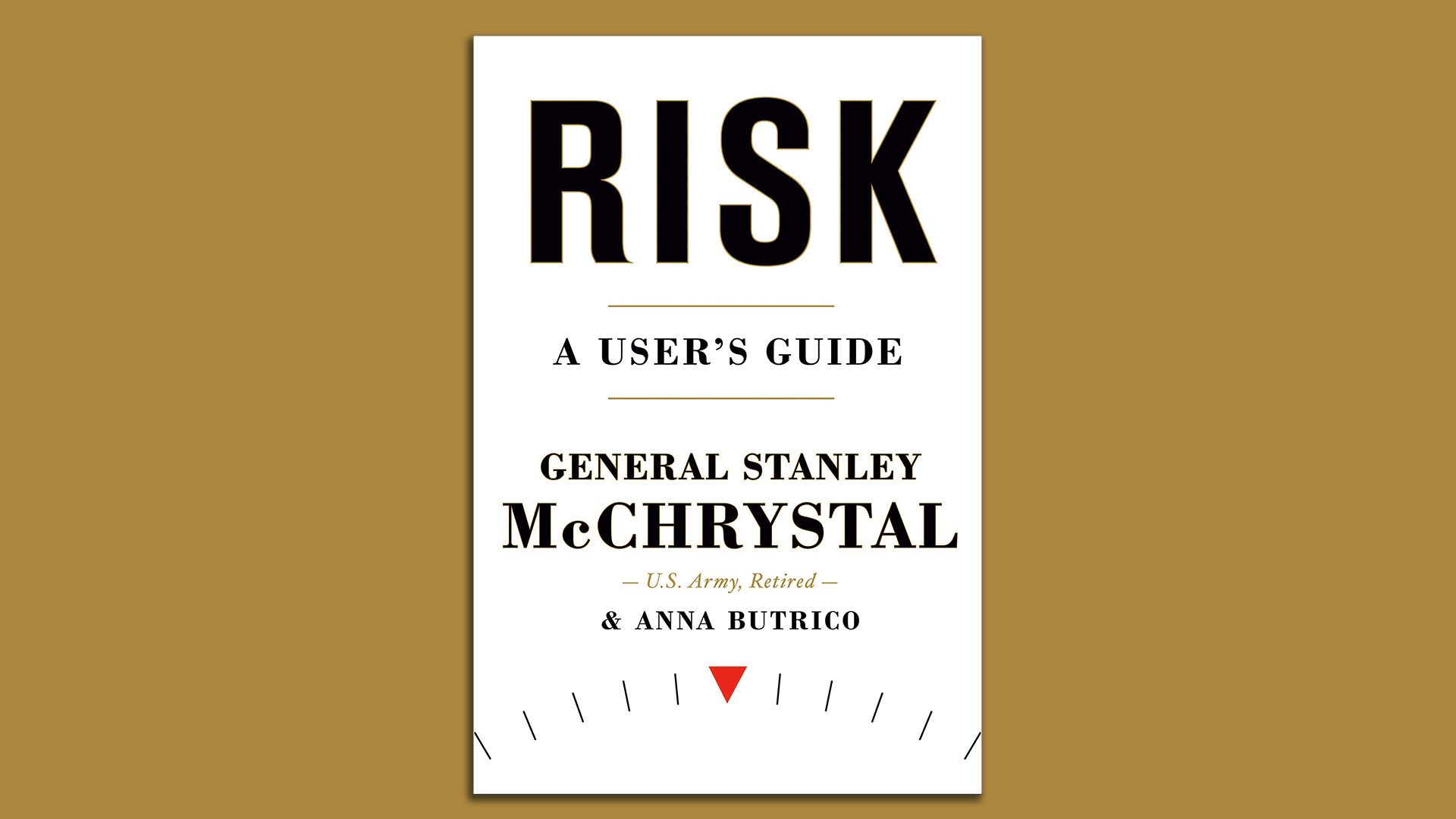
Gen. Stanley McChrystal, who ended his Army career in 2010 as the head of U.S. and international forces in Afghanistan, has a new book out on how to handle risk.
Why it matters: From conventional military threats to infectious diseases to economic catastrophes, we live in a world defined by risk — and shaped by our response to it.
- McChrystal argues we should focus on minimizing our vulnerabilities to the risks we face.
What's happening: I spoke to McChrystal about his new book "Risk: A User's Guide," which came out earlier this week.
On choosing between two risks in the Afghanistan withdrawal:
- "There was an in-place peace agreement with the Taliban that had ended Americans being killed, so if you make the decision not to withdraw, you're going to buy into an open-ended level of risk on that."
- "On the other hand, if you try to go very quickly, it leaves you more vulnerable in the short term, though it gets you out sooner and decreases the amount of time you're at risk. When you look at it, it was probably a rational decision made in a very difficult environment."
On how to define risk:
- "Risk is threat times vulnerability. But we're not good at predicting threats while we have agency over our vulnerabilities."
- "There's a mathematical relationship between threat and vulnerability, so try to drive your vulnerabilities down to zero."
On what the COVID-19 response demonstrates about risk response:
- "We should have been in great shape by now, but we've done an incredibly weak job — and that weakness is a function of our system, not the actual strength of the threat."
4. The U.S. slowly catches up on rapid COVID tests
Illustration: Brendan Lynch/Axios
The White House allocated an additional $1 billion to buy millions of rapid at-home COVID-19 tests earlier this week.
Why it matters: Rapid tests can quickly determine whether you're infected with COVID-19 and at risk of spreading it to others, but lack of funding — and slow approval — has led to a dire shortage.
Driving the news: White House COVID-19 response coordinator Jeffrey Zients told reporters on Wednesday that the new funding — as well as an additional $2 billion allocated in September — will quadruple the number of available tests over the next few months.
- Earlier in the week the FDA also authorized Flowflex, a rapid at-home test made by ACON Laboratories that the White House expects will retail at about $10 per test, making it cheaper than other available diagnostics.
- "We'll have available supply of 200 million rapid at-home tests per month, starting in December," he said.
How it works: Rapid antigen tests — which can deliver results in as little as 15 minutes — are particularly useful for the current moment.
- As millions of Americans return to school and the workplace, rapid tests can let them quickly determine their COVID-19 status if they've been exposed to the virus or they begin to show symptoms.
- My thought bubble: My wife and I used one of our last remaining rapid tests this past weekend on my as-yet-unvaccinated 4-year-old so he could attend a bar mitzvah with us. (He was negative, which was fortunate because the party had both pizza and foosball.)
The catch: In part because of that utility, however, rapid tests have become increasingly difficult to find.
5. Worthy of your time
‘Naively ambitious’: How COVAX failed on its promise to vaccinate the world (Olivia Goldhill and Rosa Furneaux — STAT and the Bureau of Investigative Journalism)
- The inability to get vaccines to the world's poorest countries is a failure of both will and execution.
Facebook's own data is not as conclusive as you think about teens and mental health (Anya Kamenetz — NPR)
- When we've all been primed to think that social media is bad for us, asking people if social media is bad for them may not tell us that much.
Can nuclear fusion put the brakes on climate change? (Rivka Galchen — New Yorker)
- Harnessing the power that drives the sun to beat global warming.
America is running out of everything (Derek Thompson — The Atlantic)
- Tattoo these words on my forehead: "You cannot redistribute what isn’t created in the first place."
6. 1 good thing: Donating a kidney

Doctors carry out a kidney donation in France. Photo: BSIP/Universal Images Group via Getty Images
If, like me, you spend way too much time online, you probably encountered a New York Times Magazine piece this week by Robert Kolker about the "bad art friend."
- TLDR: An aspiring writer named Dawn Dorland gave a non-directed donation of her kidney — meaning it was given not to a particular recipient but to the person surgeons decided needed it most — then became upset when a more established writer named Sonya Larson used details from the event in a published short story.
The big picture: Amidst the online festival of schadenfreude, it shouldn't be lost that what Dorland did — giving a kidney to a stranger in need — is one of the most purely altruistic acts anyone can do.
By the numbers: More than 100,000 people who are on a kidney waitlist will likely die within the next five years if they don't receive an organ, even with dialysis.
- If they can get a donation, they gain a decade of additional life on average, with very little risk to the donor — making it a nearly unmatched act of effective altruism.
- You can sign up here to become a non-directed kidney donor.
The bottom line: If you do so, just remember that virtue is its own reward — unless you want to end up in the New York Times.
Sign up for Axios Future

Spot the mega-trends impacting our world