Axios Future
November 07, 2020

Welcome to Axios Future, where as a Philadelphia-area native, I'm glad to see the people of the City of Brotherly Love being recognized for something other than throwing snowballs at Santa Claus.
Of note: If you haven't subscribed, please do so here.
- Send feedback and tips to [email protected].
- Future will be off for Veterans Day, so the next newsletter will be Saturday, Nov. 14.
Today's Smart Brevity count: 1,832 words or about 7 minutes.
1 big thing: Why we struggle with the election expectations game
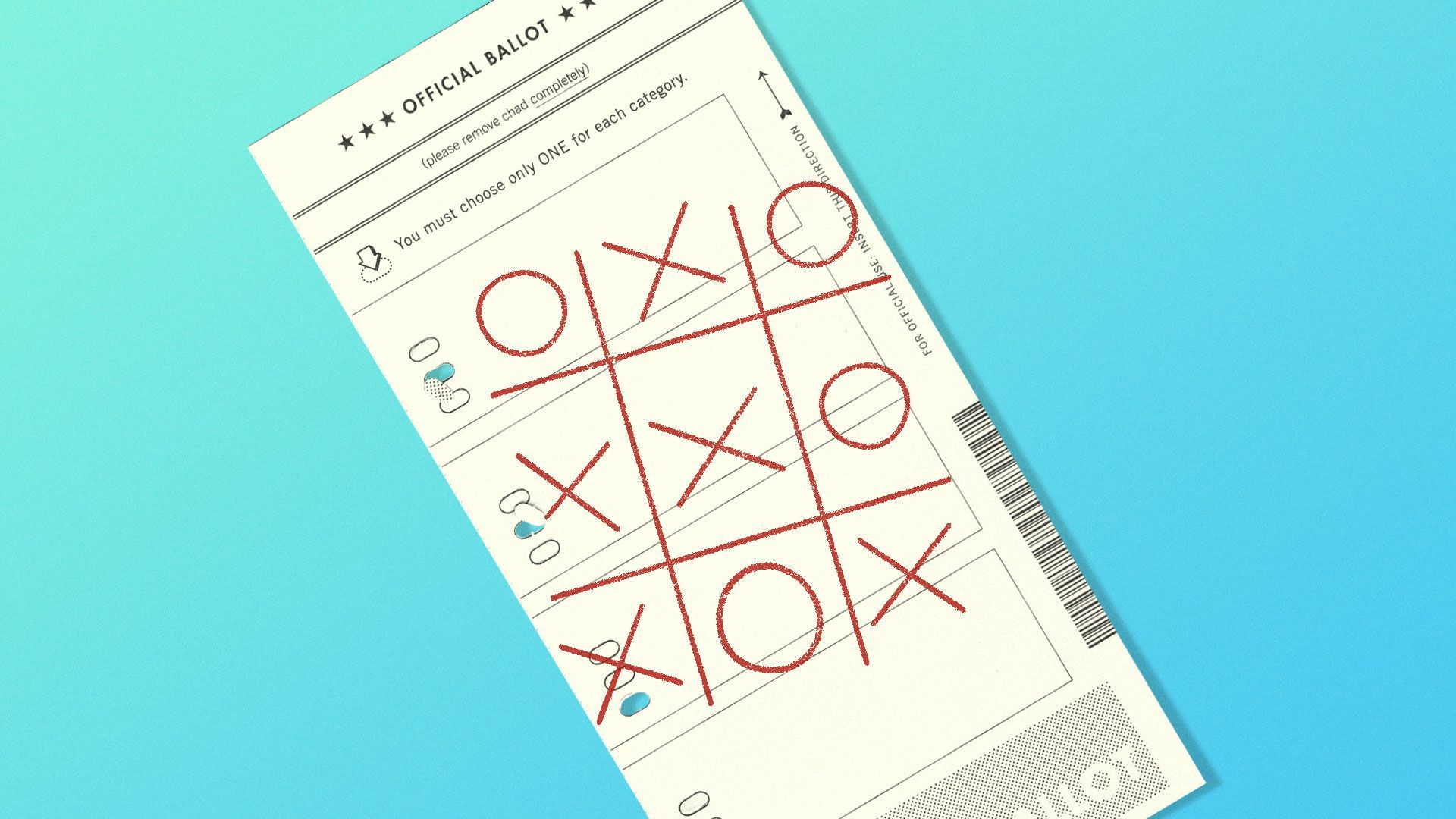
Illustration: Eniola Odetunde/Axios
Joe Biden appears close to an electoral win that will likely be narrower than election forecasts projected, and the initial sense that he underperformed expectations, which were themselves off base, could color his election and perhaps his presidency.
The big picture: We can't help but judge events based on whether they exceed or fall short of our expectations for them — but those expectations often aren't grounded in reality.
While the polling industry will sift through the reasons it missed how close the Electoral College fight ultimately was this year, it's vital to keep in mind that our shifting perception of what happened in the election is being shaped by the prior expectations formed by those polls and the order in which information about the vote has come in.
- Scientists have long known that our expectations about future events influence how we perceive those events when they occur, even on a neurological level.
Driving the news: President Trump has complained that polls projecting a Blue Wave this year equate to a form of voter suppression that kept his supporters home, but the number of votes cast this year gives no support for that argument.
- Voter turnout this year could end up being the highest since 1900, so there's not much evidence that the forecasts kept Trump's or Biden's supporters at home.
- Yet the fact that Biden seemed to be coming in below those forecasts — especially at first — likely shaped the early perceptions of the election.
The backstory: A 2020 paper found that election forecasts — which can translate what appear to be small polling gaps between candidates into fairly large probabilities that one will ultimately win — are often badly mischaracterized by the public.
- One-third of study subjects in the paper thought a candidate with an 80% chance of winning had the support of 80% of voters — which is very much not the case.
- Forecasts that Hillary Clinton was far more likely to win the 2016 election may have shaped coverage of the race as well as decisions by key officials like then-FBI Director James Comey, and could have led many of her supporters to skip voting, according to the study.
But, but, but: "If the polls are wrong, they never described reality, and there is no divergence to explain," the political writer Ezra Klein tweeted. "The map being wrong isn't a mistake of the terrain."
- The American voting population — at least in terms of electoral votes — was simply closer and more divided than we expected. Had the map been correct, we wouldn't have been surprised by a nail-biter.
Be smart: The unique nature of the 2020 election — conducted during a pandemic, with a record-breaking number of mail-in ballots — also wreaked havoc on our perceptions.
- Because different states reported results at different times — in part because battleground states like Pennsylvania were not permitted to begin counting mail-in ballots until Election Day — it appeared as if Trump had built a lead that Biden then whittled down over time.
- But remember: The votes existed before they could be counted. What appeared to be Biden "catching up" was just an illusion created by the order in which different votes were counted, albeit an illusion that helped shape how we viewed the election, as some polling experts noted.
The bottom line: Given how problems in polling are making it difficult to really know what the American electorate is thinking, we would be smart to approach the next election — and this one, as the final votes are tabulated — with a little more humility.
2. Designing digital immunity certificates for COVID
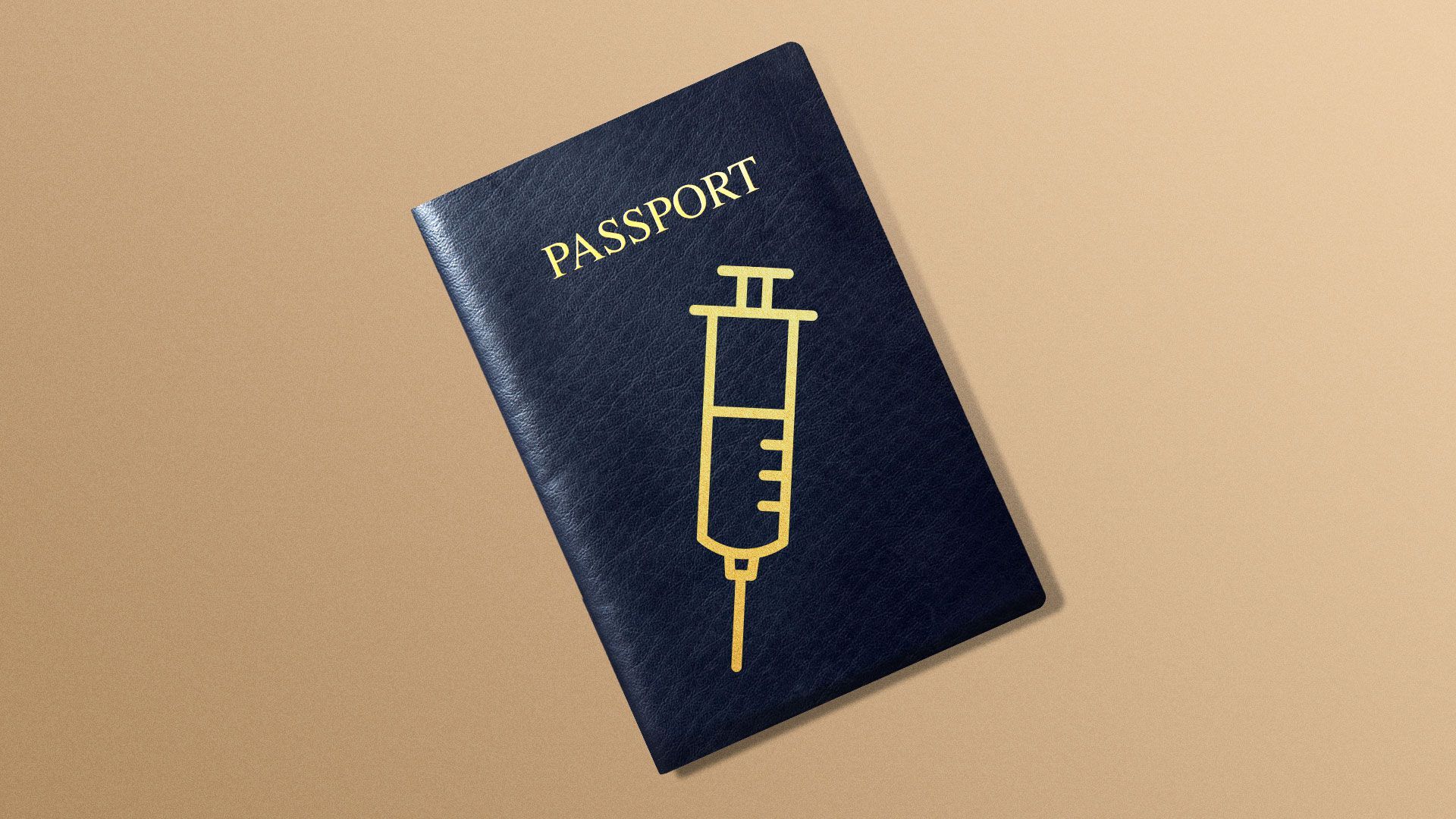
Illustration: Eniola Odetunde/Axios
Companies are preparing to design digital immunity certificates for COVID-19 that could be used when a vaccine is available.
Why it matters: The vaccine won't roll out to everyone at the same time, so we need some way for those who have been immunized to easily demonstrate that they can safely return to work and travel. The easiest way might be a digital certificate that can be linked to a passport or even a mobile phone.
Background: The World Health Organization already issues paper "yellow cards" that act as an international certification of vaccination, primarily to be used when entering a country that has enhanced health risks to travelers.
- But a paper certificate, as experts warned in a white paper released earlier this year, could be subject to fraud and would be too difficult to quickly scale up for hundreds of millions of people.
- Digital certificates, though, could be rapidly and safely distributed and made easily verifiable at borders or even in businesses, says Lars Reger, the CTO of the semiconductor company NXP, which makes biometric technology now used in some passports.
How it works: Digital certificates could be added onto biometric passports or other smart ID cards that already contain a small chip that is used to confirm the identity of the holder.
- Another option would be to make use of the contactless payment system currently available in most recent smartphones, which could "easily transport the information that someone has certified immunity," says Reger.
- Rolling out such a functionality to smartphones would eliminate the need for investing in new technology, and any business that can read contactless payments should be able to accept immunity certificates with just a software update, he says.
The catch: Some critics worry digital immunity certificates could cause discrimination between those who can show immunity and those who can't.
- We also have to be sure those who receive such certificates really are immune, an immunological uncertainty that torpedoed earlier plans to issue certificates to those who had contracted the disease.
The bottom line: The real challenge around digital immunity certificates isn't the relatively easy technology, but the hard ethical challenges around ensuring everyone ultimately has access to a workable vaccine.
3. How we produce food matters as much for the climate as what we eat
A farmer dries corn in a field in China. Photo: Yu Liangyi/VCG via Getty Images
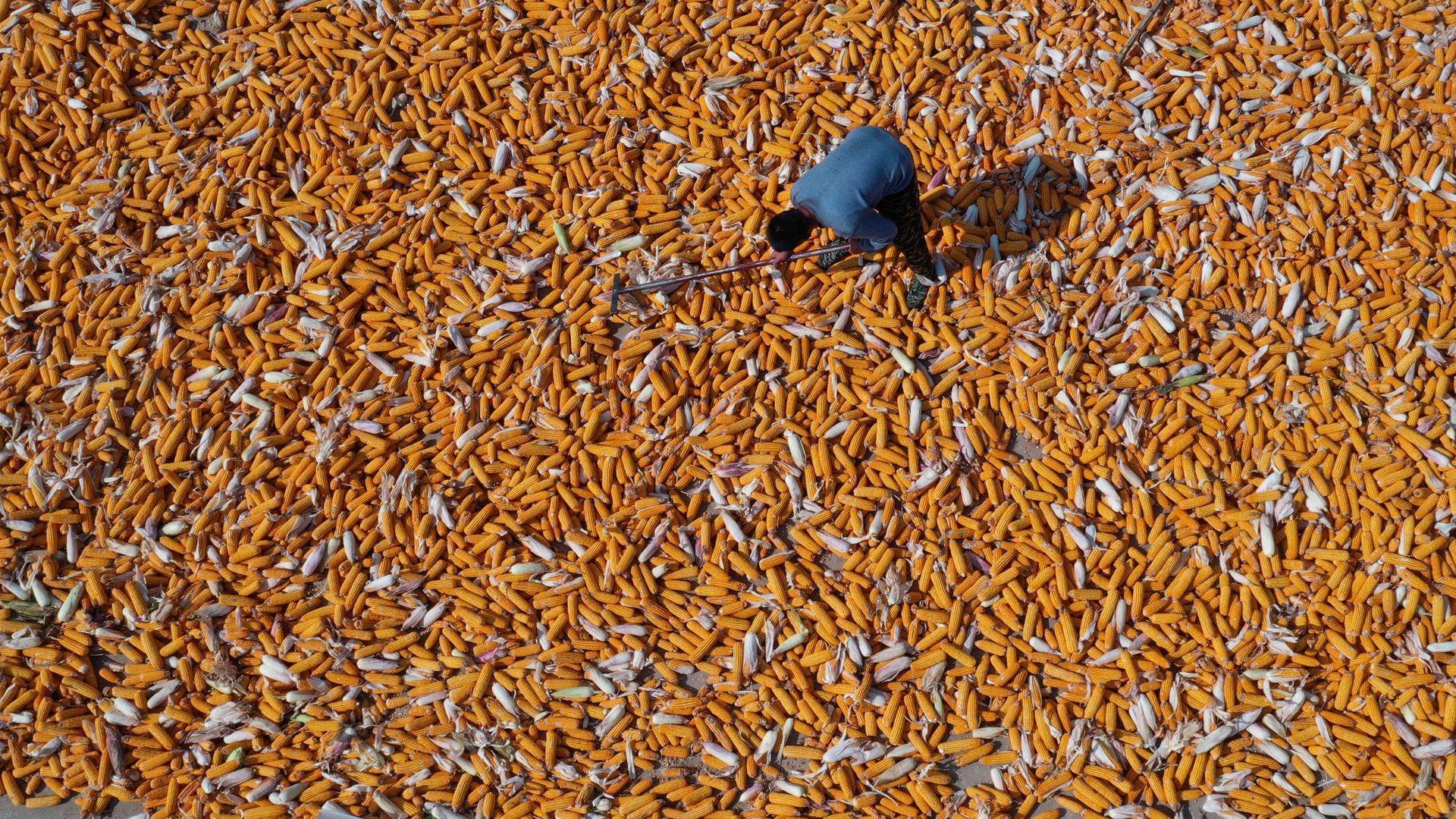
A new study finds changing the food system is vital to keeping global warming below potentially dangerous levels.
Why it matters: The global food system is projected to generate nearly 1.5 trillion tons of greenhouse gas emissions over the next 80 years, which by itself is enough to ensure the Earth warms by some 2 C over pre-industrial levels. Preventing that will require changes that go beyond what food we eat to how we produce it.
By the numbers: In the study, published in the journal Science, researchers calculated the emission reductions that could be achieved through various changes to the food economy, both behavioral and technological.
- The biggest savings would come from a near-complete global switch to a plant-heavy diet, which would cut 750 billion tons of greenhouse gas emissions.
- Reducing daily consumption to the appropriate number of calories by age — around 2,100 calories for most adults — would save 450 billion tons.
- More efficient farming would cut almost 600 billion tons.
- Engineering better-yielding crops through genetics would reduce some 210 billion tons.
- Vastly reducing food waste would save almost 400 billion tons.
How it works: Going halfway on all five of these recommendations — plus cuts to fossil fuels, an even bigger source of greenhouse gas emissions — should be enough to prevent the world from warming 2 C by 2100.
- While most experts consider it extremely unrealistic to expect a global move away from meat — especially when consumption continues to increase — mixing some behavioral changes with technological reforms seems more achievable.
4. The EV gold rush

Illustration: Aïda Amer/Axios
Wall Street speculators are flocking to electric vehicle startups, assigning gigantic valuations to companies that have yet to produce any vehicles, much less any revenue or profits, my Axios colleague Joann Muller writes.
Why it matters: Searching for the next Tesla is a risky proposition. It's still unclear how quickly the EV market will develop, or how large it will ultimately become — and some of the new EV players are likely to fail.
What's happening: At least nine EV-related startups have gone public, or will soon, through a so-called reverse merger with a publicly traded shell company. These special purpose acquisition companies (SPACS) open up new paths to public markets for many companies.
- A handful of other EV startups are sticking with private financing, some backed by deep-pocketed strategic partners like Amazon, which owns a stake in Rivian, for example.
- Although they're generally lumped together, hardly any of the newcomers are actually trying to copy Tesla, which — don't forget — struggled mightily at first.
- Instead, they're trying to broaden the market Tesla created by carving out new niches and employing different business strategies.
- Not surprisingly, each company offers a bullish view of the future — along with rosy financial projections — which Barron's cautions are highly speculative.
The bottom line: It can be hard to find the winners among all these unproven players, which helps explain the wild ride in EV stocks.
5. Worthy of your time
Can we please stop talking about the 'Latino vote'? (Andrea González-Ramírez — Gen)
- A smart take on why it was always a mistake to assume one of the most important voting groups of 2020 was ever a single monolith.
The wisdom of pandemics (David Waltner-Toews — Aeon)
- An epidemiologist on why we should approach viruses by understanding the unique cultural and biological context from which they arise.
State of surveillance (Jessica Batke and Mareike Ohlberg — ChinaFile)
- An analysis of official documents demonstrates how the Chinese government has built an unprecedented technological panopticon.
Could vacant downtown offices be turned into affordable housing? (Patrick Sisson — CityLab)
- If offices in central business districts are never fully coming back, the best option in the future might be to transform them into much-needed housing.
6. 1 hopeful thing: The crisis that hasn't happened
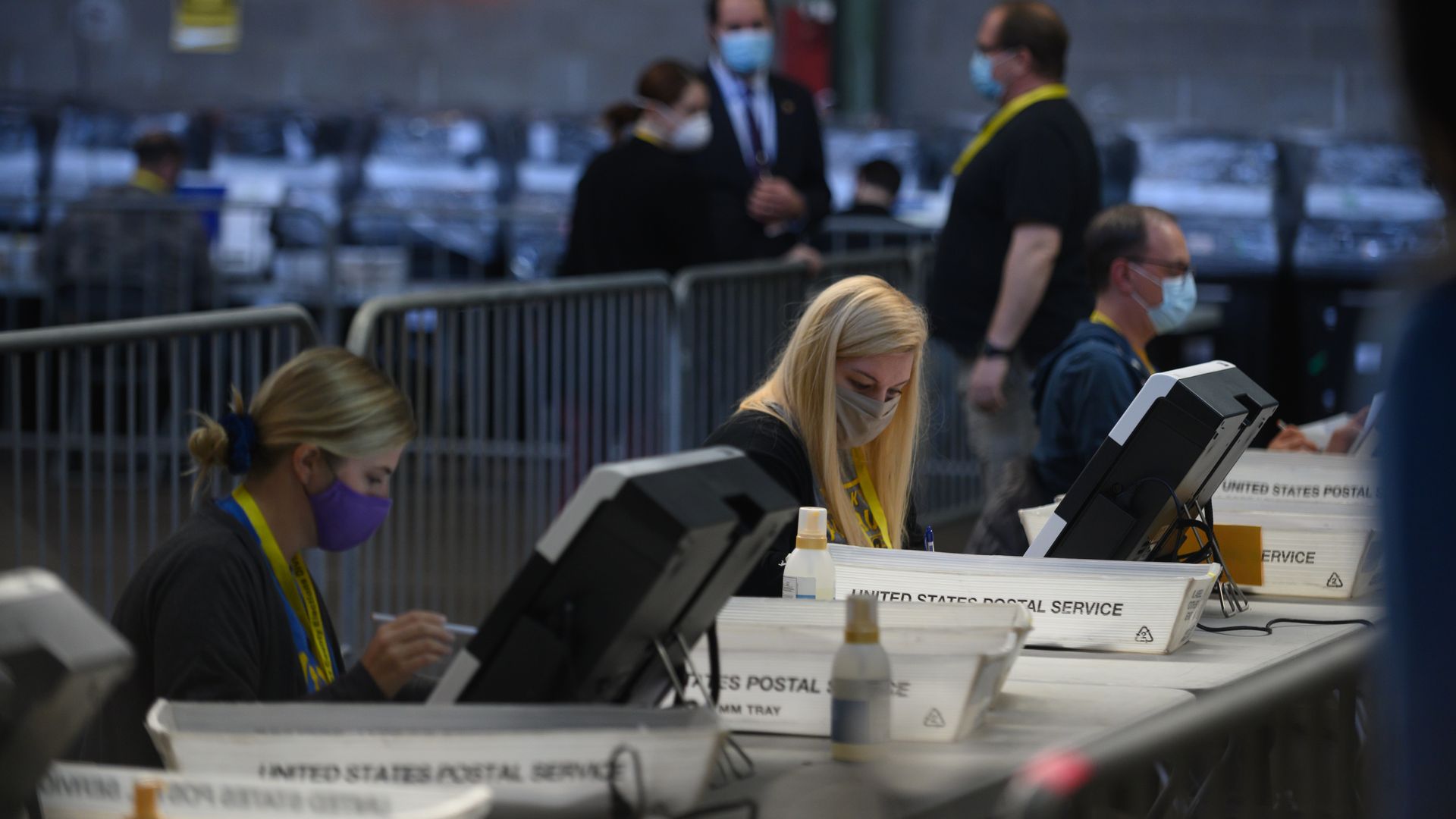
Election officials count ballots in Pennsylvania's Allegheny County on Nov. 6. Photo: Jeff Swensen/Getty Images
As hard-fought and as drawn-out as the final stages of the election have been, the violence many experts feared hasn't materialized so far.
Why it matters: Perhaps it shouldn't be much cause for celebration that the world's oldest continual democracy managed to get through an election without bloodshed. But as divided as the 2020 election showed Americans are, the vast majority of us respected the process — and each other.
What's happening: While protests have continued over the final tallying of outstanding ballots in battleground states, violence appears to have been minimal.
- Similarly, there were just a few complaints of alleged intimidation at polling places on Election Day, none of which were sufficient to prevent at least 159.8 million Americans from casting a ballot.
Flashback: This wasn't the outcome many experts were fearing in the troubled run-up to the election.
- One analyst wrote — with reason — in June that the U.S. was in a state of "incipient insurgency," facing a growth in organized violence from extremist groups.
- "American institutions may not prove as strong as we would hope," DJ Peterson, president of Longview Global Advisors, told me in September.
- Yet so far our electoral institutions, the court system and even social media platforms have performed fairly well through the election and the stressful days that have followed.
Yes, but: It's not hard to wonder what would have happened in an even closer election, or one that — like in 2000 — hung on a single disputed state.
- Assuming Joe Biden does indeed have enough votes to become the next president, it remains to be seen whether President Trump — who continues to deny the legitimacy of the election in what my Axios colleagues have called his "war against reality and truth" — will ultimately concede.
- Even if Trump refuses, however, the last few days should give us more hope that American institutions will be strong enough to carry the country through regardless.
The bottom line: Whatever your feelings about the ultimate outcome of the election, we should all be relieved that we still remain a country — for now, at least.