Axios Future
August 21, 2021

Welcome to Axios Future, where after watching Elon Musk's Tesla AI Day, I for one welcome our dancing robot overlords.
- If you haven't subscribed, please do.
- Send feedback, tips and bat baby pictures (see item 6) to [email protected].
Today's Smart Brevity count: 1,664 words or about 6 minutes
1 big thing: The biggest gift of remote work is not commuting
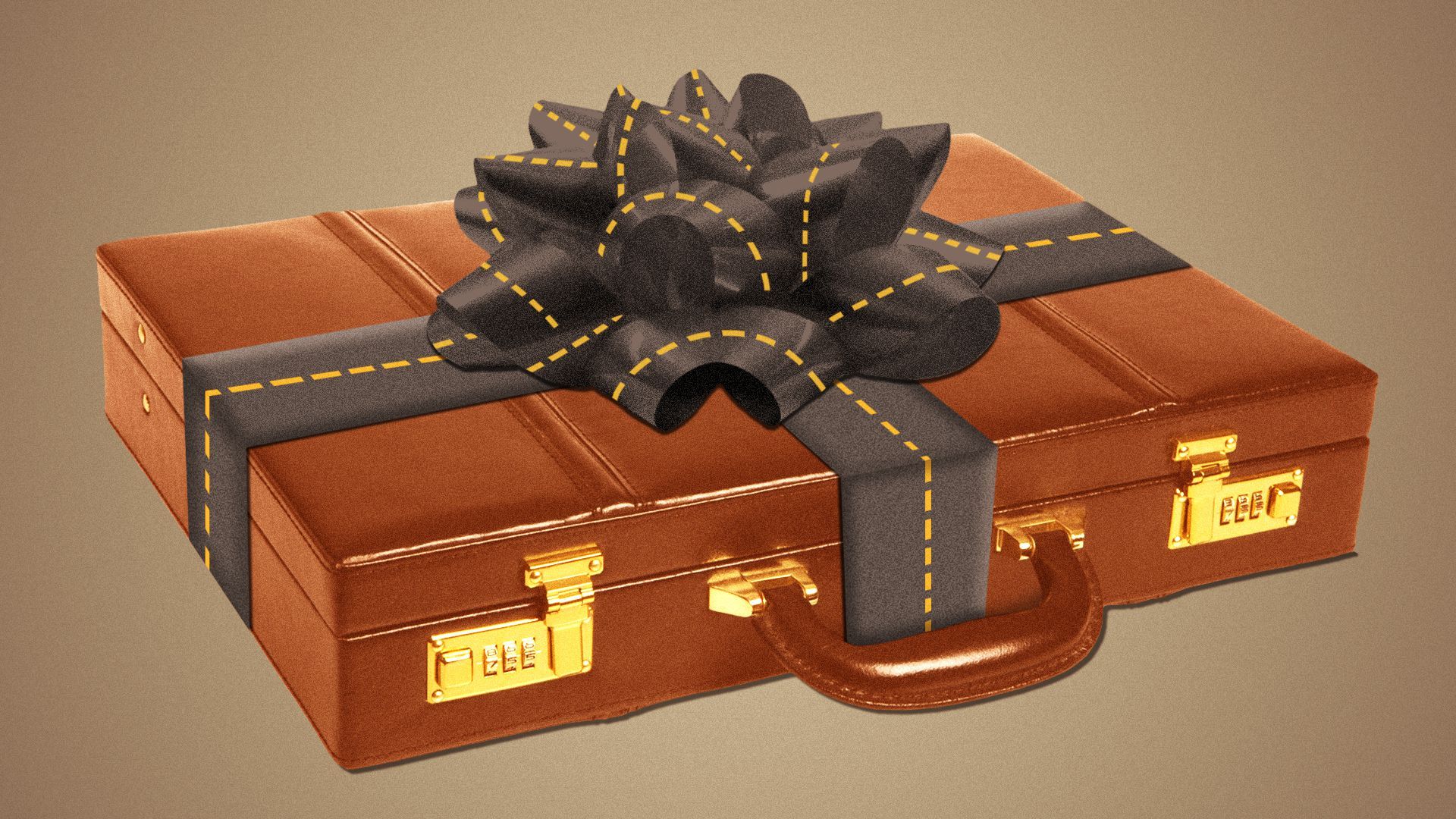
Illustration: Shoshana Gordon/Axios
A large part of the lure of remote work isn't that we hate the office — it's that we hate the experience of getting there.
The big picture: Worsening congestion and expensive housing that pushes us farther from work had already made the physical commute increasingly painful — and then the pandemic came along.
What's happening: Survey after survey shows workers at the very least want an option to retain some remote work even after the pandemic — and they're willing to take a pay cut or quit to get it.
- In a survey this month from workplace management company Hubble HQ, 79% of respondents said the best thing about remote work was the lack of a commute.
By the numbers: That shouldn't be surprising — research from psychologist Daniel Kahneman ranked the commute as the average person's single most miserable daily experience.
- And it's been getting worse: Data from the Texas A&M Transportation Institute 2021 Urban Mobility report found annual traffic delay per commuter rose from 20 hours in 1982 to 54 hours before the pandemic began, while the cost of all that delay rose from $15 billion to $101 billion.
- The situation was often worst in regions where jobs were hottest and homes were most expensive, forcing people to live far from work. A 2013 paper from the U.S. Census Bureau found the San Francisco Bay area led the nation in the percentage of "mega commuters" — commuters who traveled 50 miles or more one way — with the New York metro area coming in second.
Fast forward: Then the pandemic came, and commute times dropped drastically. Texas A&M estimates annual traffic delay per consumer fell to 27 hours in 2020.
- But even that drop is deceptive. For those Americans whose jobs could be done from home — of which 71% reported working remotely as of the end of 2020 — commute delays essentially dropped to zero.
The impact: Office employees who had been experiencing ever more miserable commutes for years suddenly got a glimpse of life without the daily car, bus or train trip.
- A good chunk of them responded by moving farther away from where offices are located in search of more space and lower costs in the suburbs, which means that if suddenly everyone had to return to the office, that daily commute would likely be even worse.
- No wonder the majority of U.S. employees want to retain at least the option of remote work — from e-commerce to home movie streaming to eating habits, convenience tends to trump all in America, especially as advances in technology make that convenient choice more palatable.
The catch: Convenience comes with a cost in all of those areas, work included.
- Data from Microsoft indicates remote work led employees to cluster more heavily in silos, which makes it harder to innovate and break out of groupthink.
- Even remote-work proponents like Github COO Erica Brescia — whose company is more than 70% remote — note they're still investing in in-person, collaborative-focused office space, "for human connection and that change of scenery."
- Facebook this week introduced its Horizon Workrooms VR app, with CEO Mark Zuckerberg telling reporters that "we shouldn't really have to physically be together to feel present or collaborate or brainstorm."
Between the lines: Whatever you think of Workrooms or VR — and it's easy to mock — the product's existence is an indication that one of the most powerful people in tech believes that something is lost without group collaboration and that virtual spaces to do that can eventually be made near equivalent to physical ones.
- That might be hard to believe watching Zuckerberg's blocky cartoon VR avatar glitch during his virtual media roundtable, but VR and online work tools will continue to improve over time.
The same likely won't be true of the physical world.
- Congestion didn't become a nightmare by accident — it's the result of decades of underinvestment in transportation infrastructure as well as housing policies that have made living close to major cities ruinously expensive.
- Planes, trains and automobiles — we haven't gotten any faster at moving from point A to B, and by some measures, we've gotten slower.
- What we're seeing around work is a reflection of technology trends — innovation moves rapidly when it comes to bytes, and far more slowly when it comes to atoms.
The bottom line: If the choices come down to working in Zuckerberg's VR office or returning to the daily commute, it's not hard to see many American workers grudgingly picking up a headset.
2. Bringing cell-grown meat to high-end restaurants
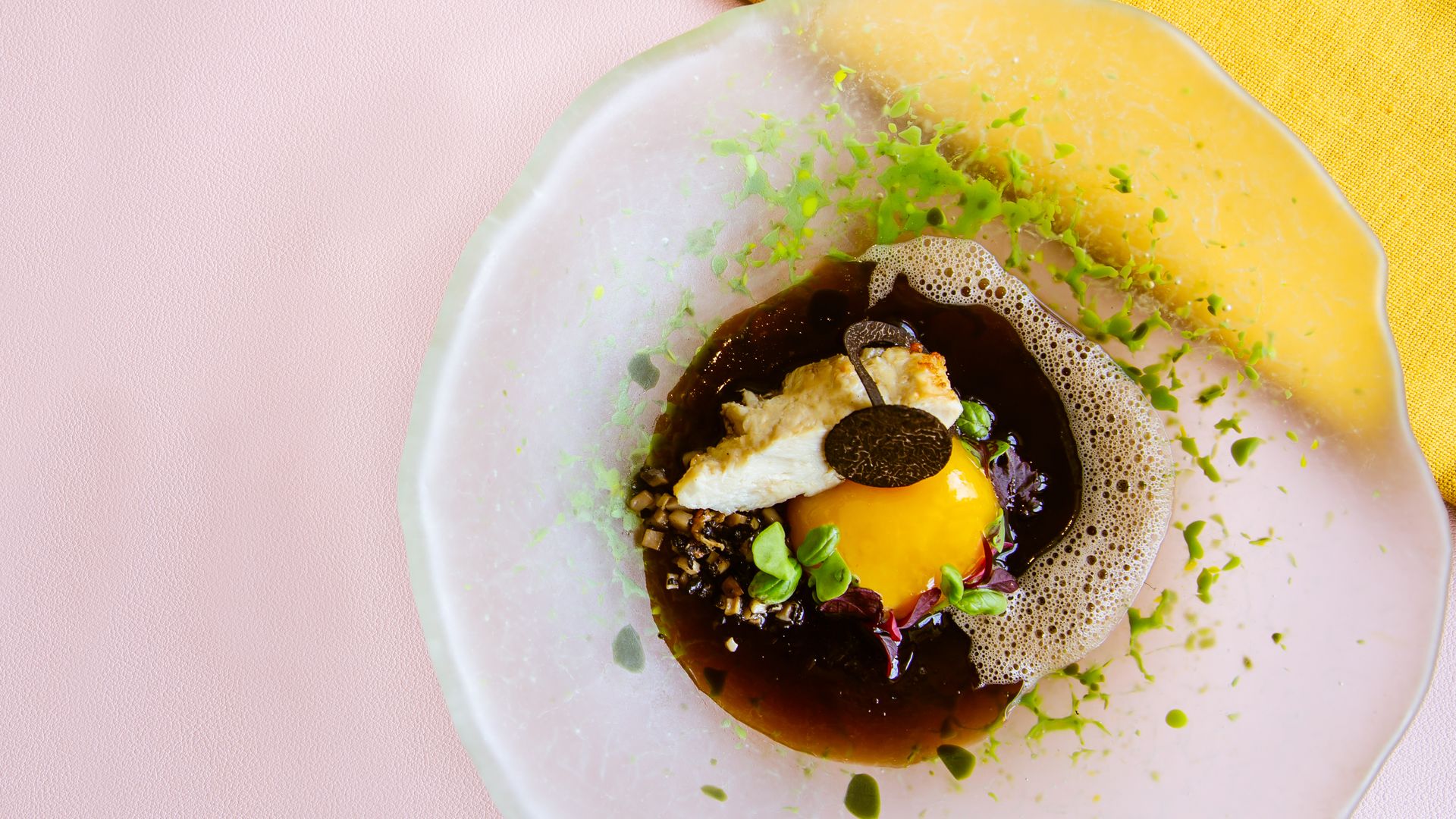
A dish by San Francisco chef Dominique Crenn using Upside Food's cultivated chicken. Photo: Courtesy of Upside Foods
A food tech startup is partnering with an avant-garde San Francisco chef to serve the company's cultivated, cell-grown chicken at her restaurant.
Why it matters: Cultivated meat — animal products grown from cells, rather than processed from slaughtered animals — faces technical and economic challenges, but it also has to gain consumer acceptance.
- Placing the products in high-end restaurants could help speed that process.
What's happening: Cultivated chicken from the Oakland-based startup Upside Foods will be served in San Francisco chef Dominique Crenn's Atelier Crenn restaurant, Upside announced on Thursday — the first such partnership between a cultivated meat maker and a three-star Michelin chef.
- This will mark the first time Crenn has served meat since 2019.
- "She took meat away from her restaurants because she didn't like the impact it had on the environment," says Uma Valeti, a cardiologist-turned-founder and CEO of Upside Foods. "When she saw what we were doing, she said she had to get this stuff for her plates."
How it works: Like other cultivated meat startups, Upside grows chicken and beef products from cell lines grown in production facilities.
- The result is meat that tastes like meat without most of the environmental or animal welfare drawbacks of conventional production.
What to watch: Upside's cultivated chicken will be served in Atelier Crenn only after it passes regulatory review from the FDA and USDA, something Valeti says he is hoping for "in the near future."
3. The world-saving side effects of the Montreal Protocol
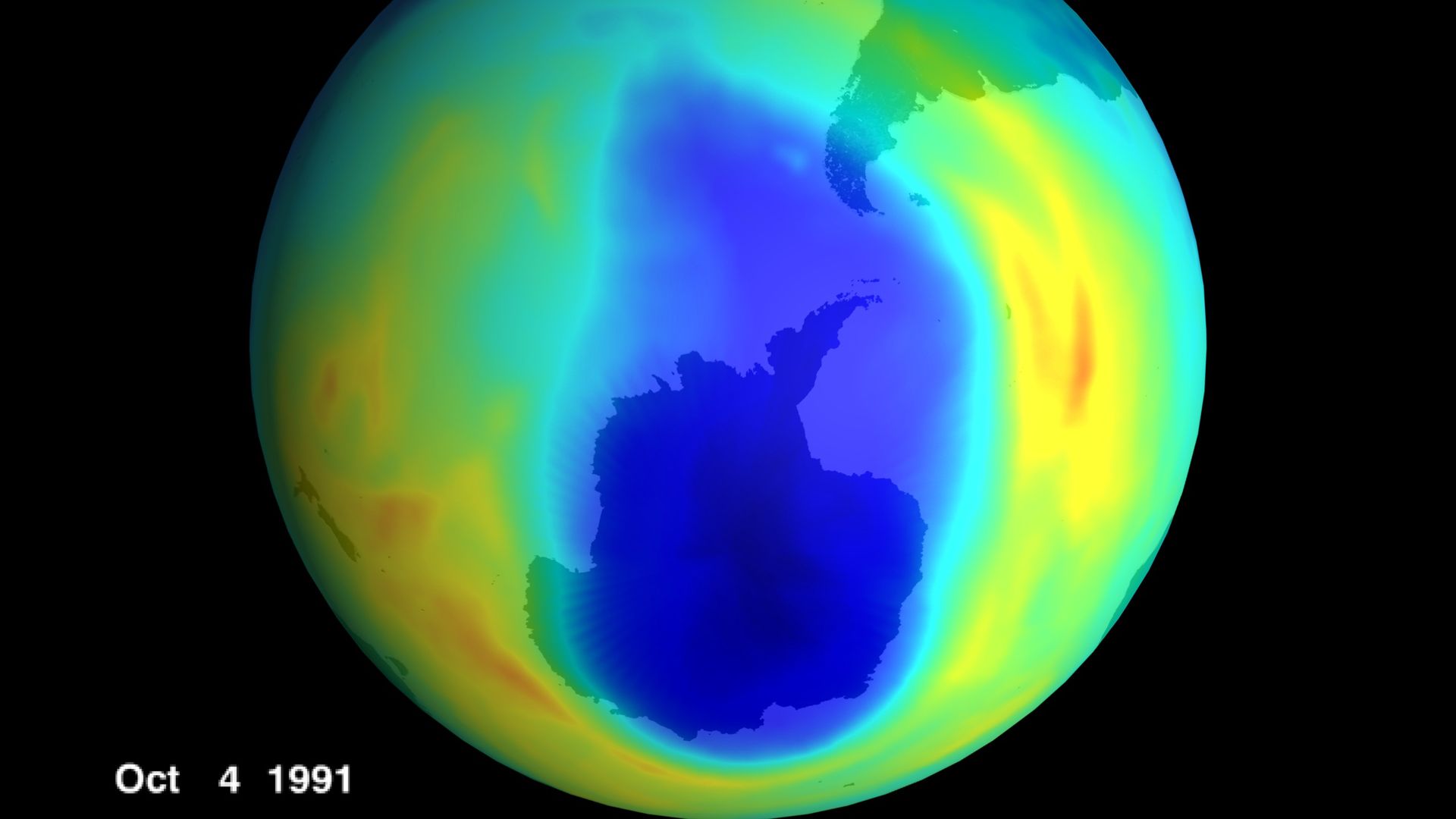
A visualization of the Antarctic ozone hole from 1991, two years after the Montreal Protocol went into effect. Credit: NASA/Goddard Space Flight Center Scientific Visualization Studio
A new study finds the 1987 Montreal Protocol, which was negotiated to stop ozone-depleting emissions, also prevented significant climate change.
Why it matters: Former UN Secretary-General Kofi Annan called the Montreal Protocol "perhaps the single most effective international agreement," and its success in both reversing ozone depletion and slowing warming shows why.
What's happening: In a study published in Nature this week, researchers simulated what would have happened to the world if the Montreal Protocol had never gone into effect.
- The treaty phased out ozone-depleting chemicals like chlorofluorocarbons (CFCs) and hydrofluorocarbons (HFCs).
- Previous research has shown the Antarctic ozone hole would have been 40% bigger in the treaty's absence.
- The new study, though, shows continued use of ozone-depleting chemicals in the absence of Montreal could have led to an additional 2.5°C of warming by the end of the century.
How it works: Some of that climate change would have been triggered by direct warming caused by CFC and HFC emissions, which act as a greenhouse gas.
- Because a damaged ozone layer would let in more harmful UV radiation, plants would have had a reduced ability to store carbon, which would have further contributed to warming.
The big picture: The success of the Montreal Protocol has often been cited as proof the global community can successfully negotiate a solution to a global environmental challenge.
- But carbon — and the fossil fuels that contain them — is far more central to the global economy than CFCs and HFCs, which could be replaced with ozone-safer alternatives at a relatively low price.
4. Using synthetic biology platforms to clean up indigo dye-making
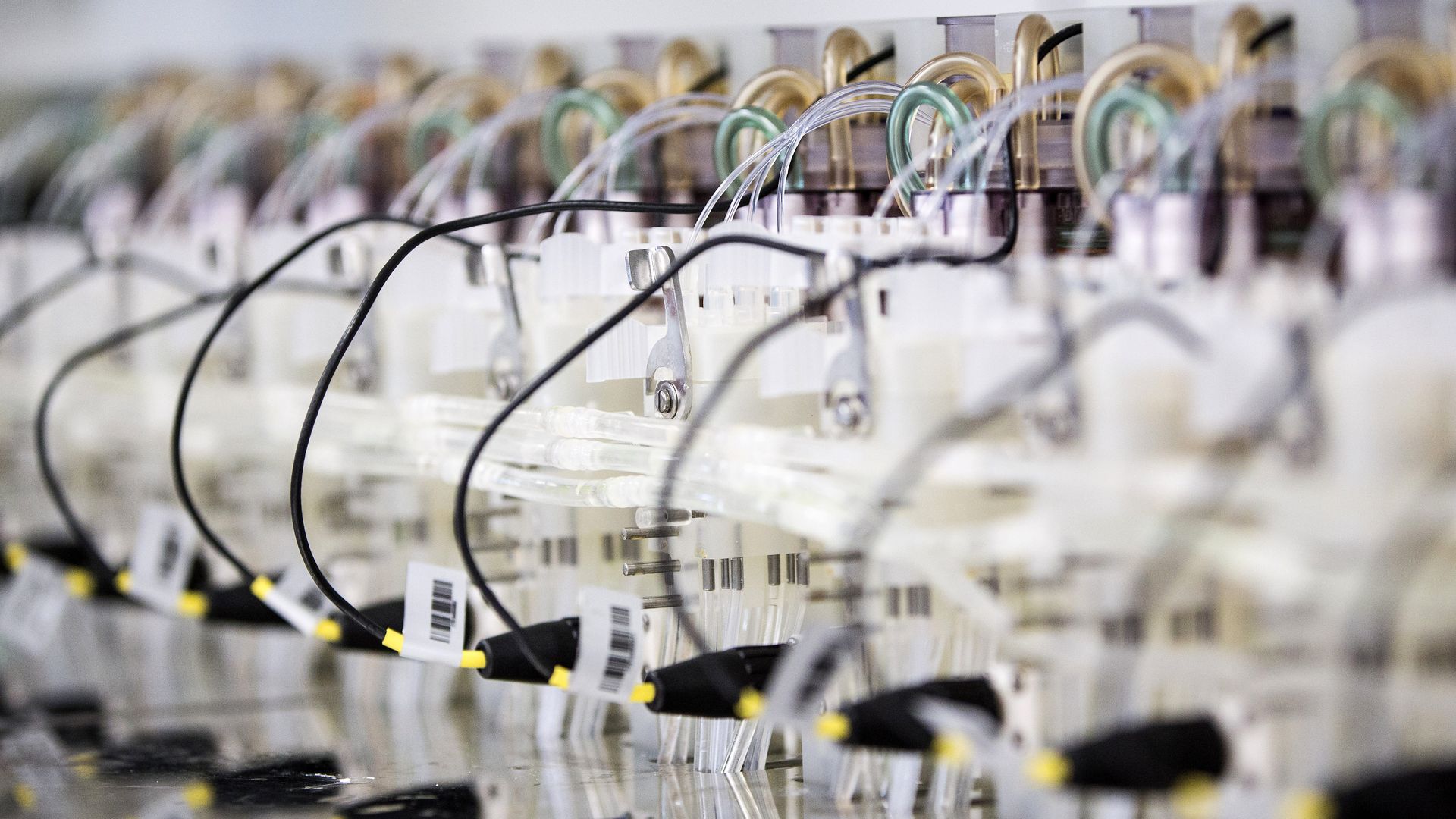
Automated fermenting machines at the synthetic biology startup Ginkgo Bioworks. Photo: Scott Eisen/Bloomberg via Getty Images
A company using a bio-based approach to making more environmentally friendly indigo dye is the first small startup to sign up with Ginkgo Bioworks' automated synthetic biology platform.
Why it matters: Boston-based Ginkgo, which recently made plans to go public via a SPAC deal, aims to become the Amazon Web Services for the growing synthetic biology world, offering its microbe engineering foundry as a platform to build out biological apps.
Driving the news: On Thursday, Ginkgo announced a new partnership with Huue, a biotech startup that uses synthetic biology to produce indigo — the dye used by the clothing industry to color a billion pairs of jeans a year — without the CO2 emissions and toxic byproducts that come from conventional dyeing.
- "There's an opportunity here to create the colors consumers want without the environmental trade-offs by using synthetic biology," says Michelle Zhu, CEO and co-founder at Huue.
What's next: Huue will use Ginkgo's automated platform to perfect and eventually scale up its microbe engineering process — a task Ginkgo CEO Jason Kelly compares to "compiling and debugging code" in the software world.
5. Worthy of your time
A natural pandemic has been terrible. A synthetic one would be even worse (Abraar Karan and Stephen Luby — STAT)
- A human-made pandemic is a real threat — and we're not remotely prepared.
How AI-powered tech landed man in jail with scant evidence (Associated Press)
- An investigation into the uncertain tech of ShotSpotter, which says it can track the location of gunshots through sound.
The rise of 3D printed houses (Economist)
- How printing buildings could be one solution to the housing crisis.
The ancient Persian way to keep cool (Kimiya Shokoohi — BBC Future)
- You too can use "wind catchers" to air-condition yourself like Xerxes the Great.
6. 1 parenting thing: Baby bats babble like human infants

A greater sac-winged bat, or what you may begin to think your crying baby looks like after you've been up all night. Photo: Michael Stifter
A new study found striking similarities between the babbling sounds of infants and those of baby greater sac-winged bats.
Why it matters: In both cases, babbling seems to have evolved as a precursor to more complex vocal behaviors like talking in humans and "singing" in adult bats.
How it works: While the bats' babbling doesn't sound much like human infants — unless your baby also produces high-pitched chirping tones, in which case you may want to contact your pediatrician or the Weekly World News — it has a similar rhythmic, non-random pattern.
What's next: Researchers hope the apparent similarities in infant babbling across species may eventually reveal common genes for vocalization.
Sign up for Axios Future
Spot the mega-trends impacting our world