Axios Future

August 28, 2021

Welcome to Axios Future, where I'm about to go on vacation/full-time toddler care.
- Future will be off next week and back in your inbox on Wednesday, Sept. 8.
If you haven't subscribed, you know the drill.
- Send feedback, tips and the best Montreal smoked meat spots to [email protected].
Today's Smart Brevity count: 1,534 words or about 6 minutes.
1 big thing: It's time to build — and tech is helping

Illustration: Megan Robinson/Axios
New tech could help bring the construction sector — which has been persistently less productive than others — into the 21st century.
Why it matters: Sluggish productivity in construction raises costs and contributes to America's severe housing crisis.
By the numbers: Labor productivity growth — how much output is produced per unit of labor input — in the global construction sector has averaged only 1% a year over the past two decades, compared to 2.8% for the world economy as a whole and 3.6% in manufacturing, according to a 2017 report by the McKinsey Global Institute.
- Between 2007 and 2019, according to data from the U.S. Bureau of Labor, productivity in the American multifamily residential and single-family residential construction sectors actually declined by 1.3% and 1.2%, respectively.
- At the same time, new housing starts are still well below their 2007 level, and housing overall has gotten increasingly expensive and scarce — a minimum-wage worker can afford a one-bedroom rental in just 7% of U.S. counties.
What they're saying: A visit to San Francisco — home to the nerve center of the U.S. tech industry and some of the country's most expensive housing — puts the importance of productivity growth in perspective, says Maria Rioumine, CEO of the construction procurement platform Agora.
- "In a place that has so much productivity and so much innovation, how is it possible that the cost of building the built environment is contributing to the astronomical increase in the cost to actually live?" she says.
How it works: Agora — which this month closed on a $33 million Series B fundraising round — attempts to juice productivity by bringing digital automation to the often manual work of organizing construction work and procurement, both for back-office employees and for foremen in the field.
- "There's been a very deep underinvestment in tech in construction, especially when it comes to the management of the supply chain," says Rioumine, who notes that companies in the construction sector currently spend 1.5% of their revenue on technology, compared to an economy-wide median of 3.3%.
- Among other features, Agora users get an Amazon-like app that provides a catalog for ordering and managing 4,000 different stock-keeping units — industry-speak for a specific item.
- "They can browse the catalog, look through the specs, and make sure the exact material they need is what they order," says Rioumine.
Another upstart in the construction tech sector is Doxel, which harnesses computer vision to assess the progress of a project in real time in what the company calls "Waze for building."
- Workers equipped with 360-degree cameras record video of a building site, which then gets sent back to Doxel's cloud platform where computer-vision algorithms determine how on track — or off track — a project is.
- "Our platform brings predictability and control to construction, and allows workers to identify and preempt any issues before they snowball into giant concerns," says Saurabh Ladha, Doxel's CEO.
Between the lines: Other productivity-enhancing innovations in the construction sector include 3D printed houses, advanced 5D modeling tools, and the use of drones for monitoring.
Yes, but: The sector will still be hampered by political and economic factors that can't be solved by AI or drones.
2. The case against taxing robots
Illustration: Aïda Amer/Axios
Taxes targeted at firms that employ robots over human workers would be counterproductive, a new article argues — and no, it wasn't written by a robot.
Why it matters: A growing number of technologists have argued that taxing companies that invest in robots would help reduce inequality and cushion job losses caused by automation, but such a tax could cost more than it's worth by slowing economic growth, WSJ's Richard Rubin writes.
How it works: The argument for a robot tax, as stated by figures as disparate as Bill Gates and New York Mayor Bill DeBlasio, is straightforward: Because the wages earned by human workers are taxed while capital investments — including in robotics — can be deducted, wide-scale automation could destroy jobs and tax revenue.
- Such a tax would disincentivize automation and could be used to support displaced workers.
But, but, but: That's precisely the problem, argues Robert Seamans, the director of NYU's Center for the Future of Management, in a new article for the Brookings Institution.
- For one thing, Seamans notes, fears of a robo-jobpocalypse are so far unfounded. A report last year by MIT's Task Force on the Future of Work found that AI and automation currently have the same effect on total job numbers as past technological shifts like industrial mechanization.
- Seamans notes that firms investing the most in robots are experiencing more employment growth than companies that don't, and any tax that slowed that adoption "will likely lead to less economic growth" — which likely means less tax revenue.
- Lastly, any robot tax would need to define what qualifies as a "robot" and what is just a piece of technology — and that question is far from clear.
The bottom line: Seamans suggests narrowing the gap between how the tax code treats capital and labor more generally, rather than targeting robots specifically, and supporting displaced workers directly.
3. Why electric robotaxis might not save the planet
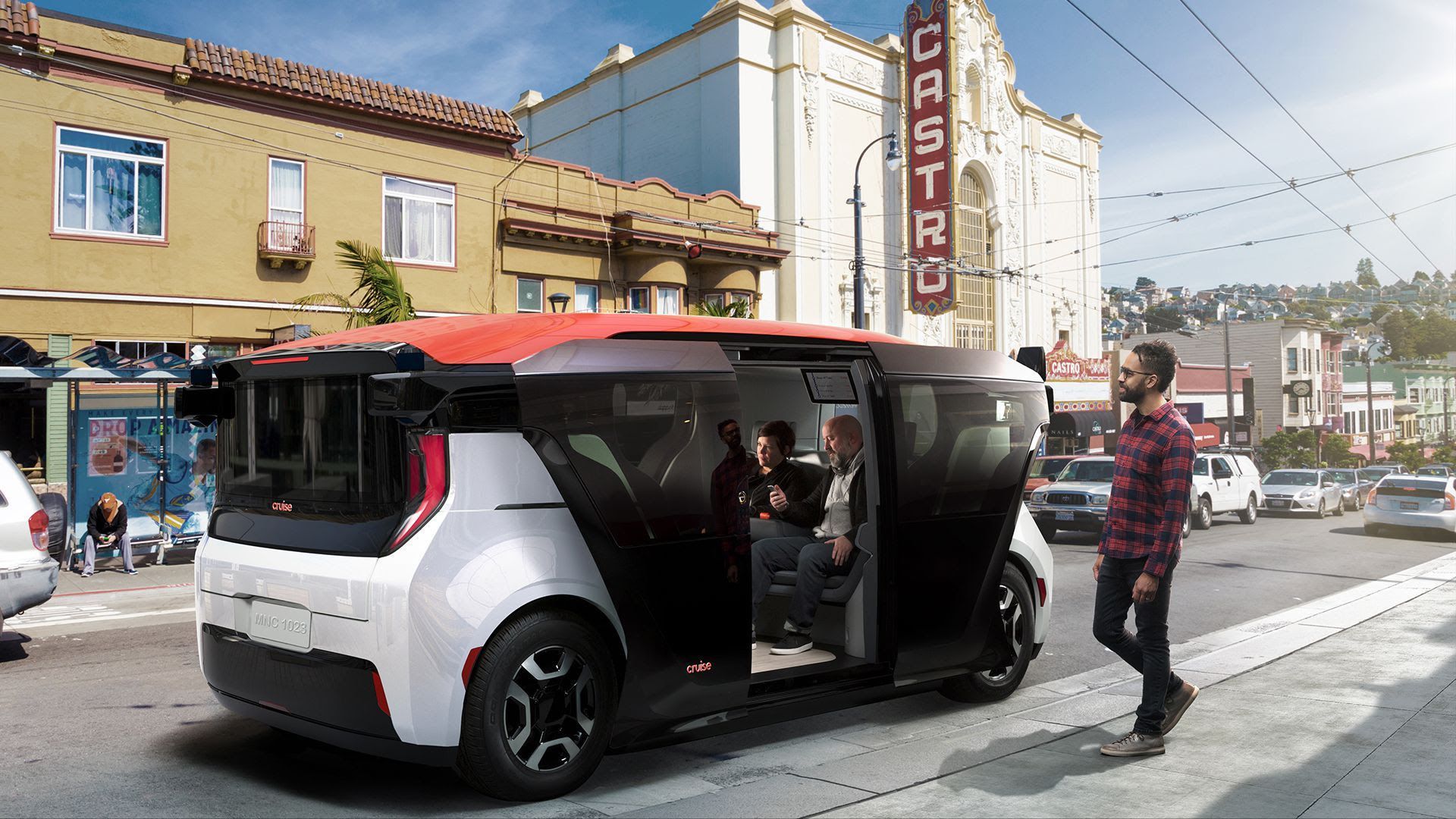
People will need to share electric robotaxis to avoid increased emissions, a study found. Photo: Cruise
Electric, self-driving taxis might not be the answer to our climate problems that many people think, a new study finds, writes Axios' Joann Muller.
Why it matters: Transportation is the largest contributor to U.S. greenhouse gas emissions, which is one reason the Biden administration is pushing for a rapid shift to electrification.
- But instead of reducing energy consumption and emissions that contribute to climate change, widespread deployment of electric robotaxis could exacerbate those problems, the joint Harvard-MIT study found.
What they're saying: “While electric vehicles themselves have lower emissions than traditional gasoline-powered ones, our work shows that deploying electric robocabs en masse on America’s streets could actually increase the number of trips, miles driven and overall emissions,” says Harvard law professor Ashley Nunes, the study's lead author.
What they did: By studying data from San Francisco, Nunes’ team concluded that the convenience of ubiquitous fleets of robotaxis would increase demand for rides, generating more trips and more vehicle miles traveled — erasing the electric vehicles' environmental benefits.
Key takeaway: To avoid worsening emissions, electric robotaxis would need to be 55% cleaner than today's EVs — or people need to stop riding solo, the study concluded.
4. Federal agencies plan more face recognition

Photo: Joan Cros/Corbis via Getty Images
Ten federal agencies plan to expand the use of facial recognition technology by 2023, according to a Government Accountability Office (GAO) report released Tuesday, writes Noah Garfinkel.
Why it matters: How to use facial recognition ethically and how to regulate such technology are major questions society hasn't yet answered, even as more government agencies begin using it.
Driving the news: The 10 agencies cited in the GAO report are the departments of Agriculture, Commerce, Defense, Homeland Security, Health and Human Services, Interior, Justice, State, Treasury and Veterans Affairs.
- Many federal agencies want to use this technology for solving crimes, which could be a violation of privacy, per the Washington Post.
- A June GAO report described how the U.S. Postal Inspection Service was using Clearview AI to solve mail-related crimes.
The big picture: Many tech companies are stalling law enforcement's adoption of this technology.
- In June 2020, Amazon stopped the sale of facial recognition technology to the police for one year, citing a lack of federal regulation over these products. The ban was extended indefinitely in May 2021.
5. Worthy of your time
Chinese factories are having labor pains — "We can hardly find any workers" (Stella Yifan Xie and Liyan Qi — Wall Street Journal)
- It's not just the U.S. that is suffering from a labor shortage — China, workshop to the world, is seeing the same problem, and it's likely to worsen.
The economic case for letting in as many refugees as possible (Jerusalem Demsas — Vox)
- Far from being too crowded, much of the U.S. is empty — and it could use the influx of people.
The new chief chaplain at Harvard? An atheist (Emma Goldberg — New York Times)
- Chalk this one up to the growing trend of "spirituality without religion."
The dream of carbon air capture edges toward reality (Jon Gertner — Yale Environment 360)
- The technology has to develop if we're going to avoid catastrophic climate change, but major hurdles remain.
6. 1 good thing: Cooling the Great Barrier Reef

A green turtle swims among the corals of the Great Barrier Reef in Australia. Photo: Jonas Gratzer/LightRocket via Getty Images
Scientists are creating artificial clouds in an effort to shield Australia's Great Barrier Reef, Nature reports.
Why it matters: The Great Barrier Reef is the largest coral reef system in the world — and it's under tremendous threat from climate change.
How it works: A group of scientists in Australia has conducted preliminary trials to blow ocean mist into the sky and artificially brighten clouds.
- The work is meant to prove the idea that juicing clouds could reduce sunlight hitting the waters around the reef.
Background: In 2017, a massive marine heat wave washed over the Great Barrier Reef, killing sea life and leading to widescale coral bleaching — what happens when the symbiotic algae that give coral its color die, turning the reef a ghostly white.
The big picture: The field trials — an early experiment in geoengineering that purposefully alters the climate — suggest the technology may work even better than computer models suggested, offering a rare ray of hope for the oceans.