Axios Future
August 07, 2021

It's time to go back ... to Axios Future. After a couple of months launching the great Axios What's Next newsletter, I'm back on the future beat.
- Our next edition will be the following Saturday.
If you haven't subscribed, do it here.
- Send feedback, tips and ideas to [email protected].
Today's Smart Brevity count: 1,788 words or about 7 minutes
1 big thing: Vaccines show the promise — and limits — of technofixes
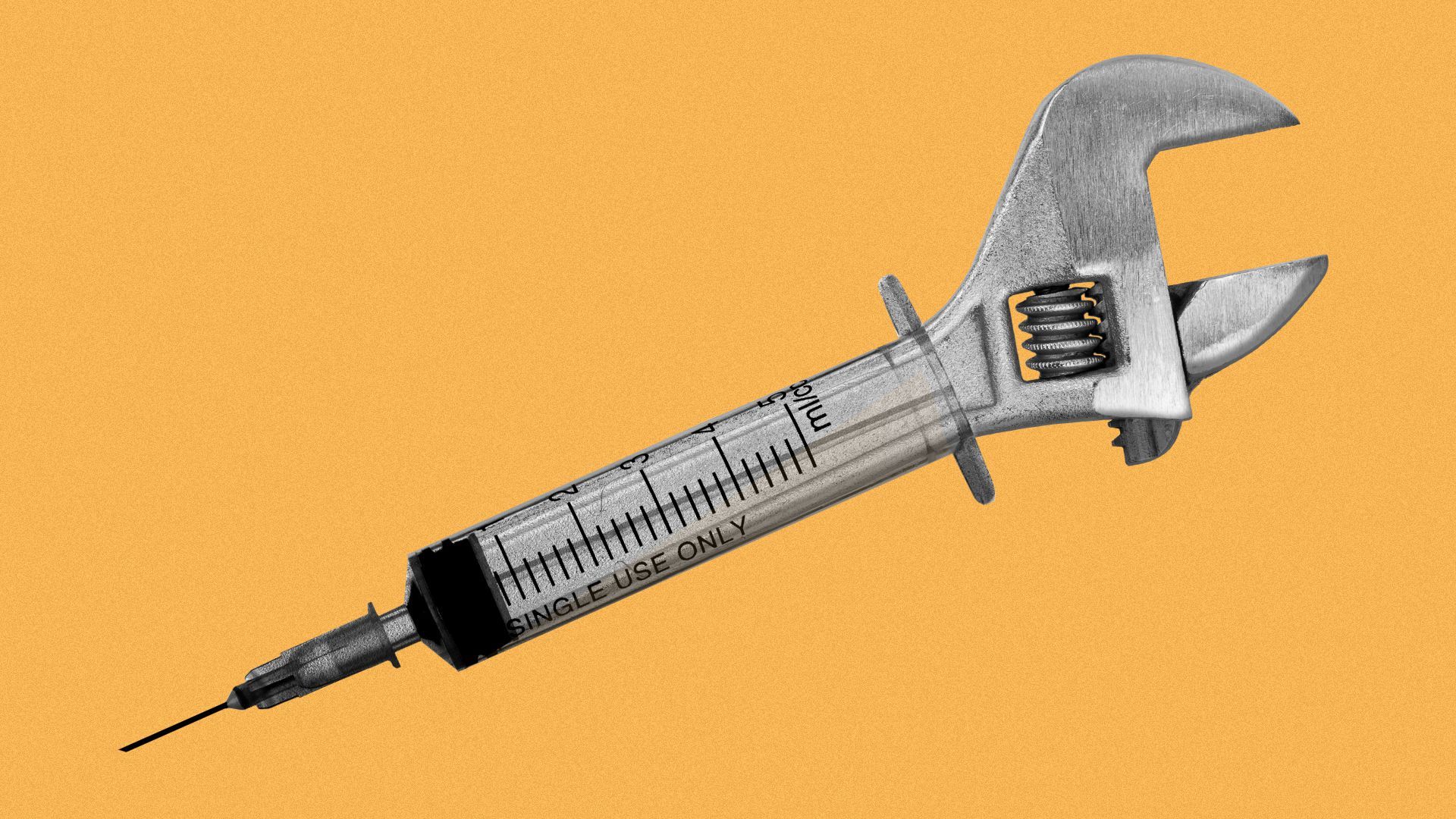
Illustration: Sarah Grillo/Axios
COVID-19 vaccines are about as effective as a single technological solution to a major threat can be — and our struggles to adopt and distribute the shots demonstrate their limits.
Why it matters: The pandemic is just one of many global challenges we'll face in the years ahead, but technofixes alone can't save us without a supportive social and political structure.
The big picture: Amid rising concern about the Delta variant's rapid spread and greatly increased infectiousness, it's worth remembering just how far we've come since the start of 2021.
- In early January, the U.S. was averaging around 250,000 new COVID-19 cases every day, and more than 3,000 people a day were dying.
- Our only ability to slow the spread involved socially and economically cumbersome strategies like shutdowns, social distancing and ubiquitous masking — little different from how we would have fought a pandemic a century ago.
Fast forward to August. Even with the Delta surge, cases and especially deaths and hospitalizations are vastly down from the winter peak — and it's almost entirely thanks to the effectiveness of the vaccines.
- If you want to see how difficult it is to crush COVID-19 without widespread vaccination, look at Australia — vaccinated at less than 16% and back in lockdown — though you'd likely need to watch from a distance, as its borders remain effectively shut even to its expats.
Be smart: A vaccine as effective as the COVID-19 shots represents the ultimate example of a technofix — a fire-and-forget solution that solves a complex problem without the need for difficult social and political trade-offs.
- Or at least it might, if authorities could convince all eligible Americans to actually take the shots, and if they could organize an equitable distribution that would get vaccines to the billions of people still waiting.
- Governors and legislators in some red states have banned vaccine mandates, taking off the table one of the best tools to improve uptake.
- The result of those social and political failures is unnecessary illness and death and a higher chance SARS-CoV-2 will mutate into more dangerous variants. Plus, poorer countries have an estimated 270 million people — up from 150 million before the pandemic — who are facing life-threatening food shortages.
Yes, but: Technologies are never deployed in a vacuum.
- "We have this idea of technology as a silver bullet, rather than something more prosaic, one tool among many," Alexa Hagerty, former research associate at Cambridge University's Centre for the Study of Existential Risk, said on a recent panel. "But technology doesn't just travel solo."
- Even the best vaccines in the world — and the mRNA COVID-19 vaccines can plausibly lay claim to that title — will be hobbled if political divisions and social distrust mean millions of people refuse to take them, and if geopolitics prevent them from even reaching those who need them most.
Between the lines: The troubled rollout of the COVID-19 vaccines should give us pause before we count on similar technofixes to bail us out of future threats — especially since few of them will be as amenable to a single technological solution as a pandemic.
2. Exclusive: New data hub to forecast infectious disease outbreaks
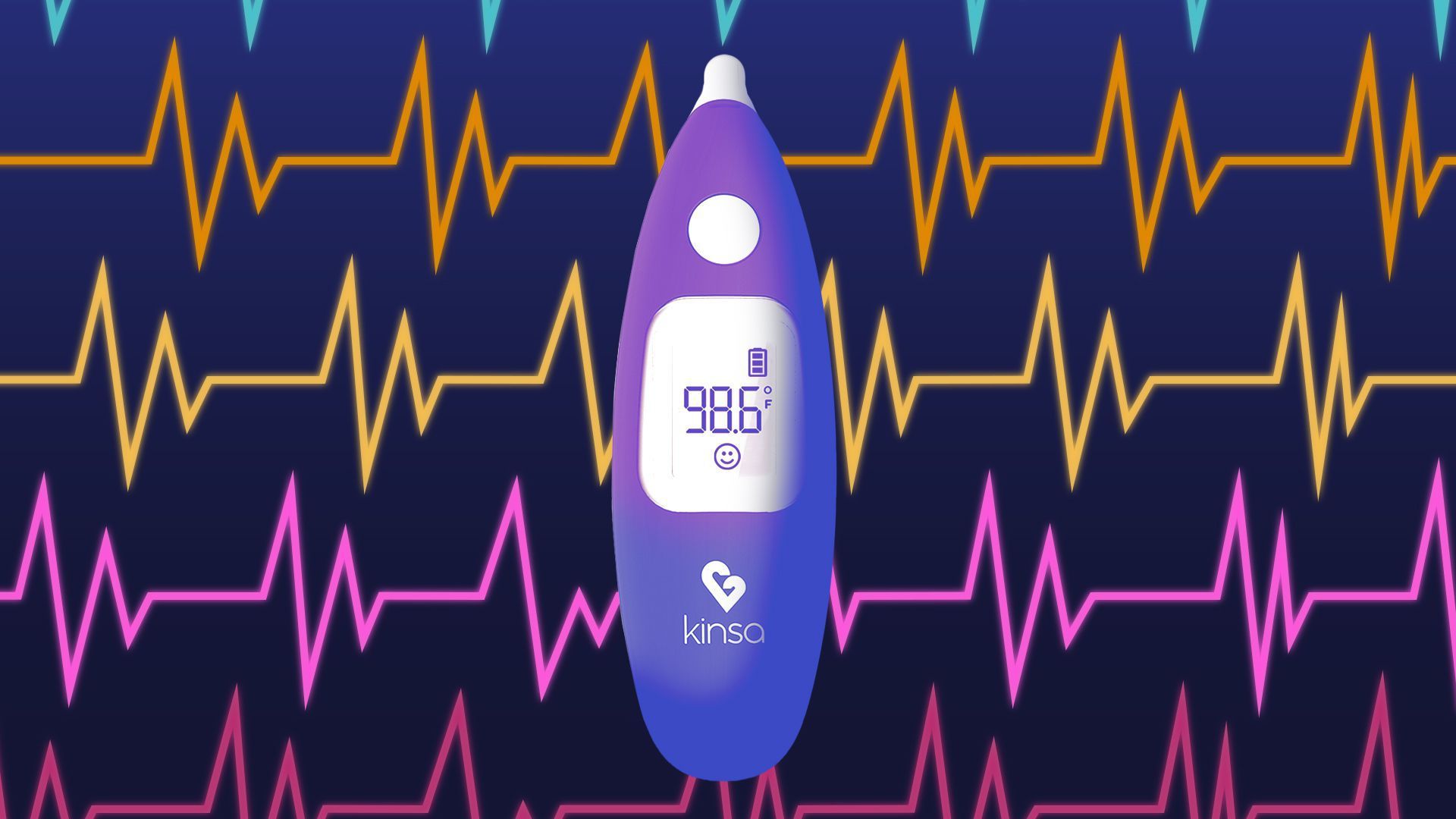
Photo illustration: Sarah Grillo/Axios. Photo courtesy of Kinsa
Kinsa, a startup that makes and distributes internet-connected smart thermometers, is developing a data hub that can provide highly specific forecasts about infectious disease outbreaks, Axios has learned.
Why it matters: Days matter when it comes to heading off a new outbreak or surge, and better forecasting models can help policymakers act to stop disease disasters before they're out of control.
How it works: Kinsa's millions of smart thermometers give the company what founder and CEO Inder Singh calls "highly sensitive data about where and when outbreaks are occurring, and how fast they're spreading," weeks before cases start to show up in doctor's offices and hospitals.
- Yes, but: Kinsa's existing model "is not super specific," Singh says. While some predictions can be made if fevers start to spike outside normal cold or flu seasons — as was the case when Kinsa picked up rising fevers in March 2020 — "it doesn't say 'this is the flu,' or 'this is COVID.'"
What's new: Kinsa is building an updated data hub that will be able to take data on fevers and symptoms from its smart thermometers and app and pair that with broader health data about what's going on in a community.
- This will include COVID-19 vaccination and hospitalization rates, genetic epidemiology of viruses in circulation, mobility data, stay-at-home orders — even information about the demand for cold and flu medication.
- Put all that together, and you can create a prediction model that is both highly sensitive to emerging outbreaks and "highly specific about differentiating between illnesses," Singh says.
What to watch: Kinsa is already picking up on an unusual rise over the past month in influenza-like illness among 2- to 9-year-olds, which is 23% above normal for this time period and could represent COVID, flu, colds or something else.
3. Arguing over degrowth
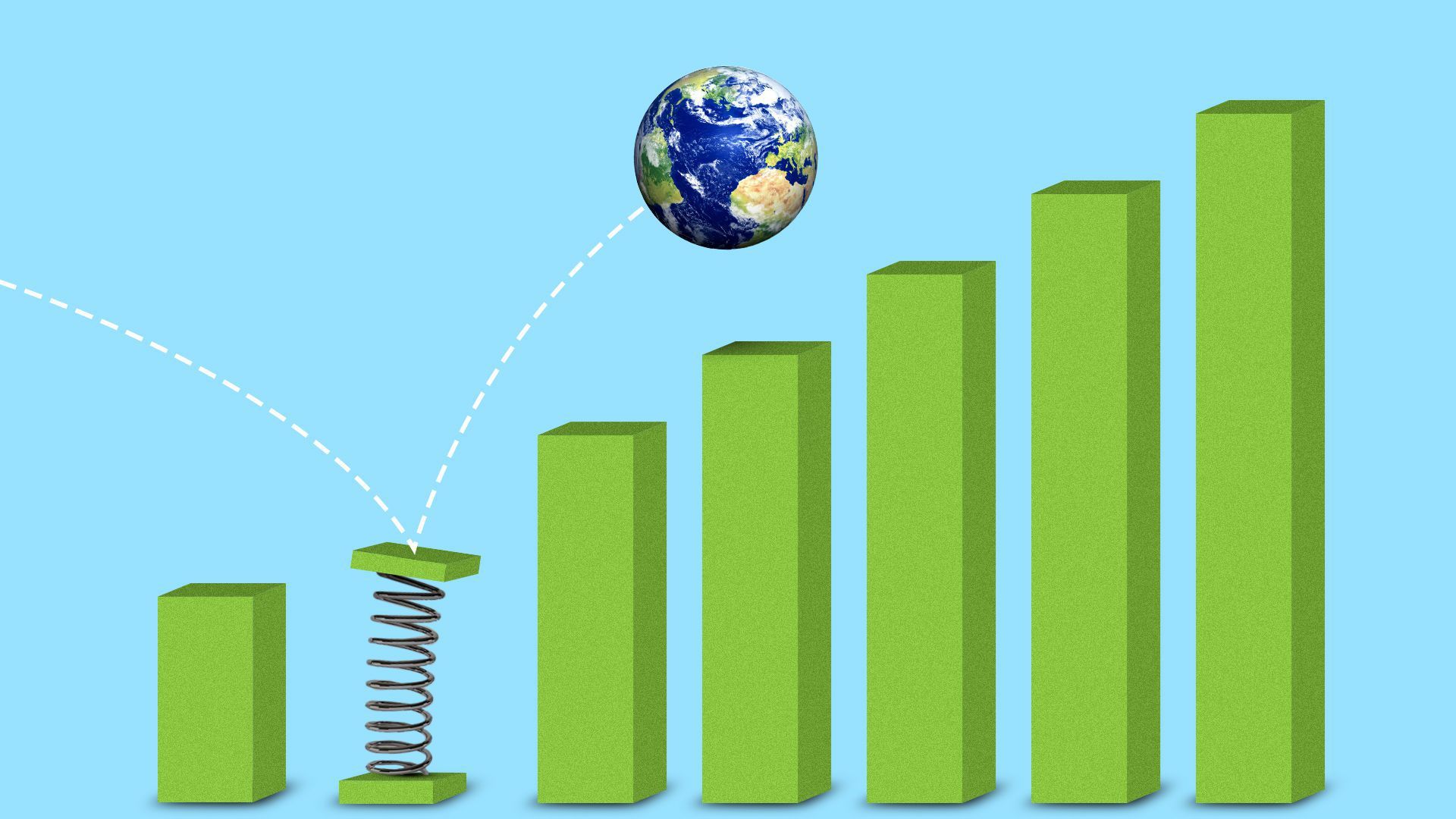
Illustration: Aïda Amer/Axios
A series of new articles and studies illustrate the growing struggle over "degrowth" — the argument by some environmentalists that we must shrink and rebalance the global economy to avoid climate catastrophe.
Why it matters: Degrowth is a radical solution for what can feel like a radical problem, but it's difficult to avoid the conclusion that if it could ever be implemented, degrowth would be a cure worse than the disease.
What's happening: In a smart piece for Vox's Future Perfect vertical earlier this week, Kelsey Piper meticulously picked apart some of the leading arguments for degrowth.
- Degrowth — which calls for accepting shrinking GDP as a prerequisite to saving the planet — is "a bold, even romantic vision," Piper writes. "But there are two problems with it: It doesn’t add up — and it would be nearly impossible to implement."
By the numbers: Contrary to the arguments of degrowthers that it's impossible to keep economies growing while reducing carbon emissions, Piper notes that 32 countries — including the U.S. — have achieved absolute decoupling, reducing carbon emissions even as GDP keeps rising.
- And while degrowthers want industrialized economies to take the lead in shrinking GDP, Piper argues that degrowth "would do nothing about the bulk of emissions, which are occurring in developing countries" that need to keep growing fast to pull their citizens out of poverty.
The other side: Jason Hickel, an economic anthropologist and a leading proponent of degrowth, co-authored a paper published this week arguing that further growth in already rich countries isn't necessary for social progress and that new climate models are needed to map out a post-growth world.
- Continued growth while combatting climate change requires betting on "speculative and risky" technologies, like direct air carbon capture, that may never be feasible, Hickel and his co-authors write.
The bottom line: Technofixes alone, as I write above, won't be enough to save us.
- But degrowth requires relying on radical political changes that are at least as speculative and risky as many of those technofixes, and which seem even less likely to pan out.
Go deeper: How stalling growth hurts the planet
4. The cyborg Olympics

Illustration: Annelise Capossela/Axios
The Olympics are designed to showcase the frontiers of human athletic achievement, but technology has always played a role in helping athletes push the limits.
Why it matters: With some data suggesting that pure human athletic ability in many Olympic events may be plateauing, technology will become even more important to helping the best become better.
What's happening: Records are meant to be broken, and at the Tokyo Olympics, they've been falling in droves — especially on the track and in cycling.
- In the 400-meter men's hurdle, Rai Benjamin of the U.S. beat the world record — and still finished second when Karsten Warholm of Norway went even faster.
- In the men's team pursuit track cycling event, Denmark set an Olympic record in the qualifying heats only to lose in the finals when the Italian team blazed past the world record.
Between the lines: The events where world records fell most frequently at Tokyo tended to be those where new equipment or even better surfaces could play a bigger role.
- Track stars like Warholm have benefited from using "super spikes" designed for sprint events, while the spongy track at Tokyo is "the most technologically advanced athletic track in the world," according to the company that designed it.
- Even in an event as fundamental as archery, South Korean Olympians set multiple world records thanks in part to better bow and arrows made with the support of Hyundai.
The other side: World records in throwing and jumping field events — where technology plays less of a role — have been much harder to beat, lasting for an average of more than 23 years.
- But there's a technological side to this as well, albeit a dark one — many of the existing records were set between the 1970s and 1990s, when doping of athletes went largely unpoliced.
5. Worthy of your time
Inside the first-ever scientific study of post-mortem meditation (Daniel Burke — Tricycle)
- A wild story about the first-ever scientific study of "thukdam," a Buddhist meditative state where consciousness supposedly continues for weeks after death.
What we owe to future generations (Sigal Samuel — Future Perfect)
- A long read into one of the knottiest challenges we face — how to prioritize future people who don't even exist yet.
A growing problem (Ryan Avent — The Bellows)
- The Economist writer pens a thoughtful take on the ethics of degrowthism, and whether we can ever be convinced that enough is enough.
What will history say about COVID? (Karen Emslie — Knowable Magazine)
- From a pair of nurse's shoes to the coronavirus model Anthony Fauci used in public briefings, museums gather artifacts from the age of COVID.
6. Number of the day: $450,000

Richard Branson on the livestream of the Virgin Galactic Unity 22 Spaceflight on July 11. Photo illustration: Pavlo Gonchar/SOPA Images/LightRocket via Getty Images
That's how much a single ticket aboard Virgin Galactic's SpaceShip Two spaceplane will cost, the company announced on Thursday.
- $450,000 will take you to space — or at least, sort of space, given that SpaceShip Two will go 53 miles above the Earth's surface, a bit shy of the Kármán Line.
By the numbers: Personally, I'm all in favor of the space race, but before you slap down nearly half a million for a few minutes of weightlessness, it's worth considering what else $450,000 can buy:
- A full ride to Princeton University ($310,000 for four years) for about one and a half kids.
- Four Tesla Model Xs, with enough left over for about nine Tesla Powerwalls.
- Enough aid to feed 11,250 hungry children for a year, according to the NGO World Help.
The bottom line: Be aware that if you do view this as a good use of money, you'll still be waiting for a while — Virgin Galactic isn't scheduled to start flights until late 2022, and hundreds of customers already have tickets.