Axios Des Moines

September 09, 2025


🗓️ We're on Tuesday already!
🧩 Become a core piece of our newsroom when you become a member today.
🎂 Happy birthday to our Axios Des Moines members Katherine Harrington and John Pollak!
Today's newsletter is 760 words — a 3-minute read.
1 big thing: Minnesota water lessons

Iowans worried about nitrate-laced water may have lessons to learn from Minnesota, where enforceable farm rules contrast with Iowa's more voluntary approach, according to environmental activists.
Why it matters: Health experts have expressed concerns that even a little bit of nitrates can contribute to long-term health consequences, like premature births and cancers.
The big picture: Agricultural sources are linked with the majority of nitrates found in the Des Moines metro's drinking water sources.
State of play: Minnesota, known for its lakes and recreation, imposes more requirements on farming operations to protect its waters in comparison to Iowa and other Midwestern states, says Michael Schmidt, general counsel for the Iowa Environmental Council.
- Schmidt worked for the Minnesota Pollution Control Agency before moving to Iowa.
By the numbers: 93% of Minnesotans served by public water systems had average nitrate levels at or below 3 mg/L in 2022, per Minnesota Public Health.
- In contrast, Des Moines' tap water has frequently exceeded 5 mg/L for decades — a level researchers say can cause health ailments, despite being under the federal mandate of 10 mg/L.
Zoom in: Some Minnesota laws include requiring buffer strips, stricter permitting for large animal confinements and restricting fall fertilizer application.
The intrigue: Iowa farm fields also have the largest number of acres that are tile-drained in the country.
- Pipes in the ground help remove excess water on farm fields, improving crop success and reducing erosion, but they can also more quickly move nitrates towards water sources instead of filtering them through the ground.
- Research at Iowa State shows how cover crops can help filter nitrates from tile-drained water.
Between the lines: Iowa's Nutrient Reduction Strategy identifies similar strategies to Minnesota with suggestions on how to cut nitrates by 45% including rotating crops, adding buffers, establishing wetlands, and fine-tuning nitrogen application.
Since the plan was finalized in 2013, conservation has improved in the state, according to the Iowa Department of Agriculture.
- Even then, to reach that 45%, Schmidt says nearly every acre needs to have some sort of conservation practice on it, and he finds that unlikely to happen voluntarily.
- "The economic incentives are to maximize production," Schmidt says. "The conservation encouragement can be outweighed by that."
2. Zoom in: Water law details
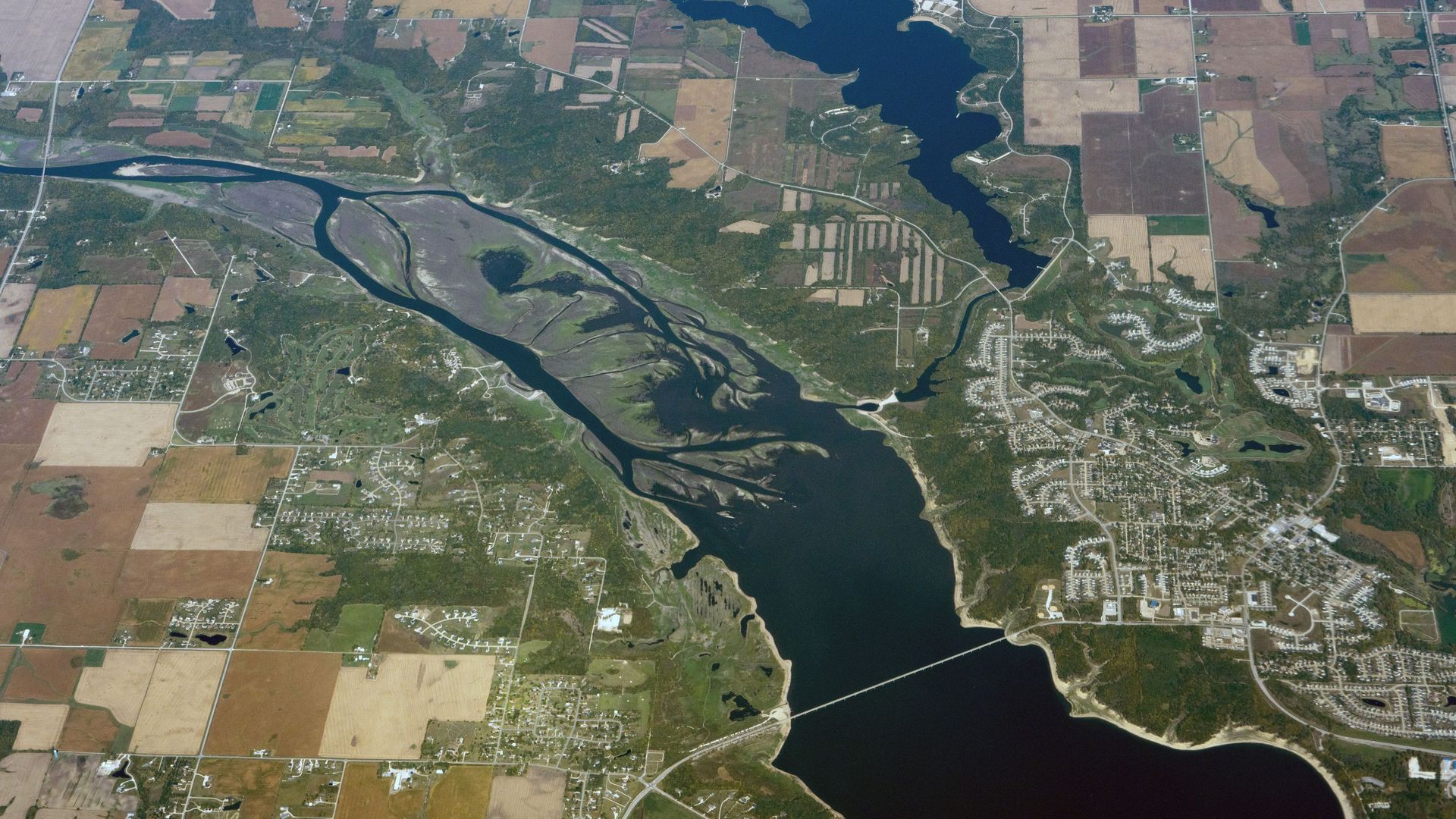
Minnesota required farmers to implement buffer strips in 2017, which are planted between cropland and waterways to slow erosion and filter pollutants before they reach the water.
- By 2019, 98% of Minnesota farms were following the law, Schmidt notes.
- Iowa incentivizes and helps farmers add buffer crops through the state's Nutrient Reduction Strategy — though it would need dramatically more to make a dent in the state's nitrate levels, per American Public Media.
CAFO oversight: Minnesota requires most large animal confinements to hold federal National Pollutant Discharge Elimination System permits, which impose more comprehensive rules for facilities that discharge waste into waterways.
- But states are in charge of determining what CAFOs need permits.
- In 2023, Minnesota had 1,566 CAFOs and 1,009 had permits. Iowa had 4,025 CAFOs, but only 157 permits. Neighboring Nebraska had 1,555 CAFOs and 489 permits.
- Iowa lawmakers have recently considered requiring medium and large CAFOs to obtain permits, though those efforts have not passed in the Legislature. Iowa's medium and large CAFOs have to follow the state's manure management plan.
Nitrogen application: Minnesota also has restrictions on fall and winter manure application.
- Iowa doesn't allow manure application on frozen or snow-covered ground. The state does allow it in the fall, but because there aren't crops on the ground, it can lead to more nitrogen loss, Schmidt says.
3. The Ear: Catch up on the news

🗞️ The Minnesota Star Tribune is closing its printing plant and will be printed at the Gannett facility in Des Moines starting in late December. (Star Tribune)
🏫 Southeast Polk Community School District announced a $51 million bond referendum vote in November to fund local school projects. (Southeast Polk Community School District)
🏗️ Renewablade of Bondurant has begun production using ground-up discarded wind turbine blades to create products like retaining wall blocks, exemplified by a recent project in downtown Des Moines. (Iowa Capital Dispatch)
4. 💩1 potty PSA to go


💧 1 more PSA: DSM's spraygrounds had a rough start this season, but they will remain open through Sept. 30 (weather permitting).
This newsletter was edited by Chloe Gonzales.
Sign up for Axios Des Moines
