Axios Crypto

March 01, 2024
GM! As you read this, Crystal and Brady are in Denver looking at NFTs and degens, and considering buying plush Bufficorns.
- Email us: [email protected]
Today's newsletter is 1,087 words, a 4-minute read.
😎 1 big thing: ETHDenver vibes
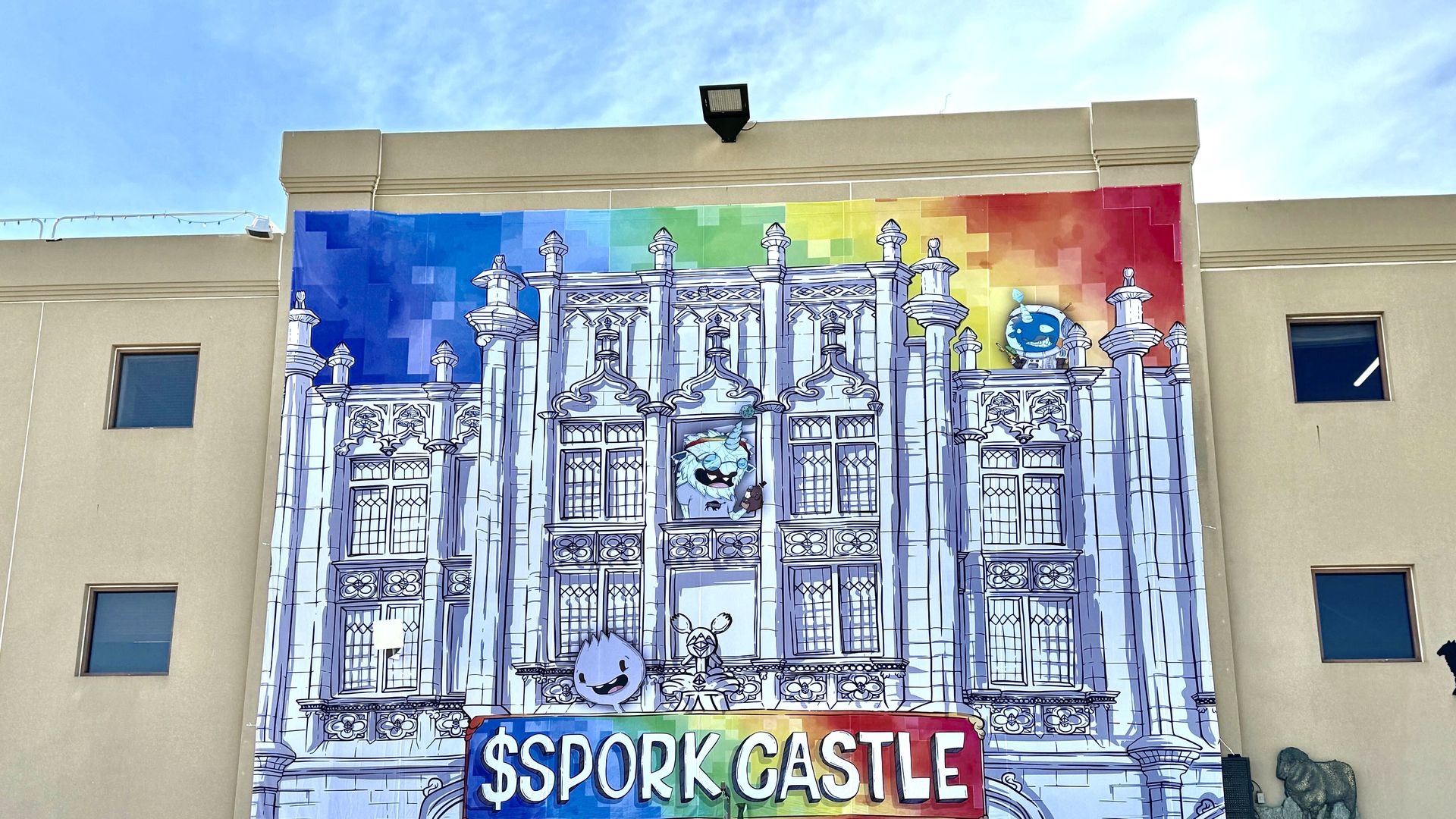
The place of much of the crypto vibing. Photo: Crystal Kim/Axios
The vibe shift is palpable at ETHDenver, the world's longest-running Ethereum-dedicated conference, Crystal writes.
Zoom in: Developers, founders, venture capitalists, a giant squid, pirates, puppies, babies and toddlers were packed into the National Western Complex, a venue designed for the rodeo: People riding bucking bulls.
- Folks who aren't here, clearly aren't here, mistakenly thinking ETHDenver was at the Denver Convention Center where a giant blue, standing bear rests his paws.
The big picture: Folks on- and off-stage yesterday were exuberant, matching the market's vertical move as bitcoin and altcoin prices surge.
- Crypto needs to keep building, they say, yet the status quo of the U.S. government's hostility toward the sector remains.
State of play: Crypto loves SEC Commissioner Hester Peirce, who graced the stage yesterday afternoon for a fireside chat on the state of regulation: "We're in an enforcement-only mode," she said.
- Could chair Gary Gensler change his mind and start writing rules that would help crypto firms operate without fear of regulatory action — sure, but Peirce doesn't see change at the SEC arriving soon, she said.
- Erik Voorhees, founder and former CEO of ShapeShift, in a panel talk about AI and blockchain technology, pointed to what the crypto community might not remember: Washington is not a friend.

What we're watching: The convergence of crypto and TradFi is rolling on.
- I chatted with Consensys founder and chief Joe Lubin about supercycles, the inevitable crumbling of the old guard and the new technology (blockchain) driving a paradigm shift that could be felt for generations.
- He said the ETH ETF was inevitable.
Behind the scenes: There were lots of double-take moments and lols shared with strangers who felt like friends.
- Robert F. Kennedy, the independent crypto-friendly presidential candidate, had a booth giving out voters' pins that read: BUIDL WITH KENNEDY. (He's due to speak tomorrow.)
- A gaggle of dudes crowded around a Liquid Death vending machine, and one remarked, "We're not even thirsty, we just like to game anything."
💭 Crystal's thought bubble: Boys like games, and games like boys with money.
💻 2. ETHDenver dispatch: Bringing user experience to DeFi

Wil Johnston, founder of Infinex, and Noah Litvin, contributor to Synthetix. Photo: Brady Dale/Axios
Imagine a world where the interface with decentralized finance (DeFi) looked much like the Coinbase app, with roughly as easy usability, Brady writes.
Why it matters: DeFi offers investors access to a financial system that has no secrets, which makes it much more difficult for some horrible black swan to build up behind the scenes.
- Case in point: Like the fact that every non-DeFi crypto lender was exposed to Three Arrows Capital.
Infinex started as a way to create a user interface for Synthetix's perpetual futures market, its founder, Wil Johnston, tells Axios at ETHDenver.
- Synthetix is a DeFi protocol that started as a way to make synthetic versions of all kinds of assets on Ethereum. As it moved to layer-2 chains, it was able to offer more complex products: Most importantly, its perpetual futures market (futures products without an expiration date), or "perps."
- Johnston now envisions it as something that any DeFi product can plug into and give it an easy-to-use skin.
How it works: Infinex uses the Lit Protocol to make a traditional web login that still leaves users in control of their identity. So logging on to its platform feels like logging into familiar websites.
- It's also taking advantage of other new tooling that makes it cheaper to check data on-chain.
State of play: Infinex is not running yet. Users are signing up for early access to earn points to show their interest in the system.
- This will help the company sort out who to let in first and will probably affect the inevitable token.
- The next move will be to start allowing deposits of usd coin (USDC), which will enable more points (likely in less than a month).
People with different risk tolerances will want to choose how much security and convenience they want.
- "You can build trusted applications atop trustless, but not vice versa," Noah Litvin, a contributor to the Synthetix app, tells Axios.
What's next: Synthetix perps will be the first product offered on Infinex. Johnston is looking at integrations with decentralized exchanges, yield-bearing stablecoins and yield-trading projects as well.
Reality check: For as long as there has been DeFi, there have been entrepreneurs promising to make it super easy.
- It's not easy yet, but it's probably a matter of time. It used to be hard to build a website, too, but now there's Squarespace and Wix.
💳 3. ETHDenver dispatch: Gnosis Pay
The Gnosis Pay card that founder Marco Nunes uses. Photo: Brady Dale/Axios
Gnosis Pay showed Axios its payments card, which the company describes as a "decentralized checking account."
Why it matters: The founder personally tested their system against other cards from various banks and fintechs and found it got the best foreign exchange conversion for dollars in Europe, Brady writes.
Under the hood: Gnosis Pay has worked out a way to imitate traditional payments in the crypto world so the company never touches a user's funds.
- Fiat settlement is taken care of by Icelandic firm Monerium, which got approval to offer e-money in Europe in 2019.
- Monerium also issues the stablecoins that user funds in a Gnosis Pay account are all held in. The company is pushing to get usd coin (USDC), the world's second-largest stablecoin, on board soon.
Between the lines: Gnosis Pay is not the first company to connect cryptocurrency to some kind of payments card, but "every other company before, in the settlement, they touch the funds," Marco Nunes, CEO of Gnosis Pay, tells Axios.
- Most of the work was figuring out the regulatory environment and the payments flow, plus making partners comfortable. The technology was a much easier lift.
Yes, but: The product is only available to Europeans (including folks in the U.K.).
- But it works in the U.S. Nunes has been using his in Denver.
📺 4. Catch up quick
Illustration: Shoshana Gordon/Axios
🏦 Bank of America and Wells Fargo are offering bitcoin ETFs to some of their wealth management clients. (Bloomberg)
🦦 Stablecoins have seen slightly more dollar inflows year-to-date than bitcoin ETFs. (Blockworks)
⛏️ Eight states filed a friend of the court brief against the SEC in its lawsuit against U.S.-based crypto exchange Kraken. (CoinDesk)
🦑 5. Culture hash: Seen at ETHDenver
A pirate with a giant dancing squid. Photo: Brady Dale/Axios
Coming out of the Zen Lounge at the Spork Castle at EthDenver, I saw this pirate with a giant dancing squid, Brady writes.
The latest: I asked him what he was promoting. In a pirate accent, he explained that he'd only come to pit his giant squid against the Spork Whale (the mascot of this year's gathering).
- But he and his squid had not yet been able to find that particular leviathan.
Yes, but: Based on its body language, the squid was having a good time anyway.
This newsletter was edited by Pete Gannon and copy edited by Carolyn DiPaolo.
🧸 Crystal bought a Bufficorn stuffie and named her ETHel. —B & C
Sign up for Axios Crypto

Brady Dale covers crypto and blockchain impacts on markets and regulation.