Axios Crypto

January 26, 2024
Hiiii, today we dig into life, at the very beginning. Plus, more outflows.
- Say hello: [email protected]
Today's newsletter is 995 words, a 3Β½-minute read.
1 big thing: Science and blockchain
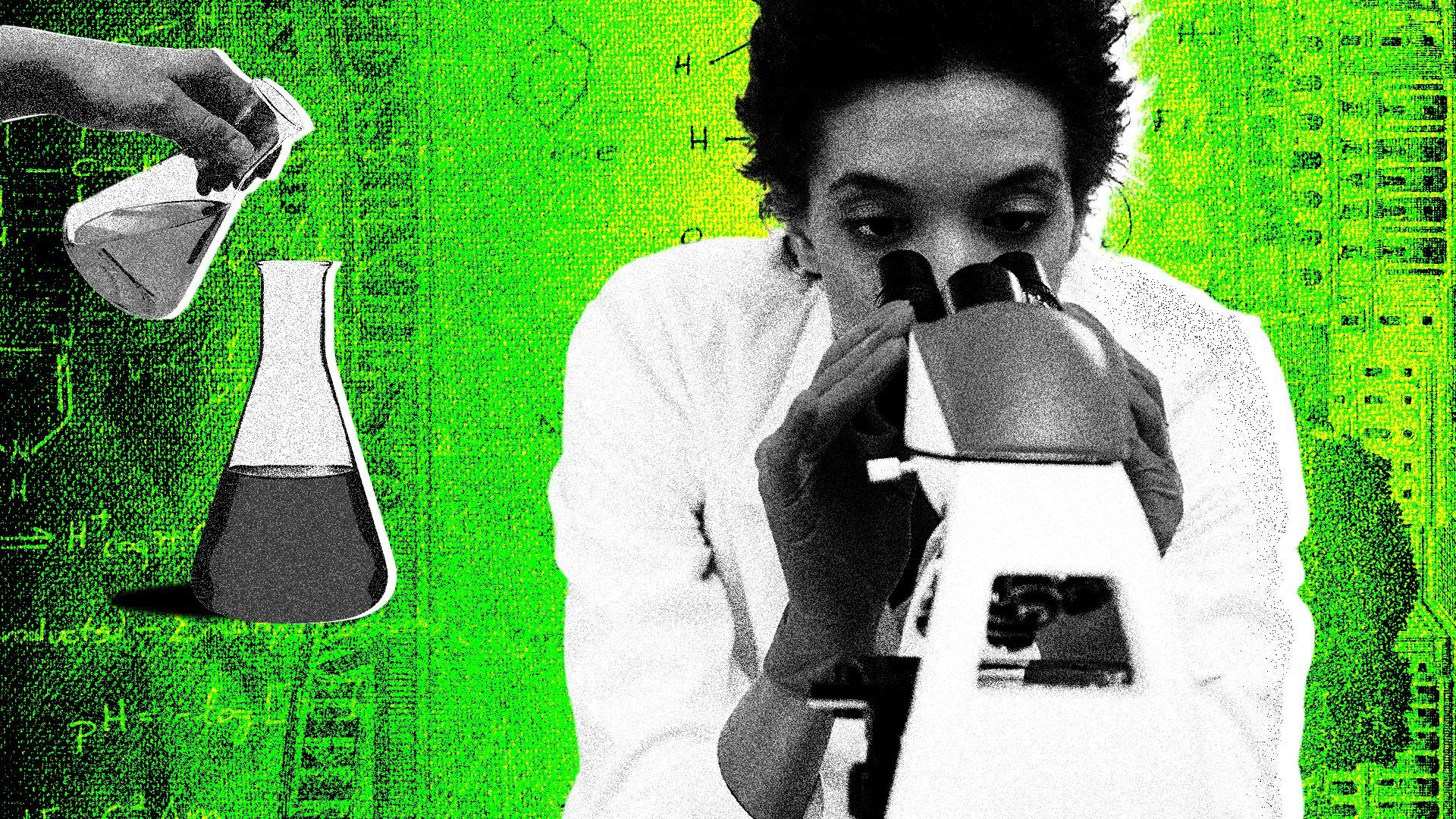
Illustration: Tiffany Herring/Axios
Of all the potential use cases for crypto technology, seldom do you hear "helping to understand the origins of life."
Why it matters: A shoutout to blockchains from the scientific community is a win for the industry, helping to validate blockchain's wide range of application possibilities, Axios' Pete Gannon writes.
Driving the news: A team of scientists from ββthe Korea Institute for Basic Science and the Polish Academy of Sciences published research in the journal Chem this week, claiming to have generated the largest-known network of prebiotic reactions.
- That's a fancy way of describing chemical reactions that give rise to other things that could ultimately have led to the origin of life on Earth. That's pretty interesting.
The problem in this type of work is that to create of list of potentially relevant reactions, you need to calculate billions of possibilities. This is hard to do, and very expensive if you try.
What they did: To start, the researchers worked with Allchemy, a scientific software company that does this sort of thing. Using computational synthesis and AI algorithms, they created 50,000 molecules believed to have emerged during the origins of life on Earth.
- Then came the hard part.
For this they turned to the Golem Network, a pioneer in what's known as DePIN, or Decentralized Physical Infrastructure Networks.
- Golem, which offers its network Golem tokens in exchange for spare computing power, tapped hundreds of computers from around the world to calculate more than 11 billion putative prebiotic reactions, resulting in a network of 4.9 billion that were deemed plausible.
The big picture: This type of computing power requires supercomputers or other sources like cloud computing service providers, which require big money β something not often available for scientific researchers.
- "If you asked me two years ago, I'd be thinking we'd need years for this type of work," the paper's senior author Bartosz Grzybowski told Chemeurope.com. "But for a fraction of the cost, in two or three months, we finished a task of 10 billion reactions, 100k times bigger than we did previously."
Zoom out: Grzybowski told Chemeurope that it's his hope that blockchain technology can be repurposed in a way that can revolutionize the process for large scale calculations in his field.
- "I hope people in computer science can figure out how can we tokenize cryptocurrencies in some way that can benefit global science," he told the pub.
The bottom line: Advocates of decentralized science, or DeSci, would agree.
π 2. Charted: Bitcoin futures outflows


While all eyes have been on the new bitcoin ETF darlings' money flows, an older product looks like a shrinking violet, Crystal writes.
Flashback: ProShares Bitcoin Strategy ETF was the first bitcoin futures product that landed on the market in October 2021, and topped $1 billion within days of its launch.
State of play: Since the approval of spot bitcoin, which had been talked up as the superior, more direct way to get exposure to the world's largest digital asset, BITO's assets under management has been sapped roughly $500 million.
- That would make sense, because some BITO buyers were using it to bet on the price of bitcoin going up, and now they have other options.
- BITO also charges a 0.95% annual fee, higher than most of the new ETFs even without their early-bird discounts.
Of note: ARK Invest last week bought its own bitcoin ETF shares, while selling BITO.
What we're watching: There are dozens of such investment products, some holding bitcoin proxy stocks, others', derivatives, that could fade into the background as the new nine steal the spotlight.
π 3. Bitcoin education
Illustration: Sarah Grillo/Axios
The next great challenge for bitcoin ETF issuers, post-SEC approval, will probably be selling it to people who don't know anything about it, Crystal writes.
Driving the news: Education initiatives for advisors are already underway: BlackRock is set to host a webinar this afternoon talking "bitcoin access made easy" and "insights from early market activity."
- Every shop with a bitcoin ETF will do something like this (or they should).
Zoom in: The landing pages of the new bitcoin ETFs aren't that different from those that track the S&P 500, touting their simplicity and their low fees. (That speaks to the technology that is the ETF more so than the underlying asset.)
Quick take: The "easy button" is a good way to market to the crypto-savvy public, but for people who don't know what "it" is, accessibility isn't a reason to invest. (In that way, mass adoption looks like a crypto project years in the making, not one to be catapulted into the mainstream anytime soon).
Details: Some issuers are farther along than others.
- Fidelity has research on everything from "proof of work" to the halvening.
- VanEck models what a sliver of bitcoin can do for a portfolio's returns.
- Bitwise has tools available to account holders for portfolio simulation and measuring correlation.
What we're watching: The argument for "why bitcoin" could coalesce around bitcoin as the 21st century's answer to gold, given what the two assets have in common.
- ARK's Cathie Wood, BlackRock's Larry Fink, and Fidelity's Jurrien Timmer have said as much.
π’ 4. Catch up quick
Illustration: Annelise Capossela/Axios
β³ Spot ETH ETF application decisions are delayed. (CoinDesk)
π¨π³ Investors in China are finding ways around the bitcoin ban. (Reuters)
π€ Mining rig maker Canaan sold preferred shares to raise $50 million plus intended for R&D, "expansion of production sale" and general corporate purposes. (The Block)
π₯Ύ 5. Policy bootcamp
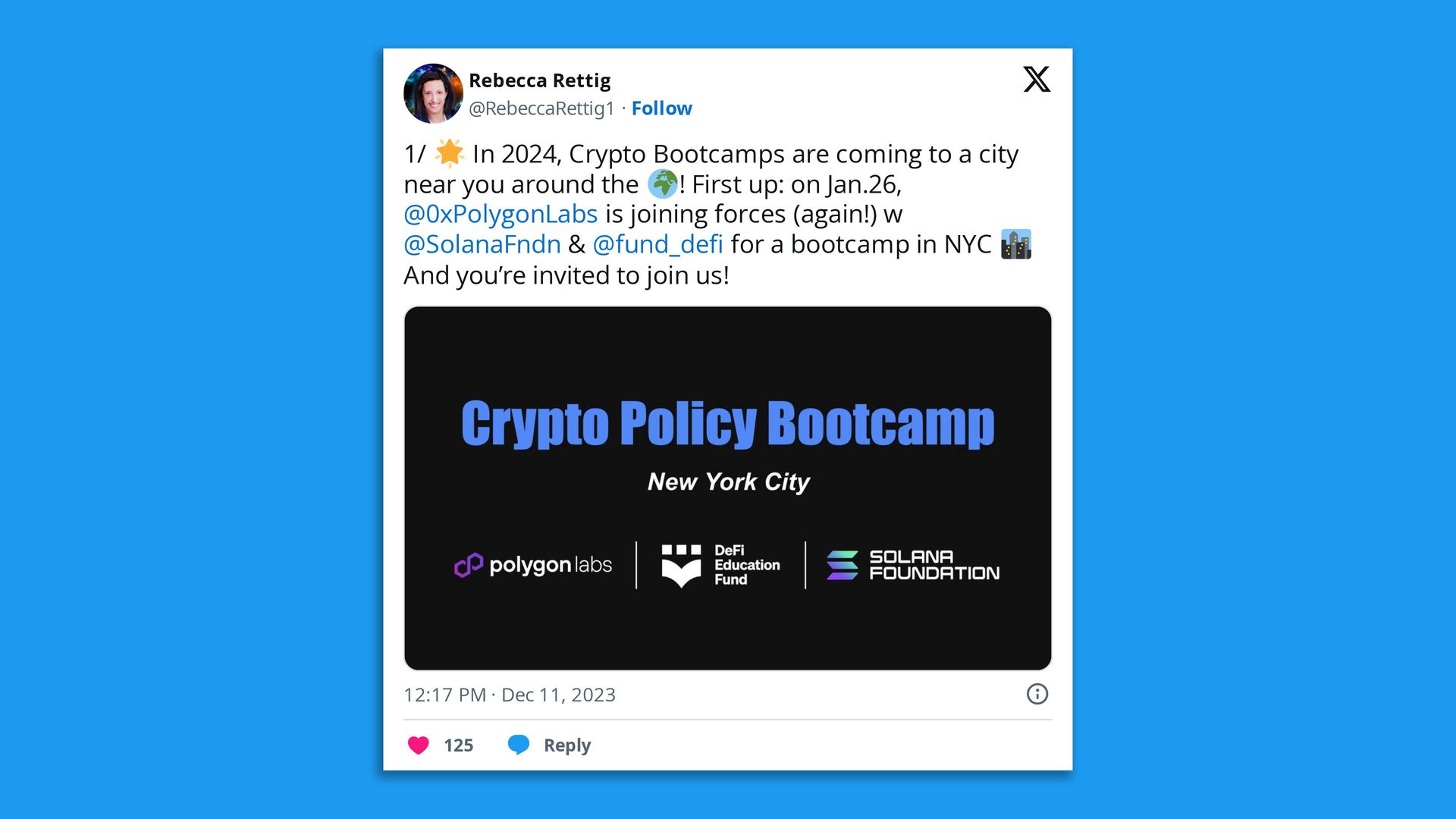
Screenshot: @RebeccaRettig1/X
Here's another crypto learning opportunity happening today, Crystal writes.
What's happening: Polygon Labs, the Defi Education Fund and the Solana Foundation are hosting a crypto policy bootcamp in NYC.
- Polygon's Rebecca Rettig in the π§΅ said the education initiative will provide "tools to make your voice heard."
- Applications to attend are closed and space was limited to 25 spots, (womp, womp) but there will be other such occasions.
π Crystal's thought bubble: I'd be interested to hear what was up for discussion ... guessing recent Coinbase and Binance.US hearings would be fertile ground.
- Plus, SEC Chair Gary Gensler's September 2023 meeting calendar was released per FOIA services.
This newsletter was edited by Pete Gannon and copy edited by Bryan McBournie.
π Bitcoin's back at $41,000-levels and rising. βB & C
Sign up for Axios Crypto

Brady Dale covers crypto and blockchain impacts on markets and regulation.