Axios Crypto

March 08, 2024
It's the buzziest thing on the web, so you knew AI would show up in these pages eventually, right? Here we are.
🚨 Situational awareness: Ether (ETH) is nudging $4,000. It's 18% below its all-time high of $4,878.
- Are you terrified or elated about the AI future? [email protected]
Today's newsletter is 1,136 words, a 4½-minute read.
🤖 1 big thing: Blockchainers stan open-source AI
Illustration: Aïda Amer/Axios
Many blockchainers at ETHDenver told Axios about a battle underway: Whether or not artificial intelligence (AI) code will be dominated by open-source software or locked inside the biggest companies on Earth, Brady writes.
Why it matters: This transformative technology may or may not ultimately be made open to inspection by the public, but open-source advocates believe they've got just enough time to win.
The big picture: "We don't want the most transformative technology of our time to just be controlled by Microsoft, Google and OpenAI," Doug Petkanics of Livepeer told Axios.
- Open-source proponents found President Biden's executive order on AI disappointing. Petkanics described it as a path to give the big companies a lock on the industry.
Between the lines: Blockchain companies Axios met with in Denver, meanwhile, believe they have great roles to play in an open-source AI future.
Livepeer is a decentralized video processing service. It sees a big new business line ahead for participants in its network: rendering video generated with AI.
- The demo of Sora, OpenAI's video generator, blew everyone's mind. Petkanics estimates that Stability.AI's open-source version is much less than a year from catching up.
Ritual is a startup with backing from Archetype VC. We spoke to its founder, Niraj Pant, who told us it's making it "easy for smart contract developers to build AI applications."
- It's focused on facilitating chatbot applications. When FriendTech was blowing up on Base, they built an AI bot to play along, called Frenrug (no one beat it).
- Ritual is built to connect blockchain apps to any of the open-source large-language models, such as Facebook's Llama 2.
Cloud providers serving AI have been clogged with demand. Leaders from two decentralized compute networks, Akash and POKT, which are good at finding caches of idle capacity, told Axios that these developments were an opportunity for them.
- In fact, Akash just announced availability for 64 NVIDIA H100s and A6000s.
The intrigue: One of the biggest recent AI stories was the bizarre behavior of Google's AI image generator.
- Greg Osuri, Akash's creator, told us, "The problem is we don't know what biases are incorporated into these networks because they are closed."
- But Dermot O'Riordan, with the non-profit foundation supporting POKT, told Axios that the answer wasn't rules about models, but more options and clarity.
- "Every model is biased, so you just need more models," he said.
The bottom line: If there's one thing blockchain development has shown us it is that you end up with lots of options when development is out in the open.
Intrigued by AI, too? We've got a newsletter for that.
🔥 2. Charted: AI coins as the sector heats up
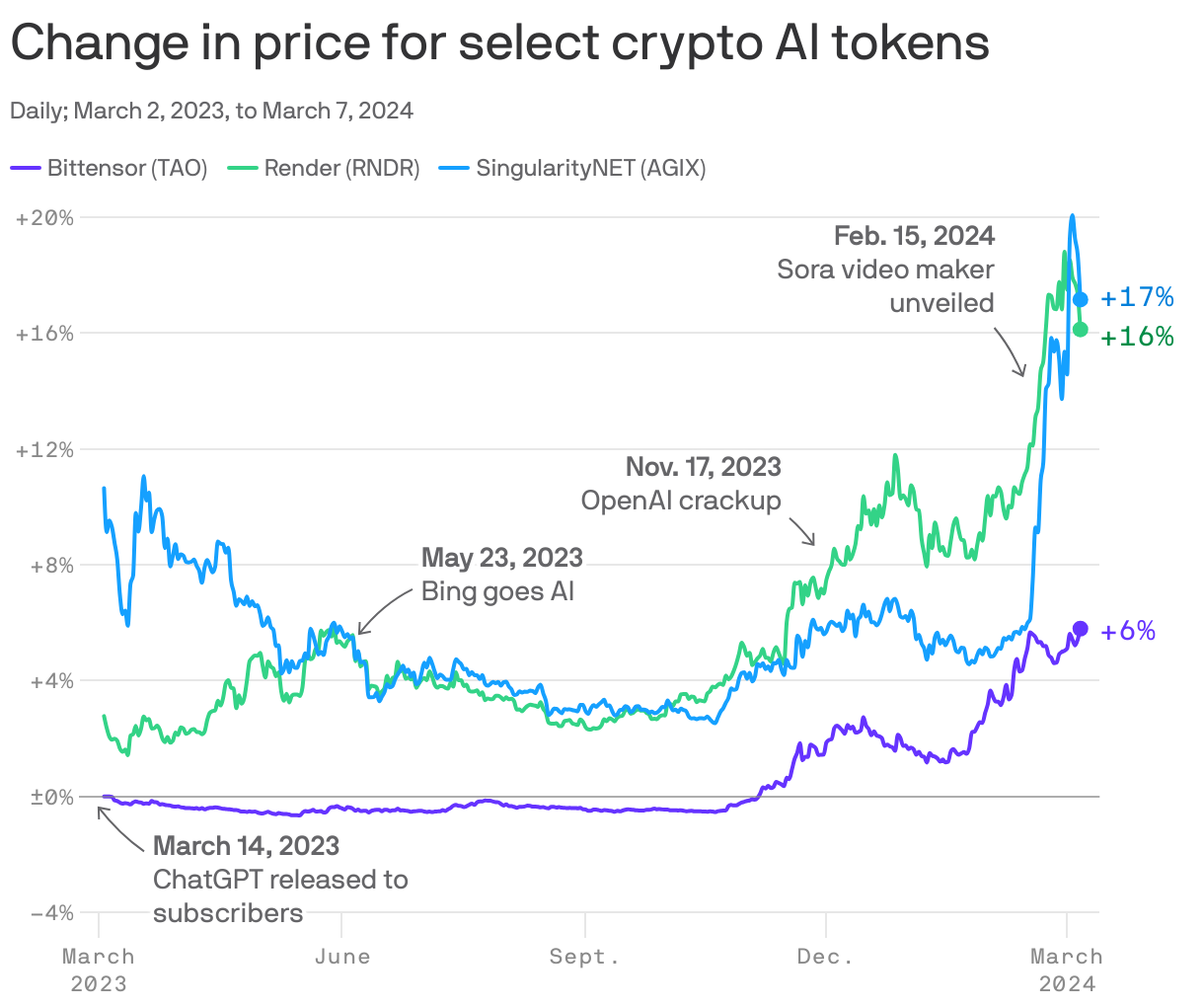
The truth is that we probably don't know which AI tokens are the definitive ones, yet, Brady writes.
- And it's also hard to separate the recent rise in AI token prices from the general uptick in the cryptocurrency market, led by Bitcoin.
These are three blockchain companies specifically pitching themselves as AI adjacent, with leading market caps in the category.
- Bittensor has the biggest market cap of these. It's trying to take Bitcoin's security model and apply the computation behind its proof-of-work to actual computing problems, making a machine-learning megasystem — with a coin.
- Render is a decentralized network for rendering artwork digitally (think: video game assets).
- SingularityNET is a marketplace for AI services.
What we're watching: There are lots of tokens associated with this technology. It remains to be seen if any of them prove to be a true standout.
🔮 3. AI, the great liar, and cryptography, the truth-teller
Illustration: Aïda Amer/Axios
Irony of ironies: Cryptography was created to keep secrets, but it's turned out to be a way to verify the truth as well, Brady writes.
Why it matters: AI is going to wash the internet with nonsense content (well, even more...), but — if content distributors get their act together — the internet could have a framework for verifying not only which content came from a person, but even certain claims about its origin.
- Such as the location where a photo was taken.
What they're saying: The internet has scaled up data transmission, but it has done little for how societies deliberate about what's true or not true (in other words: data processing), Alan Ransil, a member of the team behind Operad, told Axios in Denver.
- Thus far, cryptography has been good at showing the string of people who touched some image or piece of data, but Operad aims to provide more context.
- The key context it wants to provide: Who else trusts this piece of data.
How it works: Cryptography allows people and devices to make unfakeable signatures.
- Running a piece of data through a cryptographic algorithm produces a deterministic hash against a unique key.
- It's easy to verify a signature as valid, but basically impossible to fake such a signature.
So, for example, cameras can sign a photo as verifiably produced by a camera.
- Decentralized physical infrastructure networks (DePIN — basically, networked machines, such as sensors) might one day be able to verify that the photographer was standing where he said he was.
Blockchains themselves provide another feature: proof-of-time. If attestations get made and then posted to a blockchain, you know for sure that they have at least existed since that moment.
- Perhaps an attestation existed before, but if someone tries to claim they were created later, you know they weren't.
Evan Shapiro, creator of the "lightest blockchain," Mina, hopes to try his hand at a proof-of-humanity on the network he designed, he told us in Denver. That is, a way for the web to separate humans from bots.
- Worldcoin, the eyeball-scanning startup, offers the best-known such proof in crypto these days.
Reality check: Cryptography can do these things, but that doesn't mean web giants will implement the solutions. "The problem is getting the buy-in," Akash's Osuri told us.
- For example, where do we most often see fake news? On social media. Those networks need to add tools to look for cryptographic attestations and check them.
What's next: Operad has its eye on these AI models we were talking about above.
- "The goal is to contextualize not just the datasets, but also the algorithms," Ransil said. In other words, to verify how some model generated its output.
🚴 4. Catch up quick
Illustration: Shoshana Gordon/Axios
💸 Sens. Cynthia Lummis and Kirsten Gillibrand are working on a stablecoin bill, and they've shown it to staff at NYDFS. (Axios)
🇲🇪 Montenegro decided to send Terra co-founder Do Kwon to South Korea. (Unchained)
🏆 Goldman Sachs upgraded Coinbase from a "sell" to a "neutral" rating. (Decrypt)
🕊 Bonus: A thousand people held and forced to run pig-butchering scams on strangers were released from a compound in Myanmar. (DW)
💬 5. ETHDenver Quoted: This time is different.
"This time around what we're not seeing is lots of private institutions launching their own blockchains. ... They are embracing public blockchain settlement layers, and that's where I think we'll see a lot of innovation in the future."— Ryan Rasmussen, researcher, Bitwise, at ETHDenver 2024
This newsletter was edited by Pete Gannon and copy edited by Carolyn DiPaolo.
Maybe you're excited to see the latest Dune this weekend, but we're excited for Razzlekhan: The Movie! —C & B
Sign up for Axios Crypto

Brady Dale covers crypto and blockchain impacts on markets and regulation.