Axios Crypto

February 28, 2023
GM! Thanks for being here with us. One big state is getting active in crypto rules, plus a new DeFi offering.
🚨 Situational awareness: Robinhood disclosed an SEC investigation into its crypto dealings in its latest 10-K filing.
- Email: [email protected]
Today's newsletter is 1,291 words, a 5-minute read.
🦅 1 big thing: New York state of mind

Illustration: Sarah Grillo/Axios
States are picking up the federal slack in crypto regulation with their own sets of rules, but the latest to put down its measures is piggybacking on another's — one held up as among the more onerous, if not the most onerous, in the country.
What's happening: Illinois yesterday introduced a pair of bills, one of which aims to create a licensing framework for firms to operate in the state, the other, granting authority and resources to enforce them, Crystal writes.
- The Fintech-Digital Asset Bill is broad legislation aimed at updating existing rules to tech, but it also includes a licensing model for crypto firms, borrowing from New York's BitLicense.
Be smart: The BitLicense was criticized for how broadly the state defined firms that would come under its mandate, but also for its rigorous and lengthy application process.
The big picture: Before FTX, New York was held up as an example of a regulatory dead zone for crypto. After FTX, it's being hailed as an example of where nobody died.
- "A number of those firms that have failed were not operating in New York," Illinois Department of Financial and Professional Regulation (IDFPR) regulatory innovation officer David DeCarlo tells Axios.
- "That goes to some of the requirements put on these firms before they could operate in the state, to make sure that those very common-sense protections are in place for consumers."
Zoom in: Illinois' efforts to regulate crypto were already underway, but "accelerated" following the major collapses of last year, DeCarlo says.
- "We’re trying to take the best of what’s working and package it in a way that puts Illinois in the forefront of consumer protection."
- "That helps raise the bar nationally in terms of consumer protections at this critical time and place," he says.
How it works: Like New York, Illinois would ask crypto firms to have operations in place for anti-fraud and money-laundering monitoring, but also the financial resources to withstand the swings specific to crypto and the broader economy.
- Firms could be asked to produce documents and/or put through examinations or investigations; plus, pay any associated fees.
- The bill also allows New York state licensees in good standing to apply for a conditional license to operate during a transition period, which DeCarlo describes as an "on-ramp" to Illinois.
Yes, but: That on-ramp would service Coinbase and a few others. (See Charted.)
Flashback: Benjamin Lawsky, the architect of the BitLicense, expected other states to copy his model by virtue of it being at a financial epicenter, and then, no one did.
- California introduced a crypto bill last year to put its own licensing model in place, but Gov. Gavin Newsom vetoed it, saying it was premature and federal legislation was on the way.
What we're watching: Whether those bills make it to Illinois Gov. JB Pritzker's desk.
The bottom line: Eight years and one big crypto collapse later, New York is starting to look like the template.
🍎 2. Charted: An exclusive club


Peak BitLicense looks like a long time ago, Crystal writes.
The big picture: Since the New York Department of Financial Services (NYDFS) instituted the BitLicense in 2015, 30-odd firms have been approved.
- The most recent are coincafe, a site to buy and sell bitcoin, and eToro, a platform for stock and crypto trading.
Details: The BitLicense is criticized because its mandates apply to virtually any firm that touches crypto and it features a lengthy application process; some firms just bypass the state.
- New York City Mayor Eric Adams has called it "stifling."
Flashback: At the end of 2019, NYDFS relaxed some of its token listing standards to allow firms to self-certify using guidelines.
- Of note: Dogecoin is listed for approval, and so is the now-halted BUSD by white-label issuer Paxos.
The bottom line: The few that do get one, though, hold it up like a forever stamp of approval.
🛤 3. Fixed rate DeFi

Illustration: Gabriella Turrisi/Axios
Decentralized finance (DeFi) lenders are accessible, but they are not super predictable.
Why it matters: As DeFi works to compete with traditional finance, it has to meet some of its table-stakes offerings. One of those: fixed rate lending. There's a whole cadre of borrowers who don't want to risk rates changing over the life of a loan, Brady writes.
The latest: Term Finance announced a $2.5 million seed round led by Electric Capital, with participation from Coinbase Ventures, Circle Ventures, Robot Ventures and others.
- The firm says it's aiming for institutional scale.
Context: Lending has been one of the big use cases for DeFi to this point, with stalwarts like Aave, MakerDAO and Compound leading the way.
- In basically all cases, borrowers have to deposit more than they want to borrow to receive a loan.
- That's capital inefficient, but it's efficient in other ways. There's no forms to fill out. No credit checks. No approvals. If you have the money to back the loan, you get it.
How it works: Term will offer a kind of pooled auction approach.
- Borrowers and lenders will post assets and suggest terms, the smart contract will find a middle ground and whichever participants are game to proceed can do so, Billy Welch, one of the co-founders, tells Axios.
- Lenders will receive tokens that account for their asset. These will be tradable.
Catch up fast: Term enters the market alongside other projects aiming to give borrowers a loan experience more like the traditional kind, as fixed-rate lending has been something of an albatross for DeFi. For example:
- Element Finance announced raising $32 million in 2021. It's had less than $10 million on hand since last September, though it's been as high as $200 million.
- Notional announced raising $10 million in 2021, following a prior seed round. It's had about $50 million in its smart contracts on most days so far this year.
- Yield Protocol went live in 2020. It only has about $8 million in deposits right now.
Zoom out: Aave offers a "stable" rate, but not a fixed rate. Basically, borrowers pay a bit more for their rate to change less, but it can still change. It has a little under $5 billion in available liquidity.
- That said, none of their markets are showing a stable rate right now.
Be smart: The appetite for these kinds of products is likely to remain weak until people feel more confident in putting their crypto collateral at risk. That is, until prices are rising.
- Now's the time for experimentation and troubleshooting. The winners here will be made when the sun shines on crypto again.
🏁 4. Catch up quick
😣 Digital Currency Group lost $1.1 billion last year. (CoinDesk)
🛑 Coinbase Global said it would suspend Binance's namesake stablecoin BUSD starting March 13. (CoinDesk)
🐒 Yuga Labs, the folks behind NFT collections including the Bored Ape Yacht Club, will debut its first stab at a Bitcoin-based project later this week. (Decrypt)
💳 Visa and Mastercard are holding off on crypto-integration plans. (Reuters)
🎰 5. Culture hash: The correct answer is "gambling"
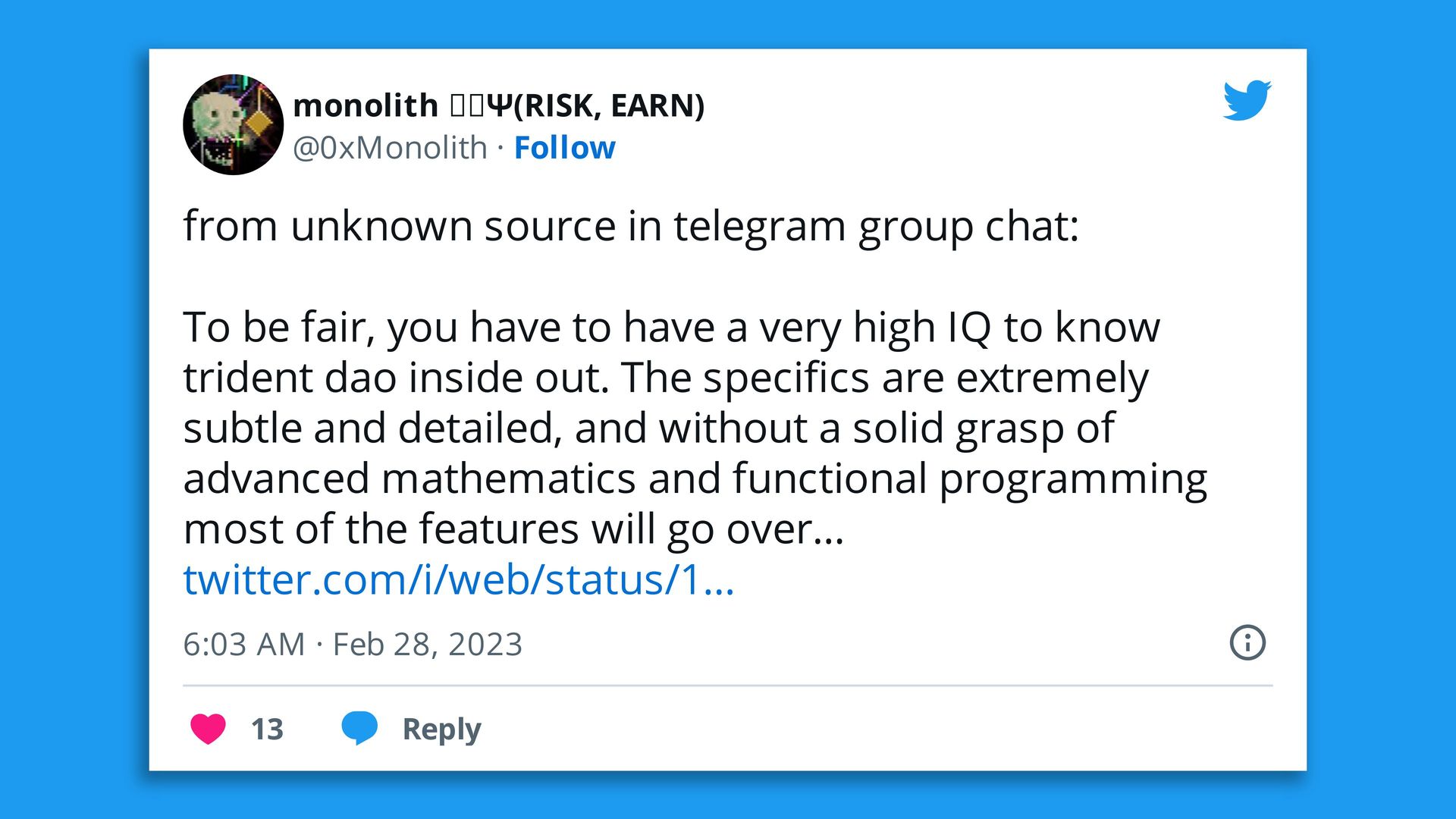
Screenshot: @0xMonolith (Twitter)
It's worth clicking the link above to see the rest of this message. This is what Twitter with blogging built in looks like, Brady writes.
Zoom out: What's fun and maddening about the internet is it's hard to know when something is earnest or a complete joke. This seems more like the latter but I'm not sure.
What they're saying: "As a consequence people who dislike trident truly ARE idiots- of course they wouldn’t appreciate, for instance, the humour in brocdevs existential catchphrase 'Always sunny, sometimes Florida' which itself is a cryptic reference to Turgenev’s Russian epic Fathers and Sons. I’m smirking right now..." the re-posted Telegram post reads.
Context: The topic at hand is TridentDAO, a gaming project running on Arbitrum, a layer-2 chain on Ethereum.
- Trident promises to "fix" play-to-earn gaming. Remember that whole Axie Infinity thing?
- Its solution is "risk-to-earn." That is: gambling.
Yes, but: We all already know about gambling.
This newsletter was edited by Pete Gannon and copy edited by Carolyn DiPaolo.
🦌 Forward this to your friends in Illinois. —C & B
Sign up for Axios Crypto

Brady Dale covers crypto and blockchain impacts on markets and regulation.