Axios Crypto

August 07, 2025

Hello, Crypto readers! Congress is in recess, and so is Brady. But the president's pen is said to be working — and we have you covered on a couple of things expected today.
- ... (Brady will be back at the helm Tuesday.)
Today's newsletter is 834 words, a 3-minute read.
1 big thing: Crypto and 401(k)s


President Trump is expected to sign an executive order today that paves the way for crypto assets — along with private equity and real estate — into 401(k)s.
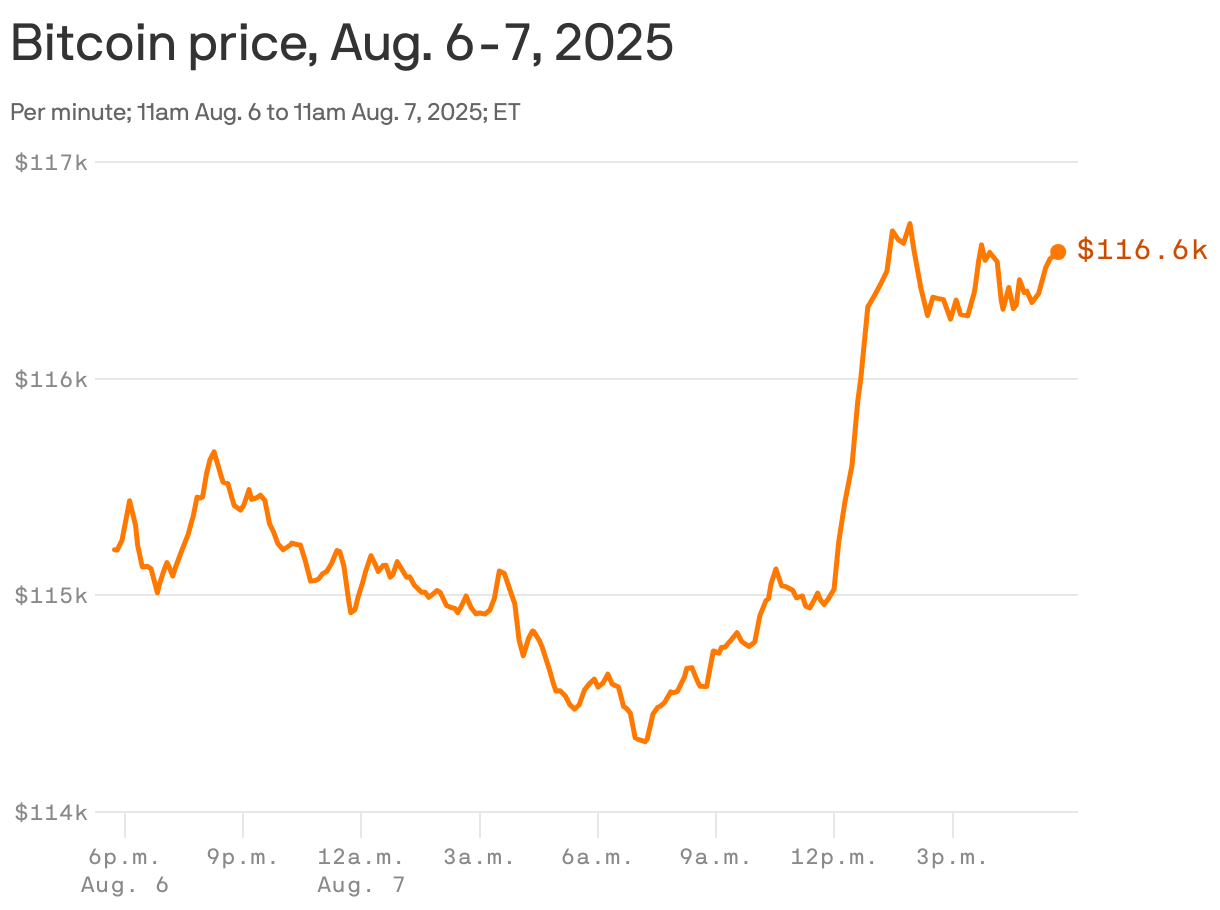
Why it matters: It's more kindling thrown on the crypto fire, with bitcoin rising more than $1,600 this morning on the prospect of nearly $9 trillion held in U.S. retirement accounts getting access to digital assets.
The intrigue: Trump's move to open private retirement accounts to alternative assets is no surprise — but crypto's inclusion in today's planned executive order is, for some.
- Wall Street has been expecting the EO for months, but early talks reportedly focused on it applying broadly to private-equity assets.
- Crypto's sudden inclusion in the order feels to some on Wall Street like that guy who someone else invited to the party at the last minute, the WSJ suggested last week.
- "Large private-fund managers would rather not have the crypto distraction," a person involved in the discussions told the WSJ. Some in the 80-year-old PE industry worried about a public backlash and a reputation hit from being linked to crypto.
Reality check: EO or not, the writing has been on the wall for months regarding the Trump admin's desire to ease barriers between crypto and retirement accounts.
- The Labor Department in May rescinded guidance from 2022 that cautioned employers against including cryptocurrency in 401(k)s.
- Last month, a White House working group report on crypto assets included "the rules applicable to digital assets with respect to retirement accounts" on a shortlist of "substantive issues that could be addressed" through future guidance or legislation.
Driving the news: The expected order, as reported by Bloomberg, tells the Labor Department to take another look at its rules on using alternative assets in retirement plans under ERISA, the law that sets standards and protections for private-sector retirement plans.
- Labor would also need to clarify how fiduciary duties apply when those kinds of assets are included in investment options, addressing a reluctance to include them now out of fear of being sued.
- Labor Secretary Lori Chavez-DeRemer is also directed to team up with the Treasury, SEC, and other agencies to see if any rule changes are needed.
- Meanwhile, the SEC will be asked to help make it easier for people managing their own retirement accounts to invest in alternative assets.
The other side: Democratic lawmakers have already come out opposed to the idea.
- Four senators, including crypto critic Elizabeth Warren (D-Mass.), sent a letter in June criticizing the Labor Department's decision to withdraw the cautionary guidance, citing crypto's price volatility and the potential for scams.
Yes, but: That opposition extends to other private assets as well. For critics, like Warren, it's about putting retirement savings at risk, exposing investors' nest eggs to assets with less transparency and disputed performance histories.
The bottom line: Exchange-traded funds made bitcoin accessible to more institutional investors and retail traders 19 months ago, and are credited as a major factor in bitcoin's run of growth. Retirement accounts are the next frontier.
2. Bitcoin's bounce
3. Trump targets debanking

A second executive order expected to be signed today also carries some crypto implications.
- The EO directs bank regulators to investigate whether any institutions have engaged in discrimination and debanked potential customers on the basis of politics, religious beliefs or disfavored industry participation, according to a White House official.
The big picture: A number of conservatives and crypto executives have claimed for years they were debanked for political reasons, and the Senate Banking Committee held a hearing on some of those claims in February, Axios' Jeffrey Cane notes.
Zoom in: Biden-era bank regulators' approach to crypto has been branded by some "Operation Choke Point 2.0," where regulators pushed banks to avoid offering crypto services and allegedly cut off individuals and businesses connected with the industry.
- The atmosphere pushed many projects offshore, the industry contends — and Trump has talked often of bringing them back with a new approach to regulation and new laws offering clarity for how crypto can grow.
State of play: While the allegations of "conservative" debanking run much wider than crypto, the White House has already declared the Biden-era approach to digital assets, at least, over.
- "Under the Trump Administration, Operation Choke Point 2.0 is dead—not just in spirit, but in substance," the White House working group wrote.
- It went on to note all of the steps regulators have taken to rescind prior guidance that discouraged banks from participating in lawful crypto participation, including dropping the concept of " reputational risk" as part of their scrutiny.
The bottom line: As far as it extends to crypto, today's EO — if signed — looks intended to make sure banks are playing nice.
This newsletter was edited by Pete Gannon and copy edited by Carolyn DiPaolo.
Sign up for Axios Crypto