Axios Crypto

May 15, 2025

No word yet on when stablecoin legislation might be back on the Senate floor. But we're just a week away from Bitcoin Pizza Day and the Trump token dinner. How will you celebrate?
🍕 Email us if you plan to make pineapple jalapeno pizza: [email protected]
Today's newsletter is 1,121 words, a 4-minute read.
1 big thing: 💳 Mastercard's master plan

Mastercard is leaning into a stablecoin-enhanced future for payments.
Why it matters: The company manages over a billion payment cards all over the world, enabling transactions in well over 100 currencies.
- It recently joined the roster of players competing to establish territory in the stablecoin "Game of Thrones."
The big picture: With Washington, D.C., looking more favorably on the digital asset industry, "you're going to find a lot more entities and companies looking at the overall positive regulatory outlook in the U.S., looking to enter the U.S.," Raj Dhamodharan, the company's executive vice president for digital assets, tells Axios.
- "We think we can play a very constructive role in tapping into the power of the technology."
Mastercard is focusing on the immediate opportunities: remittances, payments and business-to-business transactions, Dhamodharan explained.
- For people deep in cryptocurrency, Mastercard has been making it easier for them to unlock money made through trading, and using that money for day-to-day transactions.
- For example, users of applications like MetaMask, Kraken and OKX can get debit cards issued against their cryptocurrency holdings. If they use the card to make a payment, their account will be debited the appropriate amount of stablecoin, while the merchant will be paid the corresponding amount of local currency.
The latest: Just today, Mastercard announced its latest crypto industry partnership with MoonPay, a crypto payments app, to enable stablecoin payments by consumers.
- Mastercard previously announced plans to enable merchants to receive payments in Circle's USDC and stablecoins issued by Paxos.
Zoom in: Remittances has been a topic in the cryptocurrency space for a long time — sending money earned in one country to families or friends in another country. It's a giant use case.
- For decades, payment processors have shaved a lot of money off global workforces remitting their earnings. Crypto has always promised a route around that, but it hasn't been as big as blockchain believers hoped.
- The problem has been at the edges. How can a worker turn cash, a check or a payment card into cryptocurrency? Then how can their family back home receive it and turn it into spendable money?
- Mastercard is stepping in with on-chain identity products that allow people to register things — like email or phone numbers — as points to send or receive digital money. (We've reported on an email-like payment system that runs over the Lightning network.)
Reality check: Dhamodharan tells us Mastercard still imagines money will typically begin as traditional money, get transmitted as stablecoin, and end up as regular money again, at least in part.
2. State of play: Stablecoin legislation
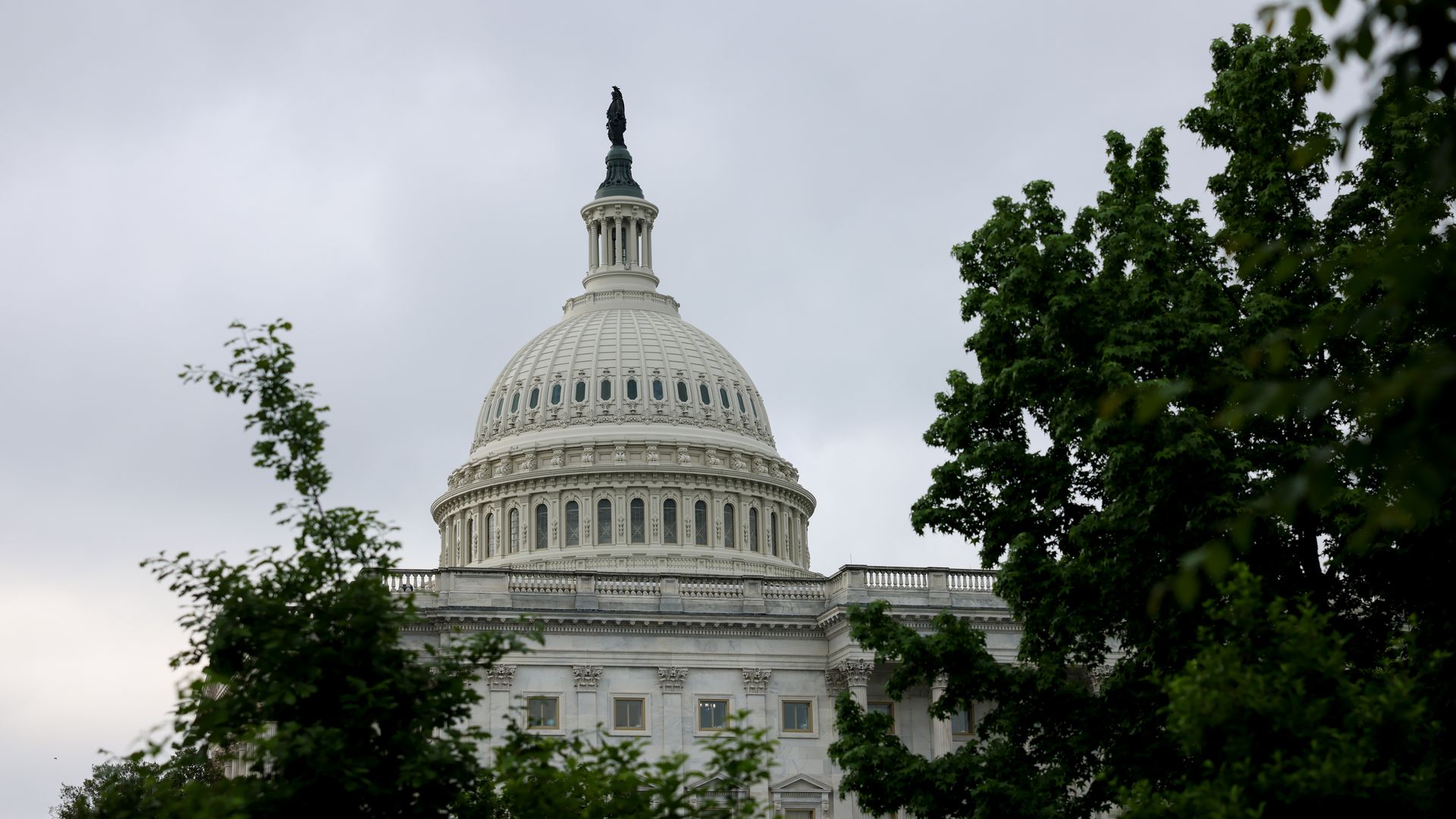
There's still no definitive word on when a stablecoin bill will make it back to the Senate floor after a failed procedural vote last week.
- A bipartisan group of negotiators have been working to move the bill forward, but the circle of people who have seen the recent changes is still small, congressional sources say.
What they're saying: The legislation's sponsor, Sen. Bill Hagerty, told Bloomberg Tuesday that he hoped Democrats would agree to move it before the Memorial Day recess.
- "I think we're, like, on the 2-yard line, but maybe we'll be pushing back to the 5-yard line," Sen. Ruben Gallego (D-Ariz.) told Politico. "Can't exactly tell."
🏛️ Brady's thought bubble: The story changes every day here in D.C., but the prognosis for the legislation is much rosier coming from Republicans than Democrats.
- And the GOP needs some Ds to pass something.
3. Charted: Ethereum leveled up

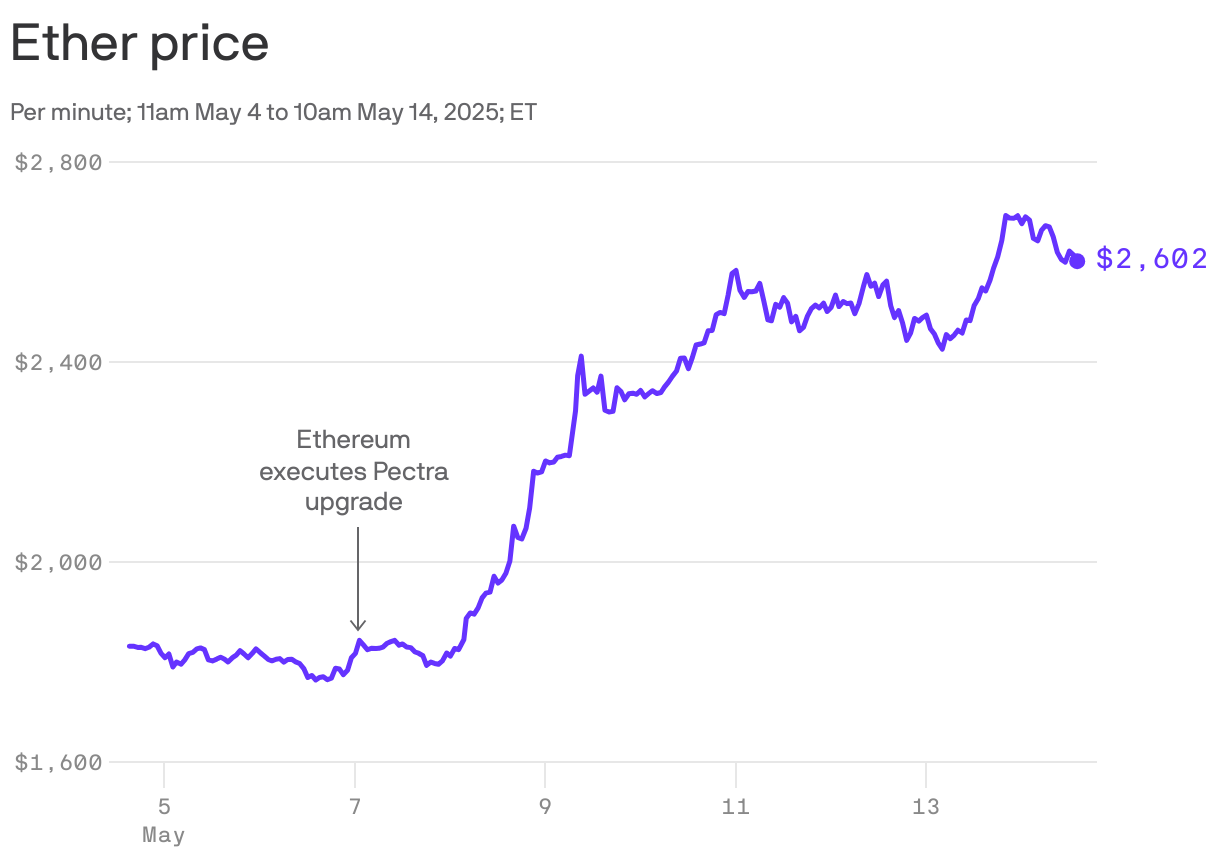
We haven't focused on coin prices too much in these pages lately, but it would be crazy to ignore the fact that Ethereum's coin, ether (ETH), is up like 40% in recent days.
The big picture: The second-largest blockchain has been adapting to what its most avid users want and is working to drive value back to the core change.
Between the lines: I like to say that you never know what changes prices in this world, but it's pretty clear that the recent Pectra upgrade on Ethereum did it, and the increased value has held now for a week (which in crypto time is months).
- Pectra did a bunch of wonky things mostly for superusers, such as making staking more flexible and improving how layer-2 blockchains communicate with Ethereum proper.
- Long story short: It's working.
Zoom out: Another topic we haven't covered here, but that this fits into: The leadership at the Ethereum Foundation has changed.
- Ethereum isn't a company, so no one is 100% in charge, but the Ethereum Foundation is sort of the chief cat herder for the blockchain.
- It's re-focusd on projects and evolution in Ethereum that will drive value to its investors rather than aiming for pie in the sky, utopian dreams.
By the numbers: ETHBTC, the ratio of ETH price to that of bitcoin, is down 46% over the last year.
- But it's up since Pectra.
- Since BTC effectively functions as an index of the whole crypto market, Ethereum fans would hope that their coin at least goes up at roughly the same rate as bitcoin, but it's been just the opposite for a while now.
4. Catch up quick

⛰️ A hub for crypto crime has somehow registered in Colorado. (Wired)
🔒 Telegram shut down a massive illicit marketplace on the platform. (CoinDesk)
👿 Coinbase today disclosed that it's received a $20 million ransom demand from hackers who bribed overseas support agents to steal sensitive customer data. It said it isn't paying, and instead is offering a $20 million reward fund for information leading to an arrest. (CNBC)
5. By the numbers: $21 million in losses

Lots of people lost money on Official Trump, the meme coin launched by the president, even over the recent period where it almost doubled in value.
The latest: Since Fight Fight Fight Inc., announced a contest for the largest holders of the Trump token to have dinner with President Trump, almost $300 million has flowed into the token, according to Nansen, an on-chain wallet tracking platform.
- Over the same period, over $21 million worth of losses were realized, far outweighing gains made by traders who took advantage of the uptick in the token's price since the announcement.
Not-so-fun fact: There are 21 million bitcoins (some still unmined), and the Trump dinner is on Bitcoin Pizza Day.
- So that figure for realized losses is a bit painfully elegant.
Zoom out: Official Trump was trading in the $7 range before the contest, but it went up to nearly $16 while it was ongoing.
- That's still far below prices in the beginning, when most novice traders got in.
💭 Our thought bubble: It looks like lots of those early buyers saw that the gains during the dinner contest weren't enough to get them out of the red and gave up.
- Only 13 wallets that Nansen tracks as "smart money" still hold the token, as of yesterday's report.
This newsletter was edited by Pete Gannon and copy edited by Carolyn DiPaolo.
📣 Stand With Crypto, the grassroots group launched by Coinbase, swarmed the Capitol with members yesterday, pushing their elected reps for crypto legislation. —Brady
Sign up for Axios Crypto