Axios Crypto

April 19, 2024
TGIF! In the U.S., it looks like the halving is coming today, late tonight on the East Coast. But never fear: It will be 4/20 at GMT, so the memelords can rest easy.
- Bitcoin has perked up a little in the last day, trading around $64.5k at press time.
We know of parties in Denver, Tulsa and Paris. Do you have a halving observance planned? [email protected]
Today's newsletter is 927 words, a 3½-minute read.
🍊 1 big thing: Big day for Bitcoin
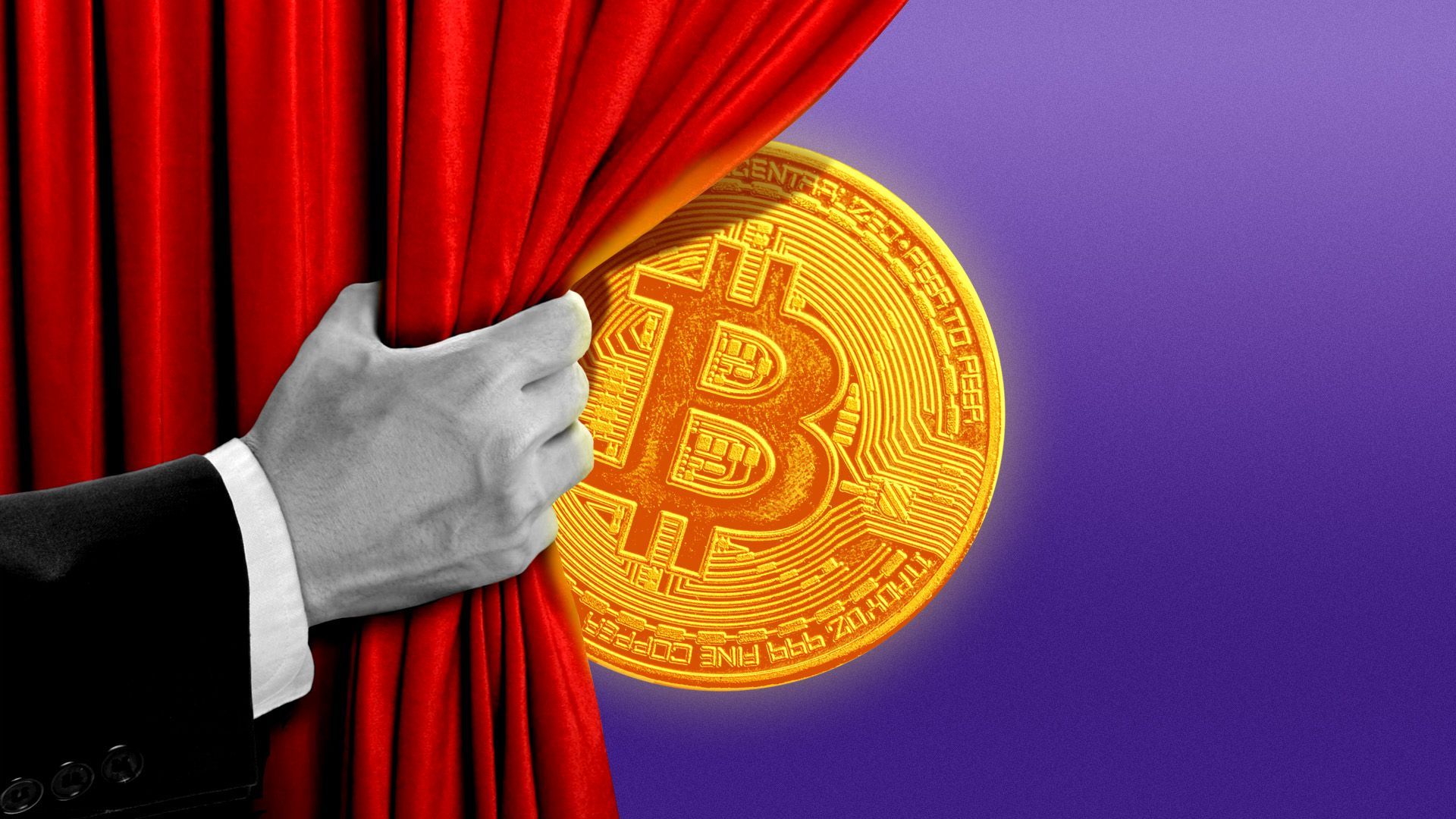
Illustration: Sarah Grillo/Axios
The halving is expected in roughly nine hours, but it's not just that making today a big day for the orange coin — Runes, the new token standard for Bitcoin, is scheduled to release alongside it.
Why it matters: This remains the year of Bitcoin, and Runes is likely to extend that narrative, Brady writes.
Catch up quick: To understand Runes' significance in the Bitcoin ecosystem, we first have to look at Ordinals.
- Runes is the creation of Casey Rodarmor, a Bitcoin-devoted developer, who previously came up with a way to run NFTs on Bitcoin.
That earlier idea was Ordinals, and they have two interesting features:
- They store the NFT artwork on the actual Bitcoin blockchain. Very few NFTs you have heard of do this, but Ordinals do. It forces them to use pretty low-resolution imagery in general, but users kind of like that.
- It works by linking data to a specific fraction of a bitcoin, a satoshi (one one-hundred-millionth of a bitcoin). This allows for interesting properties, such as creating an Ordinal off a satoshi from the block reward following today's halving.
- Then the Ordinals protocol was used by others to create tokens on Bitcoin. These are known as BRC-20 tokens.
Ordinals have had a big impact on the Bitcoin network. Fee spend on Ordinals has reached a cumulative $258 million.
- That's earnings to miners that wouldn't have happened otherwise. Never mind how it's driven up fees for normal transactions.
- $183 million of that total spend on inscriptions has been on BRC-20 tokens.
And that brings us to Runes. BRC-20s have been found to be inefficient and complicated.
- Runes will be a more efficient method to achieve the same end.
💭 Brady's thought bubble: I will eat my hat if Runes doesn't drive a speculative frenzy.
The latest: Taproot Wizards, one of the pioneering collections, is already talking about its Rune offering in its Discord channel.
- Plus, there's already infrastructure. RunesDEX announced raising $2 million to build an automated market maker for trading Runes (think, Uniswap-for-Bitcoin).
The intrigue: Even now, the narrative of NFTs being dead is much less true when Bitcoin gets factored in.
- NodeMonkes, the apex Bitcoin NFT project, have a floor price of 0.44 BTC (around $27,000). It has briefly flipped Bored Apes Yacht Club in market cap.
What we're watching: Block rewards for miners are going to drop in half today — that's certain. Provided demand to use Bitcoin stays the same, fees are going to become a greater portion of miners' revenue.
- If Runes is as popular as folks expect, fee revenue could make up a much larger portion of miner revenue.
💸 2. Charted: The halving in dollar terms


Looked at one way, each halving is less and less significant. That is, if you look at it in terms of bitcoin (BTC), Brady writes.
- A block reward reduction of 25 BTC is a lot bigger than a reduction of 3.125 BTC, like it's going to drop today.
Yes, but: In dollar terms (which is what miners pay salaries and utility bills with), the reduction has been greater by an order of magnitude with every block reward reduction.
- In dollar terms, this halving is by far the most impactful to date.
By the numbers: For the dollar value of the next halving, sometime in 2028, to be reduced by more than a million dollars (continuing the trend of an order of magnitude increase), bitcoin would have to be trading for at least $640,000.
🥭 3. Eisenberg found guilty on all three counts

Illustration: Natalie Peeples/Axios
A jury found Avraham "Avi" Eisenberg guilty on all three counts of fraud and manipulation yesterday in a $110 million crypto trade scheme using the Mango Markets platform, Crystal writes.
Why it matters: The case was the first known test for a jury to decide whether U.S. laws governing fraud and market manipulation apply to decentralized finance (DeFi).
Between the lines: The 28-year-old Eisenberg will be held to account for his actions on Oct. 11, 2022, when a series of trades he made intentionally boosted the price of Mango Markets' native token, MNGO, as well as the price of futures contracts.
- He used the inflated futures holdings as collateral to borrow other cryptocurrencies on the platform, then quickly withdrew those assets and walked away from his collateral.
- Eisenberg never disputed the facts of the strategy but contended that what he did was legal and permitted by the DeFi protocol, a principle in the industry known as "code is law."
The big picture: U.S. laws apply to DeFi.
What we're watching: Eisenberg is set to be sentenced on July 29; he faces a maximum of 20 years in prison.
📰 4. Catch up quick
🎮 Yuga Labs has offloaded the game it made, HV-MTL, and burned a bunch of its NFTs. (Decrypt)
🕹 NFT-enabled game Nyan Heroes did very well in the Epic Games store during its preview. (The Block)
😋 Demand for bitcoin ETFs has slowed ahead of the halving. (Blockworks)
⛓️ 5. Tether on Telegram
Illustration: Sarah Grillo/Axios
Tether has announced that tether (USDT) will be minted on The Open Network, which runs toncoin (TON), Brady writes.
- Toncoin was up 18% as of 9am ET today on the news, the biggest 24-hour gain of any coin in the top 50.
How it works: Tether issues USDT on lots of chains, and The Open Network is the latest.
By the numbers: According to Tether's transparency page, $10 million has been authorized on TON, but only $3 million has been issued.
The intrigue: TON has been integrated with Telegram, the messaging app that's pushing a billion users.
- TON is built on technology that originated within Telegram, but that the company later open-sourced. It claims to be independent of the company.
This newsletter was edited by Pete Gannon and copy edited by Carolyn DiPaolo.
Something else we're watching: The fees on the halving block — they could be huge. There's lots of reasons why projects might want access to Block No. 840,000, the first with the new block reward. —C & B
Sign up for Axios Crypto

Brady Dale covers crypto and blockchain impacts on markets and regulation.