Axios Crypto

August 11, 2022
Hello, Thursday! Today we talk about magic math and how bitcoin is the leading indicator for crypto news. Plus, FTX's new educational campaign.
π¨ Situational awareness: Ethereum took its last step before its upgrade to a proof-of-stake network as the third and final testnet, Goerli, successfully completed its so-called merge. ETH went up 14% on the news.
- The phone lines are open: [email protected]
This newsletter was edited by Pete Gannon and is 1,242 words, a 4.5-minute read.
πͺ 1 big thing: Millions of users but no knowledge

Illustration: Gabriella Turrisi/Axios
Zero-knowledge proofs are made out of math that's a lot like magic β that's really the best way to put it, Brady writes.
- That math looks like it's going to be the way Ethereum enables millions of people to transact with each other β but in a way they can afford.
Why it matters: Ethereum is a $200 billion blockchain that owns the markets in programmable money, non-fungible tokens and decentralized finance. But it becomes way too expensive for normal people when they want to use those things.
- Zero-knowledge technology aims to keep the costs flat, while the user numbers go way, way up.
State of play: Several teams are working now on using the technology to verify transactions on additional blockchains that extend Ethereum, which necessitate checking them en masse back on the original chain. (Ethereum is the brain of the octopus, while these new chains are tentacles with little brains of their own.)
- "We give you a way to know the right thing is done with your data even if you're not watching," Eli Ben-Sasson, co-founder of StarkWare, tells Axios.
What it is: Zero-knowledge proofs allow a computer to know some data is valid without reading it. That's why it's a bit like magic.
- It's like a bouncer who can only let invited people into an exclusive event, without knowing the names of the people on the guest list.
Why it works: At a very high level, a proof allows someone to put a lot of information together and someone else to quickly verify that one little piece of information is in there, accurately.
- For example, the proof could crunch thousands of transactions between lots of strangers, but someone could use that proof just to verify that Frank had in fact made a specific transaction with Edward.
- "You essentially compress computation," Alex Gluchowski, CEO and co-founder at Matter Labs, one of the teams advancing this technology tells Axios.
Who's doing it: Several companies are working to launch blockchains that lean on Ethereum's security and run code just like it does.
- The companies known to be working in this direction include StarkWare, Matter Labs, Polygon, Scroll and likely others.
What they're saying: "Existing use cases, like DeFi, and these other applications that already have product market fit... [the] majority of them are simply not accessible to everyone," Mihailo Bjelic of Polygon tells Axios, "because you have to pay $10, $40 for a small transaction."
What we're watching: Most look to Ethereum to continue to dominate smart contract blockchains, but there's always the chance that another blockchain (such as RISC Zero, which just raised $12 million) could put it all together even better.
- Probably not, but maybe.
The big picture: Ethereum creator Vitalik Buterin recently wrote a blog post breaking down zero-knowledge systems into four different buckets, charting a course to unlimited users, none of whom have to worry about trusting each other.
The bottom line: Bitwise recently highlighted the cost of using Ethereum as the most important issue in crypto. Zero-knowledge technology could be what solves that.
π 2. Charted: New normal in crypto news

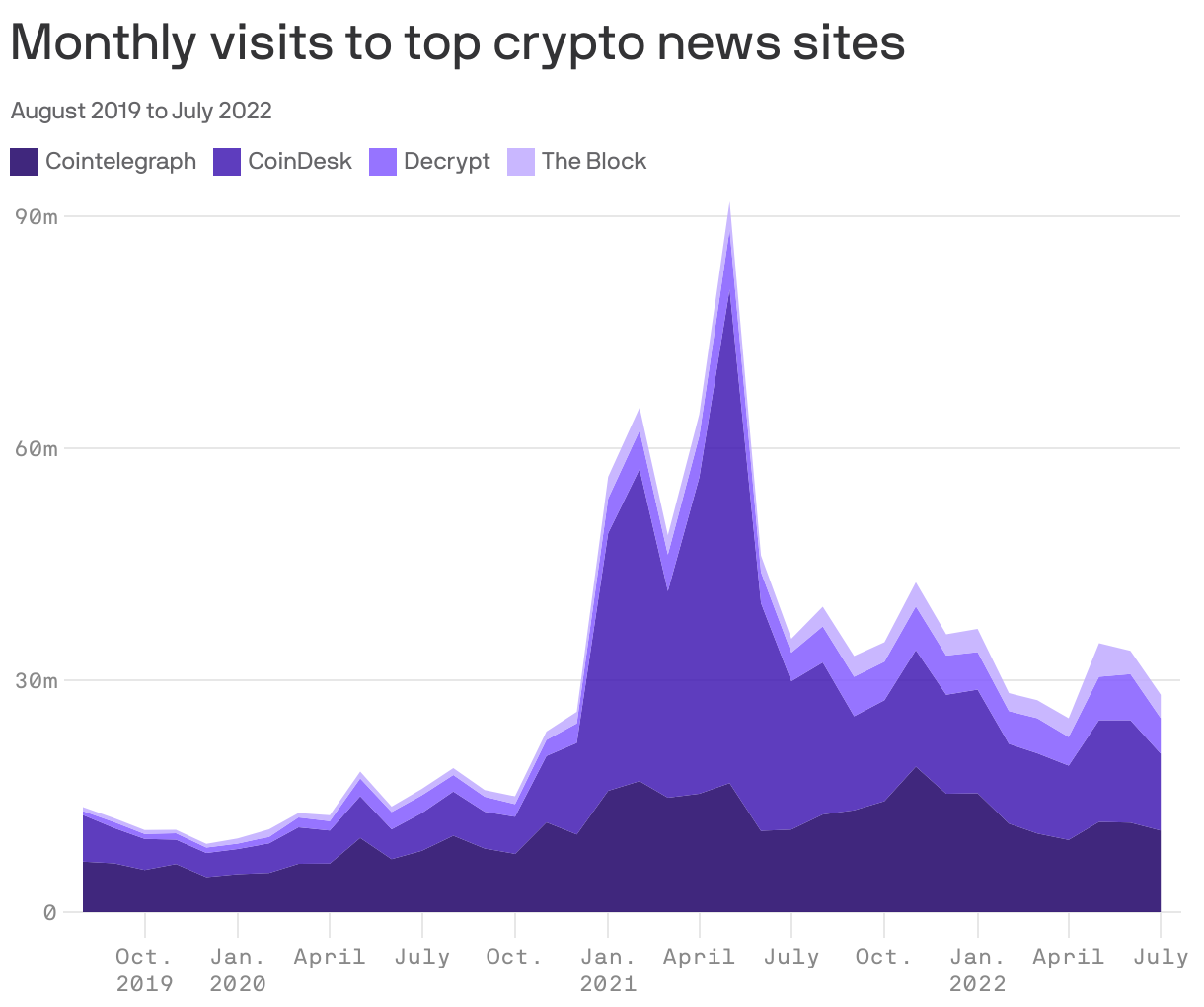
Bitcoin price is an easy way to compare the global interest in cryptocurrency now to any prior time, but there's another way to look at it: how many people are reading crypto news, Brady writes.
- Similarweb uses a wide array of third-party data inputs to estimate traffic to apps and websites. This chart shows their guess for the combined attention at four of the leading crypto sites.
- Of note: Bitcoin price is down, but it looks like there might be a permanent increase in people following crypto news.
Driving the news: Imagine the bitcoin price overlaid with this chart, and you'll see the relationship.
- Bitcoin first broke out from its yearslong doldrums in early 2021. From around $11,000 in September 2020 to over $40,000 in January.
- By April, when the chart is highest, that's the first rush. It goes over $60,000 for the first time.
- Then it crashes out again as the NFT market cools. It's down around $30,000 in July.
- It pops again later that year, hitting its all-time high of $69,044 in November. Views don't spike the same though, probably because many new users had jumped ship. Those who remained were already jaded.
The big picture: Even as prices have come back down to Earth, it looks like there is a new normal for interest in crypto.
- It appears many of 2021's newcomers are sticking around.
πΌ 3. FTX sells the people on crypto
Illustration: Annelise Capossela/Axios
Digital asset exchange FTX has launched a web campaign to bring the public around on cryptocurrency, called "Get to Know Crypto."
Why it matters: Starting with the White House's executive order in the spring, 2022 has become the year policymakers have moved beyond holding the odd hearing about the industry and started drafting laws.
- They are more likely to actually enact laws if they have informed voters.
Driving the news: "Get to Know Crypto" is both a simple website designed to explain basics about blockchain technology and an embedded video (that's 1/3 ad for FTX), Brady writes.
- According to a spokesperson, it's an extension of a community education program announced in May.
Between the lines: While the world probably doesn't need another crypto explainer, "Get to Know Crypto" looks like it might be the leading edge of a broader education campaign by FTX to move the country toward enacting some sort of law or regulation.
What they're saying: In a statement from FTX policy chief Mark Wetjen, the company expresses support for legislation on both the House and the Senate sides, saying, "The U.S. urgently needs cryptocurrency legislation that puts American innovation, job creation, and economic opportunity back in the driverβs seat."
Details: Each piece of legislation identified by the company seems to favor the Commodities Futures Trading Commission.
- The House has the Digital Commodity Exchange Act, which came out in April.
- The Senate has the Responsible Financial Innovation Act, which came out in June.
- The Digital Commodities Consumer Protection Act came out this month.
Our thought bubble: As far as explainers go for those truly interested in what crypto is? We've said before, you'll never understand crypto from videos and reading. You just have to try it. (Just like you can't learn to swim without swimming.)
π€ 4. Catch up quick
π§βπ» A phishing attack on email marketing firm Klaviyo caused a data breach at Swan Bitcoin, a bitcoin maximalist owned savings firm, according to a disclosure. (Decrypt)
π΄ BlackRock creates a product for direct exposure to bitcoin for institutional clients. (The Block)
π Mining firm Hut 8 reported second quarter losses of $69 million, largely on its crypto holdings, but a 15% increase in its bitcoin portfolio. (CoinDesk)
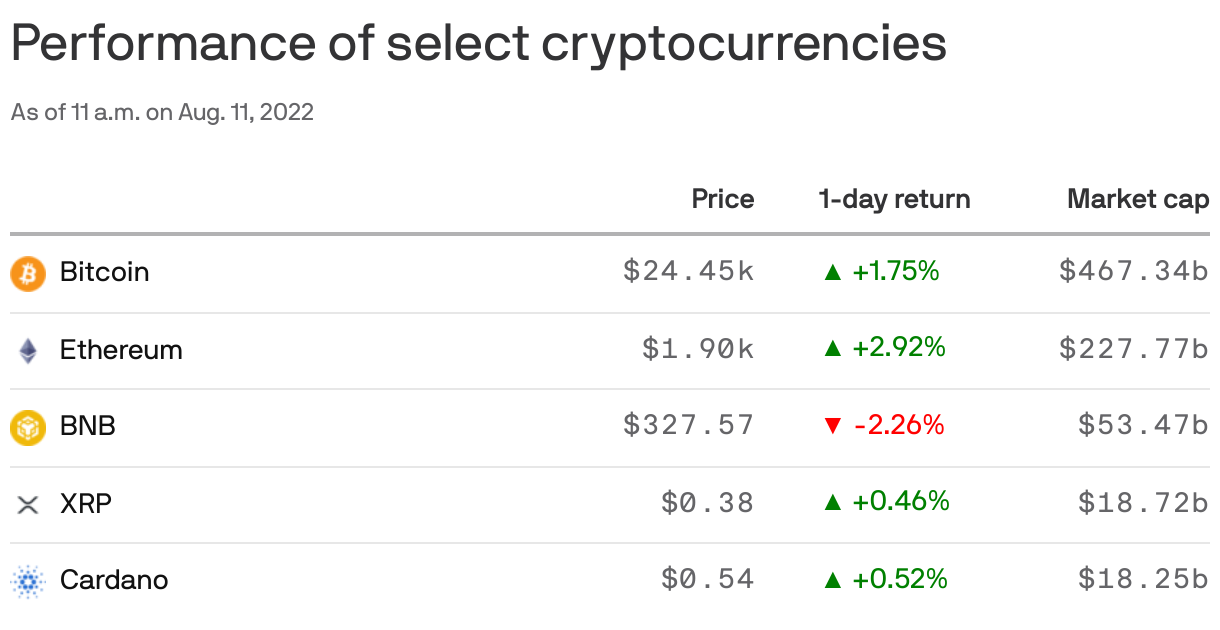
Top coins

π§ 5. Culture hash: Betrayal by a decentralized protocol
Screenshot: @readDanwrite (Twitter)
Centralized platforms, man!
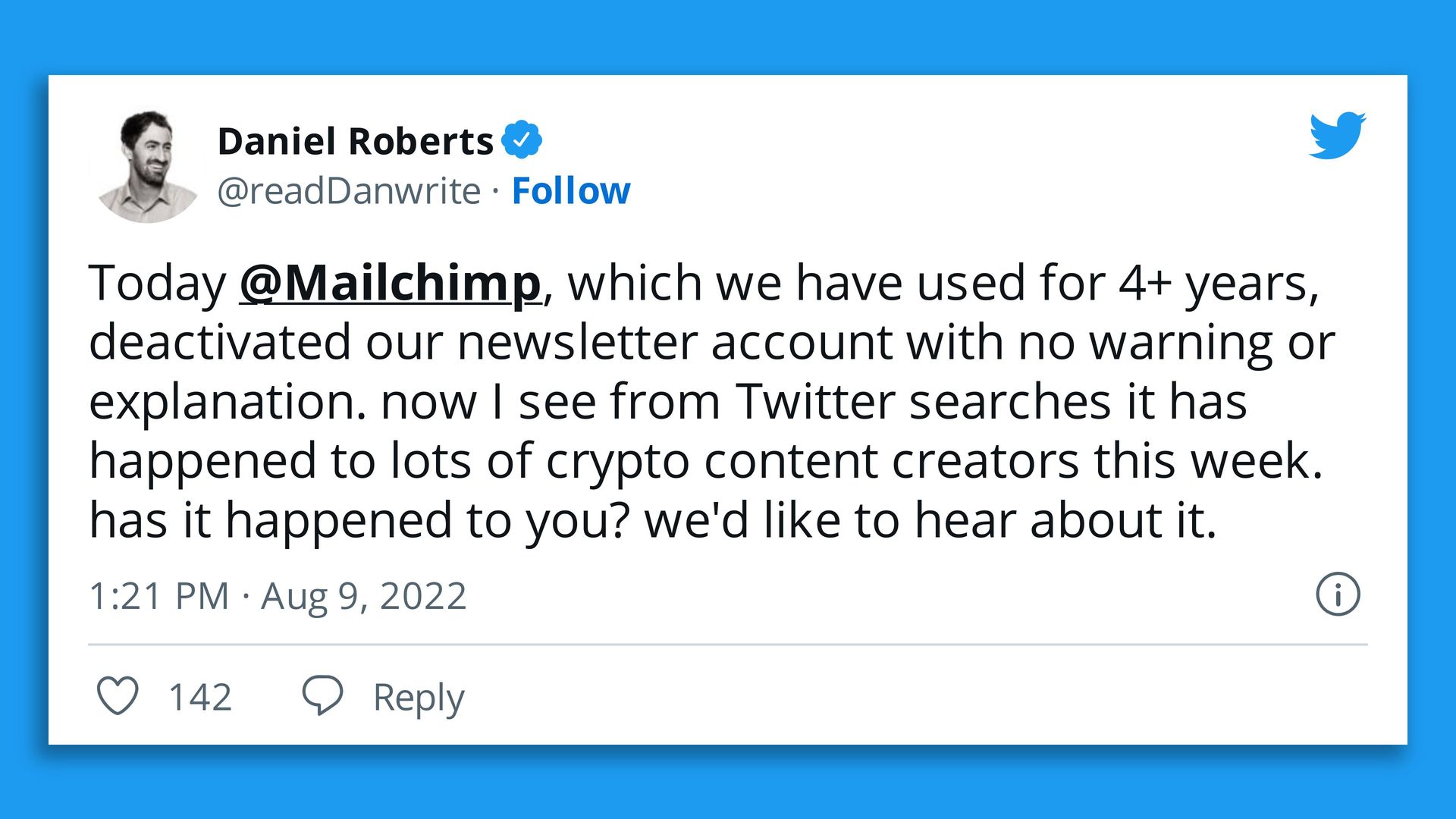
Context: Decrypt's editor got the bad news that Mailchimp, a big email list company made famous by the podcast "Serial," had shut down its service without warning, precisely because it runs crypto content, Brady writes.
- It turns out Decrypt wasn't the only one. Its reporters hit the digital street and found that several crypto companies have lost service in the last few days.
- The company has been pretty iffy about crypto firms going back to 2018.
Meanwhile, a newer firm out of Britain waved its hand as crypto-friendly.
Be smart: Email companies may be capricious, but email itself is a completely decentralized protocol, at its core. Anyone can set up their own email server and run their own email, if they want.
- The real tragedy of email is that no one is even trying to make it better.
Seriously, though, it sounds boring, but this Goerli testnet news really is the biggest thing happening. It's huge. βC & B
Sign up for Axios Crypto

Brady Dale covers crypto and blockchain impacts on markets and regulation.