Axios Crypto

November 08, 2023
Hello, hello! Today's newsletter is a mix of bullish signs and some final spasms of severe negativity. Which way, crypto market?
- Is today the day bitcoin price stays over $35,000 when this newsletter goes out? Looking good...
- Feel free to send us questions or tips: [email protected]
Today's newsletter is 1,233 words, a 4Β½-minute read.
πͺ¦ 1 big thing: Bitcoin life insurance
Zac Townsend, CEO of Meanwhile. Photo illustration: Axios Visuals. Photo: Paige Newton, courtesy of Meanwhile
Life insurance is boring, which is just what bitcoin needs, according to Zac Townsend, the CEO of Meanwhile.
Why it matters: Building classic financial services on newfangled digital assets is a road to building out crypto's original vision:
- An alternative financial system based on a monetary system that's not subject to the whims of politicians, Brady writes.
What they're saying: "Bitcoin has this culture of HODLing and has this culture of long-term store of value, and that's really what life insurance is about," Townsend says.
How it works: Meanwhile is a life insurance company that does everything in bitcoin, while still offering tax advantages that customers might expect for products they're considering for estate planning.
- Speaking very broadly, a customer that gives Meanwhile 10 BTC can expect a beneficiary to receive 20 BTC after the customer dies (precise terms are subject to actuarial analysis, etc., but that's been a rough idea of the deal, here in the early days).
- Townsend called that price a "ballpark." The minimum buy-in, for now, is five bitcoin over five years (roughly $175,000).
To meet its obligations, the company runs a conservative credit desk, targeting a 3% return in bitcoin (2% is all it needs to pay death benefits).
- A selling point is that, over time, users can borrow against their benefit tax-free, Townsend explained.
The intrigue: "We accept all our premiums in bitcoin. We pay all our claims in bitcoin," Townsend says. "Because all our assets and liabilities are in bitcoin, the price of bitcoin doesn't matter."
State of play: In June, Meanwhile announced it raised $19 million.
- That's reached a little over $20 million now, with Stillmark β a Bitcoin-focused fund β joining later, Townsend tells Axios.
- The company got its sandbox license with the Bermuda Monetary Authority at the end of last year. (Bermuda is a leading nation for domiciling insurance companies)
- "The way we talked to them about it was, 'We're going to build a boring life insurance company,'" he said.
Townsend declined to disclose numbers but says Meanwhile is selling policies. Right now, it's only available in the U.S.
- His goal is to offer it in places where saving is harder, such as Argentina, Zimbabwe and Nigeria.
Zoom out: The company runs with seven people now, but Townsend thinks a large insurance company can be built with low overhead by using artificial intelligence to do jobs like customer service.
The bottom line: "We have already worked on policies right now that are going to outlive me," he says.
π 2. Charted: The HODLer POV

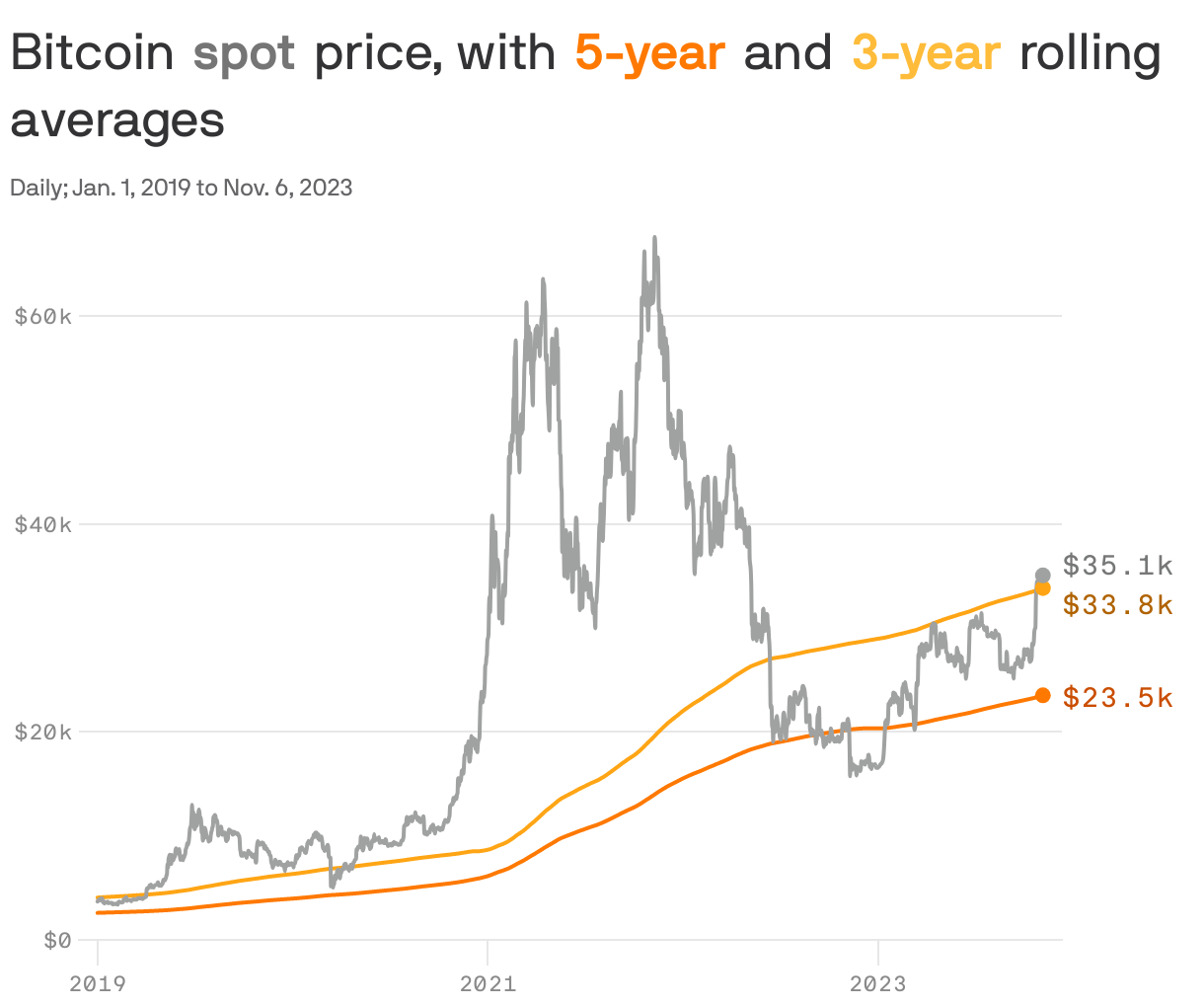
This chart illuminates the HODLer mentality, Brady writes.
- Bitcoin price can bounce all over day-to-day, but β if you zoom out β it's been a pretty steady march upward.
Be smart: HODL is a bitcoin meme that refers to the idea of holding onto the asset even though the daily wild gyrations in price.
- Most people who have bought crypto have lost money, but most people also don't hold on for long.
- As this chart shows, over any multiyear horizon β so far β investors make money. It's the hype-chasers who have lost out.
How it works: The basic strategy (also used for other assets) is known as dollar-cost averaging.
- You don't put down a big bet on one day. You put down small, affordable bets at regular intervals (ignoring price) over time. It's the antithesis of "timing the market."
- $100 on the fifth of every month for a year is dollar-cost averaging. $1,200 when you get your tax return is a lottery ticket.
The bottom line: A person could have bought at the top of the 2017 cycle and still be way ahead today if he or she didn't sell when the price cratered through 2018.
- Patience, so far, has paid off.
π«‘ 3. Sentiment holds steady through the pain
Illustration: Annelise Capossela/Axios
The general public has headed for the door, but the people convinced by crypto have sat tight, according to new research from Morning Consult, Brady writes.
What they're saying: "Interest in cryptocurrency has held steady even with the industry facing ongoing regulatory and media scrutiny," analyst Jaime Toplin writes at the opening of the cryptocurrency section of the company's semiannual report, "The State of Consumer Banking & Payments."
Details: Since January 2022, analysis of survey responses has generally maintained that roughly 20% of the public owns cryptocurrency and a little more than 20% intends to buy it in the next month.
- From the prior July to the most recent one, the share of people who say they are using crypto in some way (as payment or to send value to others) has ticked up slightly.
- PayPal has been the most popular way to hold the asset (44% of respondents who hold crypto). Only one self-sovereign crypto wallet even showed up on the survey: Metamask (11%).
Yes, but: "Notably, October saw a slight downtick in ownership and intent to purchase, which could be the beginning of a trend," Toplin notes.
- This runs counter to the longstanding narrative that bitcoin price ticks up in October.
- That said, at the very end of the month, expectations of a spot bitcoin ETF caused enough fresh demand that October 2023 ended as another "Uptober," making a negative trend less likely.
The intrigue: More crypto owners than non-owners believe the sector should be regulated.
- "These attitudes toward regulation contravene the pervasive idea that crypto owners want the space to remain the Wild West of financial services," Toplin writes.
In the weeds: The data comes from the monthly surveys Morning Consult conducts online with 2,200 to 4,400 adults, as well as a selection of other surveys conducted by the company.
π4. Catch up quick
π HSBC, the giant British bank, is following BNY Mellon in offering custody service for digital assets. (CNBC)
π Robinhood crypto trading revenue fell dramatically in Q3. (Blockworks)
π A subsidiary of the company that launched the EOS blockchain is looking at buying the remains of the FTX exchange. (WSJ)
πͺ Coatue slashes its internal valuation for OpenSea, the top NFT marketplace, by 90%. (The Information)
βοΈ 5. Culture hash: Call before you send
Screenshot: u/wpeironnet (social media)
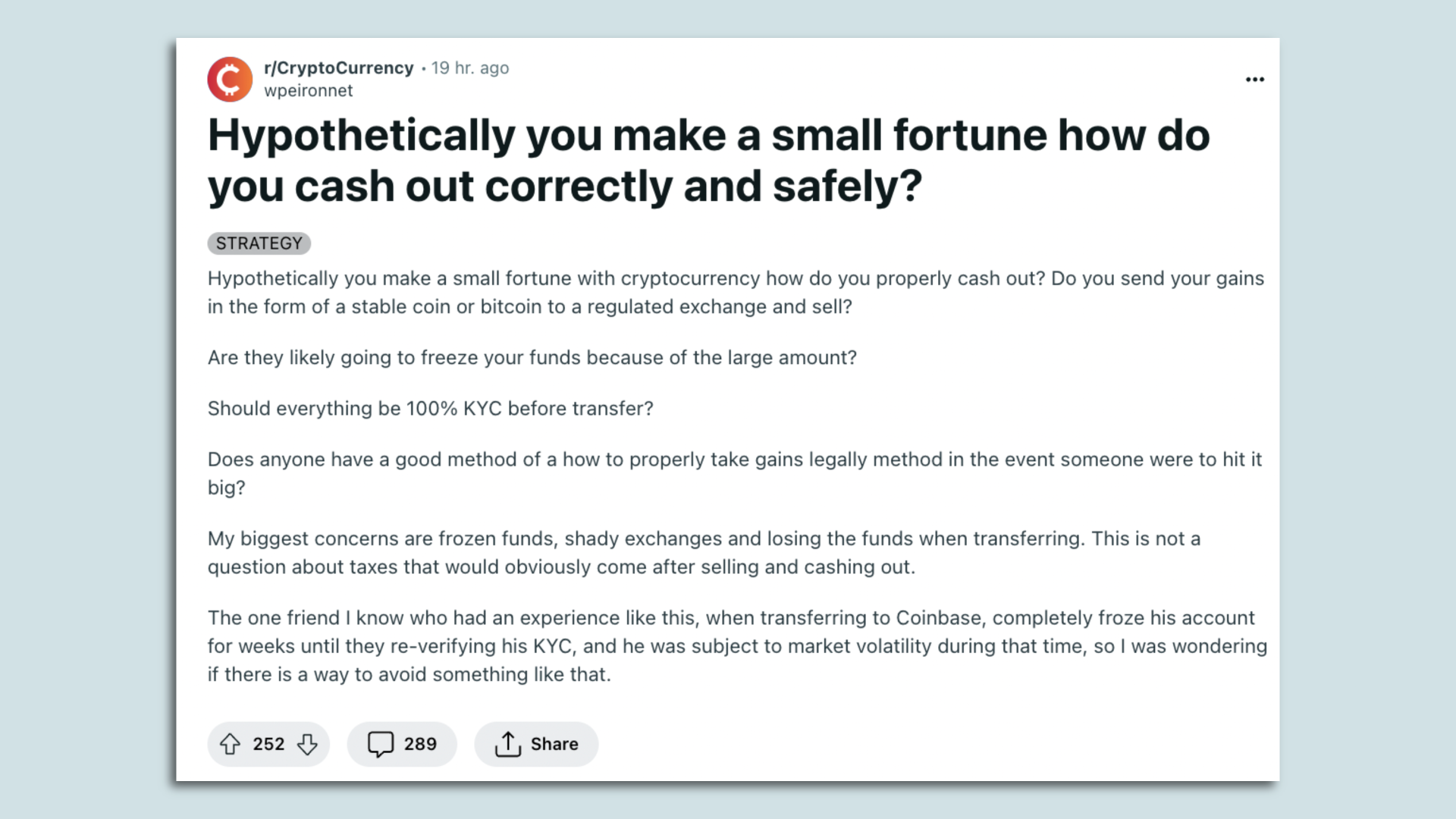
The best way to avoid snafus when cashing out a large amount of cryptocurrency is to check with all your counterparties first β that's according to multiple respondents in a Reddit thread on the question.
Why it matters: Banks (and crypto exchanges) get alarmed when someone who's never moved lots of money suddenly moves lots of money, Brady writes.
- When the legacy financial system gets surprised, they freeze accounts while they check things out (exchanges do it, too).
What they're saying: "My biggest concerns are frozen funds, shady exchanges and losing the funds when transferring," Reddit user wpeironnet writes in his post.
- He points out that some of the biggest holders of assets like bitcoin have gathered lots of the stuff in cash transactions or other kinds of trades, never previously touching a traditional exchange.
- When they want to turn those holdings into traditional money, though, there can be hiccups.
The answer: Call the exchange. Call your bank. Do all the identity checks first. Let them know what you're doing. That should prevent anything getting frozen (and potentially putting your sell order on the wrong side of a dip).
- As another user, noburnyet, put it, "Last bullrun I called my bank to let them know more money was coming in than normal. Only response I got was, in general we don't care where the money is coming from or how much. Only if you try to spend too much we will flag it."
This newsletter was edited by Pete Gannon and copy edited by Carolyn DiPaolo.
Our time in court is having a long-term impact β Crystal and Brady are eschewing Twitter, at least somewhat. βC & B.
Sign up for Axios Crypto

Brady Dale covers crypto and blockchain impacts on markets and regulation.