Axios Crypto

December 16, 2022
Hello, hello! Here's our explainer of the lame-duck crypto legislation that came out this week. It will probably fade out but it's still a doozy.
๐ง [email protected]
Today's newsletter is 1,025 words, a 4-minute read.
๐บ๐ธ 1 big thing: No financial privacy on the chains

Illustration: Sarah Grillo/Axios
Americans would have no refuge in blockchains for financial privacy under legislation introduced by two U.S. senators, Brady writes.
Why it matters: A major driver for the creation of cryptocurrency was to give people a cash-like experience on the internet, with a digital currency that could be passed from one user to another, just like paper bills and coins.
- Like cash, privacy isn't perfect with most cryptocurrencies, but both are more private than transactions with debit or credit cards that are tied to an identity.
Driving the news: Sens. Elizabeth Warren (D-Mass.) and Roger Marshall (R-Kan.) introduced The Digital Asset Anti-Money Laundering Act of 2022 on Wednesday.
What they're saying: โOur common-sense bill will make it harder for criminals to finance their criminal activities, like the trafficking of illicit fentanyl through the dark web, that can harm innocent Kansans,โ Marshall said in a statement.
Zoom out: At issue is the fact that cryptocurrency was designed to be a bearer asset, insofar as a person's identity wouldn't be tied to the digital assets they held.
- In other words, a person could store it themselves, using software that people usually describe as a "wallet." The legislation refers to these as "unhosted" wallets.
- The bill would require anyone facilitating transactions on a blockchain โ such as the validators or miners that process them โ to register as a financial institution and make certain guarantees about people using the network for higher-value transactions.
The other side: "The legislation is clear on its face," research director Peter Van Valkenburgh wrote for Coin Center, a non-profit focused on crypto policy issues. "The intended result is to forbid Americans from having any technological guarantees of personal privacy."
- In October, Coin Center sued the U.S. Treasury after it sanctioned Tornado Cash, a privacy tool that runs on Ethereum.
Quick take: This is such far-reaching legislation that it's hard to imagine how existing blockchains would continue to operate in the United States.
- It would be "simple," however, for new chains to launch designed to comply. Participation in running such a chain would be much more expensive, however, so it's unlikely to be as decentralized as Bitcoin or Ethereum.
Flashback: The legislation hearkens back to a Trump-era unhosted wallet rule out of the Financial Crimes Enforcement Network (FinCEN).
- That rule covered fewer participants, stopping at requiring checks from banks and money services businesses before they permitted high-dollar-value transactions from sending cryptocurrency to personal wallets.
๐ 2. Charted: Polygon is getting YUGE

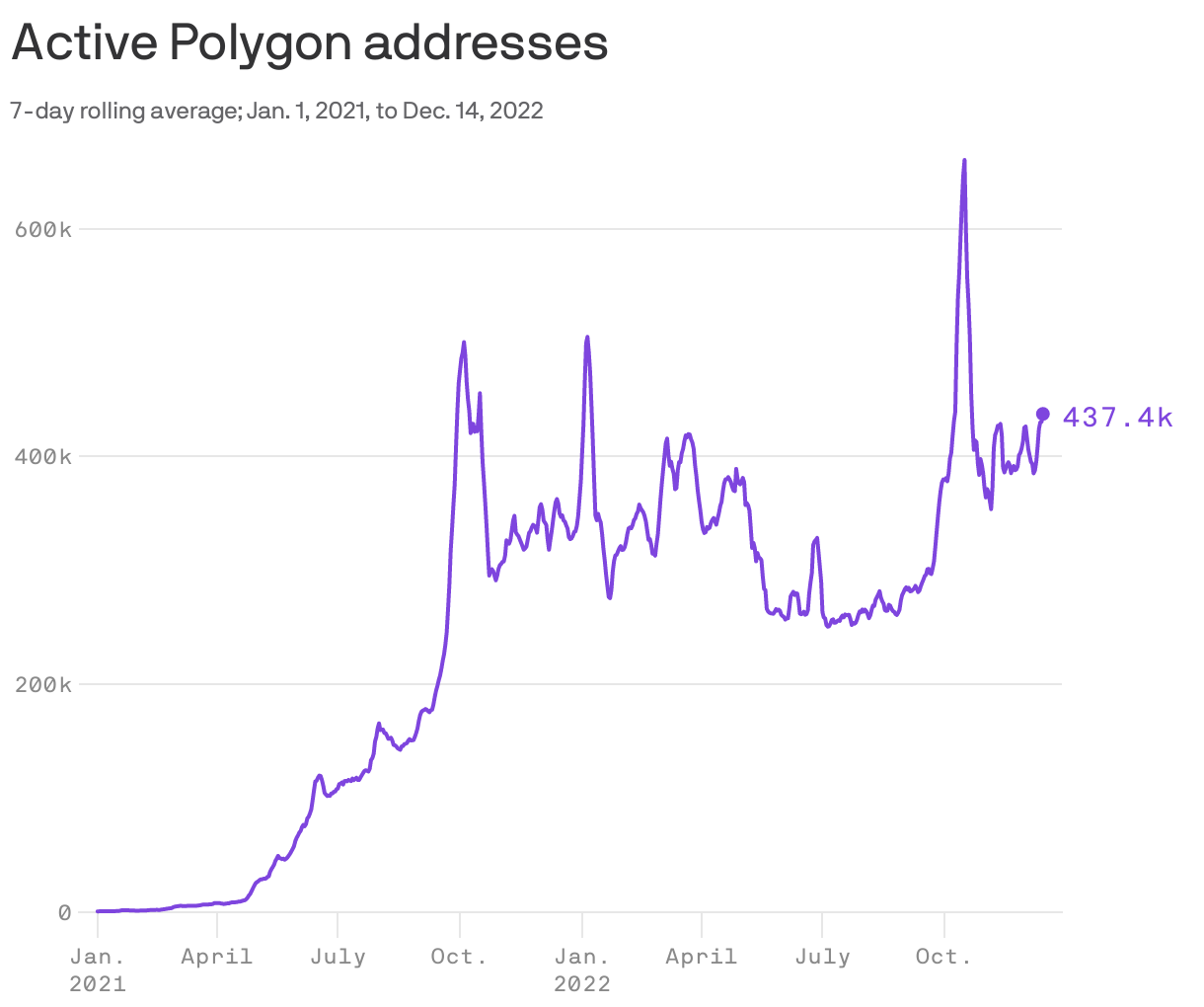
The blockchain chosen by the company that won the right to license former President Trump's image for an NFT series was Polygon, Brady writes.
- Polygon stands on its own, but it was built to complement Ethereum. The two chains interoperate as easily as is technically possible, and they run similarly.
Driving the news: Above and beyond the recent series of presidential collectibles, Polygon is generally growing, despite the crypto downturn.
By the numbers: Active addresses depends on what buzzy releases are attracting users, so it varies a lot. At the height of the bull market, daily active addresses was about 215,000 to 300,000 each day.
- These days, a typical day is more like 330,000 to 420,000 active addresses.
- Unique addresses are also up 40% since the market crashed in May.
Of note: Polygon is much, much cheaper to use than Ethereum. Everything still costs something, but it's so much less that users are more likely to experiment and play on it.
The bottom line: The market is in terrible shape but that doesn't mean users have completely left.
๐ฝ 3. The hardest state for crypto biz is harder now
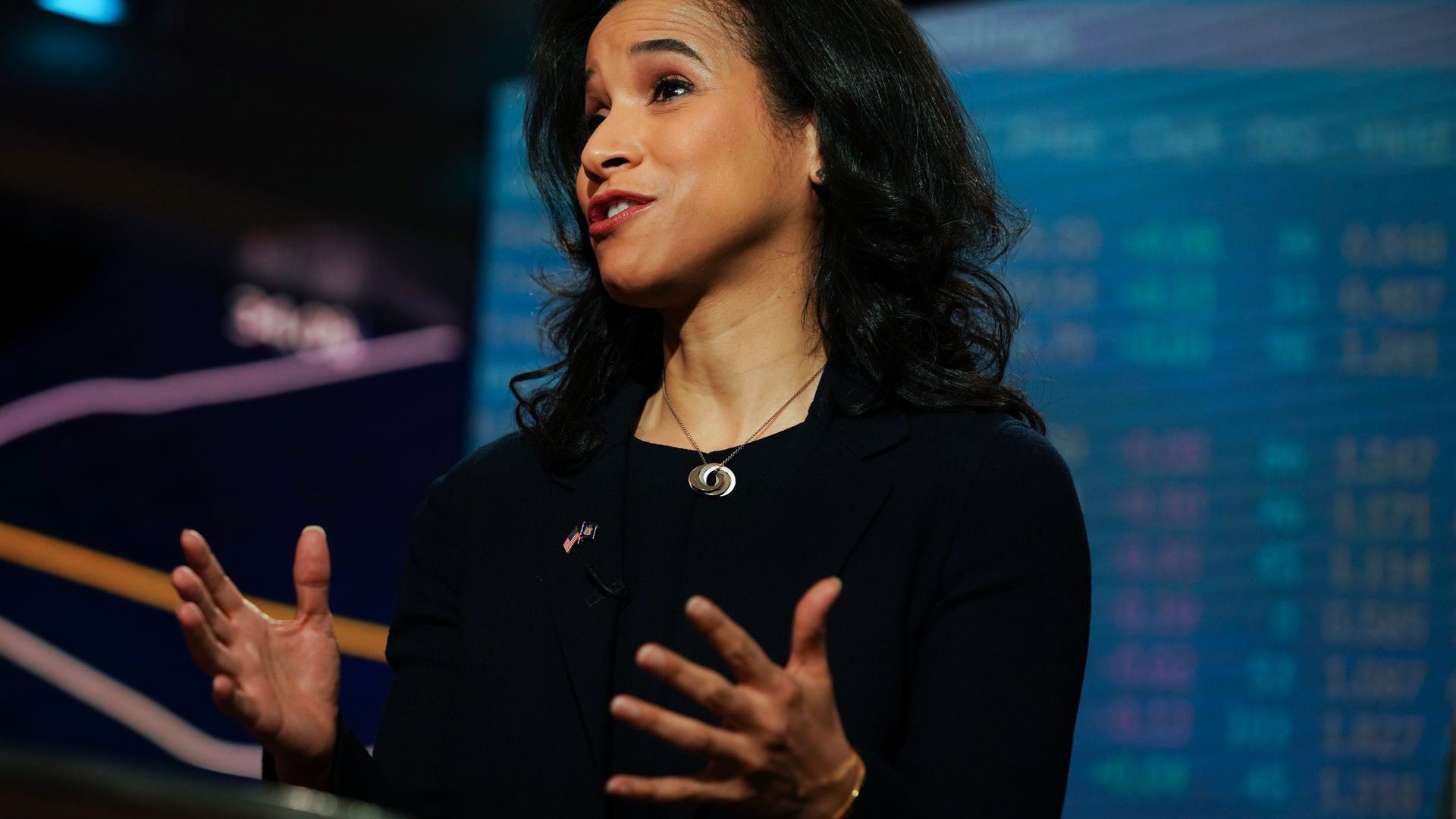
Adrienne Harris, superintendent of the New York State Department of Financial Services. Photo: Christopher Goodney/Getty
Banks licensed in New York were handed a checklist of submission requirements for the state's regulator if they want to do business in crypto, Crystal writes.
What's happening: The New York State Department of Financial Services (NYDFS) yesterday clarified guidelines for regulated banks that wish to start crypto operations, asking them to submit a business plan to the regulator at least 90 days prior.
Why it matters: New York, home of the BitLicense, is already a place crypto firms bypass because of strict mandates to operate.
- Yesterday's fresh guidance is the first move NYDFS has made to clarify requirements for crypto activities since FTX's collapse.
What they're saying: Superintendent Adrienne Harris in a statement emphasized how critical the guidelines would be in "ensuring that consumersโ hard-earned money is protected," and regulated banks "remain resilient and competitive."
Details: While the new guidelines draw heavily on the state's existing framework, they provide additional information on how institutions may seek approval.
- They come with a checklist of required information for review, covering business plans, risk management, corporate governance and oversight, consumer protection, financials, and legal and regulatory analysis.
The bottom line: It was already expensive and hard to run a crypto business in New York. It's harder now.
๐ผ 4. Catch up quick
๐งฎ Mazars Group has stopped working for crypto clients, one of which was Binance. (Bloomberg)
๐ฐ Singapore-based Amber Group, a Sequoia and Temasek-supported trading group, closed a $300 million funding round. (TechCrunch)
๐ FTX filed a motion to sell four units of its business: Embed Technologies, LedgerX LLC, FTX Japan, and FTX Europe. (Decrypt)
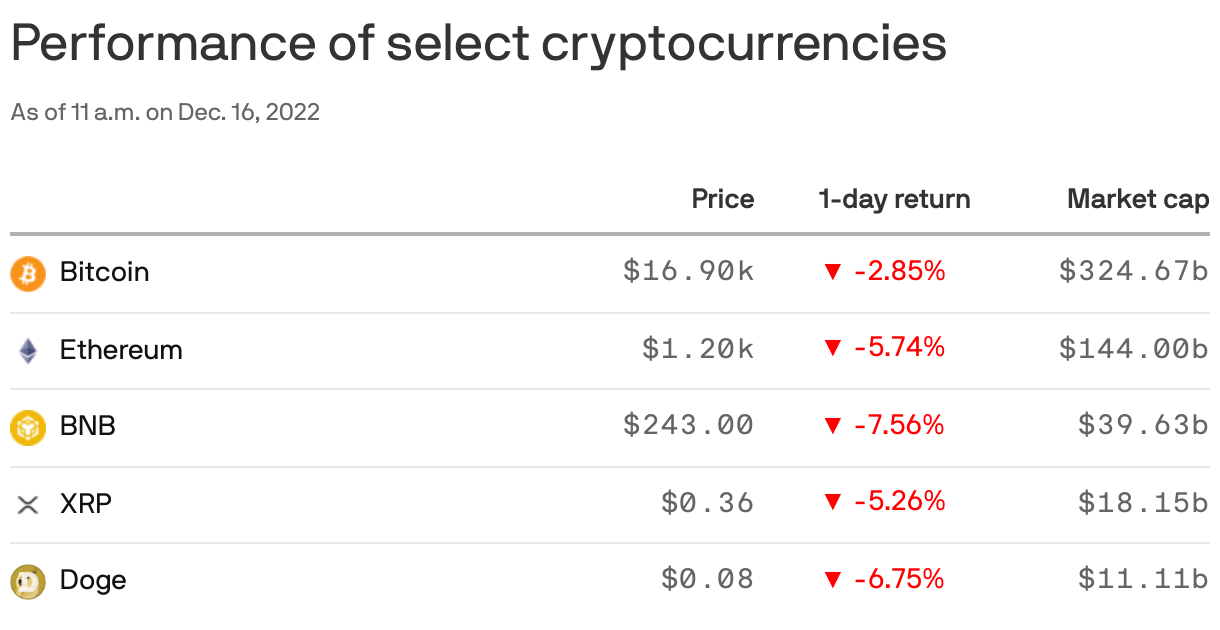
Top coins

๐ป 5. Culture hash: New York's bitcoin bar
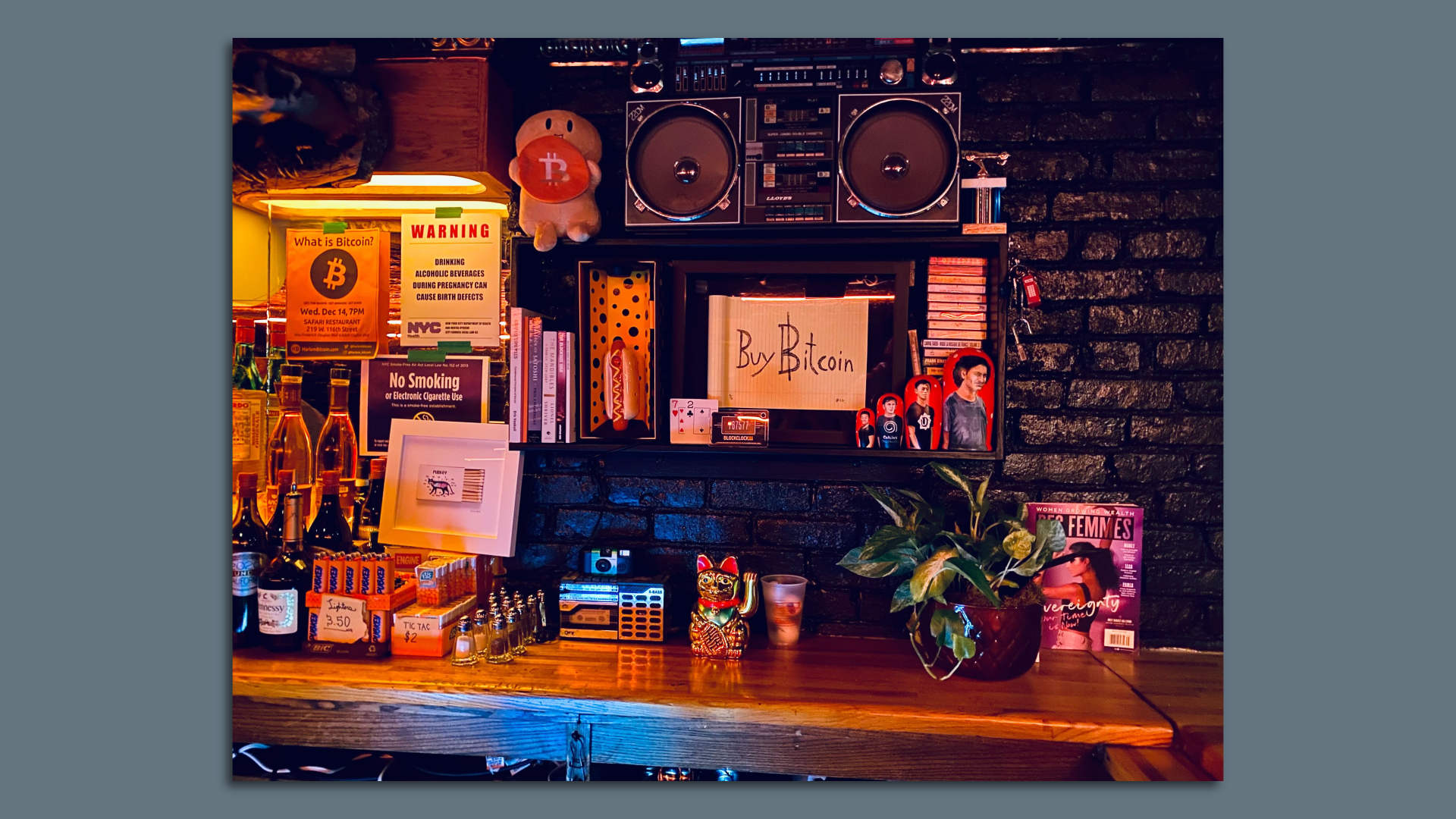
Does that sign look familiar? PubKey bar in New York. Photo: Crystal Kim/Axios
PubKey is a bitcoin bar on Washington Place in Manhattan, Crystal writes.
- The bar does not accept bitcoin as payment but plans to later.
The vibe: It's a spot for crypto enthusiasts and normies to quaff themed drinks, eat elevated bar foods, and presumably, talk about crypto.
Details: There's an orange pill(sner) or Miller High Life with sweet vermouth and Campari. (It's a negroni for the orange-pilled crowd.)
- It's a rather new venue: One can tell by the nesting doll of disgraced crypto leaders that includes Sam Bankman-Fried.
- "PubKey" is a reference to public keys.
What they're saying: Eavesdropping on conversation turned up topics from Adderall to FTX and of course, bitcoin.
The best story came from a barfly we'll call "Norm," though he was no normie. He cannot recall this, but has been told that he ate another customer's hotdog after it was clear the person who ordered it was not going to eat it (they were a different kind of rekt).
- The dogs are very good. The Chicago-style one was my fave.
๐ญ Our thought bubble: How many bitcoin references do you see in the tchotchkes in our photo?
This newsletter was edited by Pete Gannon and copy edited by Carolyn DiPaolo.
Substack faceoff for weekend reading: Scott Alexander's contrarian take on why crypto matters vs. Matt Yglesias's contrarian take on why it doesn't. โC & B
Sign up for Axios Crypto

Brady Dale covers crypto and blockchain impacts on markets and regulation.