Axios Crypto

May 31, 2022

Hello! It's good to be back with everyone after the long weekend. I hope you didn't miss us yesterday! Today we are continuing Friday's take on crypto startups with an explainer. Plus: Even web3 companies have to do payroll.
🧏♂️ Send us your feelings on crypto now that the market is in a very bad mood: [email protected].
💡 Don't forget what we told you last week about never clicking links in emails or text messages promoting things. Check out this tweet.
This newsletter was edited by Pete Gannon and is 1,081 words, a 4-minute read.
⚙️ 1 big thing: How crypto startups work
Illustration: Sarah Grillo/Axios
From one perspective: DeFi operates on a new business model. From another: It just re-invented stocks. Time will tell, Brady writes.
Why it matters: Blockchains might be creating a much more fluid way for people to participate in money-making enterprises, all powered by tokens — digital items that grant users rights but also sometimes have special functions within a protocol.
- They also might just be reinventing the world we already know, something very close to equity with maybe some gains in efficiency and flexibility.
How it works: When I started writing about crypto projects full time in 2017, I was struck by something very weird: None of the companies planned to take a cut of the money spent on the platforms they were building.
- One day, I was talking to a company that was making a blockchain version of eBay, and the founder was very clear that all its users would make money in various ways. But the company building it all would take nothing.
- The company was making a token, however, and it would sell it in an initial coin offering (ICO). The idea was that sellers on its platform would have to post some token to have a "store" and buyers would use the token to buy stuff.
- That way, if the store became popular, lots of people would want the token, and its price would go up.
- And, of course, the people who created the token had a lot of the token, which they got for free. Any gains were pure profit.
This model started to change around two years ago.
Projects, led by Compound, the DeFi money market, started distributing what they called "governance tokens" (they might as well have been called "growth tokens" though) to users on their platforms.
- Governance tokens were a lot like equity. They worked as votes over the project's future.
- If the company that created the DeFi protocol only kept 10% to 20% of the tokens for themselves, they could claim to no longer control it.
- Still, if a protocol had a billion-dollar market cap, 20% of the tokens would still be worth a lot of money.
So this was the new business model: Crypto companies were not trying to earn profits, they were trying to drive value to a token.
- Incidentally, sometimes tokens serve some other role in the work of a protocol, and sometimes token holders vote to give a cut of revenue to token holders.
Yes, but: Wouldn't all that raise all sorts of regulatory red flags? Oh... yes. Very yes. It will play out for years.
- But it's also true that regulators could shut every crypto company down and all the crypto protocols would just keep running. It's tricky.
Flashback: That crypto-eBay project I mentioned? It quit messing with that idea long ago, but its team is still going. They aren't making anything they set out to make, but it's still all about the token.
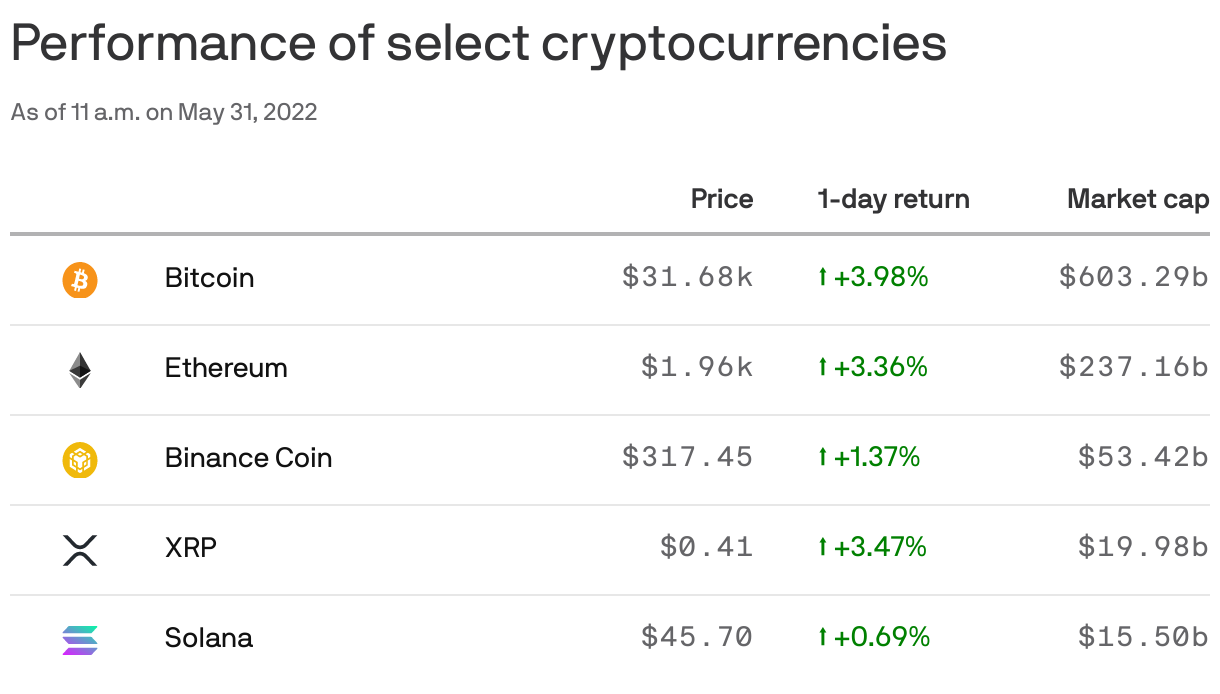
Top coins
🛠 2. DAO tools
Illustration: Annelise Capossela/Axios
DAOs may be a revolutionary new way of organizing an enterprise, but they still have to get payroll out, Crystal writes.
Driving the news: Utopia Labs, a startup that aims to bring back-office tools to decentralized autonomous organizations (DAOs), raised $23 million in a Series A fundraising round led by Paradigm, a venture capital shop started in 2018 by Coinbase co-founder Fred Ehrsam and former Sequoia Capital partner Matt Huang.
Why it matters: DAOs have seen massive growth over the past year as an alternative to C-Corps and LPs. There are an estimated 4,834 such organizations, with roughly $10 billion sitting in DAO treasuries, according to DeepDAO.io, an analytics platform.
- Context: DAOs are member-owned communities that aim to use blockchain, less centralized leadership, to make decisions to achieve a goal.
How it works: Utopia's proposition — payroll and payments for crypto-native organizations, to start — is to centralize operations for these decentralized organizations.
- For example, when Utopia Labs met months ago with SushiSwap, the DAO was manually invoicing for events and other services. Utopia changed that by creating payment request links that Sushi now uses to bill their customers and can have in one place.
- "DAOs have increasingly complex needs in managing their organizations," Matt Mizbani, a partner at Paradigm tells Axios. "We're excited to partner with Utopia as they build the operating system for DAOs to streamline their operations."
State of play: Utopia now works with more than 100 DAOs, up from roughly 30 earlier this year.
- Besides SushiSwap, the list includes Friends With Benefits and OlympusDAO, according to Utopia.
- The company is averaging 75% month-over-month growth in payment volume, which in April hit $15 million, according to Utopia.
Co-founders Kaito Cunningham, 23, Pryce Adade-Yebesi, 22, Alexander "Alex" Wu, 21, and Jason Chong, 24, too, met online in DAO-fashion.
- "We weren't a DAO, but we had the same ethos," Cunningham, chief of Utopia, tells Axios. "DAOs are an extremely important experiment in human coordination."
- Example: The infamous ConstitutionDAO aimed to collectively buy a copy of the U.S. Constitution, only to be outbid at auction by billionaire Kenneth Griffin of Citadel.
In the weeds: Other investors in Utopia include Coinbase Ventures, Circle Ventures, and billion-dollar HR platform Gusto.
- Utopia Labs declined to comment on its valuation.
Flashback: Utopia announced that they raised $1.5 million from investors led by Kindred Ventures in October.
The bottom line: Utopia Labs' vision to help DAOs with minutiae, like payroll, points to the future of work.
🏃 3. Catch up quick
🔐 Custody and prime brokerage Copper gets approval of its anti-money laundering standards from Swiss regulator. (The Block)
🌲 A drug dealer talks about why he loves crypto. (Crypto Island)
🤓 A Wikipedia editor takes on the cryptocurrency industry. (Washington Post)
👟 Nike is buying web3 names such as dotswoosh.eth. (Decrypt)
👻 4. Culture Hash: Luna Classic pump
Scrrenshot: @MrDiamondhandz1 (Twitter)
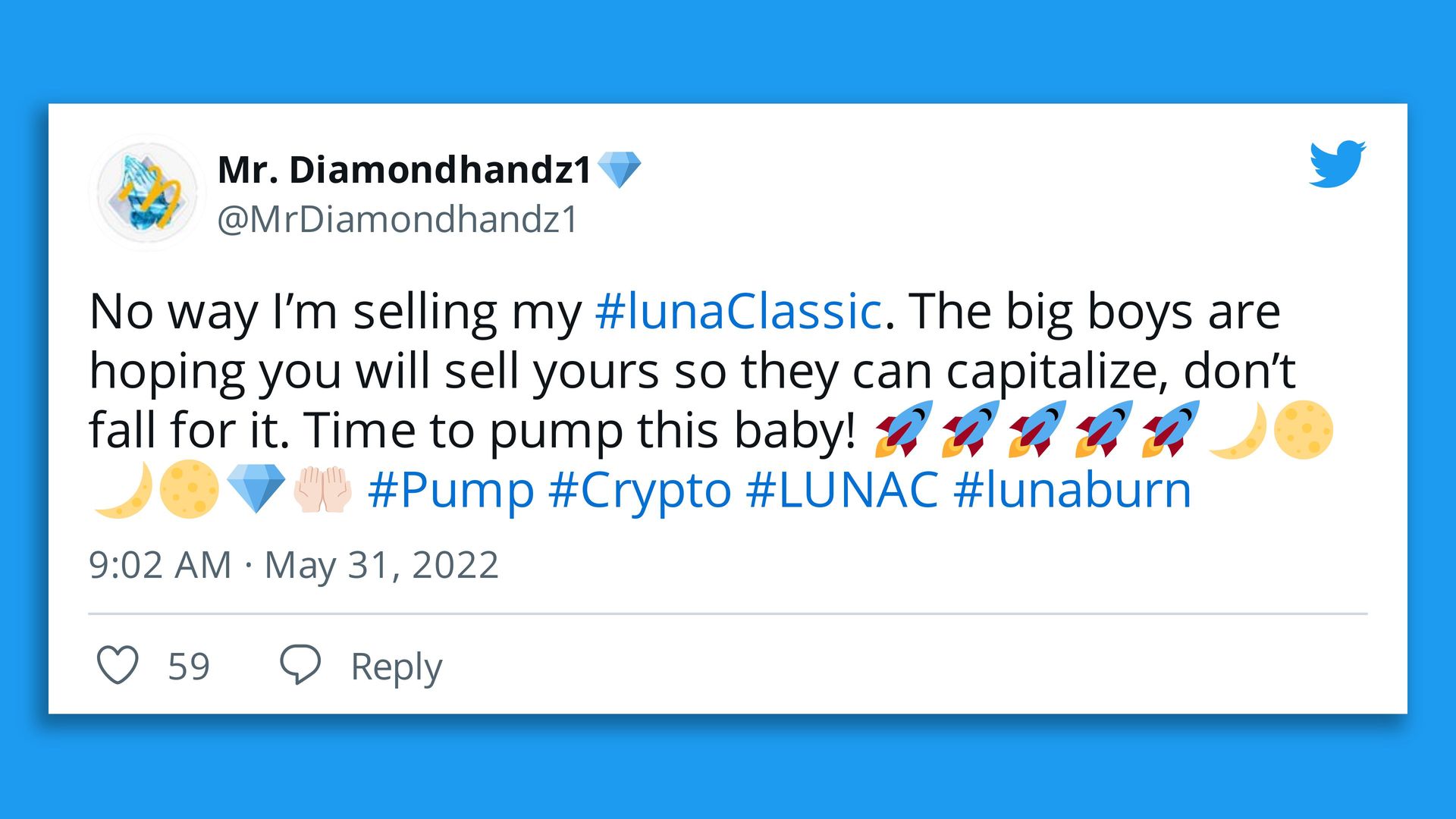
Pumping penny stocks used to be a big play for email spammers, but now they seem to like Twitter better, Brady writes.
Details: Remember how that stablecoin, terraUSD blew up? It was backed by another token called luna, the value of which went basically to zero (bajillionths of a penny).
- During the weekend, the new Terra chain launched, and there's a new luna coin, making the old into "Terra Classic" or "lunc."
Gamblers and spammers love a coin with name recognition and minuscule value. They can buy up loads for next to nothing and then even a small movement can mean huge gains.
Be smart: The key developers have moved on from the old Terra chain. Any gains on lunc are just buzz and market manipulation. It's an old game.
The person who created the memecoin Shiba Inu pulled a Satoshi Nakamoto-like exit. Like both of them, we will say goodbye (but only until tomorrow). —C & B
Sign up for Axios Crypto

Brady Dale covers crypto and blockchain impacts on markets and regulation.