Axios Crypto
April 18, 2023

Another day, another case against the crypto industry.
🚨 Situational awareness: As we write this, Rep. Patrick McHenry is absolutely grilling SEC chair Gary Gensler about whether or not ether is a security.
🍬 How many of our readers have been around since the original OMG airdrop? [email protected]
Today's newsletter is 1,174 words, a 4-minute read.
🫵 1 big thing: The SEC names a few more securities

Illustration: Maura Losch/Axios
There is one way the SEC can be made to say whether or not a crypto asset is a security: when it needs to make a case against an intermediary, Brady writes.
Driving the news: On its way to suing the crypto exchange Bittrex and its founder for failing to properly register its platform (more on that below), the U.S. securities regulator named several tokens available to trade on the exchange as securities.
Details: OmiseGo (OMG), algorand (ALGO), dash (DASH), tokencard (TKN), naga (NGC) and i-house token (IHT).
- The last three on this list seem to barely exist now and never mattered much. The first three all have interesting places in crypto history, however.
OmiseGo was a payments crypto project that was meant to run on Ethereum. It was born out of a Stripe-like company based in Asia. It largely wound down, and what remains was folded into the Boba Network, a smaller layer-2 running atop Ethereum.
- It did an early initial coin offering for its OMG token where it aimed to raise $19 million in 2017, just ahead of the last crypto boom.
- Once its token, OMG, went live, it promoted it by airdropping 5% of the token supply to everyone who had held a modicum of ether up to some prior point.
- This airdrop was unlike any today because no one even had to claim it. The OMG just appeared in everyone's wallets. No one would do this today: It would be seen as spammy and too expensive. Ethereum was so small then, though.
DASH. Like many early altcoins, DASH is a bitcoin fork, one that was originally known as DarkCoin, because it enabled some early privacy features.
- In 2018 and 2019, the institutions behind DASH were making much of its role fostering commerce in places like Venezuela, where the local currency wasn't reliable.
- Globally, though, if DASH had an early lead in the developing world, it seems to have lost it, particularly as stablecoins have exploded.
Algorand. This was an early alternative layer-1 that aimed to be a much faster cryptocurrency for making payments.
- The blockchain started producing blocks in 2019. Early on, it promoted itself heavily as one that would enable financial inclusion.
- On Crypto Twitter, a lot of people have noted that Gary Gensler, before he was SEC chair, had once had some positive things to say about algorand (he doesn't really say much, to be fair, and it's clearly an aside) at an MIT event in 2019.
Quick take: Calling what he said "shilling" is a bit much.
Flashback: In the Coinbase insider trading case the agency named AMP, RLY, DDX, XYO, RGT, LCX, POWR, DFX and KROM as securities.
- In its case against FTX, it named FTT.
The bottom line: It's not much of a list, but it's growing.
🤨 2. Charted: The coins react
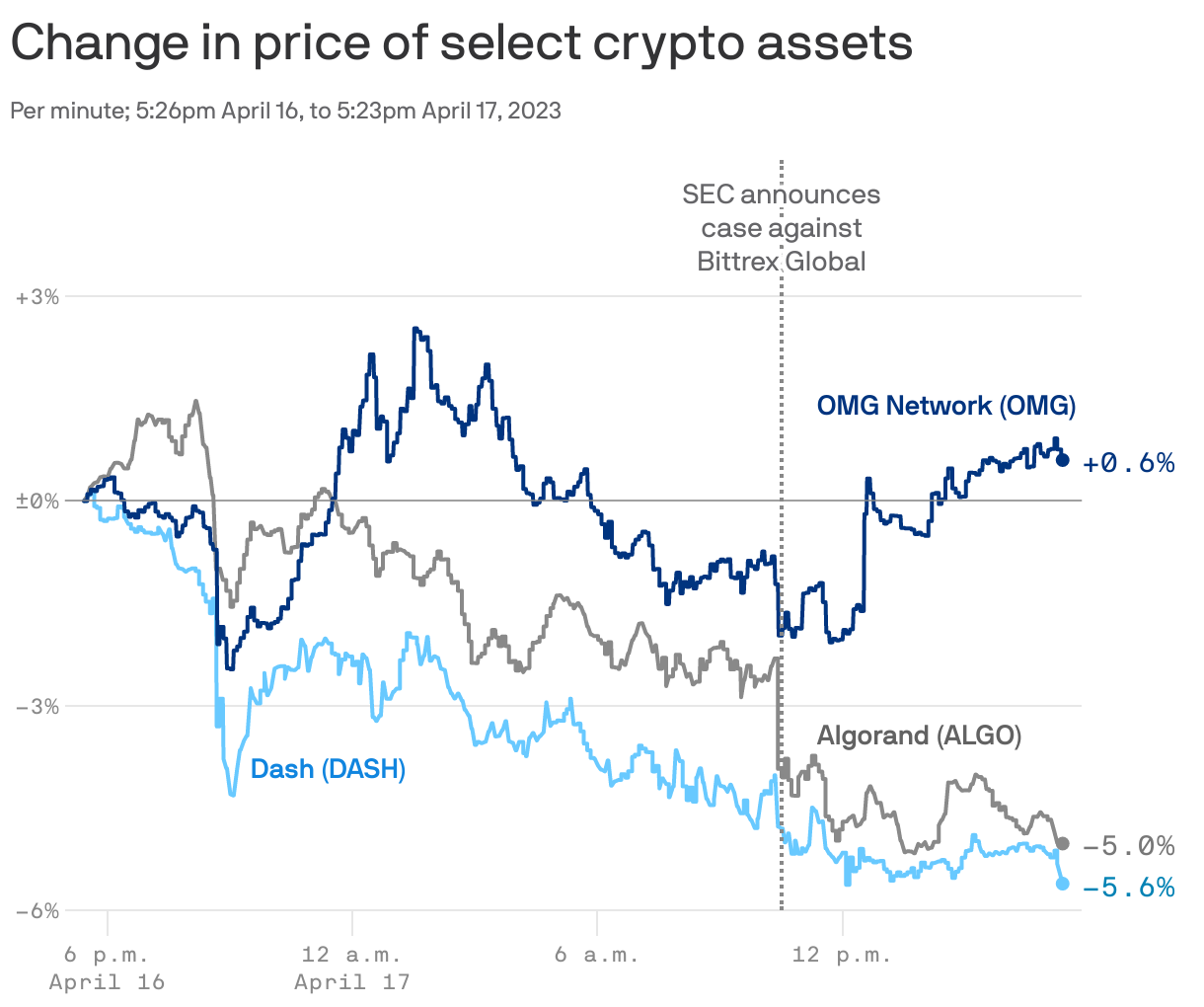
So two of yesterday's main characters reacted much as one would expect, Brady writes.
- On word that the SEC had called the coins out as securities that should have been registered with it, ALGO and DASH plummeted in value.
Yes, but: OMG did too, but somewhat less so. And then it perked back up. Why?
- It's really hard to say. My best guess — it reminded traders that OMG even existed.
As the Boba Network absorbed the OMG community, it offered some kind of airdrop to OMG holders, but I can't tell if that offer is still good. (It's probably not.)
✋ 3. Not so fast, Bittrex
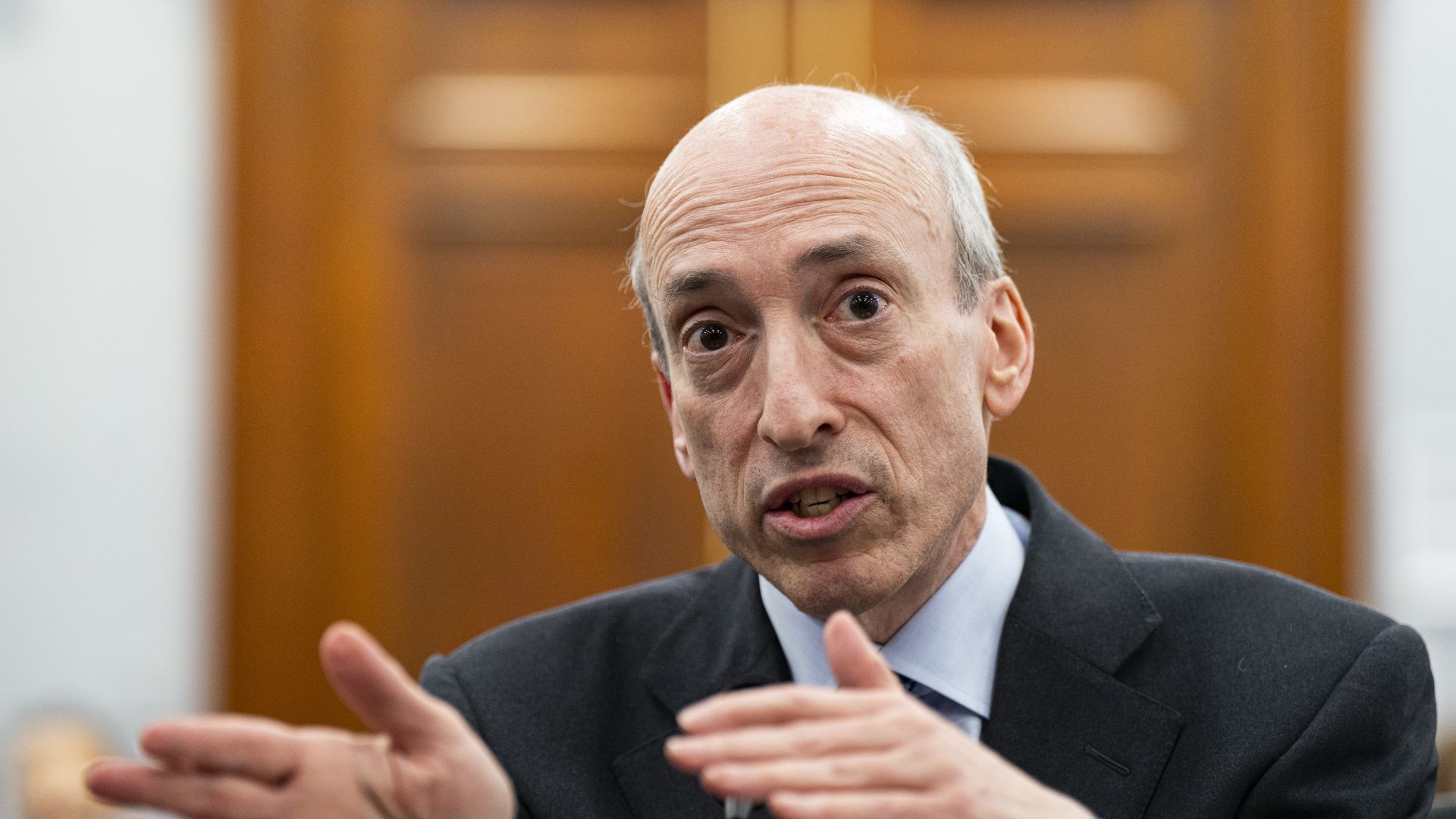
SEC chair Gary Gensler; Photo: Al Drago/Bloomberg via Getty Images.
The SEC enforcement actions keep on coming, Crystal writes.
Driving the news: The regulator sued Seattle-based Bittrex yesterday, for operating an unregistered exchange and listing what it considers securities — less than a month after the company said it was exiting the U.S. market due to regulatory uncertainties.
The big picture: "The SEC sees everything, with the exception of bitcoin, as a security. Across the board, whether they state it or not, the tokens being listed are securities, period," says Christopher LaVigne, co-chair at Withers digital asset practice. "Globally applicable, broadly applicable."
- Yes, but: "Industry participants and their lawyers don’t see it that way."
Between the lines: Stakes are high enough, and relations stretched enough, that matters are increasingly being settled in court.
What we're watching: Meanwhile, the impact of the SEC's enforcement action was "immediately" visible in ALGO liquidity on U.S. crypto exchanges, according to data compiled by Kaiko.
- Of note: "Liquidity [on Coinbase] has essentially been cut in half while Kraken's has fallen about 25%, according to Kaiko's Riyad Carey, who examined ALGO trading pairs on the biggest exchanges.
- "Binance's is up slightly. This generally tracks with what we'd expect given that this [action] would only affect U.S. exchanges."
Details: The lawsuit argues that Bittrex was purposefully non-compliant because the rules were clear — the same argument SEC chair Gary Gensler tweeted yesterday.
- It alleges the company, over the course of Shihara's tenure, purposely evaded rules that it knew applied to it, coordinating with crypto issuers to "scrub" certain statements that would have otherwise precluded the asset from trading on Bittrex's platform.
Flashback: The SEC's enforcement division reached out in March to notify the exchange of a possible lawsuit, according to the Wall Street Journal.
- Bittrex's general counsel said that the firm may litigate the issue unless there was a "reasonable settlement offer."
What they're saying: Bittrex Global said in a press release that it has "no U.S. customers" and that, apart from the Wells Notice, it received no written communication from the SEC. The company said it plans to "vigorously defend" its position in court.
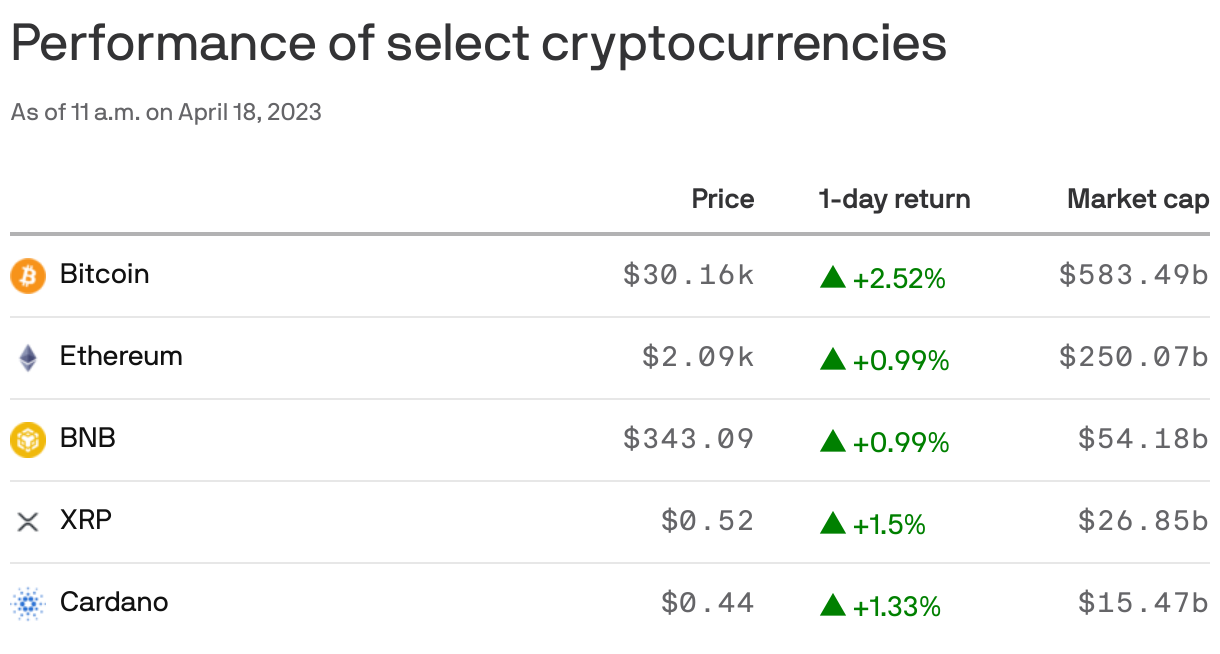
Top coins
📹 5. Culture hash: Retro-Gary
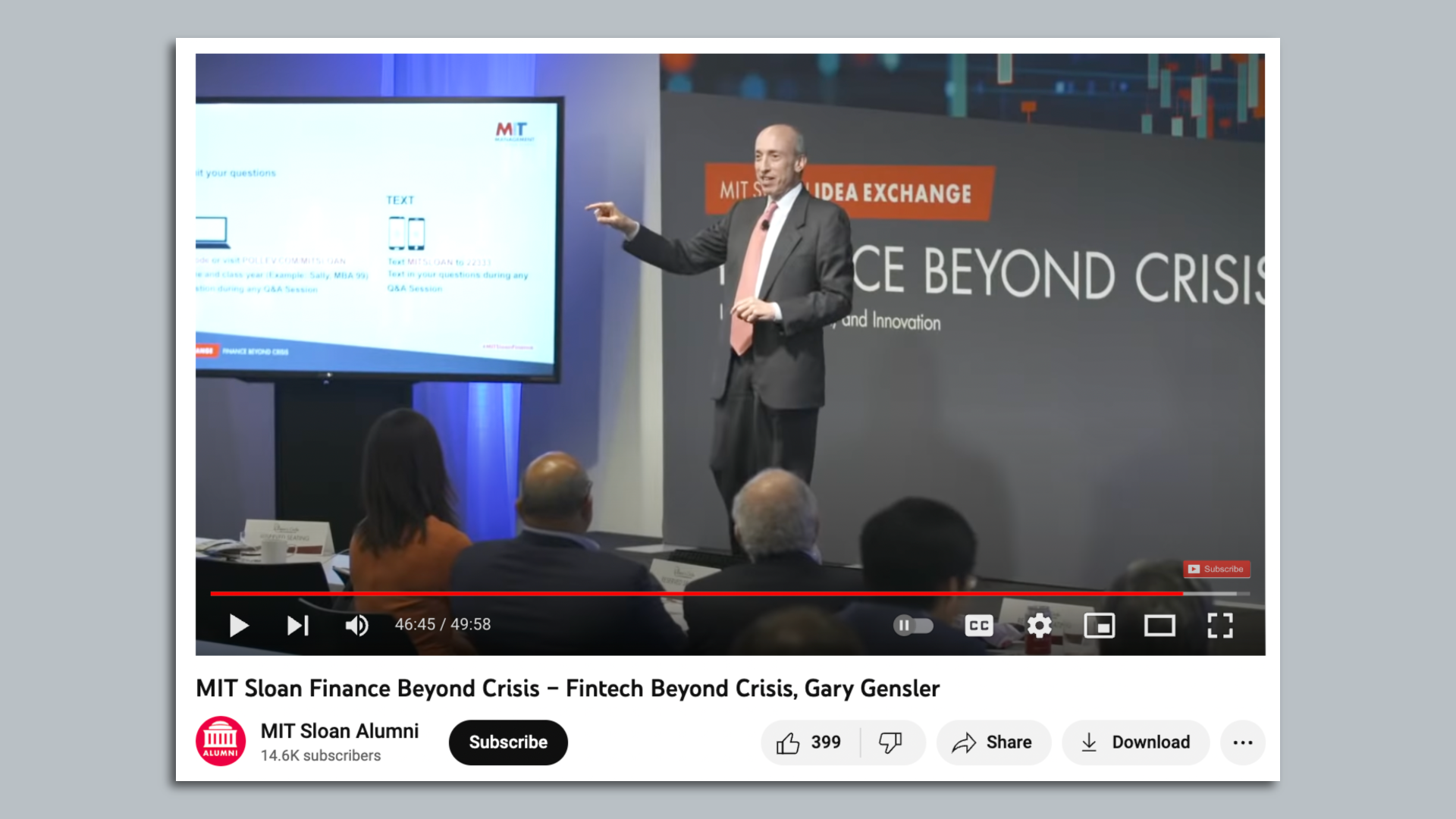
Screenshot: MIT Sloan Alumni (YouTube)
Let's revisit that Gary Gensler appearance (April 2019) everyone is talking about (we discussed it under algorand in 1️⃣), but not the bit everyone is talking about (our link is queued to the bit we want to talk about).
- Of note: At the time of the speech, Gensler was a professor at MIT. It's a safe bet, however, that he had ambitions to return to D.C.
Zoom in: The last question of the session is: "Why don't regulators regulate cryptocurrency out of existence? Aren't they mainly tax evasion and an illegal activity conduit?"
- Gensler rambles for a while about the history of governments dealing with cryptocurrency and where bitcoin and such are traded the most, pointing out that even China didn't really ban it when folks said it had in 2018.
- Gensler basically answered: "That's not the move."
What they said: "At the core is, I think most governments, and I would agree with this, feel it is not their job to ban something. It's to say: This is new technology, we'll be technology neutral. Can we bring it inside the socially accepted parameters of tax law, anti-money laundering, investor protection and the like?" he concluded.
The bottom line: In blockchain time, 2019 was a long time ago. You are here.
This newsletter was edited by Pete Gannon and copy edited by Carolyn DiPaolo.
👀 A Fortune alum from its early days of crypto coverage and EIC at Decrypt has decamped to go to a crypto fund. This idea of private entities making their own media channels is catching on. —C & B
Sign up for Axios Crypto

Brady Dale covers crypto and blockchain impacts on markets and regulation.